Mechanized Irrigation Systems Market Size, Share, Industry Trend & Analysis Research Report: Information By Type (Drip Irrigation System, Sprinkler Irrigation System, and Others), By Crop Type (Cereals Grains, Pulses Oilseeds, Fruits & Vegetables, and Others), And By Region (North America, Europe, Asia-Pacific, And Rest Of The World) – Forecast Till 2035
As per Market Research Future analysis, the Mechanized Irrigation Market Systems Market Size was estimated at 11.58 USD Billion in 2024. The Mechanized Irrigation Market Systems industry is projected to grow from 13.25 USD Billion in 2025 to 51.2 USD Billion by 2035, exhibiting a compound annual growth rate (CAGR) of 14.47% during the forecast period 2025 - 2035
Key Market Trends & Highlights
The Mechanized Irrigation Market Systems Market is experiencing robust growth driven by technological advancements and sustainability initiatives.
The adoption of smart technologies is transforming irrigation practices across various agricultural sectors.
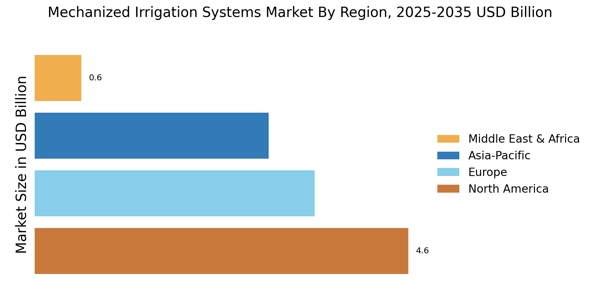
North America remains the largest market for mechanized irrigation systems, while Asia-Pacific is recognized as the fastest-growing region.
Drip irrigation systems dominate the market, whereas sprinkler irrigation systems are witnessing rapid growth due to their efficiency.
Rising water scarcity and increasing crop production needs are key drivers propelling the demand for mechanized irrigation solutions.
Market Size & Forecast
2024 Market Size
11.58 (USD Billion)
2035 Market Size
51.2 (USD Billion)
CAGR (2025 - 2035)
14.47%
Major Players
Netafim (IL), Valmont Industries (US), Rain Bird Corporation (US), Hunter Industries (US), Jain Irrigation Systems (IN), Lindsay Corporation (US), Toro Company (US), Irritec (IT), Bauer (AT), Komet (DE)
Our Impact
Enabled $4.3B Revenue Impact for Fortune 500 and Leading Multinationals
Partnering with 2000+ Global Organizations Each Year
30K+ Citations by Top-Tier Firms in the Industry
Mechanized Irrigation Market Trends
The Mechanized Irrigation Market Systems Market is currently experiencing a transformative phase, driven by the increasing demand for efficient water management solutions in agriculture. As global populations rise, the pressure on food production intensifies, prompting farmers to adopt advanced irrigation technologies. These systems not only enhance crop yields but also optimize water usage, which is becoming increasingly critical in regions facing water scarcity. Furthermore, the integration of smart technologies, such as sensors and automation, appears to be revolutionizing traditional practices, allowing for precise control over irrigation processes. This shift towards mechanization is likely to foster sustainable agricultural practices, aligning with global efforts to combat climate change and promote environmental stewardship. In addition, the Mechanized Irrigation Market Systems Market is witnessing a growing trend towards sustainability and eco-friendliness. Stakeholders are increasingly aware of the environmental impacts of conventional irrigation methods, leading to a surge in demand for systems that minimize water waste and energy consumption. Innovations in drip and sprinkler irrigation technologies are indicative of this trend, as they provide targeted water application, reducing runoff and evaporation. As regulatory frameworks evolve to support sustainable practices, the market is poised for further growth, with an emphasis on solutions that not only meet agricultural needs but also contribute positively to the ecosystem.
Adoption of Smart Technologies
The Mechanized Irrigation Market Systems Market is seeing a notable shift towards the incorporation of smart technologies. These innovations, including IoT devices and automated controls, enable farmers to monitor and manage irrigation systems with greater precision. This trend enhances efficiency, reduces water waste, and allows for real-time adjustments based on environmental conditions.
Focus on Sustainability
Sustainability is becoming a central theme within the Mechanized Irrigation Market Systems Market. As awareness of environmental issues grows, there is an increasing demand for irrigation solutions that minimize resource consumption. Technologies that promote water conservation and reduce energy usage are gaining traction, reflecting a broader commitment to eco-friendly agricultural practices.
Integration of Data Analytics
The integration of data analytics into irrigation practices is emerging as a significant trend. By leveraging data from various sources, farmers can make informed decisions regarding water usage and crop management. This analytical approach not only optimizes irrigation efficiency but also enhances overall agricultural productivity, aligning with the market's evolution towards more data-driven methodologies.
Mechanized Irrigation Market Drivers
Rising Water Scarcity
The increasing prevalence of water scarcity is a critical driver for the Mechanized Irrigation Market Systems Market. As populations grow and agricultural demands intensify, the need for efficient water usage becomes paramount. Mechanized irrigation systems offer precision in water application, which can significantly reduce waste. Reports indicate that regions facing severe water shortages are increasingly adopting these systems to optimize their water resources. This trend is likely to continue as climate change exacerbates water availability issues, compelling farmers to invest in advanced irrigation technologies. The Mechanized Irrigation Market Systems Market is thus positioned to expand as stakeholders seek solutions to mitigate the impacts of water scarcity.
Technological Advancements
Technological innovations play a pivotal role in shaping the Mechanized Irrigation Market Systems Market. The advent of smart irrigation technologies, including automated systems and IoT integration, enhances the efficiency and effectiveness of irrigation practices. These advancements allow for real-time monitoring and data-driven decision-making, which can lead to improved crop yields and reduced operational costs. Market data suggests that the adoption of such technologies is on the rise, with many farmers recognizing the long-term benefits of mechanized systems. As technology continues to evolve, the Mechanized Irrigation Market Systems Market is expected to witness further growth driven by these innovations.
Focus on Sustainable Practices
The shift towards sustainable agricultural practices is a key factor influencing the Mechanized Irrigation Market Systems Market. Farmers are increasingly recognizing the importance of environmentally friendly methods that conserve resources and minimize environmental impact. Mechanized irrigation systems are designed to optimize water usage, thereby reducing runoff and promoting soil health. Market trends indicate that consumers are also favoring sustainably produced goods, which further incentivizes farmers to adopt such practices. As sustainability becomes a central theme in agriculture, the Mechanized Irrigation Market Systems Market is likely to experience growth driven by this paradigm shift.
Increasing Crop Production Needs
The growing demand for food production is a substantial driver for the Mechanized Irrigation Market Systems Market. As the global population continues to rise, the pressure on agricultural systems to produce more food intensifies. Mechanized irrigation systems facilitate higher crop yields by ensuring optimal water delivery and reducing labor costs. Market analysis indicates that regions with high agricultural output are increasingly investing in these systems to meet production targets. This trend is expected to persist as food security becomes a pressing concern, thereby propelling the Mechanized Irrigation Market Systems Market forward.
Government Initiatives and Support
Government initiatives aimed at promoting sustainable agriculture are significantly influencing the Mechanized Irrigation Market Systems Market. Various countries are implementing policies that encourage the adoption of mechanized irrigation systems through subsidies and financial incentives. These initiatives are designed to enhance agricultural productivity while conserving water resources. For instance, programs that provide funding for the installation of advanced irrigation systems are becoming more common. This support not only aids farmers in transitioning to mechanized solutions but also aligns with broader environmental goals. Consequently, the Mechanized Irrigation Market Systems Market is likely to benefit from these favorable governmental policies.
Market Segment Insights
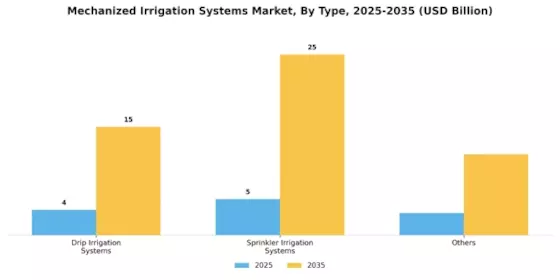
By Type: Drip Irrigation Systems (Largest) vs. Sprinkler Irrigation Systems (Fastest-Growing)
In the Mechanized Irrigation Systems Market, the market share distribution reveals Drip Irrigation Systems as the largest segment, capturing a significant portion of the market. This type is widely adopted due to its efficiency in water usage and effectiveness in crop yield enhancement. Sprinkler Irrigation Systems, while not as large, are rapidly increasing their share, highlighting a shift towards systems that offer flexibility and scalability based on varying agricultural needs.
The growth trends in this segment reflect a changing landscape in agricultural practices, driven by the need for sustainable water management in farming. The increasing emphasis on precision agriculture, along with government initiatives promoting efficient irrigation practices, plays a crucial role in expanding both Drip and Sprinkler Irrigation Systems. The adaptability and technological advancements in these systems cater to diverse farming requirements, further driving their market growth.
Irrigation Systems: Drip (Dominant) vs. Sprinkler (Emerging)
Drip Irrigation Systems are recognized as the dominant player in the Mechanized Irrigation Systems Market. Their design allows for targeted water delivery directly to the plant roots, minimizing water wastage and boosting crop production. This system is especially beneficial for high-value crops where water efficiency is paramount. Conversely, Sprinkler Irrigation Systems are emerging rapidly, positioning themselves as a versatile option for a wide range of crops. Their ability to cover larger areas with adjustable spray patterns makes them attractive for farmers looking to optimize irrigation across diverse terrains. Both systems reflect a growing trend towards resource-efficient farming solutions, yet they cater to distinct agricultural strategies.
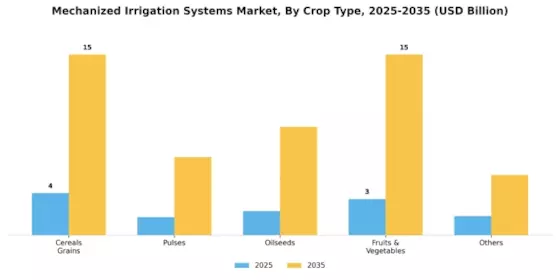
By Crop Type: Cereals Grains (Largest) vs. Fruits & Vegetables (Fastest-Growing)
In the Mechanized Irrigation Systems Market, the distribution of market share among various crop types showcases cereals and grains as the largest segment, benefiting from widespread agricultural practices and high demand for staple foods. Following closely, pulses and oilseeds maintain substantial yet smaller shares, while fruits and vegetables emerge as a competitive segment fueled by increasing consumer preference for fresh produce. Other categories also contribute to market diversification, but they hold relatively lesser shares.
Growth trends in the Mechanized Irrigation Systems Market are significantly influenced by the increasing need for efficient water management and sustainable agricultural practices. Key drivers include technological advancements in irrigation systems, rising awareness regarding water conservation, and government support for mechanization. The fast-growing segment of fruits and vegetables is particularly impacted by changing dietary preferences and urbanization, which encourages farmers to adopt innovative irrigation methods to enhance crop yield and quality.
Pulses (Emerging) vs. Oilseeds (Dominant)
In the Mechanized Irrigation Systems Market, pulses represent an emerging segment characterized by increasing cultivation driven by health trends and nutrition awareness. Farmers are adopting mechanized irrigation systems to optimize water use and improve crop yield for pulses, which are often cultivated in diverse climates. In contrast, oilseeds are considered a dominant segment due to their extensive usage in cooking oils and animal feed, resulting in higher demand. The adoption of advanced irrigation technologies for oilseeds is essential to enhance production efficiency, especially in regions facing water scarcity. Both segments are experiencing unique growth trajectories that underscore the importance of mechanization in modern agriculture.
Get more detailed insights about Mechanized Irrigation MarketRequest Free Sample
Regional Insights
North America : Technological Innovation Leader
North America is the largest market for mechanized irrigation systems, holding approximately 40% of the global market share. The region's growth is driven by advanced agricultural practices, increasing water scarcity, and government initiatives promoting efficient water use. Regulatory frameworks, such as the Clean Water Act, encourage sustainable irrigation practices, further boosting demand for mechanized systems. The United States and Canada are the leading countries in this market, with significant contributions from key players like Valmont Industries and Rain Bird Corporation. The competitive landscape is characterized by innovation and technological advancements, with companies focusing on smart irrigation solutions to enhance efficiency. The presence of established firms and a strong distribution network supports market growth, making North America a hub for mechanized irrigation technology.
Europe : Sustainable Agriculture Focus
Europe is witnessing a growing demand for mechanized irrigation systems, accounting for approximately 30% of the global market share. The region's focus on sustainable agriculture and water conservation is driving this growth. Regulatory initiatives, such as the EU Water Framework Directive, promote efficient water management practices, encouraging farmers to adopt advanced irrigation technologies to meet environmental standards. Leading countries in this market include Germany, France, and Italy, where companies like Irritec and Komet are making significant strides. The competitive landscape is marked by a mix of established players and innovative startups, all striving to meet the increasing demand for efficient irrigation solutions. The emphasis on sustainability and technological advancements positions Europe as a key player in the mechanized irrigation systems market.
Asia-Pacific : Rapid Growth and Adoption
Asia-Pacific is emerging as a significant market for mechanized irrigation systems, holding around 25% of the global market share. The region's growth is fueled by increasing agricultural productivity demands, water scarcity issues, and government support for modern irrigation techniques. Countries like India and China are leading the charge, with initiatives aimed at enhancing agricultural efficiency and sustainability. India, in particular, is witnessing rapid adoption of mechanized irrigation systems, driven by key players like Jain Irrigation Systems and Toro Company. The competitive landscape is evolving, with both local and international firms vying for market share. The presence of diverse agricultural practices and varying climatic conditions further enhances the demand for tailored irrigation solutions, making Asia-Pacific a dynamic market for mechanized irrigation systems.
Middle East and Africa : Resource Management Challenges
The Middle East and Africa region is increasingly recognizing the importance of mechanized irrigation systems, accounting for approximately 5% of the global market share. The region faces significant water scarcity challenges, driving the demand for efficient irrigation solutions. Government initiatives aimed at improving agricultural productivity and water management are key growth drivers, with countries like South Africa and the UAE leading the way. In South Africa, the adoption of advanced irrigation technologies is gaining momentum, supported by local players and international firms. The competitive landscape is characterized by a mix of established companies and emerging startups, all focused on addressing the unique challenges of water management in arid regions. The emphasis on innovative irrigation solutions positions the Middle East and Africa as a growing market for mechanized irrigation systems.
Key Players and Competitive Insights
The Mechanized Irrigation Systems Market is currently characterized by a dynamic competitive landscape, driven by the increasing demand for efficient water management solutions in agriculture. Key players are actively engaging in strategies that emphasize innovation, regional expansion, and sustainability. Notably, companies such as Netafim (IL), Valmont Industries (US), and Jain Irrigation Systems (IN) are at the forefront of this market, each adopting distinct operational focuses that collectively shape the competitive environment. Netafim (IL) is recognized for its pioneering efforts in drip irrigation technology, while Valmont Industries (US) emphasizes a diversified portfolio that includes center pivot irrigation systems. Jain Irrigation Systems (IN) is leveraging its extensive experience in the Indian market to expand its global footprint, particularly in emerging economies.
In terms of business tactics, companies are increasingly localizing manufacturing to enhance supply chain efficiency and reduce costs. This approach appears to be particularly effective in regions where agricultural practices are rapidly evolving. The market structure is moderately fragmented, with several key players exerting influence over various segments. The collective actions of these companies suggest a trend towards consolidation, as they seek to enhance their competitive positioning through strategic partnerships and acquisitions.
In August 2025, Valmont Industries (US) announced a strategic partnership with a leading agricultural technology firm to develop advanced precision irrigation solutions. This collaboration is expected to enhance Valmont's product offerings, allowing for more efficient water usage and improved crop yields. The strategic importance of this partnership lies in its potential to position Valmont as a leader in the integration of technology and irrigation, aligning with the growing trend towards precision agriculture.
Similarly, in September 2025, Jain Irrigation Systems (IN) launched a new line of solar-powered irrigation systems aimed at reducing dependency on conventional energy sources. This initiative not only underscores Jain's commitment to sustainability but also addresses the increasing demand for eco-friendly agricultural practices. The introduction of solar-powered systems is likely to resonate well with environmentally conscious consumers and could enhance Jain's market share in regions facing energy challenges.
Moreover, in July 2025, Netafim (IL) expanded its operations into Southeast Asia by establishing a new manufacturing facility in Vietnam. This move is indicative of Netafim's strategy to tap into emerging markets where mechanized irrigation is gaining traction. The establishment of local manufacturing capabilities is expected to reduce lead times and improve service delivery, thereby strengthening Netafim's competitive edge in the region.
As of October 2025, the Mechanized Irrigation Systems Market is witnessing significant trends such as digitalization, sustainability, and the integration of artificial intelligence in irrigation practices. Strategic alliances are increasingly shaping the competitive landscape, as companies recognize the value of collaboration in driving innovation. Looking ahead, it appears that competitive differentiation will evolve from traditional price-based competition to a focus on technological advancements, sustainable practices, and reliable supply chains. This shift may redefine how companies position themselves in the market, emphasizing the importance of innovation and adaptability in meeting the changing needs of the agricultural sector.
Key Companies in the Mechanized Irrigation Market include
Industry Developments
September 2016: Lindsay introduced 9500DS Drop Span Option to its pivot system product line. This new product allows growers to irrigate more acres while avoiding permanent obstacles such as buildings, fences, and equipment.
February 2019: Reinke Manufacturing opens a new distribution center in Tifton, Georgia, USA. The expansion will help the company serve the eastern and northern regions of the United States.
Future Outlook
Mechanized Irrigation Market Future Outlook
The Mechanized Irrigation Market Systems Market is projected to grow at a 14.47% CAGR from 2025 to 2035, driven by technological advancements, water scarcity, and increasing agricultural productivity demands.
New opportunities lie in:
Integration of IoT for real-time monitoring and control systems.
Development of solar-powered irrigation solutions for sustainable farming.
Expansion into emerging markets with tailored mechanized solutions.
By 2035, the market is expected to be robust, driven by innovation and increased adoption.
Market Segmentation
Mechanized Irrigation Market Type Outlook
Drip Irrigation Systems
Sprinkler Irrigation Systems
Others
Mechanized Irrigation Market Crop Type Outlook
Cereals Grains
Pulses
Oilseeds
Fruits & Vegetables
Others
Report Scope
MARKET SIZE 2024
11.58(USD Billion)
MARKET SIZE 2025
13.25(USD Billion)
MARKET SIZE 2035
51.2(USD Billion)
COMPOUND ANNUAL GROWTH RATE (CAGR)
14.47% (2025 - 2035)
REPORT COVERAGE
Revenue Forecast, Competitive Landscape, Growth Factors, and Trends
BASE YEAR
2024
Market Forecast Period
2025 - 2035
Historical Data
2019 - 2024
Market Forecast Units
USD Billion
Key Companies Profiled
Netafim (IL), Valmont Industries (US), Rain Bird Corporation (US), Hunter Industries (US), Jain Irrigation Systems (IN), Lindsay Corporation (US), Toro Company (US), Irritec (IT), Bauer (AT), Komet (DE)
Segments Covered
Type, Crop Type, Region
Key Market Opportunities
Integration of smart technology enhances efficiency in the Mechanized Irrigation Systems Market.
Key Market Dynamics
Rising demand for efficient water management drives innovation and competition in mechanized irrigation systems.
What is the current valuation of the Mechanized Irrigation Systems Market?
The market valuation was 11.58 USD Billion in 2024.
What is the projected market size for the Mechanized Irrigation Systems Market by 2035?
The market is projected to reach 51.2 USD Billion by 2035.
What is the expected CAGR for the Mechanized Irrigation Systems Market during the forecast period?
The expected CAGR for the market from 2025 to 2035 is 14.47%.
Which companies are considered key players in the Mechanized Irrigation Systems Market?
Key players include Netafim, Valmont Industries, Rain Bird Corporation, and Jain Irrigation Systems.
What are the main types of mechanized irrigation systems in the market?
The main types include Drip Irrigation Systems, Sprinkler Irrigation Systems, and Others.
How much is the Drip Irrigation Systems segment valued at in 2024?
The Drip Irrigation Systems segment was valued at 3.5 USD Billion in 2024.
What is the projected value of the Sprinkler Irrigation Systems segment by 2035?
The Sprinkler Irrigation Systems segment is projected to reach 25.0 USD Billion by 2035.
Which crop types are driving the demand for mechanized irrigation systems?
Cereals Grains, Pulses, Oilseeds, and Fruits & Vegetables are key crop types driving demand.
What was the value of the Fruits & Vegetables segment in 2024?
The Fruits & Vegetables segment was valued at 3.0 USD Billion in 2024.
What is the potential growth for the Others segment in the Crop Type category by 2035?
The Others segment in the Crop Type category is projected to reach 5.0 USD Billion by 2035.
Author
Author
Snehal Singh
Manager - Research
High acumen in analyzing complex macro & micro markets with more than 6 years of work experience in the field of market research. By implementing her analytical skills in forecasting and estimation into market research reports, she has expertise in Packaging, Construction, and Equipment domains. She handles a team size of 20-25 resources and ensures smooth running of the projects, associated marketing activities, and client servicing.
read more
Co-Author
Sakshi Gupta
Team Lead - Research
Currently a Team Lead in consumer goods, FMCG, and F&B, she translates rigorous research into decisive strategy. She develops GTM roadmaps, pricing architectures, and competitive benchmarks for companies across Europe, the US, and APAC. She synthesize insights, align cross-functional teams, and drive execution from brief to measurable outcomes. She leads end-to-end engagements with crisp analysis, compelling storytelling, and a strong command of Power BI, Tableau, SQL, and advanced research platforms.
Research Methodology on Mechanized Irrigation Market
INTRODUCTION
The research report titled “Mechanized Irrigation Market – Global Industry Analysis, Size, Share, Growth, Trends, and Forecast, 2023-2030”, prepared by Market Research Future (MRFR), provides an in-depth analysis of the global mechanized irrigation market. The analysis to be presented is based on two primary research approaches: primary research and secondary research.
The report states that mechanized irrigation is an efficient and cost-effective form of irrigation that utilizes various mechanized means to water the soil. It provides precise, efficient, and uniform distribution of water. The report identifies factors such as a rising population, concerns regarding the supply of water and improved living standards of people which is resulting in an increased demand for food products, as major reasons for the growth of the mechanized irrigation market.
RESEARCH METHODOLOGY
1.0 INTRODUCTION
The research methodology adopted to conduct this study was to collect, organize, and analyse data from different sources. The research methodology is divided into four parts – primary research and secondary research, data collection, and data analysis. The primary research approach is used to obtain first-hand information from the market participants while the secondary research approach is used to locate and collect secondary data from existing sources. The data collection methods used include desk research, telephone interviews, and experts’ opinions. The approaches used for data analysis include the bottom-up approach, top-down approach, factor analysis, time-series analysis and demand-side and supply-side data triangulation. The study as such is an analysis of the previous studies.
2.0 RESEARCH APPROACH
This project has been conducted using a mixed-method research approach, as it combines both qualitative and quantitative methods. This approach is logical because it allows for a broad interpretation of the data and the ability to provide a holistic overview of the market. The primary research approach was used for obtaining primary data from direct interviews and surveys. The secondary research approach was used for gathering information from published reports, books, and various journals.
3.0 DATA COLLECTION
3.1 Primary Research
Primary data was collected or gathered through direct interviews and surveys. The target population of this research was the key market players of the mechanized irrigation market such as manufacturers, suppliers, distributors, and other industry experts. The interviews were conducted with the help of semi-structured questionnaires.
3.2 Secondary Research
Secondary data was collected through published reports, books, journals, magazines, and online databases. An extensive review of the available literature on the market was conducted to capture the current and recent trends in the mechanized irrigation market. The collected data was then analyzed and organized.
4.0 DATA ANALYSIS
The data gathered from both primary and secondary sources was compiled, tabulated, and analyzed to assess and forecast the performance of the mechanized irrigation market for 2023 to 2030. A data triangulation was also conducted to ensure the accuracy and precision of the report. The approaches used for data analysis include the bottom-up approach, top-down approach, factor analysis, time-series analysis and demand-side and supply-side data triangulation.
CONCLUSION
The research methodology adopted in this study includes primary research and secondary research and has been conducted using desk research, telephone interviews, and expert opinion. Data triangulation was conducted to ensure the accuracy and precision of the report. This report is an analysis of existing data and publications to provide a holistic overview of the mechanized irrigation market.
“This is really good guys. Excellent work on a tight deadline. I will continue to use you going forward and recommend you to others. Nice job”
Noah MalgeriCo-Founder
“Thanks. It’s been a pleasure working with you, please use me as reference with any other Intel employees.”
Joseph AguayoSales Operations & Pricing Manager
“Thanks for sending the report it gives us a good global view of the Betaïne market.”
Peter Groot koerkampAccount and Business Manager
“Thank you, this will be very helpful for OQS.”
La Terria DoddProgram Support Specialist
“We found the report very insightful! we found your research firm very helpful. I'm sending this email to secure our future business.”
Younghwan ChoiSenior Retail Manager
“I am very pleased with how market segments have been defined in a relevant way for my purposes (such as "Portable Freezers & refrigerators" and "last-mile").
In general the report is well structured. Thanks very much for your efforts.”
Mark IrwinManagement Consultant
“I have been reading the first document or the study, ,the Global HVAC and FP market report 2021 till 2026. Must say, good info! I have not gone in depth at all parts, but got a good indication of the data inside!”
Rob KooikerGroup Product Manager HVAC & Fire Protection GMA
“We got the report in time, we really thank you for your support in this process. I also thank to all of your team as they did a great job.”
Akif MorogluStrategy & Business Development Director
“The Automotive 48V ECU Components Procurement Intelligence Study” was a complex project, but the Market Research Future (MRFR) team handled it with quality, agility, and customer-centricity. They delivered all requested data on time and within the agreed scope. The team, including Shubhendra Anand and Rahul Gotadki, was always readily available to clarify questions and swiftly implement necessary adjustments, driving the project to a successful conclusion within a very demanding timeframe.
I would also like to specifically commend Akshay Agarwal for his responsiveness and support at every stage—from our initial inquiry on May 6th through to final delivery on June 18th. His dedication made the entire process seamless.”
Guilherme Gomes MartinsProduct Management Director