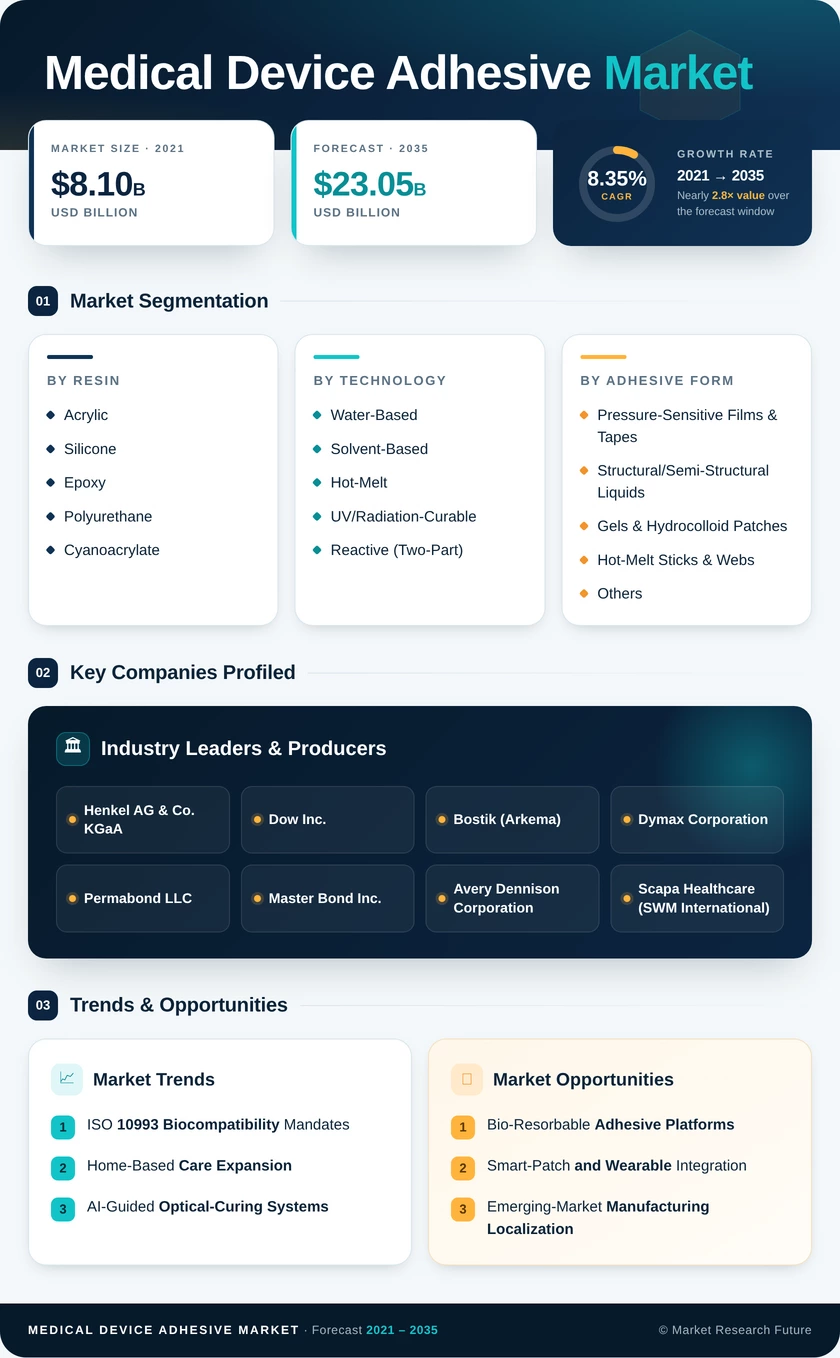
SEGMENTATION QUICK REFERENCE
| Dimension | Sub-Segments | Dominant Segment (2025) | Fastest Growing Segment (2026–2035) |
| By Resin | Acrylic, Silicone, Epoxy, Polyurethane, Cyanoacrylate, Others | Acrylic (31.0% share) | Silicone (8.75% CAGR) |
| By Technology | Water-Based, Solvent-Based, Hot-Melt, UV/Radiation-Curable, Reactive (Two-Part) | Water-Based (37.1% share) | UV/Radiation-Curable (9.00% CAGR) |
| By Adhesive Form | Pressure-Sensitive Films & Tapes, Structural/Semi-Structural Liquids, Gels & Hydrocolloid Patches, Hot-Melt Sticks & Webs, Others | Pressure-Sensitive Films & Tapes (39.5% share) | Gels & Hydrocolloid Patches (8.90% CAGR) |
| By Application | Medical Devices & Equipment, External Medical Applications, Internal Medical Applications, Dental Applications | Medical Devices & Equipment (46.9% share) | Internal Medical Applications (9.20% CAGR) |
| By Geography | North America, Europe, Asia-Pacific, South America, Middle East & Africa | North America (35.4% share) | Asia-Pacific (9.10% CAGR) |
MARKET SEGMENTATION OVERVIEW
By Resin
| Sub-Segment | Key Trend |
| Acrylic | Cost-efficient bonding for high-volume disposable devices; dominant share anchored in diagnostic strip lamination |
| Silicone | Fastest growth driven by sterilization resilience and implantable-device compatibility |
| Epoxy | Structural bonding applications in imaging and diagnostic equipment housings |
| Polyurethane | Flexible lamination for wound-dressing and transdermal delivery systems |
| Cyanoacrylate | Rapid-set surgical tissue closure for superficial wound management |
| Others | Specialty formulations, including polyolefin and rubber-based adhesives for niche applications |
Resin selection in the medical device adhesive market is increasingly dictated by end-use sterilization protocols and regulatory biocompatibility requirements, with silicone and polyurethane chemistries gaining ground in applications where gamma and e-beam exposure is standard.
By Technology
| Sub-Segment | Key Trend |
| Water-Based | Dominant technology driven by VOC emission regulations and clean-room compatibility |
| Solvent-Based | Legacy installed base declining as environmental mandates tighten. |
| Hot-Melt | High-speed application in packaging and pouch-sealing operations |
| UV/Radiation-Curable | Fastest growth fueled by AI-guided curing and precision device assembly demand |
| Reactive (Two-Part) | High-strength structural joints for Class III device housings and implant components |
Technology selection reflects a dual transition: away from solvent-based systems under regulatory pressure and toward UV-curable platforms enabled by AI process control and LED energy efficiency gains.
By Adhesive Form
| Sub-Segment | Key Trend |
| Pressure-Sensitive Films & Tapes | Largest segment driven by wearable biosensor and CGM patch volumes |
| Structural/Semi-Structural Liquids | Device housing and component assembly requiring high shear strength |
| Gels & Hydrocolloid Patches | The fastest-growing form of chronic wound care migrates to home settings. |
| Hot-Melt Sticks & Webs | Automated packaging and sterile-barrier sealing applications |
| Others | Specialty foams, transfer tapes, and custom die-cut configurations |
Form-factor innovation in the medical device adhesive market is tracking the proliferation of body-worn electronics, with pressure-sensitive films engineered for extended skin contact now representing the single largest product category by volume.
By Application
| Sub-Segment | Key Trend |
| Medical Devices & Equipment | Largest segment encompassing Class II/III device assembly and sensor bonding |
| External Medical Applications | Wound closure, ostomy appliance attachment, and electromedical electrode fixation |
| Internal Medical Applications | Fastest growth as bio-resorbable tissue adhesives approach commercial readiness. |
| Dental Applications | Orthodontic bracket bonding, restorative filling adhesion, and prosthetic cementation |
Application segmentation reflects the widening gap between established external-use adhesive volumes and the emerging high-growth internal-use frontier, where bioresorbable and tissue-contact chemistries are advancing through regulatory pipelines toward commercial deployment.