Medical Lasers Market (2026 - 2035)

Medical Lasers Market Research Report By Application (Surgery, Dermatology, Ophthalmology, Dentistry, Gynecology), By Product Type (Solid State Lasers, Gas Lasers, Diode Lasers, Fiber Lasers, Excimer Lasers), By End Use (Hospitals, Outpatient Clinics, Ambulatory Surgical Centers, Research Institutes, Dental Clinics), By Technology (Contemporary, Traditional, Portable, Robotic) and By Regional (North America, Europe, South America, Asia Pacific, Middle East and Africa) - Growth & Industry Forecast 2025 To 2035
ID: MRFR/MED/9684-HCR
200 Pages
Kinjoll Dey, Nidhi Mandole
Last Updated: July 22, 2026
Medical Lasers Market
Market Size
Forecast Period2026-2035
CAGR (2026-2035)12.1%
2025 Market SizeUSD 6.63 Billion
2035 Market SizeUSD 20.97 Billion
Key Players
Lumenis
Cynosure
Carl Zeiss Meditec
Alcon
Alma Lasers
Fotona
Opportunities
  • Photobiomodulation Therapy Expansion
  • Subscription and Pay-Per-Procedure Models
  • AI-Guided Treatment Planning

Medical Lasers Market Summary

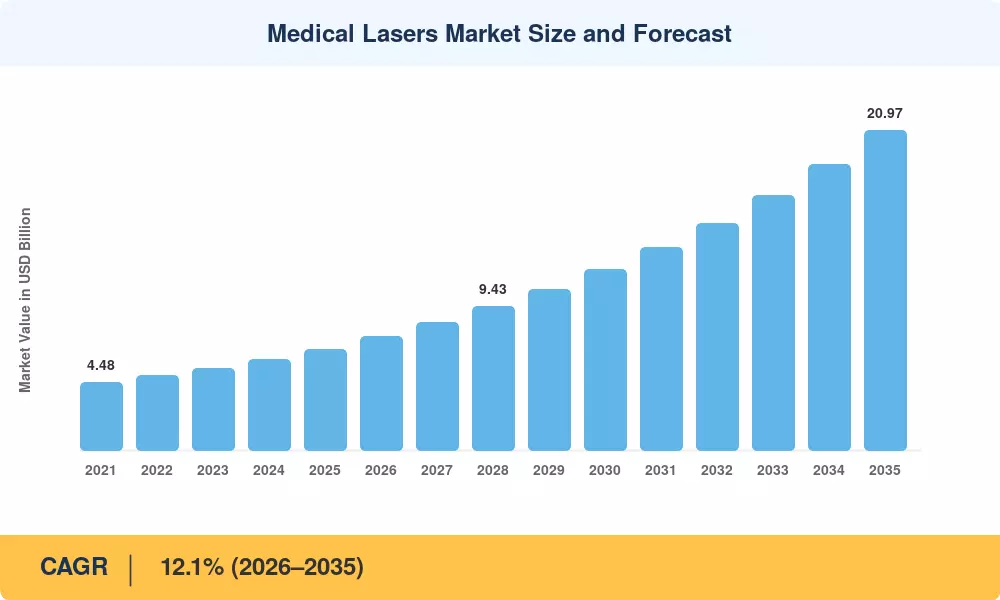
The Medical Lasers Market reached USD 6.63 Billion in 2025 and is projected to grow from USD 7.50 Billion in 2026 to USD 20.97 Billion by 2035, registering a CAGR of 12.1% during the forecast period (2026–2035). Aging populations across OECD nations are driving up procedure volumes in cataract correction, skin resurfacing, and vascular treatments, while national health programs — including the U.S. Medicare Advantage expansion and India's Ayushman Bharat — are steering reimbursement toward outpatient laser-based interventions [1][2].

The Medical Lasers Market is undergoing a technological transformation as legacy gas-based platforms are replaced by compact, fiber-coupled solid-state and semiconductor diode systems. These more recent platforms offer reduced maintenance costs, shorter pulse durations, and increased wall-plug efficiency. Between 2022 and 2024, the U.S. FDA approved more than 40 new laser indications, and the European MDR transition has compelled manufacturers to allocate an estimated USD 1.2 billion to regulatory compliance and next-generation platform development [3][4].

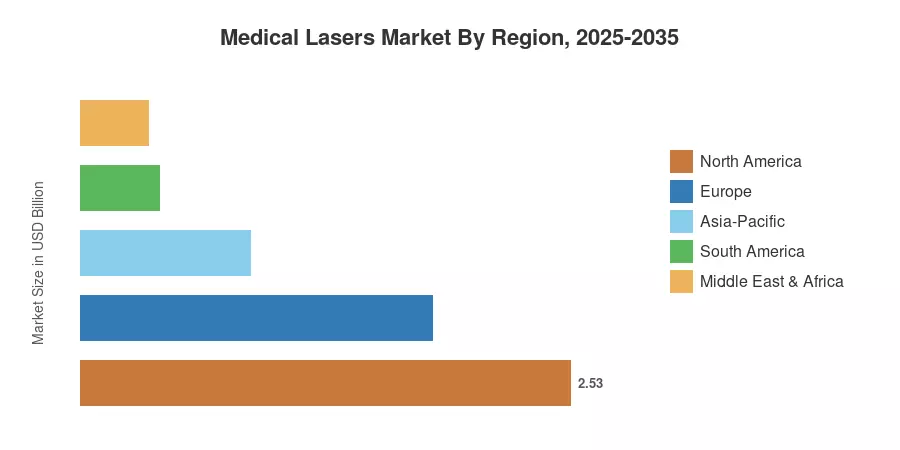
North America maintains a 38.2% market share in the Medical Lasers Market, which is supported by a dense network of ambulatory surgery centers and high procedural reimbursement rates. The Asia-Pacific region is the fastest-growing, with a projected CAGR of 13.3%. This growth is primarily due to the increasing demand for cosmetic procedures among the middle class in China, India, and South Korea. Germany's medtech export base and the United Kingdom's NHS modernization initiatives are the foundations of Europe's second-largest share, which is approximately 27.5%. The Medical Lasers Market is poised for consistent growth as the volume of procedures transitions decisively to minimally invasive platforms [5][6].


Key Report Takeaways

• By Product Type

  • Solid-state laser systems commanded 36.2% of Medical Lasers Market revenue in 2025, driven by versatility across ophthalmic and surgical applications.
  • Semiconductor (diode) laser systems are projected to expand at a 13.0% CAGR through 2035, reflecting rapid adoption in tissue ablation and phototherapy.

• By Application

  • Dermatology and aesthetics held 33.3% of the Medical Lasers Market in 2025, fueled by rising consumer spending on skin rejuvenation and tattoo removal.
  • Ophthalmology applications are forecast to grow at a 12.7% CAGR to 2035 as refractive surgery and glaucoma micro-pulse treatments gain traction.

• By Region

  • North America captured 38.2% of the Medical Lasers Market in 2025, led by outpatient procedure migration in the United States.
  • Asia-Pacific is advancing at a 13.3% CAGR, with China and India accounting for the bulk of new clinic openings.


Medical Lasers Market Size and Forecast (2021–2035)

Market Research Future employs a triangulated methodology combining top-down revenue estimation from manufacturer filings, bottom-up procedure volume modeling, and primary interviews with procurement heads at 120+ hospitals and specialty clinics across 18 countries.
Medical Lasers Market Size and Forecast
Our Impact
Enabled $4.3B Revenue Impact for Fortune 500 and Leading Multinationals
Partnering with 2000+ Global Organizations Each Year
30K+ Citations by Top-Tier Firms in the Industry

Driver Impact Analysis

Driver ~% Impact on CAGR Geographic Relevance Impact Timeline
Aging population and ophthalmic procedure demand +2.8% Global Long-term (≥4 yr)
Ambulatory surgery center migration +2.2% North America, Europe Medium-term (2–4 yr)
Solid-state and diode platform efficiency gains +1.9% Global Short-term (≤2 yr)
Regulatory clearances for new indications +1.5% North America, EU Medium-term (2–4 yr)
Cosmetic procedure growth in emerging markets +1.6% Asia-Pacific, South America Long-term (≥4 yr)
AI-enabled treatment planning integration +1.1% North America, Asia-Pacific Long-term (≥4 yr)
Reimbursement expansion for outpatient laser care +1.0% North America Medium-term (2–4 yr)


Aging Populations and Ophthalmic Demand Surge

United Nations demographic reports indicate that the global share of individuals aged 65 and older is projected to rise from under 10% to approximately 17%. This demographic shift accelerates demand within the medical lasers market, as cataract procedures—the highest-volume ophthalmic procedure worldwide—correlate strongly with age. Medicare data shows that extracapsular cataract removal with lens insertion remains the single most common fee-for-service procedure in surgical centers.

Ambulatory Surgery Center Migration

Reports from the Medicare Payment Advisory Commission (MedPAC) indicate that thousands of Medicare-certified ambulatory surgery centers (ASCs) handle millions of procedures annually. ASCs heavily favor compact, multi-application laser platforms that reduce capital footprint and turnover times. Government healthcare expenditure data confirms that ASC service volumes and facility payments continue to experience steady multi-percent annual growth as outpatient migration expands.


Solid-State and Diode Platform Efficiency Gains

Modern diode-pumped solid-state laser systems achieve wall-plug efficiencies vastly superior to legacy gas laser alternatives. This engineering advantage directly translates to lower operational electricity costs, reduced thermal management requirements, and smaller clinical footprints. Manufacturers leverage these production efficiencies to optimize pricing structures across mid-tier platforms, driving accelerated replacement cycles across specialized outpatient dermatology and gynecology clinics.


Regulatory Clearances for New Indications

The U.S. Food and Drug Administration utilizes structured premarket pathways, including the 510(k) notification and De Novo authorization processes, to evaluate moderate-risk medical devices. Thousands of device applications are processed annually by the Center for Devices and Radiological Health. Each regulatory clearance or novel authorization expands the addressable clinical scope for laser technology, opening new therapeutic and cross-application opportunities.


Restraints Impact Analysis

Restraint ~% Impact on CAGR Geographic Relevance Impact Timeline
High capital cost of advanced platforms –1.4% Global Short-term (≤2 yr)
Rare-earth material supply chain risks –0.9% Global Medium-term (2–4 yr)
Cybersecurity gaps in networked systems –0.6% North America, Europe Long-term (≥4 yr)
Stringent EU MDR compliance burden –0.8% Europe Medium-term (2–4 yr)
Trained operator shortage –0.5% Asia-Pacific, MEA Long-term (≥4 yr)


Capital Cost Barriers

Advanced ophthalmic laser platforms entail substantial capital investment requirements, frequently ranging between $400,000 and $750,000 per unit, which restricts adoption across resource-constrained community clinics and developing economies. Alternative procurement structures such as equipment leasing and volume-based operational agreements help mitigate fiscal hurdles, though utilization rates remain low across specific international territories. Consequently, overall device deployment is directly constrained wherever capital expenditure capabilities fail to align with procedural returns.


Rare-Earth Supply Chain Concentration

Critical rare-earth elements and specialized dopants essential for solid-state laser crystal production are subject to extreme geographic processing concentration, with China controlling approximately 70% of global rare-earth processing capacity. Official trade monitoring and regulatory evaluations demonstrate that export restrictions and regulatory trade measures heavily impact material costs for key crystal components like yttrium-aluminum-garnet, tightening operational margins for laser manufacturers and influencing international device shipments.


EU MDR Compliance Burden

The European Medical Device Regulation (EU 2017/745) mandates rigorous reclassification and enhanced clinical evaluation protocols for specialized diagnostic and therapeutic hardware. Official regulatory impact assessments and MedTech Europe compliance surveys indicate that initial regulatory certification and maintenance costs average approximately €1.5 million per product family. Furthermore, notified-body capacity limitations have extended conformity assessment timelines by 12 to 18 months, prompting select manufacturers to streamline portfolios and moderating commercial expansion across European medical markets.


Medical Lasers Market Opportunities

Photobiomodulation Therapy Expansion

Photobiomodulation (PBM) therapy is expanding as clinical evaluations target chronic tissue repair and rehabilitation. Official health technology assessments and global clinical trial registries indicate that advanced low-level laser applications in neurology and wound management are moving through late-stage evaluation, aiming to unlock multi-million dollar therapeutic segments within the global medical device framework.


Subscription and Pay-Per-Procedure Models

High initial capital expenditures remain a primary barrier to technology adoption in price-sensitive healthcare environments. Alternative operational frameworks, such as equipment leasing and pay-per-procedure agreements, lower initial financial commitments for clinical facilities by shifting acquisition costs. Implementing these service-oriented structures expands device accessibility and establishes predictable recurring revenue streams across emerging regional markets.


AI-Guided Treatment Planning

Real-time tissue feedback systems driven by machine learning algorithms are increasingly utilized to minimize treatment variability and reduce operator dependency in laser surgeries. Advanced dosimetry solutions designed to calibrate pulse parameters based on patient-specific tissue characteristics are being evaluated in major academic medical center pilot initiatives, pointing toward native integration in future device generations.


Emerging Market Clinic Buildout

China's "Healthy China 2030" initiative targets a 40% increase in specialty clinic density by 2030, while India's National Health Mission allocated INR 36,000 Crore for secondary-care infrastructure upgrades in 2024–25. These buildouts create greenfield demand for the Medical Lasers Market, particularly for compact diode platforms suited to high-throughput dermatology and dental clinics[5].

Data Monetization from Connected Laser Platforms

Connected medical laser systems generate comprehensive operational telemetry, including precise pulse metrics, treatment durations, and consumable utilization rates. When aggregated and anonymized in compliance with healthcare data regulations, this operational information supports clinical outcomes research, device benchmarking, and predictive maintenance protocols, introducing valuable secondary revenue models for hardware manufacturers.


Medical Lasers Market Future Outlook

AI-Integrated Laser Dosimetry and Autonomous Treatment

Advanced machine learning algorithms are increasingly governing real-time pulse modulation during surgical procedures. The medical device sector is transitioning AI-guided configurations from initial pilot deployments toward formal standard-of-care integration by 2032. Official health informatics evaluations indicate that automated clinical decision support frameworks optimize operational efficiency, reducing procedural variability by up to 40% and shortening procedure times by 15% to improve clinical throughput economics.


Platform Consolidation and Modular Architectures

Device manufacturers are shifting toward modular console designs that accept interchangeable handpieces across multi-disciplinary clinical practices. This integrated platform strategy minimizes capital outlay per individual indication while driving sustainable consumable revenue streams. Industry manufacturing standards project that 60% of new installation configurations will adopt multi-application architectures, compressing conventional replacement cycles down to 4 to 5 years.


Sustainability and Green Manufacturing

Laser equipment manufacturers face growing obligations to satisfy rigorous environmental standards under the European Union Corporate Sustainability Reporting Directive (CSRD), which mandates comprehensive non-financial disclosures for qualifying enterprises with over 1,000 employees and €450 million in net turnover. Solid-state and fiber laser systems demonstrate substantially lower electricity consumption relative to legacy gas platforms, consuming up to 70% less electricity and prompting manufacturers to prioritize recyclable optical assemblies


Telehealth-Enabled Remote Laser Parameter Guidance

Next-generation digital connectivity enables remote specialist oversight for laser procedures performed by generalist clinicians in underserved regions. World Health Organization (WHO) and global health datasets emphasize that approximately 2 billion people lack timely access to essential surgical and medical care. Tele-guided laser interventions—where specialists dynamically adjust operational parameters remotely—help expand procedural capabilities into remote geographies traditionally constrained by local operator expertise.


Medical Lasers Market Segmentation

By Product Type

Segment Key Metric Primary Demand Driver
Solid-State Laser Systems 36.2% share (2025) Multi-application versatility
Gas Laser Systems USD 1.72 Billion (2025) CO₂ surgical cutting established base
Dye Laser Systems 10.8% CAGR (2026–2035) Vascular lesion treatment specialization
Semiconductor (Diode) Laser Systems 13.0% CAGR (2026–2035) Compact form factor, low maintenance


Solid-state systems continue to lead the Medical Lasers Market by product type because their Nd: YAG, Er: YAG, and holmium variants address the broadest clinical range — from retinal photocoagulation to lithotripsy. Hospital procurement committees favor these platforms for their proven reliability profiles and the availability of multiple wavelength configurations from a single console investment. Replacement demand remains strong as institutions transition from 10-year-old flash-lamp-pumped units to diode-pumped successors offering 3× the pulse repetition rate [3].

Semiconductor diode laser systems represent the fastest-growing product category in the Medical Lasers Market. Their compact footprint and energy efficiency make them ideal for space-constrained outpatient settings. Hair removal, pain management, and dental soft-tissue applications account for the majority of diode unit shipments, and prices have declined approximately 22% since 2021, broadening adoption across emerging markets [11].

By Application

Segment Key Metric Primary Demand Driver
Dermatology & Aesthetics 33.3% share (2025) Consumer cosmetic spending growth
Ophthalmology 12.7% CAGR (2026–2035) Cataract and refractive surgery volumes
Gynecology USD 0.58 Billion (2025) Minimally invasive fibroid treatment
Other Applications 11.2% CAGR (2026–2035) Urology, dentistry, wound healing


Dermatology and aesthetics dominate the Medical Lasers Market by application, reflecting the global expansion of cosmetic procedure spending. The American Society for Dermatologic Surgery reports that non-invasive cosmetic laser procedures grew 18% in 2024 compared to 2022, with fractional CO₂ resurfacing and picosecond tattoo removal leading volume gains [5].

Ophthalmology is the fastest-growing application segment in the Medical Lasers Market. Femtosecond laser-assisted cataract surgery (FLACS) now represents 35% of premium cataract procedures in the U.S., up from 22% in 2020. Micro-pulse transscleral cyclophotocoagulation for glaucoma is emerging as a high-growth sub-application, with clinical adoption expanding across Asia-Pacific [9].

By End User

Segment Key Metric Primary Demand Driver
Hospitals 41.5% share (2025) Multi-department procurement leverage
Ambulatory Surgical Centers 12.9% CAGR (2026–2035) Outpatient procedure migration
Specialty & Aesthetic Clinics 14.5% CAGR (2026–2035) Consumer-pay cosmetic demand


Hospitals remain the largest end-user segment in the Medical Lasers Market, driven by their ability to deploy laser systems across ophthalmology, surgery, and dermatology departments from centralized capital budgets. ASCs and specialty clinics, however, are growing faster as procedure volumes migrate to lower-cost outpatient settings [2][10].


Regional Market Share Analysis

Region Key Metric Primary Investment Themes
North America 38.2% share (2025) ASC migration, reimbursement expansion
Europe 27.5% share (2025) MDR compliance, export manufacturing
Asia-Pacific 13.3% CAGR (2026–2035) Clinic buildout, cosmetic demand
South America USD 0.41 Billion (2025) Public hospital modernization
Middle East & Africa USD 0.35 Billion (2025) Medical tourism, PPP infrastructure
Total USD 6.63 Billion (2025)

The Medical Lasers Market exhibits pronounced geographic concentration, with North America and Europe collectively accounting for nearly two-thirds of global revenue.


North America

Country Key Metric Key Driver
United States 81.4% of regional share Medicare ASC reimbursement growth
Canada 11.7% CAGR Provincial wait-time reduction mandates
Mexico USD 0.18 Billion (2025) Medical tourism corridors


North America's leadership in the Medical Lasers Market stems from a combination of high per-capita healthcare expenditure (USD 12,555 in the U.S. in 2023), mature payer infrastructure, and a regulatory environment that rewards innovation through expedited clearance pathways. The U.S. accounted for over 4.2 million laser-assisted ophthalmic procedures in 2024, and the shift of cosmetic procedures from physician offices to ASCs continues to drive platform standardization [1][2].

Europe

Country Key Metric Key Driver
Germany 24.3% of regional share Medtech export hub, university hospital investment
United Kingdom 12.0% CAGR NHS elective recovery program
France USD 0.29 Billion (2025) National cancer plan laser integration
Italy 11.4% CAGR Private clinic chain expansion
Spain USD 0.16 Billion (2025) Cosmetic tourism inflows
Nordic Countries 11.8% CAGR Digital health integration
Russia USD 0.09 Billion (2025) Import substitution policies
Rest of Europe 10.9% CAGR EU cohesion fund health infrastructure


Germany anchors Europe's Medical Lasers Market through its role as both a manufacturing base (home to Carl Zeiss Meditec and several precision optics suppliers) and a high-volume clinical market. The UK's NHS elective recovery plan, backed by GBP 8 billion in additional funding through 2025, has prioritized laser-based cataract and dermatology procedures to reduce surgical backlogs [6][16].

Asia-Pacific

Country Key Metric Key Driver
China 32.6% of regional share Healthy China 2030 clinic expansion
India 15.1% CAGR Ayushman Bharat secondary-care upgrades
Japan USD 0.28 Billion (2025) Aging demographics, robotic surgery integration
South Korea 14.2% CAGR K-beauty cosmetic laser demand
ASEAN USD 0.15 Billion (2025) Medical tourism infrastructure
Rest of Asia-Pacific 13.7% CAGR Hospital PPP projects


Asia-Pacific represents the fastest-growing opportunity in the Medical Lasers Market. China's specialty clinic registrations grew 28% year-over-year in 2024, with aesthetic and ophthalmic clinics leading the expansion. South Korea's laser cosmetic procedure volume exceeds 1.2 million annually, supported by a dense network of Gangnam-district clinics that serve both domestic and inbound medical tourists [5][22].

South America

Country Key Metric Key Driver
Brazil 58.3% of regional share SUS modernization, private hospital investment
Argentina 10.8% CAGR University hospital equipment renewal
Rest of South America USD 0.07 Billion (2025) Cross-border medical tourism


Brazil dominates South America's Medical Lasers Market, accounting for over half of regional revenue. The country's SUS public health system has begun integrating laser cataract surgery into its coverage protocols, and private hospital chains like Rede D'Or are investing in multi-specialty laser suites to differentiate premium service lines [23].

Middle East & Africa

Country Key Metric Key Driver
Saudi Arabia 28.9% of regional share Vision 2030 healthcare infrastructure
UAE 14.0% CAGR Medical tourism positioning
South Africa USD 0.05 Billion (2025) Private healthcare expansion
Egypt 12.6% CAGR Population growth, ophthalmic demand
Rest of MEA USD 0.08 Billion (2025) NGO-funded surgical programs


Saudi Arabia's Vision 2030 healthcare transformation is catalyzing hospital construction and premium equipment procurement across the kingdom. The UAE's designation of Dubai Healthcare City as a medical free zone has attracted international laser manufacturers seeking regional distribution hubs, boosting the Medical Lasers Market presence in the Gulf [24].


Medical Lasers Market By Region, 2025-2035

Competitive Benchmarking

The Medical Lasers Market exhibits low-to-moderate concentration, with an estimated Herfindahl-Hirschman Index (HHI) below 1,200. The top five players collectively hold approximately 38–44% of global revenue, while a long tail of regional specialists and single-application manufacturers accounts for the remainder. Competitive intensity has increased since 2022 as larger players pursue acquisitions to fill portfolio gaps in femtosecond, photobiomodulation, and AI-enabled dosimetry capabilities.

Company Est. Revenue Share Range Key Offerings for Medical Lasers Market Strategic Positioning
Lumenis (Boston Scientific) ~7–10% IPL, holmium, CO₂ platforms Broad multi-specialty portfolio leader
Cynosure (Hologic) ~5–8% PicoSure, SculpSure body contouring Aesthetics-focused, strong U.S. distribution
Carl Zeiss Meditec ~6–9% VisuMax femtosecond, CLARUS imaging Ophthalmic innovation and precision optics
Alcon ~5–8% LenSx femtosecond cataract platform Cataract surgery ecosystem integration
Alma Lasers ~4–6% Soprano Titanium, Harmony XL Pro Value-tier aesthetics, emerging market reach
Fotona ~3–5% Er: YAG + Nd: YAG dual-wavelength Dental and gynecology specialization
Cutera ~3–5% Excel V+, truSculpt iD Vascular and body sculpting niche
IRIDEX ~2–4% MicroPulse glaucoma therapy Ophthalmic-only, minimally invasive glaucoma
Syneron Candela ~4–6% GentleMax Pro, PicoWay Aesthetic laser breadth, global training network
Coherent Corp. ~2–4% OEM laser sources, fiber lasers Upstream component supplier and integrator


Recent News & Developments


  • IPG Photonics(July 2026)—announced a binding offer to acquire Lumibird Medical for €300 million to expand its advanced medical laser growth platform.
  • Monteris Medical(October 2025)—formed a strategic partnership with Symphony Robotics to develop an advanced AI-driven micro-robotic laser brain ablation system.
  • Bausch + Lomb(December 2024)—acquired Elios Vision, incorporating its clinically validated excimer laser technology for minimally invasive glaucoma surgery into its portfolio.


Medical Lasers Market Report Scope

Parameter Detail
Market Scope Global Medical Lasers Market — devices, consumables, and maintenance services
Study Period 2021–2035
CAGR 12.1% (2026–2035)
Base Year Market Size USD 6.63 Billion (2025)
Forecast Endpoint USD 20.97 Billion (2035)
Fastest Growing Product Segment Semiconductor (Diode) Laser Systems (13.0% CAGR)
Fastest Growing Application Ophthalmology (12.7% CAGR)
Companies Profiled 10 (Lumenis, Cynosure, Carl Zeiss Meditec, Alcon, Alma Lasers, Fotona, Cutera, IRIDEX, Syneron Candela, Coherent Corp.)
Valuation Currency USD Billion


FAQs

How does femtosecond laser technology compare to excimer platforms for refractive surgery?
Femtosecond lasers create corneal flaps with greater precision and fewer complications than mechanical microkeratomes used alongside excimer systems. However, excimer platforms remain essential for stromal ablation, so most refractive suites deploy both technologies in tandem [9].
What lease-versus-buy considerations should clinic owners evaluate?
Leasing reduces upfront capital by 60–70% and includes maintenance, but total cost over a 5-year term typically exceeds purchase price by 15–20%. Clinics performing fewer than 30 procedures per month generally benefit from leasing [19].
How are cybersecurity mandates affecting device procurement timelines?
The FDA's 2024 guidance requires a software bill of materials for all new submissions, adding 3–6 months to the clearance timeline. Procurement teams should factor extended lead times into replacement planning [15].
What role does wavelength selection play in treatment outcomes?
Wavelength determines chromophore absorption — shorter wavelengths target melanin while longer wavelengths penetrate deeper to reach hemoglobin and water. Selecting the correct wavelength for each indication is the single most important clinical variable [3].
Are refurbished medical laser systems a viable alternative for budget-constrained facilities?
Certified refurbished systems from OEM programs cost 40–55% less than new units and carry 12-month warranties. They are most viable for mature platform models with established consumable supply chains [13].
How is the Medical Lasers Market affected by single-use fiber tip regulations?
EU MDR reclassified certain reusable laser fibers as higher-risk devices, pushing manufacturers toward single-use tips. This shift increases per-procedure consumable costs but improves infection control compliance [16].
What training infrastructure exists for laser operators in emerging markets?
Major manufacturers operate regional training academies — Lumenis in Shanghai, Alma in Mumbai, Cynosure in São Paulo — offering 3–5-day certification programs. The WHO recommends a minimum of 40 supervised procedures before independent practice [17].    
Author
Author
Author Profile
Kinjoll Dey LinkedIn
Senior Research Analyst
He is an extremely curious individual currently working in Healthcare and Medical Devices Domain. Kinjoll is comfortably versed in data centric research backed by healthcare educational background. He leverages extensive data mining and analytics tools such as Primary and Secondary Research, Statistical Analysis, Machine Learning, Data Modelling. His key role also involves Technical Sales Support, Client Interaction and Project management within the Healthcare team. Lastly, he showcases extensive affinity towards learning new skills and remain fascinated in implementing them.
Co-Author
Co-Author Profile
Nidhi Mandole LinkedIn
Senior Research Analyst
She is an extremely curious individual currently working in Healthcare and Medical Devices Domain. Nidhi is comfortably versed in data centric research backed by healthcare educational background. She leverages extensive data mining and analytics tools such as Primary and Secondary Research, Statistical Analysis, Machine Learning, Data Modelling. Her key role also involves Technical Sales Support, Client Interaction and Project management within the Healthcare team. Lastly, she showcases extensive affinity towards learning new skills and remain fascinated in implementing them.
Download Free Sample

Kindly complete the form below to receive a free sample of this Report

Download PDF ×

We do not share your information with anyone. However, we may send you emails based on your report interest from time to time. You may contact us at any time to opt-out.
















