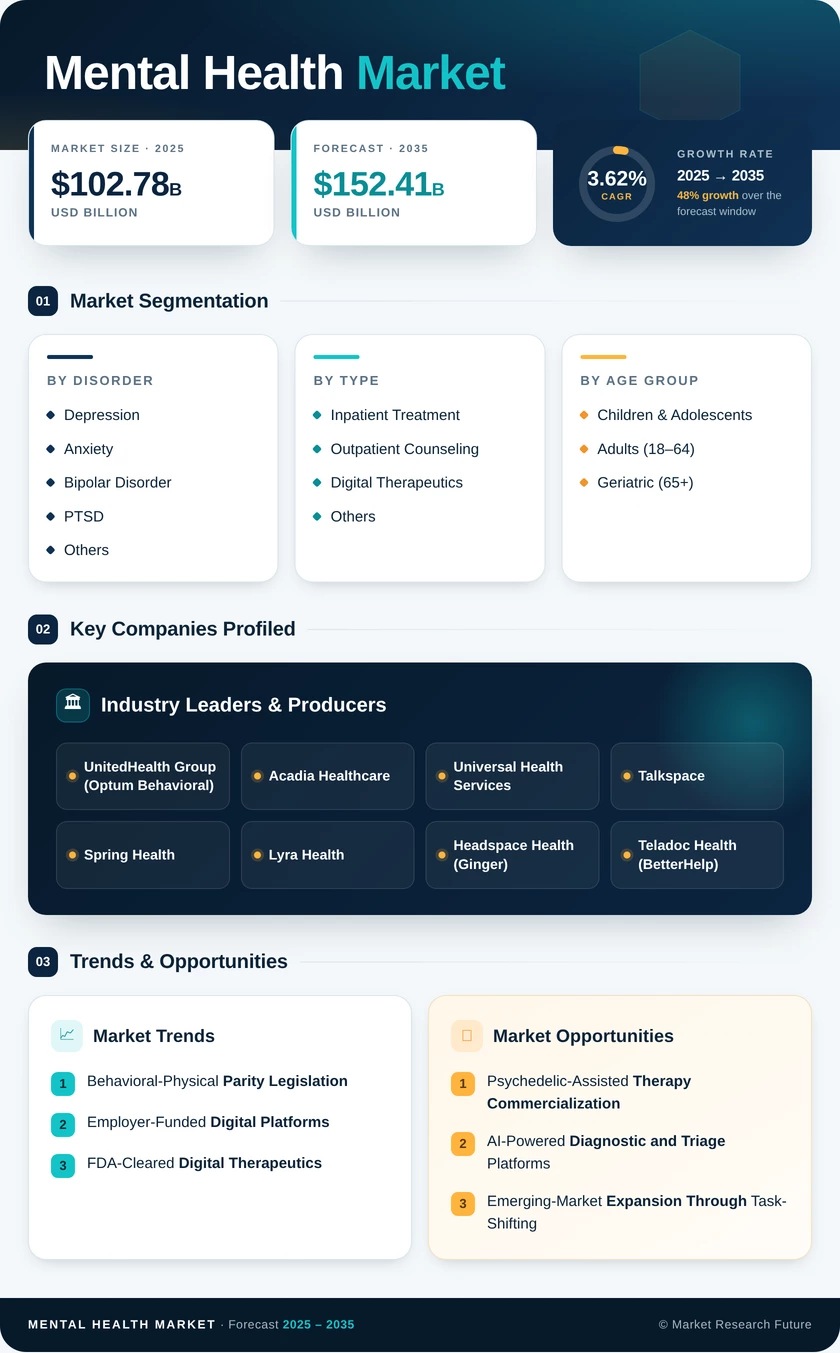
Segmentation Quick Reference
| Dimension | Sub-Segments | Dominant Segment | Fastest Growing Segment |
| By Disorder | Depression, Anxiety, Bipolar Disorder, PTSD, Others | Depression (37.94% share, 2025) | PTSD (5.68% CAGR) |
| By Mental Health Market Type | Inpatient Treatment, Outpatient Counseling, Digital Therapeutics, Others | Outpatient Counseling (45.39% share, 2025) | Digital Therapeutics (7.18% CAGR) |
| By Age Group | Children & Adolescents, Adults (18–64), Geriatric (65+) | Adults 18–64 (64.94% share, 2025) | Geriatric (5.56% CAGR) |
| By End User | Hospitals & Clinics, Community Mental-Health Centers, Employers & Corporate Wellness, Others | Hospitals & Clinics (49.12% share, 2025) | Employers & Corporate Wellness (7.55% CAGR) |
Market Segmentation Overview
By Disorder
| Sub-Segment | Key Trend |
| Depression | Expanding primary-care screening mandates and SSRI generics are driving volume growth |
| Anxiety | Workplace stress and digital platform adoption are sustaining double-digit referral increases |
| Bipolar Disorder | Improved diagnostic accuracy, reducing misdiagnosis lag from 6 years to 3 years |
| PTSD | Veteran-focused programs and the psychedelic-assisted therapy pipeline are accelerating clinical demand |
| Others | Eating disorders and OCD are gaining recognition through social media awareness campaigns |
Depression and PTSD define the poles of the disorder segmentation — the former through sheer prevalence and established treatment pathways, the latter through policy-driven investment and novel therapeutic modalities.
By Mental Health Market Type
| Sub-Segment | Key Trend |
| Inpatient Treatment | Bed expansion in underserved markets; acute stabilization remains non-substitutable |
| Outpatient Counseling | Telehealth parity legislation sustaining virtual session growth above 20% annually |
| Digital Therapeutics | FDA clearances and Medicare CPT reimbursement codes are creating a scalable payer pathway |
| Others | Peer-support models are gaining evidence base; residential care is shifting to community settings |
Outpatient counseling and digital therapeutics are converging as platforms blend synchronous therapy with asynchronous software modules, creating hybrid delivery models.
By Age Group
| Sub-Segment | Key Trend |
| Children & Adolescents | School-based screening programs expanding; social media impact driving demand |
| Adults (18–64) | Employer-funded platforms and digital-first access are dominating utilization |
| Geriatric (65+) | Dementia-adjacent behavioral conditions and social isolation are fueling rapid growth |
The adult cohort drives current revenues, but demographic aging in Europe and East Asia is steadily shifting the growth center toward geriatric populations.
By End User
| Sub-Segment | Key Trend |
| Hospitals & Clinics | Integrated behavioral health units within general hospitals are gaining operational priority |
| Community Mental-Health Centers | Federal and state block grants are sustaining capacity expansion in rural areas |
| Employers & Corporate Wellness | ROI-driven investment with outcome-based vendor contracts replacing EAP models |
| Others | School counselors, military behavioral health programs, and correctional mental health services |
Employers and corporate wellness platforms are redefining how behavioral health services are procured, shifting purchasing power from individual consumers to institutional buyers.