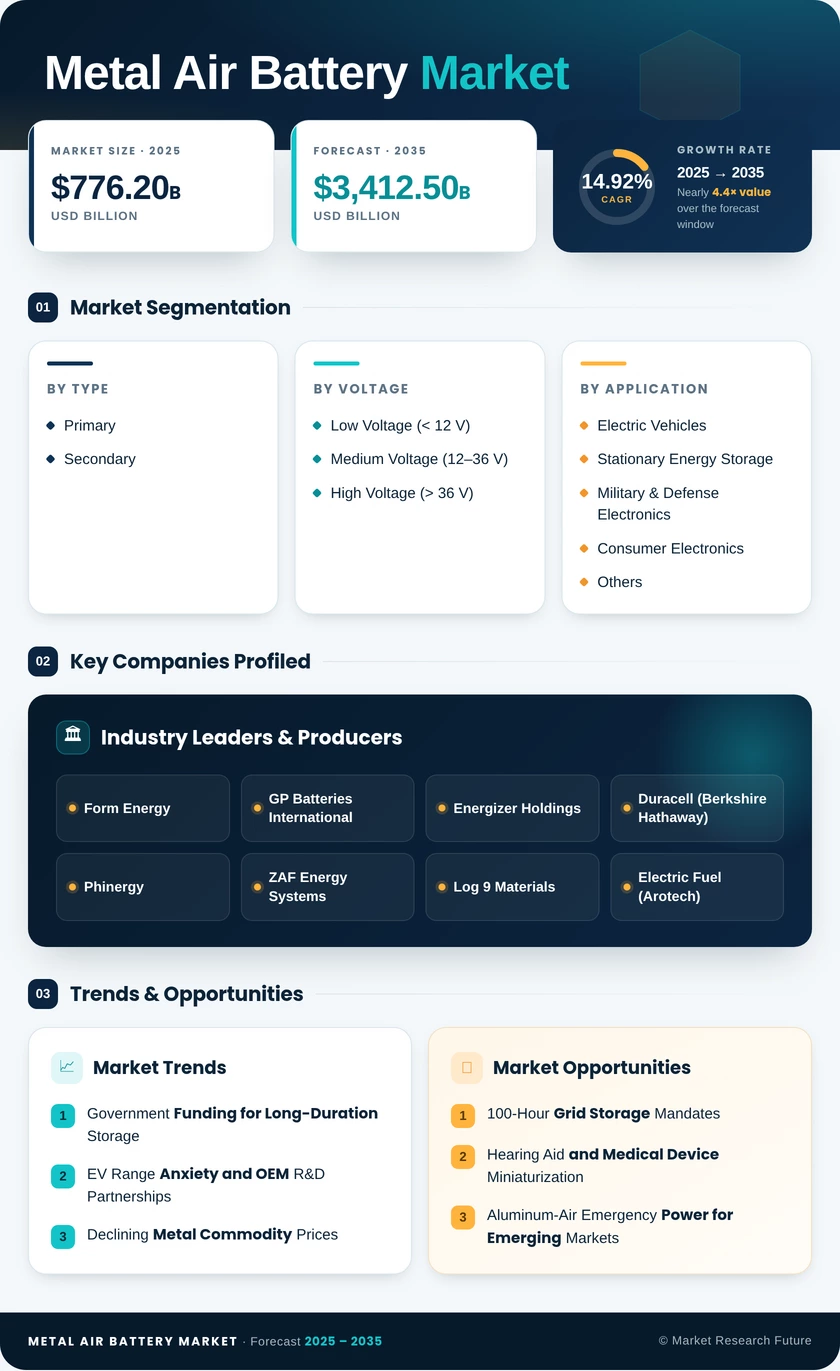
Metal Air Battery Market

ID: MRFR/EnP/9015-HCR
100 Pages
Chitranshi Jaiswal
Last Updated: June 22, 2026
Metal Air Battery Market Size, Share & Growth Analysis Report By Metal Type (Zinc-Air, Aluminum-Air, Lithium-Air, Iron-Air, Other Metal Types), By Battery Type (Primary, Secondary), By Voltage (Low Voltage (<36 V), Medium Voltage (36–100 V), High Voltage (>100 V)), By Application (Electric Vehicles, Stationary Energy Storage, Military & Defense Electronics, Consumer Electronics, Others) and By Regional (North America, Europe, South America, Asia Pacific, Middle East and Africa) – Industry Growth & Forecast to 2035
Download PDF ×

We do not share your information with anyone. However, we may send you emails based on your report interest from time to time. You may contact us at any time to opt-out.

  1. 1 Market Overview |
    1. 1.1 Study Assumptions & Market Definition |
    2. 1.2 Scope of the Study |
    3. 1.3 Research Methodology
  2. 2 Market Summary & Key Takeaways
  3. 3 Market Dynamics |
    1. 3.1 Market Drivers Analysis | |
      1. 3.1.1 Government Funding for Long-Duration Storage | |
      2. 3.1.2 EV Range Anxiety and OEM R&D Partnerships | |
      3. 3.1.3 Declining Zinc and Aluminium Commodity Prices | |
      4. 3.1.4 Bifunctional Catalyst Breakthroughs | |
      5. 3.1.5 Grid Decarbonization Mandates (100-Hour Storage) | |
      6. 3.1.6 Military and Defense Portable Power Modernization | |
      7. 3.1.7 Solid-State Metal-Air Architecture Advances |
    2. 3.2 Market Restraints Analysis | |
      1. 3.2.1 Limited Cycle Life of Rechargeable Metal-Air Cells | |
      2. 3.2.2 Air Cathode Sensitivity to Ambient Contaminants | |
      3. 3.2.3 Lithium-Ion Incumbency and Sunk Manufacturing Capital | |
      4. 3.2.4 High Cost of Precious-Metal Catalysts | |
      5. 3.2.5 Lack of Standardized Testing Protocols |
    3. 3.3 Market Opportunity Analysis | |
      1. 3.3.1 100-Hour Grid Storage Mandates | |
      2. 3.3.2 Hearing Aid and Medical Device Miniaturization | |
      3. 3.3.3 Aluminum-Air Emergency Power for Emerging Markets | |
      4. 3.3.4 Data-Driven Battery Management Platforms | |
      5. 3.3.5 Military Portable Power Modernization |
    4. 3.4 Industry Value Chain Analysis |
    5. 3.5 Porter's Five Forces Analysis
  4. 4 Global Metal Air Battery Market Size & Forecast (2021–2035) |
    1. 4.1 Historical Market Size (2021–2025) |
    2. 4.2 Current & Forecast Market Size (2026–2035) |
    3. 4.3 Market Size by Revenue (USD Million) |
    4. 4.4 Year-over-Year Growth Analysis
  5. 5 Segmentation Analysis |
    1. 5.1 By Metal Type | |
      1. 5.1.1 Zinc-Air | |
      2. 5.1.2 Aluminum-Air | |
      3. 5.1.3 Lithium-Air | |
      4. 5.1.4 Iron-Air | |
      5. 5.1.5 Other Metal Types |
    2. 5.2 By Battery Type | |
      1. 5.2.1 Primary | |
      2. 5.2.2 Secondary |
    3. 5.3 By Voltage | |
      1. 5.3.1 Low Voltage ( 36 V) |
    4. 5.4 By Application | |
      1. 5.4.1 Electric Vehicles | |
      2. 5.4.2 Stationary Energy Storage | |
      3. 5.4.3 Military & Defense Electronics | |
      4. 5.4.4 Consumer Electronics | |
      5. 5.4.5 Others
  6. 6 Regional Analysis |
    1. 6.1 North America | |
      1. 6.1.1 United States | |
      2. 6.1.2 Canada | |
      3. 6.1.3 Mexico |
    2. 6.2 Europe | |
      1. 6.2.1 Germany | |
      2. 6.2.2 United Kingdom | |
      3. 6.2.3 France | |
      4. 6.2.4 Italy | |
      5. 6.2.5 Spain | |
      6. 6.2.6 Nordic Countries | |
      7. 6.2.7 Russia | |
      8. 6.2.8 Rest of Europe |
    3. 6.3 Asia-Pacific | |
      1. 6.3.1 China | |
      2. 6.3.2 India | |
      3. 6.3.3 Japan | |
      4. 6.3.4 South Korea | |
      5. 6.3.5 ASEAN | |
      6. 6.3.6 Rest of Asia-Pacific |
    4. 6.4 South America | |
      1. 6.4.1 Brazil | |
      2. 6.4.2 Argentina | |
      3. 6.4.3 Rest of South America |
    5. 6.5 Middle East & Africa | |
      1. 6.5.1 Saudi Arabia | |
      2. 6.5.2 UAE | |
      3. 6.5.3 South Africa | |
      4. 6.5.4 Egypt | |
      5. 6.5.5 Rest of MEA
  7. 7 Competitive Landscape |
    1. 7.1 Market Share Analysis (2025) |
    2. 7.2 Competitive Benchmarking Matrix |
    3. 7.3 Company Profiles | |
      1. 7.3.1 Form Energy | |
      2. 7.3.2 GP Batteries International | |
      3. 7.3.3 Energizer Holdings | |
      4. 7.3.4 Duracell (Berkshire Hathaway) | |
      5. 7.3.5 Phinergy | |
      6. 7.3.6 ZAF Energy Systems | |
      7. 7.3.7 Log 9 Materials | |
      8. 7.3.8 PolyPlus Battery Company | |
      9. 7.3.9 Electric Fuel (Arotech) | |
      10. 7.3.10 Samsung SDI
  8. 8 Future Outlook & Strategic Recommendations (2026–2035) |
    1. 8.1 AI-Optimized Battery Management |
    2. 8.2 Electrification Supercycle and EV Integration |
    3. 8.3 Long-Duration Storage and Grid Resilience |
    4. 8.4 Sustainability and Circular Economy
  9. 9 Recent Developments & News
  10. 10 Frequently Asked Questions (FAQs)
  11. 11 Report Scope & Methodology |
    1. 11.1 Study Period & Base Year |
    2. 11.2 Data Sources & Citations |
    3. 11.3 Abbreviations
  12. 12 LIST OF TABLES |
  13. TABLE 1 Global Metal Air Battery Market Size & Forecast, by Revenue (USD Million), 2021–2035 |
  14. TABLE 2 Global Metal Air Battery Market – Year-over-Year Growth Analysis, 2021–2035 |
  15. TABLE 3 Global Metal Air Battery Market – Driver Impact Analysis |
  16. TABLE 4 Global Metal Air Battery Market – Restraint Impact Analysis |
  17. TABLE 5 Global Metal Air Battery Market – Regional Summary |
  18. TABLE 6 North America Metal Air Battery Market Size, by Country, 2021–2035 (USD Million) |
  19. TABLE 7 Europe Metal Air Battery Market Size, by Country, 2021–2035 (USD Million) |
  20. TABLE 8 Asia-Pacific Metal Air Battery Market Size, by Country, 2021–2035 (USD Million) |
  21. TABLE 9 South America Metal Air Battery Market Size, by Country, 2021–2035 (USD Million) |
  22. TABLE 10 Middle East & Africa Metal Air Battery Market Size, by Country, 2021–2035 (USD Million) |
  23. TABLE 11 Global Metal Air Battery Market Size, by Metal Type, 2021–2035 (USD Million) |
  24. TABLE 12 Global Metal Air Battery Market Size, by Battery Type, 2021–2035 (USD Million) |
  25. TABLE 13 Global Metal Air Battery Market Size, by Voltage, 2021–2035 (USD Million) |
  26. TABLE 14 Global Metal Air Battery Market Size, by Application, 2021–2035 (USD Million) |
  27. TABLE 15 Competitive Benchmarking Matrix – Global Metal Air Battery Market, 2025 |
  28. TABLE 16 Company Profiles – Key Players, Global Metal Air Battery Market |
  29. TABLE 17 Recent Developments & Strategic Announcements, 2023–2025 |
  30. TABLE 18 Report Scope & Methodology Summary |
  31. TABLE 19 Detailed Sources and Citations
  32. 13 LIST OF FIGURES |
  33. FIGURE 1 Metal Air Battery Market Dynamics – Drivers, Restraints, and Opportunities |
  34. FIGURE 2 Industry Value Chain Analysis – Metal Air Battery Market |
  35. FIGURE 3 Porter's Five Forces Analysis – Metal Air Battery Market |
  36. FIGURE 4 Global Metal Air Battery Market Size Trend, 2021–2035 (USD Million) |
  37. FIGURE 5 Metal Air Battery Market Share, by Metal Type, 2024 (%) |
  38. FIGURE 6 Metal Air Battery Market Share, by Battery Type, 2024 (%) |
  39. FIGURE 7 Metal Air Battery Market Share, by Voltage, 2024 (%) |
  40. FIGURE 8 Metal Air Battery Market Share, by Application, 2024 (%) |
  41. FIGURE 9 Metal Air Battery Market Share, by Region, 2024 (%) |
  42. FIGURE 10 North America Metal Air Battery Market Share, by Country, 2024 (%) |
  43. FIGURE 11 Europe Metal Air Battery Market Share, by Country, 2024 (%) |
  44. FIGURE 12 Asia-Pacific Metal Air Battery Market Share, by Country, 2024 (%) |
  45. FIGURE 13 South America Metal Air Battery Market Share, by Country, 2024 (%) |
  46. FIGURE 14 Middle East & Africa Metal Air Battery Market Share, by Country, 2024 (%) |
  47. FIGURE 15 Competitive Landscape – Market Concentration and Key Player Positioning

Segmentation Quick Reference

DimensionSub-SegmentsDominant SegmentFastest Growing Segment
Metal TypeZinc-Air, Aluminum-Air, Lithium-Air, Iron-Air, Other Metal TypesLithium-AirIron-Air
Battery TypePrimary, SecondaryPrimarySecondary
VoltageLow (< 12 V), Medium (12–36 V), High (> 36 V)Low VoltageMedium Voltage
ApplicationElectric Vehicles, Stationary Energy Storage, Military & Defense Electronics, Consumer Electronics, OthersElectric VehiclesStationary Energy Storage
RegionNorth America, Europe, Asia-Pacific, South America, Middle East & AfricaAsia-PacificNorth America


Market Segmentation Overview

By Metal Type

Sub-SegmentKey Trend
Zinc-AirMature primary cell production; rechargeable variants gaining traction with improved bifunctional catalysts
Aluminum-AirDisposable emergency power applications expanding in defense and off-grid telecom
Lithium-AirHighest R&D investment intensity; solid-state electrolyte integration under development
Iron-AirFastest growth driven by 100-hour grid storage demonstrations and utility procurement contracts
Other Metal TypesNiche magnesium-air and sodium-air research for marine and aerospace applications


Zinc-air and lithium-air chemistries anchor the Metal Air Battery Market from opposite ends of the maturity spectrum — zinc-air through commercial volume and lithium-air through R&D investment. Iron-air is transitioning from laboratory demonstrations to utility-scale manufacturing, while aluminum-air serves as the go-to disposable power solution for environments lacking charging infrastructure.

By Battery Type

Sub-SegmentKey Trend
PrimaryContinued dominance through hearing aid button cells and single-use military batteries
SecondaryRapid growth as rechargeable metal-air cells approach cycle life thresholds needed for grid and EV deployment


Primary cells maintain market share dominance due to established zinc-air hearing aid and aluminum-air disposable product lines. Secondary systems represent the growth frontier, with breakthroughs in bifunctional catalyst design enabling rechargeable zinc-air and iron-air cells to compete with lithium-ion on cycle life.

By Voltage

Sub-SegmentKey Trend
Low Voltage (< 12 V)Hearing aids, IoT sensors, and wearable medical devices drive stable demand
Medium Voltage (12–36 V)UAV power, military portable electronics, and automotive auxiliary systems are the fastest-growing applications
High Voltage (> 36 V)EV battery packs and grid-scale modules — early-stage but highest long-term revenue potential


Low-voltage cells represent the largest installed base by unit volume across the Metal Air Battery Market. Medium-voltage products are scaling quickly as defense and drone applications demand 24 V nominal power sources with high gravimetric energy density.

By Application

Sub-SegmentKey Trend
Electric VehiclesLargest share by value; most activity at R&D and pilot stage for lithium-air integration
Stationary Energy StorageFastest-growing; iron-air systems target 100-hour discharge for utility-scale deployments
Military & Defense ElectronicsHigh-margin niche for zinc-air and aluminum-air portable power systems
Consumer ElectronicsHearing aids dominate; rechargeable zinc-air cells targeting wearables and IoT
OthersTelecom backup, marine signal beacons, and remote sensing equipment


Electric vehicles command the largest application share in the Metal Air Battery Market by USD value, though commercial deployment timelines for lithium-air EV cells extend beyond 2030. Stationary energy storage offers the most immediate revenue pathway, with iron-air grid storage systems entering manufacturing scale-up by 2026–2027.

By Region

Sub-SegmentKey Trend
North AmericaFastest growth — DOE funding, IRA credits, Form Energy manufacturing ramp
EuropeSecond-largest market — catalyst R&D leadership, grid storage procurement
Asia-PacificDominant region — Chinese zinc-air manufacturing scale, Japanese lithium-air R&D
South AmericaEmerging — renewable integration storage and mining-linked aluminium supply
Middle East & AfricaHigh growth potential — off-grid power, NEOM storage, defense procurement


Asia-Pacific holds the largest revenue share in the Metal Air Battery Market, anchored by China's zinc-air cell manufacturing dominance and Japan's advanced lithium-air research programs. North America is accelerating fastest, driven by unprecedented federal funding commitments and the first commercial-scale iron-air battery manufacturing facility.