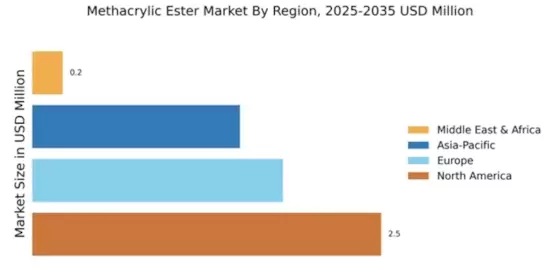
The Methacrylic Ester Market is currently characterized by a dynamic competitive landscape, driven by innovation, sustainability, and strategic partnerships. Key players such as Mitsubishi Chemical Corporation (Japan), Evonik Industries AG (Germany), and BASF SE (Germany) are actively shaping the market through their distinct operational focuses. Mitsubishi Chemical Corporation (Japan) emphasizes innovation in product development, particularly in bio-based methacrylic esters, which aligns with the growing demand for sustainable materials. Meanwhile, Evonik Industries AG (Germany) has been focusing on expanding its production capabilities to meet the increasing global demand, particularly in Asia-Pacific regions. BASF SE (Germany) is leveraging its extensive research and development resources to enhance its product portfolio, thereby reinforcing its competitive position in the market.
The business tactics employed by these companies include localizing manufacturing and optimizing supply chains to enhance efficiency and reduce costs. The Methacrylic Ester Market appears to be moderately fragmented, with several key players exerting considerable influence. This competitive structure allows for a diverse range of products and innovations, fostering a healthy environment for growth and development.
In November 2025, Mitsubishi Chemical Corporation (Japan) announced the launch of a new line of bio-based methacrylic esters, which is expected to cater to the increasing demand for sustainable materials in various applications. This strategic move not only enhances their product offerings but also positions the company as a leader in sustainability within the industry. The introduction of these products may significantly impact market dynamics, as competitors may need to adapt to the rising consumer preference for eco-friendly solutions.
In October 2025, Evonik Industries AG (Germany) expanded its production facility in Singapore, aiming to increase its output of methacrylic esters by 30%. This expansion is strategically important as it allows Evonik to better serve the rapidly growing Asia-Pacific market, which is anticipated to be a key growth driver in the coming years. The increased capacity could also provide Evonik with a competitive edge in terms of supply chain reliability and responsiveness to market demands.
In September 2025, BASF SE (Germany) entered into a strategic partnership with a leading technology firm to integrate AI-driven analytics into its production processes. This collaboration is likely to enhance operational efficiency and product quality, thereby reinforcing BASF's competitive position. The integration of advanced technologies may also facilitate faster innovation cycles, allowing BASF to respond more effectively to emerging market trends.
As of December 2025, the Methacrylic Ester Market is witnessing a shift towards digitalization and sustainability, with companies increasingly focusing on strategic alliances to enhance their competitive positioning. The current trends suggest a transition from price-based competition to a landscape where innovation, technology, and supply chain reliability are paramount. This evolution indicates that companies will need to differentiate themselves through advanced product offerings and sustainable practices to maintain a competitive edge in the market.
Leave a Comment