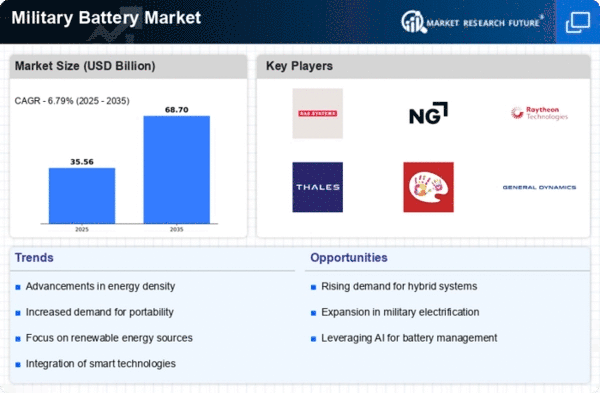
The Military Battery Market is characterized by a dynamic competitive landscape, driven by technological advancements and increasing demand for portable power solutions in defense applications. Key players such as Saft (FR), Northrop Grumman (US), and Raytheon Technologies (US) are strategically positioned to leverage innovation and partnerships to enhance their market presence. Saft (FR) focuses on developing advanced lithium-ion battery technologies, which are crucial for modern military applications, while Northrop Grumman (US) emphasizes integrating battery solutions into its broader defense systems. Raytheon Technologies (US) is also investing in next-generation battery technologies to support its defense electronics, indicating a collective shift towards high-performance energy solutions that shape the competitive environment.
In terms of business tactics, companies are increasingly localizing manufacturing and optimizing supply chains to enhance responsiveness to military needs. The market appears moderately fragmented, with several players vying for dominance. However, the collective influence of major companies like BAE Systems (GB) and Thales Group (FR) is notable, as they engage in strategic collaborations and mergers to consolidate their positions and expand their technological capabilities.
In November 2025, BAE Systems (GB) announced a partnership with a leading battery technology firm to develop next-generation energy storage systems for military vehicles. This collaboration is significant as it aims to enhance the operational efficiency and endurance of military assets, reflecting a broader trend towards integrating advanced energy solutions into defense operations. The partnership underscores BAE's commitment to innovation and its strategic focus on enhancing the capabilities of its defense offerings.
In October 2025, Thales Group (FR) unveiled a new line of compact, high-capacity batteries designed for unmanned aerial vehicles (UAVs). This launch is pivotal, as it aligns with the increasing reliance on UAVs in military operations, suggesting that Thales is positioning itself to capture a growing segment of the market. The introduction of these batteries could potentially enhance the operational range and effectiveness of UAVs, thereby reinforcing Thales's competitive edge in the sector.
In September 2025, Northrop Grumman (US) secured a contract to supply advanced battery systems for a new class of naval vessels. This contract is indicative of the company's strategic focus on expanding its footprint in maritime defense applications. By providing cutting-edge battery solutions, Northrop Grumman is likely to enhance the operational capabilities of naval forces, further solidifying its position as a leader in the military battery market.
As of December 2025, current trends in the Military Battery Market are increasingly defined by digitalization, sustainability, and the integration of artificial intelligence (AI) into battery management systems. Strategic alliances among key players are shaping the landscape, fostering innovation and enhancing supply chain reliability. The competitive differentiation appears to be shifting from price-based competition to a focus on technological advancements and sustainable practices. Companies that can effectively leverage these trends are likely to emerge as leaders in the evolving market.


















Leave a Comment