×
Request Free Sample ×

Kindly complete the form below to receive a free sample of this Report

* Please use a valid business email

Leading companies partner with us for data-driven Insights

clients tt-cursor
Hero Background

Military Electro Optical Infrared Systems Market

ID: MRFR/AD/0779-CR
136 Pages
Sejal Akre
October 2019

Military Electro-Optical Infrared ( EOIR) Systems Market Research Report Information by Type (Image Intensification, Laser and Infrared), Sensor Technology (Scanning, Starring, Multispectral and Hyperspectral), Platform (Airborne, Land-Based and Naval) and Region (North America, Europe, Asia-Pacific, Middle East & Africa and Latin America) - Forecast till 2030

Share:
Download PDF ×

We do not share your information with anyone. However, we may send you emails based on your report interest from time to time. You may contact us at any time to opt-out.

Military Electro Optical Infrared Systems Market Infographic
Purchase Options

Military Electro Optical Infrared Systems Market Summary

As per MRFR analysis, the Military Electro Optical Infrared Systems Market was estimated at 6.2 USD Million in 2024. The Military Electro Optical Infrared Systems industry is projected to grow from 8.2 in 2025 to 18.2 by 2035, exhibiting a compound annual growth rate (CAGR) of 8.3 during the forecast period 2025 - 2035.

Key Market Trends & Highlights

The Military Electro Optical Infrared Systems Market is poised for substantial growth driven by technological advancements and increasing defense investments.

  • North America remains the largest market for military electro optical infrared systems, reflecting robust defense budgets and modernization efforts.
  • The Asia-Pacific region is emerging as the fastest-growing market, fueled by rising defense expenditures and geopolitical tensions.
  • Surveillance systems dominate the market, while targeting systems are experiencing the fastest growth due to evolving military strategies.
  • Rising geopolitical tensions and technological advancements in sensor technologies are key drivers propelling market expansion.

Market Size & Forecast

2024 Market Size 6.2 (USD Million)
2035 Market Size 18.2 (USD Million)
CAGR (2025 - 2035) 8.3%

Major Players

Lockheed Martin (US), Northrop Grumman (US), Raytheon Technologies (US), Thales Group (FR), BAE Systems (GB), Leonardo (IT), Elbit Systems (IL), Hensoldt (DE), L3Harris Technologies (US), General Dynamics (US)

Military Electro Optical Infrared Systems Market Trends

The Military Electro Optical Infrared Systems Market is currently experiencing a dynamic evolution, driven by advancements in technology and increasing defense budgets across various nations. The integration of electro-optical and infrared systems into military operations enhances situational awareness, target acquisition, and reconnaissance capabilities. As nations prioritize modernization of their armed forces, the demand for sophisticated surveillance and targeting systems is likely to rise. This trend is further fueled by the growing emphasis on unmanned systems and autonomous platforms, which rely heavily on advanced sensor technologies to operate effectively in diverse environments. Moreover, the geopolitical landscape appears to be influencing procurement strategies, as countries seek to bolster their defense capabilities in response to emerging threats. The Military Electro Optical Infrared Systems Market seems poised for growth, with innovations in sensor technology and data processing capabilities playing a crucial role. Additionally, partnerships between defense contractors and technology firms may lead to the development of next-generation systems that offer enhanced performance and reliability. As the market continues to evolve, stakeholders must remain vigilant to adapt to changing requirements and technological advancements.

Increased Investment in Defense Technologies

Countries are allocating more resources to enhance their military capabilities, particularly in advanced technologies. This trend indicates a shift towards modernizing existing systems and acquiring new electro-optical and infrared solutions.

Integration of Artificial Intelligence

The incorporation of artificial intelligence into military electro-optical infrared systems is becoming more prevalent. This integration may improve data analysis, target recognition, and decision-making processes, thereby enhancing operational efficiency.

Focus on Unmanned Systems

There is a growing emphasis on unmanned aerial vehicles and ground systems that utilize electro-optical and infrared technologies. This focus suggests a strategic move towards remote operations, reducing risks to personnel while maintaining effective surveillance and reconnaissance.

Market Segment Insights

By Application: Surveillance (Largest) vs. Targeting (Fastest-Growing)

In the Military Electro Optical Infrared Systems Market, the Application segment showcases a diverse distribution of functionalities, with Surveillance emerging as the largest segment. Surveillance applications dominate the market due to their extensive use in monitoring and reconnaissance missions. Following closely, Targeting applications are witnessing significant growth, driven by advancements in precision-guided munitions and the increasing importance of accurate targeting in military operations. As a result, both segments play a crucial role in shaping the future of military engagements. Growth trends within the Application segment are fueling the expansion of Surveillance and Targeting functionalities. The surge in global defense expenditures and heightened geopolitical tensions are accelerating the adoption of sophisticated surveillance systems. Meanwhile, Targeting applications are becoming essential for modern warfare strategies, particularly with the introduction of emerging technologies such as artificial intelligence and automation. This trend highlights the evolving landscape of military operations, with a pressing need for enhanced targeting capabilities supporting mission success.

Surveillance: Dominant vs. Targeting: Emerging

The Surveillance segment stands as the dominant force in the Military Electro Optical Infrared Systems Market, characterized by its critical role in intelligence gathering and situational awareness. This segment encompasses technologies such as cameras, sensors, and monitoring systems that are essential for effective military operations. With an increasing demand for comprehensive battlefield awareness, Surveillance systems are continually being developed to provide enhanced resolution and coverage. On the other hand, the Targeting segment is identified as an emerging area, leveraging innovative technologies to improve accuracy and efficiency in engaging adversaries. Incorporating advanced algorithms and data analytics, Targeting systems are becoming integral in modern warfare, marking a pivotal shift in military tactics and operational effectiveness.

By Technology: Thermal Imaging (Largest) vs. Night Vision (Fastest-Growing)

The Military Electro Optical Infrared Systems Market is characterized by diverse technologies, with Thermal Imaging commanding the largest market share. This segment has established itself as a steadfast choice for military applications due to its ability to provide clear imaging in various environmental conditions. Night Vision follows closely, showing significant potential for growth as advancements in technology continue to enhance operational effectiveness and capabilities in low-light environments. The growth trends in this market segment are driven by the increasing demand for enhanced surveillance and reconnaissance capabilities in modern warfare. Factors such as the rising need for night-time operations, coupled with technological advancements in image processing, are propelling the development of Night Vision systems. The military's investment in research and development further fuels competition, fostering innovation across all technology segments, thereby influencing market dynamics positively.

Thermal Imaging: Dominant vs. Night Vision: Emerging

Thermal Imaging stands out as the dominant segment in the Military Electro Optical Infrared Systems Market, primarily due to its superior capability to detect heat signatures, making it indispensable for effective surveillance and targeting applications. It excels in a variety of operational scenarios, including search and rescue, border patrol, and combat operations. Conversely, Night Vision technology is emerging rapidly, owing to continuous advancements in intensifier tubes and digital night vision systems that enhance visibility in complete darkness. This segment is gaining traction due to its adaptability and integration with other sensors, which provide multidimensional situational awareness to military personnel. As the military continues to adopt dual-use technologies, both segments are positioned for significant evolution in capabilities and applications.

By End Use: Military (Largest) vs. Defense Contractors (Fastest-Growing)

The Military segment is the largest consumer of Electro Optical Infrared Systems in the military sector, accounting for a significant portion of the market share. This is driven by the continuous modernization of military forces and the increasing demand for advanced surveillance and reconnaissance capabilities. Meanwhile, Defense Contractors are rapidly gaining ground, leveraging government contracts and technological advancements to expand their presence in this space. Their share is shifting toward developing innovative solutions tailored for military applications, which is reshaping the competitive landscape.

Military (Dominant) vs. Defense Contractors (Emerging)

The Military segment remains dominant in the Electro Optical Infrared Systems market due to its substantial budgets for procurement and upgrades of surveillance systems, thermal imaging, and targeting equipment. With a focus on enhancing operational capabilities, military organizations invest heavily in advanced technologies. Conversely, Defense Contractors represent the emerging segment, driven by innovation and strategic partnerships with military agencies. They are increasingly adopting cutting-edge technologies, which not only fulfill military requirements but also provide competitive advantages through unique and efficient solutions. Their agility in adapting to market demands positions them as vital players in future military initiatives.

By Platform: Aerial Systems (Largest) vs. Naval Systems (Fastest-Growing)

In the Military Electro Optical Infrared Systems Market, the Aerial Systems segment currently holds a significant share, primarily driven by the increasing demand for surveillance and reconnaissance operations in military applications. As nations upgrade their aerial capabilities, the market is witnessing a robust distribution of shares among various platform systems, with land and portable systems also contributing notably, but Aerial systems lead due to technological advancements and critical operational needs. Conversely, the Naval Systems segment is emerging as the fastest-growing sector within the market. This growth can be attributed to increasing naval modernization initiatives and a heightened focus on maritime security. As threats in oceanic territories intensify, the demand for advanced Electro Optical Infrared systems in naval platforms is skyrocketing. This trend is expected to continue as countries invest more in their naval capabilities, elevating the importance of this segment within the overall market landscape.

Aerial Systems (Dominant) vs. Portable Systems (Emerging)

Aerial Systems are dominating the Military Electro Optical Infrared Systems Market, characterized by their advanced imaging and targeting capabilities that enhance aerial surveillance and reconnaissance missions. These systems integrate cutting-edge technology for real-time data transmission and battlefield awareness, making them indispensable for modern warfare. The investment in aerial platforms is primarily driven by the need for enhanced situational awareness and precision targeting. On the other hand, Portable Systems represent an emerging segment, designed for flexibility and quick deployment in various operational theaters. They cater to special forces and other military units requiring mobility without compromising on sensor performance. As the demand for lightweight and compact systems escalates, portable platforms are expected to see increased adoption, poised to address the tactical needs of modern armed forces.

By Component: Cameras (Largest) vs. Sensors (Fastest-Growing)

In the Military Electro Optical Infrared Systems Market, the component segment is primarily dominated by cameras, which hold the largest market share. This dominance is attributed to the increasing demand for high-resolution imaging capabilities in various military applications, including surveillance and reconnaissance. Sensors, meanwhile, are rapidly gaining traction, emerging as the fastest-growing component due to advancements in technology, making them indispensable for modern military operations. The integration of sensor technologies into electro-optical systems facilitates improved precision and operational efficiency, driving their popularity. Growing threats and the need for enhanced situational awareness are propelling the demand for advanced electro-optical systems. Cameras are often leading the charge in this segment, but sensors are rapidly evolving and innovating, becoming essential in real-time data gathering and analysis. The increasing focus on unmanned systems and autonomous operations is further boosting sensor growth, as they are crucial for data collection and weapon system integration. The combination of cameras and sensors is transforming the landscape, making military operations more efficient and effective.

Cameras (Dominant) vs. Software (Emerging)

Cameras are the dominant component in the Military Electro Optical Infrared Systems Market, known for their high-resolution imaging and adaptability to various landscapes and environments. They are crucial for reconnaissance, surveillance, and intelligence-gathering missions, enabling military personnel to make informed decisions based on detailed visual information. Advanced imaging technologies, such as thermal and night vision capabilities, enhance their effectiveness, allowing for operations in diverse conditions. On the other hand, software is emerging as a vital component, providing analytical tools that process and interpret data from cameras and sensors. As military operations increasingly rely on data-driven strategies, software integration is paramount. This segment fosters innovation through AI and machine learning, enhancing functionalities like image recognition, threat analysis, and operational planning, making it indispensable for modern military tactics.

Get more detailed insights about Military Electro Optical Infrared Systems Market

Regional Insights

North America : Market Leader in Defense Tech

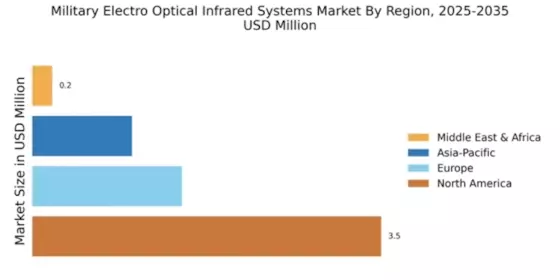
North America continues to lead the Military Electro Optical Infrared Systems market, holding a significant share of 3.1 billion in 2024. The region's growth is driven by increasing defense budgets, technological advancements, and a focus on modernization of military capabilities. Regulatory support from government initiatives further catalyzes demand, ensuring that North America remains at the forefront of military technology innovation. The United States is the primary contributor, with key players like Lockheed Martin, Northrop Grumman, and Raytheon Technologies dominating the landscape. These companies are heavily investing in R&D to enhance their product offerings. The competitive environment is characterized by strategic partnerships and collaborations, ensuring that North America maintains its competitive edge in the global market.

Europe : Emerging Defense Collaborations

Europe's Military Electro Optical Infrared Systems market is valued at 1.5 billion, reflecting a growing emphasis on defense collaboration among EU nations. The region is witnessing increased investments in advanced military technologies, driven by geopolitical tensions and the need for enhanced security measures. Regulatory frameworks are evolving to support joint defense initiatives, fostering innovation and collaboration across member states. Leading countries such as France, Germany, and the UK are at the forefront, with companies like Thales Group and BAE Systems playing pivotal roles. The competitive landscape is marked by partnerships aimed at developing cutting-edge technologies. As Europe seeks to bolster its defense capabilities, the presence of established players ensures a robust market environment.

Asia-Pacific : Rapidly Growing Defense Sector

The Asia-Pacific region, with a market size of 1.2 billion, is rapidly emerging as a significant player in the Military Electro Optical Infrared Systems market. The growth is fueled by increasing defense expenditures, modernization efforts, and regional security concerns. Countries are investing heavily in advanced military technologies, supported by favorable government policies and regulations aimed at enhancing national security. Key players in this region include countries like India, Japan, and Australia, with companies such as Elbit Systems and Hensoldt making notable contributions. The competitive landscape is characterized by a mix of domestic and international players, all vying for a share of the growing market. As the region continues to evolve, the demand for advanced military systems is expected to rise significantly.

Middle East and Africa : Strategic Defense Investments

The Middle East and Africa region, with a market size of 0.4 billion, is witnessing a gradual increase in investments in Military Electro Optical Infrared Systems. The growth is driven by rising security threats and the need for enhanced military capabilities. Governments are prioritizing defense spending, supported by international partnerships and collaborations aimed at modernizing their armed forces. Countries like the UAE and South Africa are leading the charge, with a focus on acquiring advanced military technologies. The competitive landscape includes both local and international players, with companies like Leonardo and L3Harris Technologies establishing a presence in the region. As defense budgets increase, the demand for sophisticated military systems is expected to grow, positioning the region for future advancements.

Key Players and Competitive Insights

The Military Electro Optical Infrared Systems Market is characterized by a dynamic competitive landscape, driven by technological advancements and increasing defense budgets across various nations. Key players such as Lockheed Martin (US), Northrop Grumman (US), and Raytheon Technologies (US) are at the forefront, focusing on innovation and strategic partnerships to enhance their operational capabilities. These companies are not only investing in research and development but are also pursuing mergers and acquisitions to consolidate their market positions, thereby shaping a competitive environment that is increasingly concentrated yet marked by significant innovation.

In terms of business tactics, companies are localizing manufacturing to reduce costs and enhance supply chain efficiency. The market structure appears moderately fragmented, with a few dominant players exerting considerable influence. This fragmentation allows for niche players to thrive, yet the collective strength of major companies like Thales Group (FR) and BAE Systems (GB) creates a competitive pressure that drives technological advancements and operational excellence.

In November 2025, Lockheed Martin (US) announced a strategic partnership with a leading AI firm to integrate advanced machine learning algorithms into their electro-optical systems. This move is likely to enhance the capabilities of their surveillance and reconnaissance systems, positioning them as a leader in the integration of AI within military applications. Such advancements may redefine operational effectiveness in the field, suggesting a shift towards more autonomous systems.

In October 2025, Northrop Grumman (US) secured a contract worth $500M to supply advanced infrared systems to the U.S. military. This contract not only underscores their strong foothold in the market but also highlights their commitment to meeting the evolving needs of defense forces. The financial implications of this contract could bolster their R&D efforts, further enhancing their competitive edge.

In September 2025, Raytheon Technologies (US) unveiled a new line of electro-optical sensors designed for unmanned aerial vehicles (UAVs). This innovation is indicative of the growing trend towards unmanned systems in military operations. By focusing on UAV applications, Raytheon is likely to capture a significant share of the market, as defense forces increasingly prioritize drone technology for surveillance and combat missions.

As of December 2025, the competitive trends in the Military Electro Optical Infrared Systems Market are heavily influenced by digitalization, sustainability, and AI integration. Strategic alliances are becoming more prevalent, as companies recognize the need to collaborate to stay ahead in a rapidly evolving technological landscape. The future of competition appears to be shifting from price-based strategies to a focus on innovation, technological advancements, and supply chain reliability, suggesting that companies that prioritize these areas will likely emerge as leaders in the market.

Key Companies in the Military Electro Optical Infrared Systems Market market include

Industry Developments

  • Q2 2024: Elbit Systems wins $150 million contract to supply electro-optical systems to European military Elbit Systems announced it secured a $150 million contract to deliver advanced electro-optical and infrared (EO/IR) systems for armored vehicles to a European defense customer, with deliveries scheduled over the next three years.
  • Q2 2024: Lockheed Martin opens new EO/IR sensor manufacturing facility in Florida Lockheed Martin inaugurated a new manufacturing facility in Orlando, Florida, dedicated to the production of next-generation electro-optical and infrared sensors for military aircraft and ground vehicles.
  • Q2 2024: Raytheon secures $118 million U.S. Army contract for next-gen infrared targeting systems Raytheon was awarded a $118 million contract by the U.S. Army to develop and deliver next-generation infrared targeting systems for armored combat vehicles, enhancing battlefield surveillance and targeting capabilities.
  • Q3 2024: BAE Systems launches new HawkSight multi-spectral EO/IR system for military UAVs BAE Systems unveiled the HawkSight, a multi-spectral electro-optical/infrared system designed for integration on military unmanned aerial vehicles, offering improved target detection and tracking in contested environments.
  • Q3 2024: Thales and Leonardo announce partnership to co-develop advanced EO/IR solutions for European defense Thales and Leonardo signed a strategic partnership agreement to jointly develop and market advanced electro-optical and infrared systems for European land and air defense platforms.
  • Q3 2024: Northrop Grumman delivers first shipment of LITENING advanced targeting pods to U.S. Air Force Northrop Grumman announced the delivery of the first batch of LITENING advanced EO/IR targeting pods under a new U.S. Air Force contract, supporting precision strike and reconnaissance missions.
  • Q4 2024: Rafael Advanced Defense Systems acquires Israeli EO/IR startup Visionix Rafael Advanced Defense Systems completed the acquisition of Visionix, an Israeli startup specializing in miniaturized electro-optical and infrared imaging technologies for military applications.
  • Q4 2024: General Dynamics awarded $90 million U.S. Navy contract for submarine EO/IR periscope upgrades General Dynamics received a $90 million contract from the U.S. Navy to upgrade electro-optical and infrared periscope systems on Virginia-class submarines, enhancing underwater surveillance capabilities.
  • Q1 2025: L3Harris Technologies wins $200 million contract for EO/IR systems for NATO surveillance aircraft L3Harris Technologies secured a $200 million contract to supply advanced EO/IR sensor suites for NATO's next-generation surveillance aircraft, supporting intelligence, surveillance, and reconnaissance missions.
  • Q1 2025: Teledyne FLIR launches new Black Hornet 4 nano-drone with enhanced EO/IR payload Teledyne FLIR introduced the Black Hornet 4, a nano-drone equipped with an upgraded electro-optical and infrared payload, designed for covert reconnaissance and situational awareness in urban combat.
  • Q2 2025: Saab signs $120 million contract to deliver EO/IR systems for Asian navy frigates Saab announced a $120 million contract to provide advanced EO/IR surveillance and targeting systems for a fleet of new frigates being built for an undisclosed Asian navy.
  • Q2 2025: Leonardo opens new EO/IR R&D center in the UK to accelerate defense innovation Leonardo inaugurated a new research and development center in the United Kingdom focused on advancing electro-optical and infrared technologies for military and homeland security applications.

Future Outlook

Military Electro Optical Infrared Systems Market Future Outlook

The Military Electro Optical Infrared Systems Market is projected to grow at an 8.3% CAGR from 2024 to 2035, driven by technological advancements, increased defense budgets, and rising demand for surveillance systems.

New opportunities lie in:

  • Development of advanced thermal imaging systems for unmanned aerial vehicles.
  • Integration of AI-driven analytics for real-time battlefield decision-making.
  • Expansion of portable electro-optical systems for special operations forces.

By 2035, the market is expected to achieve substantial growth, reflecting evolving defense needs and technological innovations.

Market Segmentation

Military Electro Optical Infrared Systems Market End Use Outlook

  • Military
  • Defense Contractors
  • Government Agencies
  • Research Institutions
  • Private Security

Military Electro Optical Infrared Systems Market Platform Outlook

  • Aerial Systems
  • Land Systems
  • Naval Systems
  • Portable Systems
  • Fixed Systems

Military Electro Optical Infrared Systems Market Component Outlook

  • Cameras
  • Sensors
  • Displays
  • Optics
  • Software

Military Electro Optical Infrared Systems Market Technology Outlook

  • Thermal Imaging
  • Night Vision
  • Laser Systems
  • Multispectral Sensors
  • Hyperspectral Imaging

Military Electro Optical Infrared Systems Market Application Outlook

  • Surveillance
  • Targeting
  • Reconnaissance
  • Navigation
  • Search and Rescue

Report Scope

MARKET SIZE 20246.2(USD Million)
MARKET SIZE 20258.2(USD Million)
MARKET SIZE 203518.2(USD Million)
COMPOUND ANNUAL GROWTH RATE (CAGR)8.3% (2024 - 2035)
REPORT COVERAGERevenue Forecast, Competitive Landscape, Growth Factors, and Trends
BASE YEAR2024
Market Forecast Period2025 - 2035
Historical Data2019 - 2024
Market Forecast UnitsUSD Million
Key Companies ProfiledLockheed Martin (US), Northrop Grumman (US), Raytheon Technologies (US), Thales Group (FR), BAE Systems (GB), Leonardo (IT), Elbit Systems (IL), Hensoldt (DE), L3Harris Technologies (US), General Dynamics (US)
Segments CoveredApplication, Technology, End Use, Platform, Component
Key Market OpportunitiesAdvancements in artificial intelligence enhance target recognition in the Military Electro Optical Infrared Systems Market.
Key Market DynamicsTechnological advancements drive competition and innovation in Military Electro Optical Infrared Systems, enhancing operational capabilities.
Countries CoveredNorth America, Europe, APAC, South America, MEA

Market Highlights

Author
Sejal Akre
Senior Research Analyst

She has over 5 years of rich experience, in market research and consulting providing valuable market insights to client. Hands on expertise in management consulting, and extensive knowledge in domain including ICT, Automotive & Transportation and Aerospace & Defense. She is skilled in Go-to market strategy, industry analysis, market sizing, in depth company profiling, competitive intelligence & benchmarking and value chain amongst others.

Leave a Comment

FAQs

How Military Electro-optical and Infrared Systems Market Growing ?

The Military Electro-optical and Infrared Systems Market can rise at 6% CAGR by 2030.

Who are key players of the military electro-optical and infrared systems market?

FLIR Systems Inc. (US), Excelitas Technologies (US), Leonardo SpA (Italy), and Lockheed Martin Corporation (US), are some reputed companies in the military electro-optical and infrared systems market.

What can drive military electro-optical and infrared systems market?

The increase in laser application to support military electro-optical and infrared systems market expansion.

Which region can thrive in the worldwide military electro-optical and infrared systems market?

North America military electro-optical and infrared systems market can rise exponentially.

Download Free Sample

Kindly complete the form below to receive a free sample of this Report

Compare Licence

×
Features License Type
Single User Multiuser License Enterprise User
Price $4,950 $5,950 $7,250
Maximum User Access Limit 1 User Upto 10 Users Unrestricted Access Throughout the Organization
Free Customization
Direct Access to Analyst
Deliverable Format
Platform Access
Discount on Next Purchase 10% 15% 15%
Printable Versions