Download Free Sample
Kindly complete the form below to receive a free sample of this Report
Modern Trade Retail Market Size, Share, Industry Trend & Analysis Research Report By Product Type (Grocery, Apparel, Electronics, Home Goods, Beauty Products), By Store Format (Hypermarkets, Supermarkets, Convenience Stores, Department Stores, Discount Stores), By Consumer Demographics (Millennials, Generation X, Baby Boomers, Generation Z), By Shopping Channel (Online, In-Store, Mobile Commerce) andBy Regional (North America, Europe, South America, Asia Pacific, Middle East and Africa)- Forecast to 2035
As per Market Research Future analysis, the Modern Trade Retail Market Size was estimated at 2347.12 USD Billion in 2024. The Modern Trade Retail industry is projected to grow from 2399.93 USD Billion in 2025 to 2998.0 USD Billion by 2035, exhibiting a compound annual growth rate (CAGR) of 2.25% during the forecast period 2025 - 2035
The Modern Trade Retail Market is experiencing a dynamic shift towards digital integration and sustainability.
| 2024 Market Size | 2347.12 (USD Billion) |
| 2035 Market Size | 2998.0 (USD Billion) |
| CAGR (2025 - 2035) | 2.25% |
The Modern Trade Retail Market is currently experiencing a dynamic evolution, characterized by shifting consumer preferences and technological advancements. Retailers are increasingly adopting omnichannel strategies, integrating online and offline experiences to cater to a diverse customer base. This integration appears to enhance convenience and accessibility, allowing consumers to engage with brands in multifaceted ways. Furthermore, sustainability has emerged as a pivotal concern, with many retailers striving to implement eco-friendly practices in their operations. This trend suggests a growing awareness among consumers regarding environmental impact, prompting retailers to adapt their offerings accordingly. In addition, the influence of digital technologies cannot be overstated. The rise of e-commerce platforms and mobile applications has transformed traditional shopping behaviors, leading to a more personalized shopping experience. Retailers are leveraging data analytics to understand consumer behavior better, tailoring their marketing strategies to meet specific needs. As the Modern Trade Retail Market continues to evolve, it is likely that these trends will shape the future landscape, fostering innovation and competition among retailers.
The Modern Trade Retail Market is increasingly embracing omnichannel retailing, which integrates various shopping channels to provide a seamless customer experience. This approach allows consumers to transition effortlessly between online and physical stores, enhancing convenience and satisfaction.
Sustainability initiatives are gaining traction within the Modern Trade Retail Market, as retailers recognize the importance of eco-friendly practices. This trend reflects a growing consumer demand for environmentally responsible products and services, prompting retailers to adopt greener operations.
Digital transformation is reshaping the Modern Trade Retail Market, with retailers utilizing advanced technologies to enhance customer engagement. The adoption of data analytics and mobile applications is enabling personalized shopping experiences, thereby fostering customer loyalty.
Changing demographics are reshaping the landscape of the Modern Trade Retail Market. As younger generations, particularly millennials and Gen Z, become a larger portion of the consumer base, their preferences and shopping behaviors are influencing retail strategies. These demographics tend to favor experiences over products, leading retailers to create engaging in-store experiences. Additionally, the rise of multicultural consumers is prompting retailers to diversify their product offerings to cater to a broader audience. This demographic shift is likely to drive innovation and adaptation within the Modern Trade Retail Market, as businesses seek to align with the values and expectations of a more diverse consumer population.
The expansion of e-commerce is significantly influencing the Modern Trade Retail Market. With an increasing number of consumers opting for online shopping, traditional retailers are compelled to establish a robust online presence. Recent data indicates that e-commerce sales have surged by 25% in the last year, prompting retailers to invest in digital platforms and logistics. This shift not only enhances accessibility for consumers but also allows retailers to reach a broader audience. As the lines between online and offline shopping continue to blur, the Modern Trade Retail Market is likely to experience a transformation that aligns with the preferences of tech-savvy consumers.
Sustainability has emerged as a critical driver within the Modern Trade Retail Market. Consumers are increasingly demanding environmentally friendly products and practices, prompting retailers to adopt sustainable sourcing and packaging solutions. Recent surveys indicate that 70% of consumers are willing to pay a premium for sustainable products, which has led to a notable increase in the availability of eco-friendly options in stores. Retailers are also implementing waste reduction strategies and energy-efficient practices to appeal to environmentally conscious shoppers. This focus on sustainability not only enhances brand loyalty but also positions retailers favorably in a market that is progressively prioritizing ethical consumption.
Technological advancements are playing a pivotal role in shaping the Modern Trade Retail Market. The integration of artificial intelligence and data analytics is enabling retailers to optimize inventory management and enhance customer engagement. For instance, predictive analytics tools are being utilized to forecast demand, leading to a reduction in stockouts by approximately 20%. Furthermore, the adoption of mobile payment solutions is streamlining the checkout process, thereby improving customer satisfaction. As technology continues to evolve, it is expected that retailers who embrace these innovations will gain a competitive edge, further propelling the growth of the Modern Trade Retail Market.
The Modern Trade Retail Market is currently witnessing a shift in consumer preferences towards convenience and quality. As consumers increasingly prioritize their shopping experiences, retailers are adapting by enhancing product assortments and improving store layouts. This trend is reflected in the rise of premium products, with a reported increase of 15% in sales of organic and health-focused items over the past year. Retailers are also investing in customer service training to meet the evolving expectations of consumers. This focus on consumer-centric strategies is likely to drive growth in the Modern Trade Retail Market, as businesses strive to create environments that resonate with contemporary shopping habits.
In the Modern Trade Retail Market, the distribution of market share among product types showcases Grocery as the largest segment, driven by its essential nature and consistent consumer demand. The Grocery segment appeals to a broad customer base, resulting in a significant portion of total retail sales. On the other hand, sectors like beauty products are emerging rapidly, capturing a growing audience that prioritizes personal care and wellness.
Grocery: Dominant vs. beauty products: Emerging
The Grocery segment, as the dominant force in the Modern Trade Retail Market, is characterized by a diverse assortment of food and household essentials, including fresh produce, packaged goods, and beverages. It encompasses various retail formats, including supermarkets and hypermarkets, which strategically position themselves to cater to daily consumer needs. In contrast, Beauty Products represent an emerging segment that is witnessing unprecedented growth, fueled by changing consumer lifestyles and an increasing focus on health and wellness. This segment caters to beauty enthusiasts and the broader population seeking quality personal care items, making it a vibrant part of the retail landscape.
The Modern Trade Retail Market is primarily dominated by supermarkets, which command a significant share due to their extensive product offerings, competitive pricing, and strategic locations. Discount stores are gaining traction, appealing to price-sensitive consumers and contributing to competitive dynamics within the market. Hypermarkets and convenience stores, while present, hold smaller segments compared to these leading formats due to their specific target demographics and shopping preferences.
Supermarkets (Dominant) vs. Discount Stores (Emerging)
Supermarkets serve as the dominant players in the Modern Trade Retail Market, characterized by their wide array of products and strong emphasis on customer experience. They typically feature larger store formats with ample space for fresh produce, groceries, and household items. In contrast, discount stores are emerging rapidly, focusing on low prices and value-for-money propositions. Their strategic placement in urban areas makes them accessible and appealing to the budget-conscious shopper. The growth of discount stores is driven by increasing consumer interest in affordable shopping options and the impact of economic factors on purchasing power.
In the Modern Trade Retail Market, Millennials hold the largest market share, significantly influencing buying trends and preferences. They are well-versed in digital shopping habits and value convenience, often favoring online platforms over traditional retail options. In contrast, Generation Z is emerging as the fastest-growing demographic, leveraging their digital fluency to engage with brands through social media and influencer marketing. This dynamic indicates a shift in consumer behavior, with younger demographics eager to adopt innovative shopping experiences.
Millennials (Dominant) vs. Generation Z (Emerging)
Millennials, currently the dominant group in the Modern Trade Retail Market, characterize their shopping habits by a strong preference for brands that resonate with their values, including sustainability and ethical practices. This generation is inclined towards experiences and personalized shopping, often utilizing digital tools for making informed purchases. On the other hand, Generation Z, as an emerging segment, emphasizes authenticity and transparency from retailers and seeks immersive experiences. Their purchasing decisions are heavily influenced by social media trends and peer recommendations, pushing brands to adapt to their fast-evolving preferences.
The shopping channel segment in the Modern Trade Retail Market is characterized by a distinct distribution of online, in-store, and mobile commerce channels. Online shopping maintains the largest share, fueled by the increasing consumer preference for convenience and an extensive product selection. Conversely, in-store shopping remains significant, offering personal interactions and immediate gratification, though it is experiencing moderate growth. Mobile commerce, while currently smaller in share, is rapidly gaining traction as more consumers adopt mobile devices for shopping, reflecting a shift in purchasing behavior.
In-Store (Dominant) vs. Mobile Commerce (Emerging)
In-store shopping continues to dominate the Modern Trade Retail Market, providing customers with tangible interactions, immediate product access, and personalized service that enhance the shopping experience. Brands leverage in-store promotions and physical presence for consumer engagement, creating brand loyalty. Meanwhile, mobile commerce is emerging, capitalizing on technological advancements and consumer trends favoring quick, seamless transactions via smartphones. This shift is driven by convenience, as increasingly sophisticated mobile apps offer users a user-friendly interface and tailored shopping experiences. Companies are focusing on optimizing their mobile platforms to capitalize on this growing channel, highlighting a dynamic evolution in retail shopping preferences.
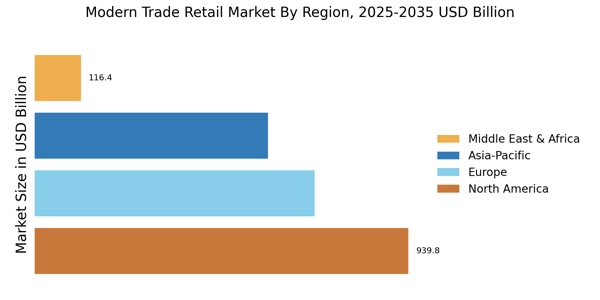
North America is the largest market for modern trade retail, holding approximately 40% of the global market share. Key growth drivers include a robust economy, high consumer spending, and the increasing trend of e-commerce integration in retail. Regulatory support for trade practices and consumer protection further catalyzes market growth. The U.S. and Canada are the largest contributors, with the U.S. alone accounting for about 35% of the market share. The competitive landscape is dominated by major players such as Walmart and Costco, which have established extensive supply chains and customer loyalty programs. Other significant players include Ahold Delhaize and Target, which are expanding their market presence through innovative retail strategies. The focus on sustainability and local sourcing is also shaping the competitive dynamics, as consumers increasingly prefer brands that align with their values.
Europe's modern trade retail market is characterized by its diversity, holding around 30% of the global market share. The region is witnessing growth driven by increasing urbanization, changing consumer preferences, and a shift towards online shopping. Regulatory frameworks, such as the EU's Consumer Protection Act, are enhancing transparency and competition, which further stimulates market dynamics. Germany and France are the largest markets, contributing approximately 25% and 20% of the regional share, respectively. Leading countries like Germany, France, and the UK host major players such as Carrefour, Tesco, and Aldi. The competitive landscape is marked by a mix of hypermarkets, discounters, and online retailers. Companies are increasingly investing in technology to enhance customer experience and streamline operations. The presence of established brands and the rise of local players are intensifying competition, making the market vibrant and dynamic.
Asia-Pacific is an emerging powerhouse in the modern trade retail market, holding approximately 25% of the global market share. The region's growth is fueled by rising disposable incomes, urbanization, and a young population increasingly inclined towards modern retail formats. Countries like China and India are leading this growth, with China alone accounting for about 15% of the global market share. Regulatory initiatives aimed at foreign investment are also enhancing market accessibility. The competitive landscape is characterized by a mix of local and international players, including Seven & I Holdings and Metro AG. The presence of e-commerce giants is reshaping traditional retail, with companies investing heavily in omnichannel strategies. The rapid adoption of technology and digital payment solutions is further driving the market, making it a focal point for innovation and investment in the retail sector.
The Middle East and Africa region is witnessing significant growth in the modern trade retail market, holding around 5% of the global market share. Key growth drivers include increasing urbanization, a growing middle class, and substantial investments in retail infrastructure. Countries like South Africa and the UAE are leading the market, with the UAE contributing approximately 2% of the global share. Regulatory reforms aimed at enhancing foreign investment are also playing a crucial role in market expansion. The competitive landscape features a mix of local and international players, with brands like Carrefour and local chains expanding their footprint. The rise of e-commerce and mobile shopping is reshaping consumer behavior, prompting retailers to adapt quickly. The focus on customer experience and innovative retail formats is becoming essential for success in this evolving market, making it a vibrant area for growth and investment.
The Modern Trade Retail Market is characterized by a rapidly evolving landscape driven by changing consumer preferences, technological advancements, and competitive strategies among key players. Modern trade channels, including supermarkets, hypermarkets, and online platforms, have profoundly transformed retail operations, enabling consumers to enjoy a more convenient and varied shopping experience.
The competitive dynamics in this market see a blend of both local and global retailers vying for market share, each striving to create a unique value proposition that appeals to diverse consumer segments. Retailers are continuously innovating in terms of product offerings, pricing strategies, and enhanced shopping experiences, resulting in a highly dynamic environment where customer satisfaction and loyalty play critical roles in determining success.
Walmart stands out prominently in the Modern Trade Retail Market, leveraging its extensive supply chain management and vast geographic footprint to achieve significant competitive advantages. The company's strengths lie in its ability to offer a comprehensive range of products at competitive prices, which appeals to budget-conscious consumers.
Walmart's investment in technology enhances operational efficiency, enabling it to streamline inventory management and improve customer service. Furthermore, the company has adeptly blended physical and digital shopping experiences, emphasizing its online offerings through a robust e-commerce platform.
This omnichannel approach helps Walmart cater to a wider audience and adapt swiftly to shifting consumer trends. Its commitment to sustainability and community engagement further positions Walmart as a leader in modern trade, fostering consumer trust and loyalty.
On the other hand, Lidl has carved a niche for itself within the Modern Trade Retail Market through its unique business model and customer-centric approach. Lidl focuses on providing high-quality products at attractive prices, appealing to value-driven consumers seeking both affordability and quality.
The retailer's strong presence in the discount grocery segment allows it to compete effectively with larger chains, utilizing a streamlined store format that emphasizes efficiency and cost savings. Lidl's rapid expansion into new markets demonstrates its adaptability and commitment to growth, often marked by the introduction of exclusive private-label products that resonate well with shoppers.
The company's emphasis on local sourcing and sustainability initiatives further enhances its reputation, building a loyal customer base that appreciates both the quality of products and the ethical considerations behind them.




Recent developments in the Modern Trade Retail Market have seen a notable shift in consumer behavior driven by the growing emphasis on e-commerce and sustainability.
Companies like Walmart and Amazon are continually enhancing their online platforms to cater to the increasing demand for convenience, while Aldi and Lidl focus on streamlining their supply chains to promote cost-effectiveness. Carrefour is investing significantly in sustainable practices, which has resonated well with environmentally-conscious consumers.
In terms of mergers and acquisitions, the retail landscape is witnessing consolidation, with Ahold Delhaize's recent acquisition of several smaller grocery chains enhancing their market presence. Similarly, the Schwarz Group, which owns Lidl, has been expanding its footprint through strategic partnerships aimed at bolstering its market position.
Furthermore, Costco continues to adapt its business model to improve customer loyalty while also exploring innovative technology solutions to enhance shopping experiences. The overall growth in market valuation among these companies underlines a competitive space that is evolving with consumer expectations, futuristic retail strategies, and sustainability efforts at the forefront of their operations.
The Modern Trade Retail Market is projected to grow at 2.25% CAGR from 2025 to 2035, driven by digital transformation, consumer preferences, and sustainability initiatives.
New opportunities lie in:
By 2035, the market is expected to achieve robust growth, adapting to evolving consumer demands.
| MARKET SIZE 2024 | 2347.12(USD Billion) |
| MARKET SIZE 2025 | 2399.93(USD Billion) |
| MARKET SIZE 2035 | 2998.0(USD Billion) |
| COMPOUND ANNUAL GROWTH RATE (CAGR) | 2.25% (2025 - 2035) |
| REPORT COVERAGE | Revenue Forecast, Competitive Landscape, Growth Factors, and Trends |
| BASE YEAR | 2024 |
| Market Forecast Period | 2025 - 2035 |
| Historical Data | 2019 - 2024 |
| Market Forecast Units | USD Billion |
| Key Companies Profiled | Walmart (US), Costco (US), Carrefour (FR), Tesco (GB), Ahold Delhaize (NL), Metro AG (DE), Seven & I Holdings (JP), Aldi (DE), Lidl (DE) |
| Segments Covered | Product Type, Store Format, Consumer Demographics, Boomers, Generation Z, Shopping Channel, Regional |
| Key Market Opportunities | Integration of advanced analytics and artificial intelligence to enhance customer experience in the Modern Trade Retail Market. |
| Key Market Dynamics | Shifting consumer preferences towards convenience drive growth in the Modern Trade Retail Market, influencing competitive dynamics. |
| Countries Covered | North America, Europe, APAC, South America, MEA |
The Modern Trade Retail Market is valued at approximately 2347.12 USD Billion in 2024.
The market is expected to reach a valuation of 2998.0 USD Billion by 2035.
The expected CAGR for the Modern Trade Retail Market during the forecast period 2025 - 2035 is 2.25%.
The Grocery segment holds the highest valuation, ranging from 800.0 to 1000.0 USD Billion.
Hypermarkets lead with valuations between 800.0 and 1000.0 USD Billion, followed by Supermarkets at 600.0 to 800.0 USD Billion.
Baby Boomers are projected to contribute the most, with valuations between 700.0 and 800.0 USD Billion.
The valuation for online shopping channels ranges from 800.0 to 1100.0 USD Billion.
Key players include Walmart, Costco, Carrefour, Tesco, and Ahold Delhaize.
The Beauty Products segment has a valuation range of approximately 247.12 to 398.0 USD Billion.
In-store shopping is valued between 1200.0 and 1500.0 USD Billion, while mobile commerce ranges from 347.12 to 398.0 USD Billion.



Kindly complete the form below to receive a free sample of this Report

“This is really good guys. Excellent work on a tight deadline. I will continue to use you going forward and recommend you to others. Nice job”


“Thanks. It’s been a pleasure working with you, please use me as reference with any other Intel employees.”


“Thanks for sending the report it gives us a good global view of the Betaïne market.”


“Thank you, this will be very helpful for OQS.”


“We found the report very insightful! we found your research firm very helpful. I'm sending this email to secure our future business.”


“I am very pleased with how market segments have been defined in a relevant way for my purposes (such as "Portable Freezers & refrigerators" and "last-mile"). In general the report is well structured. Thanks very much for your efforts.”


“I have been reading the first document or the study, ,the Global HVAC and FP market report 2021 till 2026. Must say, good info! I have not gone in depth at all parts, but got a good indication of the data inside!”


“We got the report in time, we really thank you for your support in this process. I also thank to all of your team as they did a great job.”


“The Automotive 48V ECU Components Procurement Intelligence Study” was a complex project, but the Market Research Future (MRFR) team handled it with quality, agility, and customer-centricity. They delivered all requested data on time and within the agreed scope. The team, including Shubhendra Anand and Rahul Gotadki, was always readily available to clarify questions and swiftly implement necessary adjustments, driving the project to a successful conclusion within a very demanding timeframe.
I would also like to specifically commend Akshay Agarwal for his responsiveness and support at every stage—from our initial inquiry on May 6th through to final delivery on June 18th. His dedication made the entire process seamless.”



