Molded Interconnect Device Market (2025 - 2035)

Molded Interconnect Device Market Size, Share and Research Report By Product Type (Antennae and Connectivity Modules, Sensors, Connectors and Switches, Lighting System, and Others), By Process (Laser Direct Structuring (LDS), Two-shot Molding, and Film Techniques), By Vertical (Telecommunication, Consumer Electronics, Automotive, Medical, Industrial, and Military & Aerospace) And By Region (North America, Europe, Asia-Pacific, And Rest Of The World) – Industry Forecast Till 2035
ID: MRFR/SEM/10805-HCR
128 Pages
Ankit Gupta
Last Updated: July 13, 2026
Molded Interconnect Device Market
Market Size
Forecast Period2025-2035
CAGR (2025-2035)11.35%
2025 Market SizeUSD 2.32 Billion
2035 Market SizeUSD 6.88 Billion
Key Players
LPKF Laser & Electronics AG
Molex LLC
TE Connectivity Ltd.
Harting Technology Group
2E Mechatronica BV
SelectConnect Technologies
Opportunities
  • Autonomous Vehicle Sensor Fusion Platforms
  • Wearable Health-Monitoring Ecosystems
  • South American Nearshoring Hubs

Molded Interconnect Device Market Summary

The Molded Interconnect Device Market reached an estimated USD 2.32 billion in 2025 and is projected to grow from USD 2.61 billion in 2026 to USD 6.88 billion by 2035, expanding at a compound annual growth rate of 11.35% during the forecast period. Two catalysts anchor this trajectory: the automotive industry's push to eliminate conventional wiring harnesses in favor of three-dimensional antenna substrates, and the consumer electronics sector's relentless compression of millimeter-wave antenna arrays into sub-7 mm smartphone housings. Regulatory pressure from Euro 7 emission standards, which penalize vehicle mass, has given OEMs an additional incentive to adopt injection-molded circuit carriers that shave 30–40% off interconnect weight [2].

The technical change taking place in the Molded Interconnect Device Market is replacing traditional printed circuit boards and flexible printed circuits with injection-molded thermoplastic substrates with metallized traces on curved surfaces. Capital commitments highlight the change — according to industry filings [3], prominent connection suppliers have committed a total of more than USD 420 million to MID production capacity expansions from 2023 to 2025. The Federal Ministry for Economic Affairs' micro-electronics effort in Germany and South Korea's K-Semiconductor Strategy [4] are examples of government programs that have focused more public money toward advanced packaging research that directly supports the development of molded interconnects.

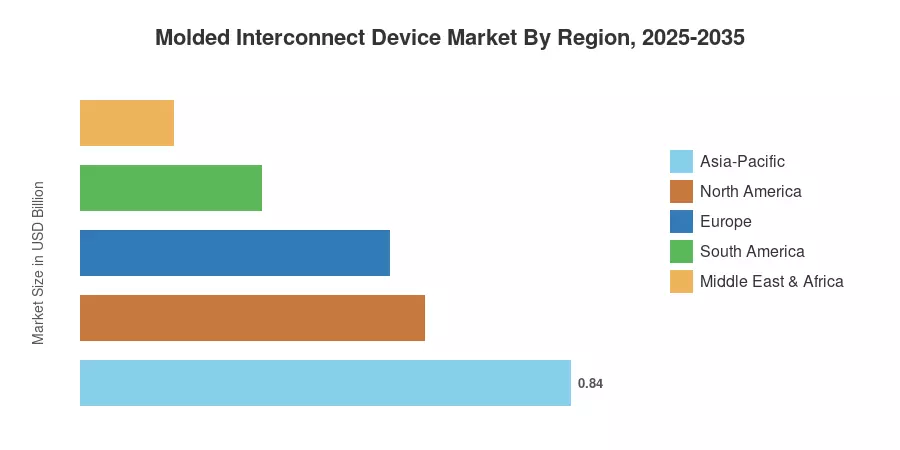
Asia-Pacific accounts for around 36.0% of the revenues of the Molded Interconnect Device Market owing to the presence of printed-circuit-board manufacturing and smartphone final assembly in China, South Korea and Vietnam. South America is the fastest-expanding region with an expected CAGR of 13.4%. This is due to nearshoring investments in line with the United States-Mexico-Canada Agreement that are bringing additional production facilities to Brazil and Mexico [5]. Europe is the next-largest region with a 23.0% share, aided by Germany’s automotive electronics cluster and rising demand for medical-device downsizing.


Key Report Takeaways

• By Process

  • Laser direct structuring commanded roughly 43.5% of the Molded Interconnect Device Market revenue in 2025, reflecting its compatibility with high-volume automotive antenna production.
  • Additive and other emerging processes are forecast to expand at an 11.75% CAGR through 2035, driven by lower tooling thresholds for prototyping applications.

• By Product Type

  • Antenna and connectivity modules represented approximately 38.2% of revenue in the Molded Interconnect Device Market during 2025.
  • Structural electronics panels are projected to register an 11.90% CAGR through 2035 as curved capacitive surfaces replace mechanical switches in premium automotive interiors.

• By End-Use Industry

  • Automotive applications accounted for an estimated 27.4% of the 2025 Molded Interconnect Device Market revenue.
  • Healthcare and medical devices are expected to record the fastest growth at an 11.85% CAGR over 2026–2035, fueled by hearing-aid miniaturization and implantable sensor demand.

• By Material

  • Liquid-crystal polymer held roughly 30.9% of the 2025 revenue share in the Molded Interconnect Device Market.
  • Polyether ether ketone is anticipated to post an 11.80% CAGR as designers push continuous-use temperatures beyond 150 °C in battery-electric-vehicle pack sensors.

• By Region

  • Asia-Pacific accounted for 36.0% of 2025 revenue in the Molded Interconnect Device Market.
  • South America is the fastest-growing region with a projected 13.4% CAGR, propelled by USMCA-aligned nearshoring investments.


Market Size and Forecast (2021–2035)

Market Research Future's estimates blend bottom-up revenue analysis of leading MID manufacturers with top-down demand modeling across automotive, consumer electronics, healthcare, industrial, and telecommunications end-use verticals. Historical data relies on company filings, trade association statistics, and customs databases; forecast assumptions incorporate capacity expansion announcements and policy investment pipelines[3].
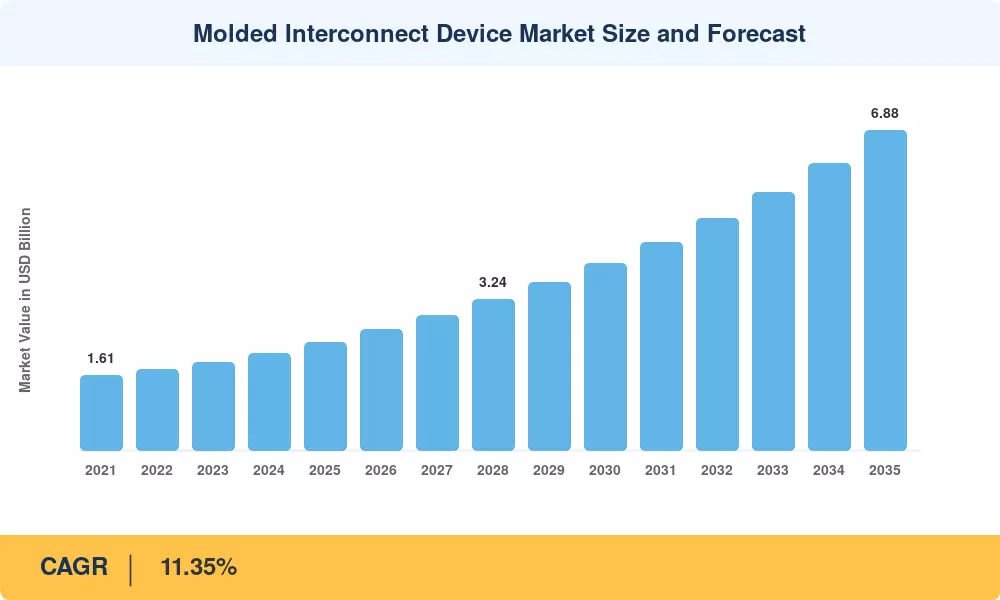
Molded Interconnect Device Market Size and Forecast
Our Impact
Enabled $4.3B Revenue Impact for Fortune 500 and Leading Multinationals
Partnering with 2000+ Global Organizations Each Year
30K+ Citations by Top-Tier Firms in the Industry

Driver Impact Analysis

Driver ~% Impact on CAGR Geographic Relevance Impact Timeline
Automotive lightweighting mandates 22% Europe, North America Short-term (≤2 yr)
5G/mmWave antenna densification 20% Asia-Pacific, North America Short-term (≤2 yr)
Battery-electric vehicle sensor growth 18% Global Medium-term (2–4 yr)
Medical device miniaturization 15% Europe, North America Medium-term (2–4 yr)
Industrial IoT adoption 12% Asia-Pacific, Europe Long-term (≥4 yr)
USMCA nearshoring incentives 8% South America, North America Medium-term (2–4 yr)
6G pre-commercialization R&D 5% Asia-Pacific Long-term (≥4 yr)


Automotive Lightweighting Mandates

The European Union’s Euro 7 regulation, formally adopted in 2024, establishes new emission standards for passenger cars and vans beginning in November 2026. By November 2027, all new vehicles registered must comply with these stringent requirements. To meet these targets, manufacturers are increasingly utilizing lightweight materials and integrated electronic components to reduce vehicle mass and improve overall fuel efficiency.


5G and Millimeter-Wave Antenna Densification

Ericsson’s Mobility Report shows that over 2.2 billion 5G subscriptions had been registered worldwide by mid-2025, and every successive generation of a handset is adding more antenna-in-package arrays to lower bezels [6]. A direct benefit to the Molded Interconnect Device Market is the fact that three-dimensional molded substrates allow conformal antenna placement on curved device edges without flexible-PCB lamination steps. Qualcomm reference designs for sub-6 GHz and mmWave modules now offer MID-compatible footprints as baseline alternatives [11].


Battery-Electric Vehicle Pack Sensors

Battery-electric vehicles require temperature, voltage, and gas-detection sensors embedded within cell modules operating at sustained temperatures above 150 °C. The International Energy Agency projected global EV sales will exceed 20 million units annually by 2027, translating to a proportional surge in high-temperature MID sensor demand [7]. Polyether ether ketone and liquid-crystal polymer substrates that match copper's coefficient of thermal expansion have become preferred materials for these applications in the Molded Interconnect Device Market.

Medical Device Miniaturization

The hearing aid industry is undergoing significant evolution, supported by regulatory changes that broaden consumer access. Technological advancements in miniaturization allow for the integration of essential electronic components—including sensors, antennas, and power contacts—directly onto the interior surfaces of device housings. This innovation eliminates the need for bulky traditional wiring, enabling the production of smaller, more discreet medical devices.


Restraints Impact Analysis

Restraint ~% Impact on CAGR Geographic Relevance Impact Timeline
High initial tooling and mold costs −18% Global Short-term (≤2 yr)
Silver and palladium price volatility −15% Global Medium-term (2–4 yr)
Limited design-for-MID expertise −12% Emerging markets Long-term (≥4 yr)
Competing flexible-PCB solutions −10% Asia-Pacific Medium-term (2–4 yr)
Certification lead times for medical MIDs −8% North America, Europe Long-term (≥4 yr)


High Initial Tooling and Mold Costs

Custom injection molds for MID substrates represent a significant fixed investment, with complex multi-cavity steel molds often exceeding USD 100,000 for high-volume production. Unlike standard PCB manufacturing, which benefits from lower entry costs, MID economics necessitate large-scale production runs to amortize these substantial upfront tooling expenses effectively, creating a substantial financial barrier for small-to-mid-size electronics enterprises.


Precious-Metal Price Volatility

The electronics industry faces persistent cost pressures from the volatility of precious metals like palladium and silver, essential for metallization and catalytic processes. Historical data show significant fluctuations in these commodity prices, with palladium, for instance, experiencing annual price changes exceeding 30% in recent cycles. Such instability complicates long-term cost modeling and impacts margin stability for contract manufacturers.

Limited Design-for-MID Expertise

A structural shortage of specialized engineering talent persists, as 73% of employers globally report difficulties filling technical roles. The design-for-MID process requires highly specific expertise in laser-structuring, polymer chemistry, and RF performance optimization. With senior engineers retiring and fewer graduates entering the field, the scarcity of these professionals remains a primary constraint on global supply chain innovation.


Molded Interconnect Device Market Opportunities

Autonomous Vehicle Sensor Fusion Platforms

Level 3+ autonomous driving architectures consolidate multiple sensor feeds, including lidar and radar, into compact modules. Integrated substrates support these systems by embedding antennas and thermal channels directly into the housing, reducing complex assembly steps. With the global market for autonomous-enabling technologies projected to exceed USD 10,000 million by 2028, these platforms offer significant potential for specialized electronic components.


Wearable Health-Monitoring Ecosystems

The global wearable medical device market is expanding rapidly, reaching a valuation of USD 68.1 billion in 2026. These devices, such as continuous glucose monitors and health-sensing rings, require biocompatible, space-efficient substrates for embedded connectivity. MID technology provides a robust alternative to rigid circuit boards, facilitating the miniaturization necessary for the next generation of high-margin, patient-centric health monitoring.


South American Nearshoring Hubs

North America’s industrial strategy increasingly prioritizes regional supply chain resilience through the USMCA framework, positioning Mexico as a primary hub for electronics and automotive manufacturing. Concurrently, Brazil’s Rota 2030 policy stimulates technological innovation within the automotive sector. These initiatives create favorable conditions for localizing MID production lines to serve the growing North American and Latin American OEM demand.


Smart-Factory and Industrial IoT Sensor Nodes

The global Industrial IoT market is estimated to reach nearly USD 210 billion in 2026, driven by widespread adoption in smart manufacturing. Ruggedized sensor nodes capable of operating in harsh, high-temperature factory environments are essential for predictive maintenance. Molded interconnect substrates offer superior vibration resistance and moisture protection, making them ideal for these high-reliability applications within the evolving industrial automation ecosystem.


Molded Interconnect Device Market Future Outlook

AI-Driven Design Optimization

Machine-learning algorithms are compressing MID design cycles from months to weeks by predicting mold-flow behavior, metallization adhesion, and RF performance simultaneously. By 2030, generative-design tools integrated into commercial CAD platforms will enable engineers without specialized MID expertise to produce manufacturable designs, broadening the Molded Interconnect Device Market's addressable customer base [15][22].

Electrification Supercycle

The International Energy Agency projects that global investments in clean energy technologies, largely driven by the electric vehicle transition, reached approximately USD 1.2 trillion in 2025. Electric cars represent roughly three-quarters of this market value, necessitating a massive scale-up in vehicle sensor integration. This sustained investment cycle remains a primary driver for high-performance electronic substrate demand through 2035


Sustainability and Circular-Economy Pressures

The EU’s Ecodesign for Sustainable Products Regulation (ESPR) is currently implementing a working plan for 2025–2030 to enhance product circularity. By 2029, the European Commission plans to introduce specific measures targeting recyclability for electrical and electronic equipment. Manufacturers utilizing integrated substrates that simplify disassembly and material recovery will likely gain significant advantages under these evolving EU market access requirements.


Platform Economics and Vertical Integration

The electronics industry is trending toward increased consolidation as major component manufacturers acquire specialized design and metallization firms. This vertical integration strategy, aimed at providing end-to-end solutions from resin selection to module testing, is reshaping competitive dynamics. As global clean energy and automotive markets expand, this consolidation is projected further to concentrate market share among top-tier integrated service providers.


Molded Interconnect Device Market Segmentation

By Process

Segment Key Metric Primary Demand Driver
Laser Direct Structuring 43.5% of 2025 revenue High-volume automotive and smartphone antenna production
Two-Shot Molding USD 0.72 Billion (2025) Cost-effective consumer-electronics housings
Film Insert Molding CAGR 10.8% Decorative automotive interior panels
Additive and Emerging Processes CAGR 11.75% Rapid prototyping and low-volume medical applications


Laser direct structuring dominates the Molded Interconnect Device Market's process landscape because it delivers fine-pitch trace resolution (down to 80 µm line/space) on complex three-dimensional geometries without the masking steps required by two-shot molding. Automotive antenna modules for GPS, V2X, and cellular connectivity rely almost exclusively on this process, and the installed base of LDS-capable laser systems has grown at roughly 15% annually since 2021 [3]. Additive and emerging processes — including aerosol-jet printing and inkjet metallization — are gaining traction for prototyping and low-volume medical applications where the cost of custom injection molds is prohibitive, pushing this category toward the fastest growth rate in the Molded Interconnect Device Market over 2026–2035.

By Product Type

Segment Key Metric Primary Demand Driver
Antenna and Connectivity Modules 38.2% of 2025 revenue 5G smartphone and automotive V2X
Sensor Housings CAGR 11.45% EV battery and industrial IoT sensors
Structural Electronics Panels CAGR 11.90% Curved capacitive surfaces in automotive interiors
Connectors and Interconnect Assemblies USD 0.31 Billion (2025) Hearing aids and wearable devices


Antenna and connectivity modules represent the volume backbone of the Molded Interconnect Device Market, with smartphone OEMs consuming millions of units per quarter for sub-6 GHz and mmWave applications. Structural electronics panels, while smaller in absolute revenue, are expanding rapidly as premium automakers replace mechanical button clusters with seamless, illuminated touch surfaces molded from polycarbonate or polyamide blends.

By End-Use Industry

Segment Key Metric Primary Demand Driver
Automotive 27.4% of 2025 revenue Lightweighting, EV sensors, V2X antennas
Consumer Electronics and Wearables USD 0.51 Billion (2025) Smartphone antenna densification
Healthcare and Medical Devices CAGR 11.85% Hearing aids, implantable sensors
Telecommunications and Infrastructure CAGR 11.50% 5G small-cell antenna modules
Industrial and Others 10.8% of 2025 revenue Factory-automation sensor nodes


Automotive is the largest single vertical in the Molded Interconnect Device Market because a single modern vehicle can incorporate 8–12 MID-based antenna and sensor modules across its roof, bumper, steering column, and battery pack. Healthcare and medical devices represent the fastest-growing end-use segment, propelled by over-the-counter hearing-aid regulations that have expanded the addressable patient population and by the growing pipeline of MID-enabled continuous-monitoring patches.

By Material

Segment Key Metric Primary Demand Driver
Liquid-Crystal Polymer (LCP) 30.9% of 2025 revenue Low dielectric loss for mmWave antennas
Polybutylene Terephthalate (PBT) USD 0.40 Billion (2025) Cost-effective automotive housings
Polycarbonate / Polycarbonate Blends CAGR 10.95% Transparent structural electronics panels
Polyether Ether Ketone (PEEK) CAGR 11.80% High-temperature EV battery sensors
Polyamide / Nylon Variants 14.2% of 2025 revenue General-purpose industrial applications


Liquid-crystal polymer leads material selection across the Molded Interconnect Device Market because its low dielectric constant (Dk ~2.9 at 28 GHz) and near-zero moisture absorption make it the substrate of choice for millimeter-wave antenna modules in smartphones and 5G infrastructure. PEEK is gaining share rapidly in applications demanding continuous operation above 150 °C, particularly battery-pack sensing for electric vehicles, where coefficient-of-thermal-expansion matching with copper traces is critical to long-term solder-joint reliability.


Regional Market Share Analysis

Region Key Metric Primary Investment Themes
Asia-Pacific 36.0% of 2025 revenue Smartphone assembly, automotive electronics
North America 25.5% of 2025 revenue EV sensor integration, defense miniaturization
Europe USD 0.53 Billion (2025) Automotive lightweighting, medical devices
South America CAGR 13.4% (2026–2035) USMCA nearshoring, Rota 2030 incentives
Middle East & Africa USD 0.16 Billion (2025) Telecom infrastructure, smart-city programs
Total USD 2.32 Billion (2025)

The Molded Interconnect Device Market exhibits a concentrated geographic profile, with Asia-Pacific and North America jointly representing over 61% of global revenue. End-use industry clusters, regulatory environments, and proximity to raw-material supply chains shape regional dynamics.


North America

Country Key Metric Key Driver
United States CAGR 10.8% EV battery-pack sensor mandates
Canada 8.2% of regional share Telecom antenna densification
Mexico USD 0.07 Billion (2025) USMCA-aligned electronics nearshoring


The United States drives the bulk of North American demand within the Molded Interconnect Device Market, anchored by Detroit's EV sensor supply chain and Silicon Valley's consumer-electronics design houses. The Inflation Reduction Act's advanced-manufacturing tax credits have encouraged domestic MID capacity investments, with two new production facilities announced in Michigan and Texas during 2024 [19]. Canada's 5G rollout across rural corridors adds incremental antenna-module demand, while Mexico's border maquiladora zones increasingly serve as low-cost assembly hubs for molded interconnect components destined for U.S. OEMs.

Europe

Country Key Metric Key Driver
Germany 28.5% of regional share Automotive Tier 1 supplier concentration
United Kingdom CAGR 10.5% Medical-device innovation cluster
France 14.2% of regional share Aerospace and defense miniaturization
Italy USD 0.05 Billion (2025) Industrial automation sensors
Spain CAGR 10.9% Renewable-energy electronics
Nordic Countries 6.8% of regional share Hearing-aid manufacturing base
Russia USD 0.03 Billion (2025) Telecom infrastructure replacement
Rest of Europe CAGR 10.2% Automotive supply-chain diversification


Germany remains Europe's anchor in the Molded Interconnect Device Market, hosting LPKF Laser & Electronics' headquarters and a cluster of automotive Tier 1 suppliers that have embedded MID antenna modules into steering-wheel, roof-liner, and dashboard assemblies. The European Commission's Chips Act earmarked EUR 43 billion for semiconductor and advanced-packaging capacity through 2030, a portion of which flows into MID-related substrate research [4]. The Nordic hearing-aid corridor — spanning Denmark and Sweden — continues to drive premium liquid-crystal-polymer MID volumes for behind-the-ear devices.

Asia-Pacific

Country Key Metric Key Driver
China 42.3% of regional share Smartphone antenna modules
India CAGR 13.2% Electronics-manufacturing incentives (PLI)
Japan USD 0.14 Billion (2025) Precision automotive sensors
South Korea 14.8% of regional share 5G infrastructure and semiconductor packaging
ASEAN CAGR 12.5% Supply-chain diversification from China
Rest of Asia-Pacific 5.2% of regional share Emerging consumer-electronics assembly


Asia-Pacific leads the Molded Interconnect Device Market primarily because China's Pearl River Delta and Yangtze River Delta host the world's densest concentration of smartphone final-assembly plants, each consuming millions of MID antenna modules annually. India's Production-Linked Incentive scheme for electronics manufacturing has attracted over USD 8 billion in committed investments since 2021, creating new demand for localized MID supply chains [20]. South Korea's role as a 5G infrastructure leader and Japan's precision automotive-sensor heritage round out the region's diverse demand drivers.

South America

Country Key Metric Key Driver
Brazil 52.1% of regional share Manaus Free Trade Zone incentives
Argentina CAGR 13.8% Automotive electronics localization
Rest of South America USD 0.04 Billion (2025) Telecom expansion


South America represents the fastest-growing geography in the Molded Interconnect Device Market, benefiting from USMCA-aligned supply-chain realignment that channels new electronics-assembly capacity into Brazil and Mexico's industrial corridors. Brazil's Rota 2030 automotive-competitiveness program offers tax deductions for locally manufactured electronics components, incentivizing OEMs to source MID substrates from domestic or regional suppliers rather than importing from Asia [5].

Middle East & Africa

Country Key Metric Key Driver
Saudi Arabia 24.3% of regional share Vision 2030 smart-city electronics
UAE CAGR 11.9% 5G and IoT infrastructure rollouts
South Africa USD 0.03 Billion (2025) Automotive assembly for export
Egypt 10.5% of regional share Telecom network expansion
Rest of MEA CAGR 10.4% Gradual industrialization


The Middle East & Africa remain a nascent but accelerating segment of the Molded Interconnect Device Market. Saudi Arabia's NEOM project and broader Vision 2030 framework are driving procurement of advanced sensor and antenna modules for smart-building and smart-transportation infrastructure [21]. The UAE's national 5G deployment, largely complete in urban centers, now extends to industrial free zones where IoT sensor nodes require ruggedized MID-based packaging.


Molded Interconnect Device Market By Region, 2025-2035

Competitive Benchmarking

The Molded Interconnect Device Market exhibits medium concentration, with an estimated top-five revenue share of 38–44% and a Herfindahl-Hirschman Index in the 800–1,100 range. The competitive field spans specialized MID pure-plays, diversified connector conglomerates, and vertically integrated automotive-electronics suppliers. Recent M&A activity signals a consolidation trend as larger players seek end-to-end process control from resin selection through finished-module testing [3].

Company Est. Revenue Share Range Key Offerings Strategic Positioning
LPKF Laser & Electronics AG ~8–11% LDS laser systems, MID prototyping services Technology licensor and equipment leader
Molex LLC (Koch Industries) ~7–10% Antenna modules, automotive MID assemblies Global connector conglomerate with vertical integration
TE Connectivity Ltd. ~6–9% Sensor housings, EV interconnect solutions Diversified industrial and automotive footprint
Harting Technology Group ~5–8% Industrial MID connectors, railway sensor modules European industrial-automation specialist
2E Mechatronica BV ~4–7% Full-service MID manufacturing, design consultancy Mid-market European pure-play
SelectConnect Technologies ~3–6% Two-shot and LDS MID production North American contract manufacturer
Taoglas Holdings ~3–5% Antenna solutions, IoT connectivity modules RF engineering and antenna design focus
Cicor Group ~3–5% High-reliability MID for medical and defense Swiss precision manufacturing heritage
JOHNAN Corporation ~2–4% Automotive MID assemblies, insert-molded modules Japanese automotive Tier 2 supplier
MID Solutions GmbH ~2–4% Prototyping, small-series MID production German engineering services specialist


Recent News & Developments

LPKF Laser & Electronics SE (April 2026): The company announced a significant expansion of its advanced laser direct structuring (LDS) manufacturing capacity to support global demand.

Molex LLC (December 2024): Completed the strategic acquisition of AirBorn, a move designed to integrate established aerospace and defense manufacturing capabilities into its existing portfolio.

  • TE Connectivity Corp. (2024): Launched a new line of LDS-structured MID connectors for EV thermal management, integrating sensors and terminals into a single thermoplastic component.


Molded Interconnect Device Market Report Scope

Parameter Detail
Market Scope Global Molded Interconnect Device Market across process, product type, end-use industry, material, and geography
Study Period 2021–2035
Historical Period 2021–2024
Base Year 2025
Forecast Period 2026–2035
CAGR (2026–2035) 11.35%
2025 Market Size USD 2.32 Billion
2035 Market Size USD 6.88 Billion
Fastest Growing Segment Healthcare and Medical Devices (by end-use); PEEK (by material)
Companies Profiled 10 (LPKF, Molex, TE Connectivity, Harting, 2E Mechatronica, SelectConnect, Taoglas, Cicor, JOHNAN, MID Solutions)
Valuation Currency USD Billion


FAQs

What minimum order volume makes MID cost-competitive versus flexible PCBs?
Most MID suppliers reach cost parity with flex-PCB assemblies at 500,000+ units annually, because injection-mold amortization drops below USD 0.15 per part at that scale [13]. Below this threshold, flex-PCB remains more economical.
How do MID substrates perform under automotive-grade thermal cycling?
LCP- and PEEK-based MID substrates routinely pass 1,000-cycle tests from −40 °C to 150 °C per AEC-Q200 standards. Copper-trace adhesion typically exceeds 1.2 N/mm after aging [2].
Can existing injection-molding equipment be retrofitted for MID production?
Standard presses require a laser-structuring station and electroless-plating line to produce MID parts. Retrofit capital ranges from USD 1.2 million to USD 3.5 million, depending on throughput targets [13].
Which certifications do medical-grade MID components require?
ISO 13485 quality-management certification and biocompatibility testing per ISO 10993 are mandatory for implantable and skin-contact MID devices [12]. FDA 510(k) clearance applies to U.S.-market products.
How does silver price volatility affect MID component pricing?
A 10% increase in silver spot price raises MID metallization costs by roughly 2–4%, as silver constitutes a small fraction of total bill-of-materials [14]. Long-term supply contracts help buffer this impact.
What design-software ecosystem supports MID development?
LPKF's CircuitPro 3D and Siemens NX MID modules are the two primary platforms, offering integrated mold-flow simulation and laser-path generation [3]. Both support standard STEP and Gerber file imports.
Are MID antennas compatible with the upcoming 6G frequency bands?
Early prototypes on LCP substrates have demonstrated functional antenna patterns at sub-THz frequencies up to 300 GHz in laboratory settings [10]. Commercial readiness depends on metallization precision improvements expected by 2030.    
Author
Author
Author Profile
Ankit Gupta LinkedIn
Team Lead - Research
Ankit Gupta is a seasoned market intelligence and strategic research professional with over six plus years of experience in the ICT and Semiconductor industries. With academic roots in Telecom, Marketing, and Electronics, he blends technical insight with business strategy. Ankit has led 200+ projects, including work for Fortune 500 clients like Microsoft and Rio Tinto, covering market sizing, tech forecasting, and go-to-market strategies. Known for bridging engineering and enterprise decision-making, his insights support growth, innovation, and investment planning across diverse technology markets.

Research Approach


Secondary Research

The secondary research process involved comprehensive analysis of technical standards databases, semiconductor industry publications, patent repositories, and authoritative manufacturing organizations. Key sources included the Institute of Electrical and Electronics Engineers (IEEE), International Electronics Manufacturing Initiative (iNEMI), IPC – Association Connecting Electronics Industries, Semiconductor Industry Association (SIA), Electronic Components Industry Association (ECIA), SEMI (Semiconductor Equipment and Materials International), American Society of Mechanical Engineers (ASME), International Organization for Standardization (ISO), National Institute of Standards and Technology (NIST), European Telecommunications Standards Institute (ETSI), Japanese Ministry of Economy, Trade and Industry (METI), China Ministry of Industry and Information Technology (MIIT), US Bureau of Industry and Security (BIS), Organisation for Economic Co-operation and Development (OECD) Industrial Production Databases, and World Semiconductor Trade Statistics (WSTS). These sources were used to collect technology adoption data, regulatory compliance standards, manufacturing process specifications, end-use industry demand metrics, and competitive landscape analysis for Laser Direct Structuring (LDS), two-shot molding, and film technique processes across antennae modules, sensors, connectors, and lighting systems.


Primary Research

Qualitative and quantitative insights were obtained by interviewing supply-side and demand-side stakeholders during the primary research process. MID technology providers, EMS (Electronics Manufacturing Services) companies, and component OEMs were among the supply-side sources, which included Chief Technology Officers (CTOs), VPs of Engineering, manufacturing leaders, and product line directors. The demand-side sources consisted of procurement directors from telecommunications infrastructure providers, automotive electronics engineers, consumer electronics product managers, medical device designers, and industrial automation specialists from tier-1 manufacturers and system integrators. The timelines for technology adoption were validated, capacity expansion plans were confirmed, and insights on design-in patterns, supply chain dynamics, and material cost trends were gathered through primary research.

Primary Respondent Breakdown:

By Designation: C-level Primaries (28%), Director Level (35%), Others (37%)

By Region: North America (32%), Europe (29%), Asia-Pacific (34%), Rest of World (5%)


Market Size Estimation

Global market valuation was derived through shipment volume analysis and revenue mapping across process technologies. The methodology included:

Identification of 50+ key technology providers and EMS partners across North America, Europe, Asia-Pacific, and Latin America

Technology mapping across Laser Direct Structuring (LDS), two-shot molding, and film technique process categories

Analysis of reported and modeled annual revenues specific to MID technology portfolios and associated component sales

Coverage of manufacturers representing 75-80% of global market share in 2024

Extrapolation using bottom-up (unit shipment volume × ASP by process type and application) and top-down (technology provider revenue validation) approaches to derive segment-specific valuations across telecommunications, consumer electronics, automotive, medical, industrial, and military & aerospace verticals

Download Free Sample

Kindly complete the form below to receive a free sample of this Report

Download PDF ×

We do not share your information with anyone. However, we may send you emails based on your report interest from time to time. You may contact us at any time to opt-out.
















