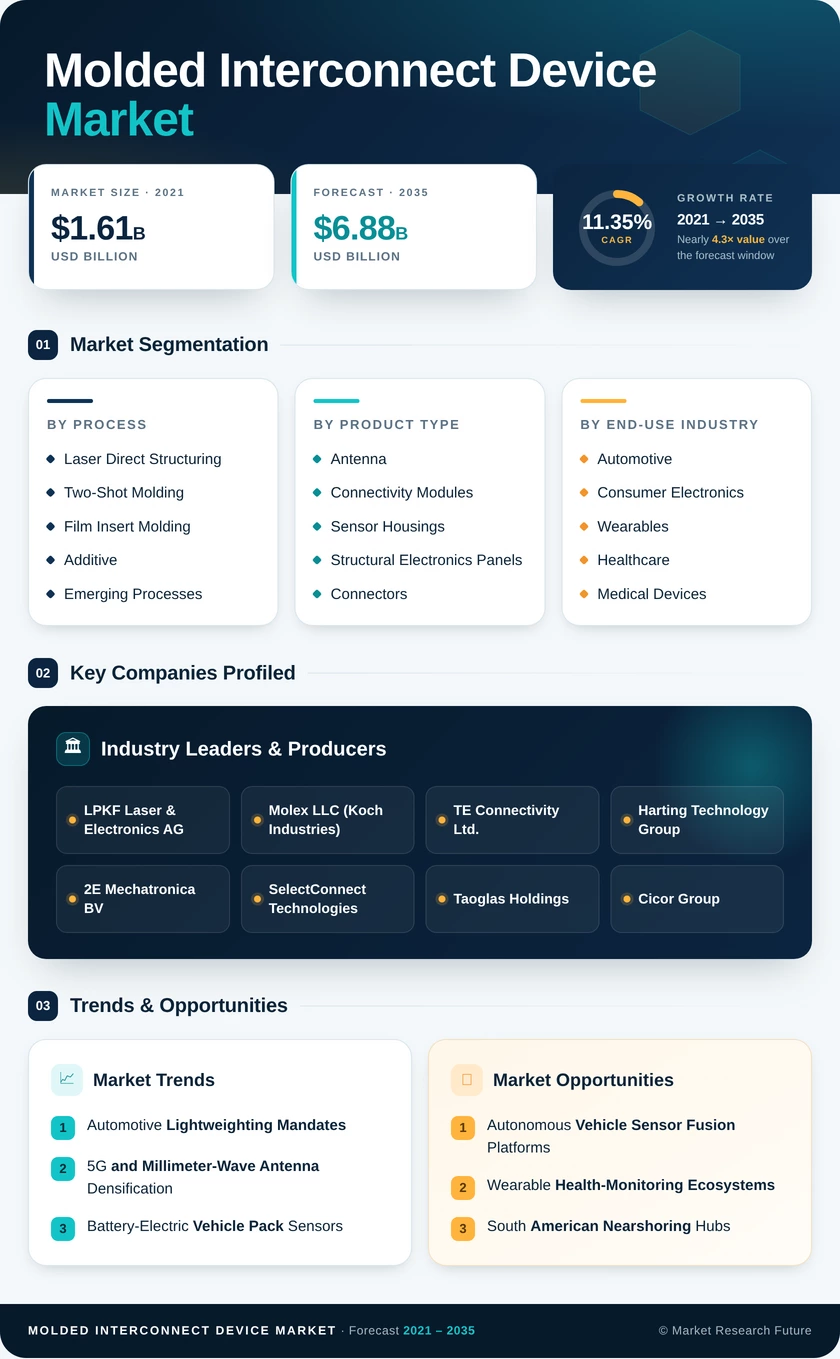
Segmentation Quick Reference
| Dimension | Sub-Segments | Dominant Segment | Fastest Growing Segment |
| By Process | Laser Direct Structuring, Two-Shot Molding, Film Insert Molding, Additive and Emerging Processes | Laser Direct Structuring | Additive and Emerging Processes |
| By Product Type | Antenna and Connectivity Modules, Sensor Housings, Structural Electronics Panels, Connectors and Interconnect Assemblies | Antenna and Connectivity Modules | Structural Electronics Panels |
| By End-Use Industry | Automotive, Consumer Electronics and Wearables, Healthcare and Medical Devices, Telecommunications and Infrastructure, Industrial and Others | Automotive | Healthcare and Medical Devices |
| By Material | Liquid-Crystal Polymer, Polybutylene Terephthalate, Polycarbonate / Polycarbonate Blends, Polyether Ether Ketone, Polyamide / Nylon Variants | Liquid-Crystal Polymer | Polyether Ether Ketone |
Market Segmentation Overview
By Process
| Sub-Segment | Key Trend |
| Laser Direct Structuring | Dominant process driven by 80 µm trace resolution, enabling high-frequency antenna designs |
| Two-Shot Molding | Cost-effective for high-volume consumer electronics housings with simpler trace geometries |
| Film Insert Molding | Gaining adoption in decorative automotive interior panels with integrated capacitive touch |
| Additive and Emerging Processes | Fastest growing due to low-tooling-cost prototyping via aerosol-jet and inkjet metallization. |
Laser direct structuring continues to anchor the process landscape, but additive techniques are closing the gap for applications where rapid design iteration outweighs high-volume cost optimization. Film insert molding occupies a specialized niche where aesthetic surface finish and embedded circuitry must coexist on the same substrate.
By Product Type
| Sub-Segment | Key Trend |
| Antenna and Connectivity Modules | Dominant segment sustained by 5G smartphones and automotive V2X antenna proliferation |
| Sensor Housings | Driven by EV battery-pack and industrial IoT temperature/pressure sensor demand |
| Structural Electronics Panels | Fastest growing as premium automakers adopt curved capacitive surfaces |
| Connectors and Interconnect Assemblies | Hearing-aid and wearable-device integration consolidates discrete connectors into molded casings. |
Antenna modules remain the volume backbone, but structural electronics panels are emerging as the category to watch, particularly as mid-tier vehicle platforms adopt touch-surface interiors previously reserved for luxury marques.
By End-Use Industry
| Sub-Segment | Key Trend |
| Automotive | Largest vertical driven by lightweighting, EV sensors, and V2X antenna mandates |
| Consumer Electronics and Wearables | Smartphone antenna densification and smartwatch miniaturization sustain steady demand. |
| Healthcare and Medical Devices | Fastest growing segment fueled by OTC hearing-aid expansion and implantable sensor pipelines |
| Telecommunications and Infrastructure | 5G small-cell antenna modules require ruggedized MID substrates |
| Industrial and Others | Factory-automation sensor nodes and aerospace connectors provide a diversified demand. |
Automotive dominance is structural, given the number of MID components per vehicle, while healthcare represents the highest-growth opportunity as regulatory liberalization expands the addressable patient population.
By Material
| Sub-Segment | Key Trend |
| Liquid-Crystal Polymer (LCP) | Dominant material for mmWave antennas due to low dielectric constant and moisture resistance |
| Polybutylene Terephthalate (PBT) | Cost-effective thermoplastic for standard automotive and consumer electronics housings |
| Polycarbonate / Polycarbonate Blends | Preferred for transparent and backlit structural electronics panels |
| Polyether Ether Ketone (PEEK) | Fastest growing material rated for continuous use above 250 °C in EV battery environments |
| Polyamide / Nylon Variants | General-purpose option for industrial connectors and ruggedized housings |
Material selection is increasingly dictated by application-specific performance requirements — dielectric properties for antennas, thermal endurance for EV sensors, and optical clarity for illuminated touch panels.