×
Hero Background
English
Chinese
French
Japanese
Korean
German
Spanish

Molecular Breeding Market Share

ID: MRFR/HC/10270-CR
177 Pages
Rahul Gotadki
July 2024

Molecular Breeding Market Research Report Information by Process (Marker-assisted selection, Marker-assisted backcrossing, QTL mapping), By Maker (SNP, SSR), By Application (Plant, Livestock), and Region (North America, Europe, Asia-Pacific, and South America, Middle East and Africa)—Forecast till 2035

Share:
Download PDF ×

We do not share your information with anyone. However, we may send you emails based on your report interest from time to time. You may contact us at any time to opt-out.

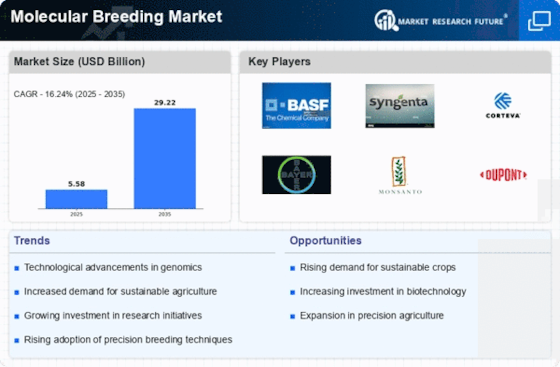
Molecular Breeding Market Infographic
Purchase Options

Market Share

Molecular Breeding Market Share Analysis

molecular breeding market share companies are employing various strategies to establish their positions and gain a competitive edge in addressing the needs of farmers, agricultural researchers, and the biotechnology industry. Molecular breeding, which integrates advanced genomic technologies with traditional breeding methods to develop improved crop varieties, requires strategic positioning to effectively capture market share and cater to the evolving demands of stakeholders.

One of the primary strategies utilized in the molecular breeding market is product differentiation. Companies invest heavily in research and development to create innovative molecular breeding solutions that offer unique benefits to agricultural stakeholders. These solutions may include advanced genotyping and phenotyping technologies, bioinformatics tools for data analysis, and predictive modeling algorithms for trait selection. By differentiating their products based on these desirable features, companies can attract customers seeking solutions to accelerate crop improvement, enhance genetic diversity, and increase yield potential.

Pricing strategy is also crucial in market share positioning within the molecular breeding market. While the development and commercialization of molecular breeding technologies involve significant investment costs, companies must balance pricing to remain competitive. Some companies choose to compete based on price by offering cost-effective molecular breeding services and solutions that provide value for agricultural researchers and breeders. This approach aims to appeal to budget-conscious customers while ensuring profitability and sustainability for molecular breeding providers.

Furthermore, companies often target niche markets or specific customer segments to tailor their molecular breeding strategies. For example, companies may focus on developing molecular breeding solutions tailored to specific crops, such as maize, wheat, rice, or soybeans. Additionally, companies may specialize in addressing particular challenges or needs prevalent in certain regions or cropping systems, such as drought tolerance, disease resistance, or nutritional quality improvement. By understanding the unique requirements and preferences of different customer segments, companies can customize their molecular breeding offerings to provide targeted solutions effectively. This targeted approach allows companies to position themselves as leaders in specific crop segments and build strong relationships with customers seeking tailored breeding solutions.

Branding and marketing efforts are also instrumental in market share positioning within the molecular breeding market. Building a strong brand identity helps companies establish credibility, trust, and recognition among agricultural researchers, breeders, and industry stakeholders. Through effective branding, companies can communicate the benefits and value proposition of their molecular breeding services and technologies, distinguishing themselves from competitors. Additionally, targeted marketing campaigns highlighting the efficiency, precision, and impact of molecular breeding on crop improvement can influence purchasing decisions and drive demand in the market.

Moreover, strategic partnerships and collaborations play a crucial role in expanding market share and enhancing competitive positioning in the molecular breeding market. Collaborating with agricultural research institutions, seed companies, biotechnology firms, and breeding associations allows companies to leverage their combined expertise, resources, and networks to penetrate new markets and reach a broader customer base. Partnerships may involve joint research and development projects, licensing agreements, or commercialization partnerships to accelerate the adoption and application of molecular breeding technologies. By forging strategic alliances, companies can capitalize on synergies, expand their market reach, and strengthen their competitive position in the molecular breeding market.

Author
Rahul Gotadki
Assistant Manager

He holds an experience of about 7+ years in Market Research and Business Consulting, working under the spectrum of Life Sciences and Healthcare domains. Rahul conceptualizes and implements a scalable business strategy and provides strategic leadership to the clients. His expertise lies in market estimation, competitive intelligence, pipeline analysis, customer assessment, etc. In addition to the above, his other responsibility includes strategic tracking of high growth markets & advising clients on the potential areas of focus they could direct their business initiatives

Leave a Comment

FAQs

What is the current valuation of the Molecular Breeding Market?

As of 2024, the Molecular Breeding Market was valued at 5.58 USD Billion.

What is the projected market size for the Molecular Breeding Market by 2035?

The market is projected to reach a valuation of 29.22 USD Billion by 2035.

What is the expected CAGR for the Molecular Breeding Market during the forecast period?

The expected CAGR for the Molecular Breeding Market from 2025 to 2035 is 16.24%.

Which companies are considered key players in the Molecular Breeding Market?

Key players in the market include BASF SE, Syngenta AG, Corteva Agriscience, Bayer AG, and Monsanto Company.

What are the main segments of the Molecular Breeding Market?

The main segments include Process, Marker, and End User, with various subcategories under each.

How does Marker-assisted selection perform in terms of market valuation?

Marker-assisted selection had a valuation of 1.67 USD Billion in 2024 and is projected to grow to 8.5 USD Billion by 2035.

What is the market valuation for SNP and SSR markers?

Both SNP and SSR markers were valued at 2.79 USD Billion in 2024, with projections reaching 13.61 USD Billion by 2035.

Market Summary

As per MRFR analysis, the Molecular Breeding Market Size was estimated at 5.58 USD Billion in 2024. The Molecular Breeding industry is projected to grow from 6.486 USD Billion in 2025 to 29.22 USD Billion by 2035, exhibiting a compound annual growth rate (CAGR) of 16.24 during the forecast period 2025 - 2035.

Key Market Trends & Highlights

The Molecular Breeding Market is poised for substantial growth driven by technological advancements and increasing consumer demand for sustainable practices.

  • Technological advancements in breeding techniques are reshaping the landscape of the Molecular Breeding Market.
  • North America remains the largest market, while Asia-Pacific is emerging as the fastest-growing region in this sector.
  • Marker-assisted selection continues to dominate the market, whereas QTL mapping is gaining traction as the fastest-growing segment.
  • Key market drivers include rising global population and food demand, alongside government support and funding initiatives.

Market Size & Forecast

2024 Market Size 5.58 (USD Billion)
2035 Market Size 29.22 (USD Billion)
CAGR (2025 - 2035) 16.24%
Largest Regional Market Share in 2024 North America

Major Players

<p>BASF SE (DE), Syngenta AG (CH), Corteva Agriscience (US), Bayer AG (DE), Monsanto Company (US), DuPont de Nemours, Inc. (US), KWS SAAT SE (DE), Limagrain (FR), Evogene Ltd. (IL)</p>

Market Trends

The Molecular Breeding Market is currently experiencing a transformative phase, driven by advancements in genetic technologies and an increasing demand for sustainable agricultural practices. This market encompasses various techniques aimed at enhancing crop traits, such as yield, disease resistance, and environmental adaptability. As global populations continue to rise, the pressure on food production systems intensifies, prompting stakeholders to seek innovative solutions. The integration of molecular markers and genomic selection is becoming more prevalent, allowing for precise breeding strategies that can significantly improve crop performance. Furthermore, the collaboration between public and private sectors is fostering research initiatives that aim to accelerate the development of new varieties, thereby enhancing food security and agricultural sustainability. In addition to technological advancements, consumer preferences are shifting towards genetically improved crops that offer better nutritional profiles and reduced environmental impact. This trend is likely to influence breeding programs, as companies strive to meet the expectations of environmentally conscious consumers. Moreover, regulatory frameworks are evolving to accommodate the rapid pace of innovation in molecular breeding, which may facilitate the introduction of novel products into the market. Overall, the Molecular Breeding Market appears poised for growth, with a focus on enhancing agricultural productivity while addressing the challenges posed by climate change and resource scarcity.

Technological Advancements in Breeding Techniques

The Molecular Breeding Market is witnessing a surge in the adoption of cutting-edge technologies, such as CRISPR and next-generation sequencing. These innovations enable breeders to make precise genetic modifications, enhancing traits like drought tolerance and pest resistance. As these technologies become more accessible, they are likely to revolutionize traditional breeding practices.

Sustainability and Environmental Considerations

There is a growing emphasis on sustainable agricultural practices within the Molecular Breeding Market. Stakeholders are increasingly focused on developing crops that require fewer resources, such as water and fertilizers. This trend aligns with global efforts to mitigate climate change and promote environmentally friendly farming methods.

Consumer Demand for Nutritional Quality

The demand for crops with improved nutritional profiles is shaping the direction of the Molecular Breeding Market. Consumers are becoming more health-conscious, prompting breeders to prioritize traits that enhance the nutritional value of food products. This shift may lead to the development of biofortified crops that address specific dietary deficiencies.

Molecular Breeding Market Market Drivers

Climate Change and Adaptation Strategies

The Molecular Breeding Market is increasingly focused on developing crop varieties that can withstand the adverse effects of climate change. As climate variability poses significant risks to agricultural productivity, molecular breeding offers a pathway to create resilient crops. Research indicates that molecularly bred crops can exhibit improved drought tolerance and disease resistance, which are critical for maintaining food security. The market for such adaptive varieties is expected to grow, with projections suggesting a 20% increase in demand for climate-resilient crops by 2028. This trend underscores the importance of molecular breeding in addressing the challenges posed by climate change.

Rising Global Population and Food Demand

The Molecular Breeding Market is significantly influenced by the rising global population, which is projected to reach approximately 9.7 billion by 2050. This demographic shift is driving an unprecedented demand for food, necessitating innovative agricultural practices. Molecular breeding offers a viable solution by enabling the development of high-yielding and resilient crop varieties. It is estimated that molecular breeding could contribute to a 50% increase in food production efficiency by 2030. Consequently, stakeholders in the agricultural sector are increasingly turning to molecular breeding techniques to meet the growing food demand, thereby propelling the Molecular Breeding Market forward.

Government Support and Funding Initiatives

The Molecular Breeding Market benefits from substantial government support and funding initiatives aimed at enhancing agricultural productivity. Various governments are recognizing the potential of molecular breeding to address food security and sustainability challenges. For instance, funding programs for research in biotechnology and molecular breeding are being established, with investments exceeding $1 billion in several regions. This financial backing not only fosters innovation but also encourages collaboration between public and private sectors. As a result, the Molecular Breeding Market is likely to expand, with increased research activities leading to the development of advanced breeding techniques and improved crop varieties.

Consumer Preferences for Sustainable Practices

The Molecular Breeding Market is responding to shifting consumer preferences towards sustainability and environmentally friendly practices. As consumers become more aware of the environmental impact of agriculture, there is a growing demand for sustainably produced food. Molecular breeding techniques can contribute to sustainable agriculture by reducing the need for chemical inputs and enhancing crop resilience. It is estimated that crops developed through molecular breeding can reduce pesticide use by up to 40%. This alignment with consumer values is likely to drive the adoption of molecular breeding practices, thereby fostering growth within the Molecular Breeding Market.

Technological Innovations in Molecular Breeding

The Molecular Breeding Market is experiencing a surge in technological innovations that enhance breeding efficiency and precision. Techniques such as CRISPR and genome editing are revolutionizing the way crops are developed, allowing for the rapid introduction of desirable traits. This technological advancement is projected to increase crop yields by up to 30% in the next decade, addressing food security challenges. Furthermore, the integration of bioinformatics and data analytics in breeding programs is streamlining the selection process, making it more data-driven and effective. As a result, the Molecular Breeding Market is likely to witness significant growth, with investments in research and development expected to reach billions of dollars by 2027.

Market Segment Insights

By Process: Marker-assisted selection (Largest) vs. QTL mapping (Fastest-Growing)

<p>In the Molecular Breeding Market, marker-assisted selection holds the largest market share due to its proven efficacy in improving crop traits quickly. Additionally, marker-assisted backcrossing contributes significantly to the market by enhancing specific traits and allowing for more precise breeding programs. QTL mapping, while smaller in current share, is rapidly gaining traction among researchers and breeders due to its ability to identify quantitative trait loci and facilitate advanced breeding techniques. As the demand for high-yield and resilient crop varieties increases, the growth of these processes will be influenced by agricultural advancements and the rising adoption of biotechnology in breeding programs. Marker-assisted selection will continue leading the market while QTL mapping is projected to expand rapidly, driven by the increasing need for precision agriculture and sustainable farming practices.</p>

<p>Marker-assisted selection (Dominant) vs. QTL mapping (Emerging)</p>

<p>Marker-assisted selection is positioned as the dominant process in molecular breeding due to its robust application in various crops, enabling rapid selection of desirable traits. It streamlines the breeding process, reducing time to market and improving efficiency. In contrast, QTL mapping is emerging as a critical tool for trait identification and selection. It leverages genomic data to locate regions of the genome associated with specific traits, allowing breeders to make informed decisions. The synergy between these two processes fosters innovation in crop improvement, with marker-assisted selection leading the mainstream application while QTL mapping paves the way for more precise and optimized selection approaches.</p>

By Marker: SNP (Largest) vs. SSR (Fastest-Growing)

<p>In the Molecular Breeding Market, Single Nucleotide Polymorphism (SNP) markers dominate the landscape, capturing a significant share due to their widespread application in various breeding programs. SNPs offer high resolution and reproducibility, making them indispensable for genotyping and genetic mapping. On the other hand, Simple Sequence Repeat (SSR) markers, while currently smaller in market share, are gaining traction due to their ease of use and ability to amplify a high number of loci, especially in plant breeding initiatives. The market dynamics indicate a strong growth trend for both segment values. The increasing demand for genetically modified organisms and the need for efficient breeding techniques are setting the stage for SNP markers to further solidify their position. Meanwhile, SSR markers are emerging as a fast-growing option, driven by advancements in sequencing technologies and the rising interest in marker-assisted selection, ensuring their relevance in future breeding strategies.</p>

<p>Marker: SNP (Dominant) vs. SSR (Emerging)</p>

<p>SNP markers are characterized by their high density across genomes, providing breeders with reliable genetic information for traits of interest. Their dominance in the market stems from robust applications in various crops and organisms, coupled with technological advancements that have made SNP genotyping more accessible and cost-effective. Conversely, SSR markers, while regarded as an emerging alternative, boast the advantages of polymorphism and ease of multiplexing. They are particularly favored in regions where genomic resources may be limited, allowing for effective genetic diversity studies and population structure analysis. As the Molecular Breeding Market evolves, both SNP and SSR markers will play crucial roles, catering to diverse breeding needs while complementing each other's unique strengths.</p>

By End User: Plant (Largest) vs. Livestock (Fastest-Growing)

<p>In the Molecular Breeding Market, the 'Plant' segment holds a dominant position, commanding a significant share of the overall market. This segment benefits from a well-established infrastructure and widespread applications in crop improvement, pest resistance, and yield enhancement. The emphasis on food security and sustainable agriculture practices further cements its strong market presence. Meanwhile, the 'Livestock' segment, although smaller in comparison, is rapidly gaining traction as advancements in genomic technologies foster increased efficiency in breeding programs. This segment focuses on enhancing traits such as disease resistance, growth rates, and feed efficiency, reflecting a shift towards more sustainable livestock production.</p>

<p>End User: Plant (Dominant) vs. Livestock (Emerging)</p>

<p>The Plant segment in the Molecular Breeding Market is characterized by its extensive application in genetically enhancing crop varieties, which is integral to meeting the global food demand. With a focus on traits such as drought tolerance and nutritional quality, this segment remains a key player in agricultural innovations. In contrast, the Livestock segment is emerging as it leverages rapid advancements in genetic engineering and biotechnology, aiming to improve animal health and productivity. The drive for more efficient meat production and the growing need for sustainable livestock practices are propelling this segment forward, making it increasingly relevant in the context of global food supply challenges.</p>

Get more detailed insights about Molecular Breeding Market Research Report—Global Forecast till 2035

Regional Insights

North America : Innovation and Research Hub

North America is the largest market for molecular breeding, holding approximately 40% of the global share. The region benefits from advanced agricultural technologies, significant investment in R&D, and supportive regulatory frameworks. The demand for genetically modified crops and sustainable agricultural practices is driving growth, with increasing consumer awareness and government initiatives promoting innovation in biotechnology. The United States and Canada are the leading countries in this market, with major players like Corteva Agriscience and Monsanto Company dominating the landscape. The competitive environment is characterized by continuous innovation and collaboration among key stakeholders, including universities and research institutions, to enhance crop yields and resilience against climate change.

Europe : Sustainable Agriculture Focus

Europe is the second-largest market for molecular breeding, accounting for about 30% of the global market share. The region's growth is driven by stringent regulations promoting sustainable agricultural practices and the increasing demand for high-quality crops. The European Union's Green Deal and Farm to Fork strategy are pivotal in shaping the market, encouraging the adoption of innovative breeding techniques to enhance food security and environmental sustainability. Leading countries in Europe include Germany, France, and the Netherlands, where companies like BASF SE and Syngenta AG are prominent. The competitive landscape is marked by a strong emphasis on research and development, with collaborations between private firms and public institutions to advance molecular breeding technologies. This synergy is crucial for addressing the challenges posed by climate change and food scarcity.

Asia-Pacific : Emerging Market Potential

Asia-Pacific is witnessing rapid growth in the molecular breeding market, holding approximately 20% of the global share. The region's increasing population and demand for food security are significant drivers, alongside government initiatives to promote biotechnology in agriculture. Countries like China and India are investing heavily in research and development to enhance crop productivity and resilience, supported by favorable policies and funding. China is the leading country in this region, with a strong focus on genetically modified crops and advanced breeding techniques. The competitive landscape features both local and international players, including Corteva Agriscience and Bayer AG, who are actively collaborating with research institutions to innovate and expand their market presence. The growing awareness of biotechnology's benefits is further propelling market growth in this region.

Middle East and Africa : Resource-Rich Opportunities

The Middle East and Africa region is emerging as a significant player in the molecular breeding market, accounting for about 10% of the global share. The growth is driven by the need for food security in arid regions and the adoption of innovative agricultural practices. Governments are increasingly recognizing the importance of biotechnology in enhancing crop yields and are implementing supportive policies to encourage investment in this sector. Leading countries include South Africa and Kenya, where local companies and international players are collaborating to develop drought-resistant crops and improve agricultural productivity. The competitive landscape is evolving, with a focus on partnerships between private firms and governmental organizations to address the unique challenges faced by the region, such as climate change and limited water resources.

Key Players and Competitive Insights

The Molecular Breeding Market is characterized by the presence of many global and regional, players. The market comprises tier-1, tier-2, and local players. The tier-1 and tier-2 players have reached across the globe with diverse types of portfolios. Companies such as Charles River Laboratories (US), Eurofins Scientific (Europe), DanBred P/S (Denmark), Intertek Group Plc (UK), and Slipstream Automation (New Zealand) dominate the Molecular Breeding Market due to Type differentiation, financial stability, strategic services, and diversified regional presence. The players are focused on investing in extensive research and development as well.

Furthermore, they adopt strategic growth initiatives, such as expansion, joint ventures, and partnerships, to strengthen their market position and capture a large customer base.

One of the primary business strategies adopted by manufacturers in the global Molecular Breeding industry to benefit clients and expand the Molecular Breeding Market sector is to manufacture locally to reduce operating costs.

Key Companies in the Molecular Breeding Market market include

Industry Developments

In March 2024, Charles River Laboratories (US) extended its breeding and housing services throughout Southern California to free up time and space to focus on research. Additionally, it gave clients access to expert advice on rat and mouse breeding concerns.

In November 2021, DanBred P/S (Denmark) has expanded its subsidiary in Belgium. The establishment of DanBred Belgium allowed the company to further strengthen its relationships with its clients and completely integrate into the Belgian molecular breeding market.

Future Outlook

Molecular Breeding Market Future Outlook

<p>The Molecular Breeding Market is projected to grow at a 16.24% CAGR from 2024 to 2035, driven by advancements in genetic technologies, increasing demand for sustainable agriculture, and regulatory support.</p>

New opportunities lie in:

  • <p>Development of precision gene editing tools for crop enhancement.</p>
  • <p>Expansion of molecular breeding services for smallholder farmers.</p>
  • <p>Integration of AI-driven analytics in breeding programs.</p>

<p>By 2035, the market is expected to be robust, reflecting substantial growth and innovation.</p>

Market Segmentation

Molecular Breeding Market Marker Outlook

  • SNP
  • SSR

Molecular Breeding Market Process Outlook

  • Marker-assisted selection
  • Marker-assisted backcrossing
  • QTL mapping

Molecular Breeding Market End User Outlook

  • Plant
  • Livestock

Report Scope

MARKET SIZE 20245.58(USD Billion)
MARKET SIZE 20256.486(USD Billion)
MARKET SIZE 203529.22(USD Billion)
COMPOUND ANNUAL GROWTH RATE (CAGR)16.24% (2024 - 2035)
REPORT COVERAGERevenue Forecast, Competitive Landscape, Growth Factors, and Trends
BASE YEAR2024
Market Forecast Period2025 - 2035
Historical Data2019 - 2024
Market Forecast UnitsUSD Billion
Key Companies ProfiledMarket analysis in progress
Segments CoveredMarket segmentation analysis in progress
Key Market OpportunitiesAdvancements in genomic technologies enhance precision and efficiency in the Molecular Breeding Market.
Key Market DynamicsTechnological advancements in genetic engineering drive competitive dynamics and regulatory adaptations in the molecular breeding market.
Countries CoveredNorth America, Europe, APAC, South America, MEA

FAQs

What is the current valuation of the Molecular Breeding Market?

As of 2024, the Molecular Breeding Market was valued at 5.58 USD Billion.

What is the projected market size for the Molecular Breeding Market by 2035?

The market is projected to reach a valuation of 29.22 USD Billion by 2035.

What is the expected CAGR for the Molecular Breeding Market during the forecast period?

The expected CAGR for the Molecular Breeding Market from 2025 to 2035 is 16.24%.

Which companies are considered key players in the Molecular Breeding Market?

Key players in the market include BASF SE, Syngenta AG, Corteva Agriscience, Bayer AG, and Monsanto Company.

What are the main segments of the Molecular Breeding Market?

The main segments include Process, Marker, and End User, with various subcategories under each.

How does Marker-assisted selection perform in terms of market valuation?

Marker-assisted selection had a valuation of 1.67 USD Billion in 2024 and is projected to grow to 8.5 USD Billion by 2035.

What is the market valuation for SNP and SSR markers?

Both SNP and SSR markers were valued at 2.79 USD Billion in 2024, with projections reaching 13.61 USD Billion by 2035.

  1. SECTION I: EXECUTIVE SUMMARY AND KEY HIGHLIGHTS
    1. EXECUTIVE SUMMARY
      1. Market Overview
      2. Key Findings
      3. Market Segmentation
      4. Competitive Landscape
      5. Challenges and Opportunities
      6. Future Outlook
  2. SECTION II: SCOPING, METHODOLOGY AND MARKET STRUCTURE
    1. MARKET INTRODUCTION
      1. Definition
      2. Scope of the study
    2. RESEARCH METHODOLOGY
      1. Overview
      2. Data Mining
      3. Secondary Research
      4. Primary Research
      5. Forecasting Model
      6. Market Size Estimation
      7. Data Triangulation
      8. Validation
  3. SECTION III: QUALITATIVE ANALYSIS
    1. MARKET DYNAMICS
      1. Overview
      2. Drivers
      3. Restraints
      4. Opportunities
    2. MARKET FACTOR ANALYSIS
      1. Value chain Analysis
      2. Porter's Five Forces Analysis
      3. COVID-19 Impact Analysis
  4. SECTION IV: QUANTITATIVE ANALYSIS
    1. Healthcare, BY Process (USD Billion)
      1. Marker-assisted selection
      2. Marker-assisted backcrossing
      3. QTL mapping
    2. Healthcare, BY Marker (USD Billion)
      1. SNP
      2. SSR
    3. Healthcare, BY End User (USD Billion)
      1. Plant
      2. Livestock
    4. Healthcare, BY Region (USD Billion)
      1. North America
      2. Europe
      3. APAC
      4. South America
      5. MEA
  5. SECTION V: COMPETITIVE ANALYSIS
    1. Competitive Landscape
      1. Overview
      2. Competitive Analysis
      3. Market share Analysis
      4. Major Growth Strategy in the Healthcare
      5. Competitive Benchmarking
      6. Leading Players in Terms of Number of Developments in the Healthcare
      7. Key developments and growth strategies
      8. Major Players Financial Matrix
    2. Company Profiles
      1. BASF SE (DE)
      2. Syngenta AG (CH)
      3. Corteva Agriscience (US)
      4. Bayer AG (DE)
      5. Monsanto Company (US)
      6. DuPont de Nemours, Inc. (US)
      7. KWS SAAT SE (DE)
      8. Limagrain (FR)
      9. Evogene Ltd. (IL)
    3. Appendix
      1. References
      2. Related Reports
  6. LIST OF FIGURES
    1. MARKET SYNOPSIS
    2. NORTH AMERICA MARKET ANALYSIS
    3. US MARKET ANALYSIS BY PROCESS
    4. US MARKET ANALYSIS BY MARKER
    5. US MARKET ANALYSIS BY END USER
    6. CANADA MARKET ANALYSIS BY PROCESS
    7. CANADA MARKET ANALYSIS BY MARKER
    8. CANADA MARKET ANALYSIS BY END USER
    9. EUROPE MARKET ANALYSIS
    10. GERMANY MARKET ANALYSIS BY PROCESS
    11. GERMANY MARKET ANALYSIS BY MARKER
    12. GERMANY MARKET ANALYSIS BY END USER
    13. UK MARKET ANALYSIS BY PROCESS
    14. UK MARKET ANALYSIS BY MARKER
    15. UK MARKET ANALYSIS BY END USER
    16. FRANCE MARKET ANALYSIS BY PROCESS
    17. FRANCE MARKET ANALYSIS BY MARKER
    18. FRANCE MARKET ANALYSIS BY END USER
    19. RUSSIA MARKET ANALYSIS BY PROCESS
    20. RUSSIA MARKET ANALYSIS BY MARKER
    21. RUSSIA MARKET ANALYSIS BY END USER
    22. ITALY MARKET ANALYSIS BY PROCESS
    23. ITALY MARKET ANALYSIS BY MARKER
    24. ITALY MARKET ANALYSIS BY END USER
    25. SPAIN MARKET ANALYSIS BY PROCESS
    26. SPAIN MARKET ANALYSIS BY MARKER
    27. SPAIN MARKET ANALYSIS BY END USER
    28. REST OF EUROPE MARKET ANALYSIS BY PROCESS
    29. REST OF EUROPE MARKET ANALYSIS BY MARKER
    30. REST OF EUROPE MARKET ANALYSIS BY END USER
    31. APAC MARKET ANALYSIS
    32. CHINA MARKET ANALYSIS BY PROCESS
    33. CHINA MARKET ANALYSIS BY MARKER
    34. CHINA MARKET ANALYSIS BY END USER
    35. INDIA MARKET ANALYSIS BY PROCESS
    36. INDIA MARKET ANALYSIS BY MARKER
    37. INDIA MARKET ANALYSIS BY END USER
    38. JAPAN MARKET ANALYSIS BY PROCESS
    39. JAPAN MARKET ANALYSIS BY MARKER
    40. JAPAN MARKET ANALYSIS BY END USER
    41. SOUTH KOREA MARKET ANALYSIS BY PROCESS
    42. SOUTH KOREA MARKET ANALYSIS BY MARKER
    43. SOUTH KOREA MARKET ANALYSIS BY END USER
    44. MALAYSIA MARKET ANALYSIS BY PROCESS
    45. MALAYSIA MARKET ANALYSIS BY MARKER
    46. MALAYSIA MARKET ANALYSIS BY END USER
    47. THAILAND MARKET ANALYSIS BY PROCESS
    48. THAILAND MARKET ANALYSIS BY MARKER
    49. THAILAND MARKET ANALYSIS BY END USER
    50. INDONESIA MARKET ANALYSIS BY PROCESS
    51. INDONESIA MARKET ANALYSIS BY MARKER
    52. INDONESIA MARKET ANALYSIS BY END USER
    53. REST OF APAC MARKET ANALYSIS BY PROCESS
    54. REST OF APAC MARKET ANALYSIS BY MARKER
    55. REST OF APAC MARKET ANALYSIS BY END USER
    56. SOUTH AMERICA MARKET ANALYSIS
    57. BRAZIL MARKET ANALYSIS BY PROCESS
    58. BRAZIL MARKET ANALYSIS BY MARKER
    59. BRAZIL MARKET ANALYSIS BY END USER
    60. MEXICO MARKET ANALYSIS BY PROCESS
    61. MEXICO MARKET ANALYSIS BY MARKER
    62. MEXICO MARKET ANALYSIS BY END USER
    63. ARGENTINA MARKET ANALYSIS BY PROCESS
    64. ARGENTINA MARKET ANALYSIS BY MARKER
    65. ARGENTINA MARKET ANALYSIS BY END USER
    66. REST OF SOUTH AMERICA MARKET ANALYSIS BY PROCESS
    67. REST OF SOUTH AMERICA MARKET ANALYSIS BY MARKER
    68. REST OF SOUTH AMERICA MARKET ANALYSIS BY END USER
    69. MEA MARKET ANALYSIS
    70. GCC COUNTRIES MARKET ANALYSIS BY PROCESS
    71. GCC COUNTRIES MARKET ANALYSIS BY MARKER
    72. GCC COUNTRIES MARKET ANALYSIS BY END USER
    73. SOUTH AFRICA MARKET ANALYSIS BY PROCESS
    74. SOUTH AFRICA MARKET ANALYSIS BY MARKER
    75. SOUTH AFRICA MARKET ANALYSIS BY END USER
    76. REST OF MEA MARKET ANALYSIS BY PROCESS
    77. REST OF MEA MARKET ANALYSIS BY MARKER
    78. REST OF MEA MARKET ANALYSIS BY END USER
    79. KEY BUYING CRITERIA OF HEALTHCARE
    80. RESEARCH PROCESS OF MRFR
    81. DRO ANALYSIS OF HEALTHCARE
    82. DRIVERS IMPACT ANALYSIS: HEALTHCARE
    83. RESTRAINTS IMPACT ANALYSIS: HEALTHCARE
    84. SUPPLY / VALUE CHAIN: HEALTHCARE
    85. HEALTHCARE, BY PROCESS, 2024 (% SHARE)
    86. HEALTHCARE, BY PROCESS, 2024 TO 2035 (USD Billion)
    87. HEALTHCARE, BY MARKER, 2024 (% SHARE)
    88. HEALTHCARE, BY MARKER, 2024 TO 2035 (USD Billion)
    89. HEALTHCARE, BY END USER, 2024 (% SHARE)
    90. HEALTHCARE, BY END USER, 2024 TO 2035 (USD Billion)
    91. BENCHMARKING OF MAJOR COMPETITORS
  7. LIST OF TABLES
    1. LIST OF ASSUMPTIONS
    2. North America MARKET SIZE ESTIMATES; FORECAST
      1. BY PROCESS, 2025-2035 (USD Billion)
      2. BY MARKER, 2025-2035 (USD Billion)
      3. BY END USER, 2025-2035 (USD Billion)
    3. US MARKET SIZE ESTIMATES; FORECAST
      1. BY PROCESS, 2025-2035 (USD Billion)
      2. BY MARKER, 2025-2035 (USD Billion)
      3. BY END USER, 2025-2035 (USD Billion)
    4. Canada MARKET SIZE ESTIMATES; FORECAST
      1. BY PROCESS, 2025-2035 (USD Billion)
      2. BY MARKER, 2025-2035 (USD Billion)
      3. BY END USER, 2025-2035 (USD Billion)
    5. Europe MARKET SIZE ESTIMATES; FORECAST
      1. BY PROCESS, 2025-2035 (USD Billion)
      2. BY MARKER, 2025-2035 (USD Billion)
      3. BY END USER, 2025-2035 (USD Billion)
    6. Germany MARKET SIZE ESTIMATES; FORECAST
      1. BY PROCESS, 2025-2035 (USD Billion)
      2. BY MARKER, 2025-2035 (USD Billion)
      3. BY END USER, 2025-2035 (USD Billion)
    7. UK MARKET SIZE ESTIMATES; FORECAST
      1. BY PROCESS, 2025-2035 (USD Billion)
      2. BY MARKER, 2025-2035 (USD Billion)
      3. BY END USER, 2025-2035 (USD Billion)
    8. France MARKET SIZE ESTIMATES; FORECAST
      1. BY PROCESS, 2025-2035 (USD Billion)
      2. BY MARKER, 2025-2035 (USD Billion)
      3. BY END USER, 2025-2035 (USD Billion)
    9. Russia MARKET SIZE ESTIMATES; FORECAST
      1. BY PROCESS, 2025-2035 (USD Billion)
      2. BY MARKER, 2025-2035 (USD Billion)
      3. BY END USER, 2025-2035 (USD Billion)
    10. Italy MARKET SIZE ESTIMATES; FORECAST
      1. BY PROCESS, 2025-2035 (USD Billion)
      2. BY MARKER, 2025-2035 (USD Billion)
      3. BY END USER, 2025-2035 (USD Billion)
    11. Spain MARKET SIZE ESTIMATES; FORECAST
      1. BY PROCESS, 2025-2035 (USD Billion)
      2. BY MARKER, 2025-2035 (USD Billion)
      3. BY END USER, 2025-2035 (USD Billion)
    12. Rest of Europe MARKET SIZE ESTIMATES; FORECAST
      1. BY PROCESS, 2025-2035 (USD Billion)
      2. BY MARKER, 2025-2035 (USD Billion)
      3. BY END USER, 2025-2035 (USD Billion)
    13. APAC MARKET SIZE ESTIMATES; FORECAST
      1. BY PROCESS, 2025-2035 (USD Billion)
      2. BY MARKER, 2025-2035 (USD Billion)
      3. BY END USER, 2025-2035 (USD Billion)
    14. China MARKET SIZE ESTIMATES; FORECAST
      1. BY PROCESS, 2025-2035 (USD Billion)
      2. BY MARKER, 2025-2035 (USD Billion)
      3. BY END USER, 2025-2035 (USD Billion)
    15. India MARKET SIZE ESTIMATES; FORECAST
      1. BY PROCESS, 2025-2035 (USD Billion)
      2. BY MARKER, 2025-2035 (USD Billion)
      3. BY END USER, 2025-2035 (USD Billion)
    16. Japan MARKET SIZE ESTIMATES; FORECAST
      1. BY PROCESS, 2025-2035 (USD Billion)
      2. BY MARKER, 2025-2035 (USD Billion)
      3. BY END USER, 2025-2035 (USD Billion)
    17. South Korea MARKET SIZE ESTIMATES; FORECAST
      1. BY PROCESS, 2025-2035 (USD Billion)
      2. BY MARKER, 2025-2035 (USD Billion)
      3. BY END USER, 2025-2035 (USD Billion)
    18. Malaysia MARKET SIZE ESTIMATES; FORECAST
      1. BY PROCESS, 2025-2035 (USD Billion)
      2. BY MARKER, 2025-2035 (USD Billion)
      3. BY END USER, 2025-2035 (USD Billion)
    19. Thailand MARKET SIZE ESTIMATES; FORECAST
      1. BY PROCESS, 2025-2035 (USD Billion)
      2. BY MARKER, 2025-2035 (USD Billion)
      3. BY END USER, 2025-2035 (USD Billion)
    20. Indonesia MARKET SIZE ESTIMATES; FORECAST
      1. BY PROCESS, 2025-2035 (USD Billion)
      2. BY MARKER, 2025-2035 (USD Billion)
      3. BY END USER, 2025-2035 (USD Billion)
    21. Rest of APAC MARKET SIZE ESTIMATES; FORECAST
      1. BY PROCESS, 2025-2035 (USD Billion)
      2. BY MARKER, 2025-2035 (USD Billion)
      3. BY END USER, 2025-2035 (USD Billion)
    22. South America MARKET SIZE ESTIMATES; FORECAST
      1. BY PROCESS, 2025-2035 (USD Billion)
      2. BY MARKER, 2025-2035 (USD Billion)
      3. BY END USER, 2025-2035 (USD Billion)
    23. Brazil MARKET SIZE ESTIMATES; FORECAST
      1. BY PROCESS, 2025-2035 (USD Billion)
      2. BY MARKER, 2025-2035 (USD Billion)
      3. BY END USER, 2025-2035 (USD Billion)
    24. Mexico MARKET SIZE ESTIMATES; FORECAST
      1. BY PROCESS, 2025-2035 (USD Billion)
      2. BY MARKER, 2025-2035 (USD Billion)
      3. BY END USER, 2025-2035 (USD Billion)
    25. Argentina MARKET SIZE ESTIMATES; FORECAST
      1. BY PROCESS, 2025-2035 (USD Billion)
      2. BY MARKER, 2025-2035 (USD Billion)
      3. BY END USER, 2025-2035 (USD Billion)
    26. Rest of South America MARKET SIZE ESTIMATES; FORECAST
      1. BY PROCESS, 2025-2035 (USD Billion)
      2. BY MARKER, 2025-2035 (USD Billion)
      3. BY END USER, 2025-2035 (USD Billion)
    27. MEA MARKET SIZE ESTIMATES; FORECAST
      1. BY PROCESS, 2025-2035 (USD Billion)
      2. BY MARKER, 2025-2035 (USD Billion)
      3. BY END USER, 2025-2035 (USD Billion)
    28. GCC Countries MARKET SIZE ESTIMATES; FORECAST
      1. BY PROCESS, 2025-2035 (USD Billion)
      2. BY MARKER, 2025-2035 (USD Billion)
      3. BY END USER, 2025-2035 (USD Billion)
    29. South Africa MARKET SIZE ESTIMATES; FORECAST
      1. BY PROCESS, 2025-2035 (USD Billion)
      2. BY MARKER, 2025-2035 (USD Billion)
      3. BY END USER, 2025-2035 (USD Billion)
    30. Rest of MEA MARKET SIZE ESTIMATES; FORECAST
      1. BY PROCESS, 2025-2035 (USD Billion)
      2. BY MARKER, 2025-2035 (USD Billion)
      3. BY END USER, 2025-2035 (USD Billion)
    31. PRODUCT LAUNCH/PRODUCT DEVELOPMENT/APPROVAL
    32. ACQUISITION/PARTNERSHIP

Molecular Breeding Market Segmentation

Molecular Breeding Process Outlook (USD Billion, 2019-2032)

  • Marker-assisted selection
  • Marker-assisted backcrossing
  • QTL mapping

Molecular Breeding Maker Outlook (USD Billion, 2019-2032)

  • SNP
  • SSR  

Molecular Breeding Application Outlook (USD Billion, 2019-2032)

  • Plant
  • Livestock

Molecular Breeding Regional Outlook (USD Billion, 2019-2032)

  • North America Outlook (USD Billion, 2019-2032)
    • North America Molecular Breeding by Process
      • Marker-assisted selection
      • Marker-assisted backcrossing
      • QTL mapping
    • North America Molecular Breeding by Maker
      • SNP
      • SSR
    • North America Molecular Breeding by Application
      • Plant
      • Livestock
    • US Outlook (USD Billion, 2019-2032)
  • US Outlook (USD Billion, 2019-2032)
    • US Molecular Breeding by Process
      • Marker-assisted selection
      • Marker-assisted backcrossing
      • QTL mapping
    • US Molecular Breeding by Maker
      • SNP
      • SSR
    • US Molecular Breeding by Application
      • Plant
      • Livestock
    • Canada Outlook (USD Billion, 2019-2032)
    • Canada Molecular Breeding by Process
      • Marker-assisted selection
      • Marker-assisted backcrossing
      • QTL mapping
    • Canada Molecular Breeding by Maker
      • SNP
      • SSR
    • Canada Molecular Breeding by Application
      • Plant
      • Livestock
    • Europe Outlook (USD Billion, 2019-2032)
      • Europe Molecular Breeding by Process
        • Marker-assisted selection
        • Marker-assisted backcrossing
        • QTL mapping
      • Europe Molecular Breeding by Maker
        • SNP
        • SSR
      • Europe Molecular Breeding by Application
        • Plant
        • Livestock
      • Germany Outlook (USD Billion, 2019-2032)
      • Germany Molecular Breeding by Process
        • Marker-assisted selection
        • Marker-assisted backcrossing
        • QTL mapping
      • Germany Molecular Breeding by Maker
        • SNP
        • SSR
      • Germany Molecular Breeding by Application
        • Plant
        • Livestock
      • France Outlook (USD Billion, 2019-2032)
      • France Molecular Breeding by Process
        • Marker-assisted selection
        • Marker-assisted backcrossing
        • QTL mapping
      • France Molecular Breeding by Maker
        • SNP
        • SSR
      • France Molecular Breeding by Application
        • Plant
        • Livestock
      • UK Outlook (USD Billion, 2019-2032)
      • UK Molecular Breeding by Process
        • Marker-assisted selection
        • Marker-assisted backcrossing
        • QTL mapping
      • UK Molecular Breeding by Maker
        • SNP
        • SSR
      • UK Molecular Breeding by Application
        • Plant
        • Livestock
      • Italy Outlook (USD Billion, 2019-2032)
      • Italy Molecular Breeding by Process
        • Marker-assisted selection
        • Marker-assisted backcrossing
        • QTL mapping
      • Italy Molecular Breeding by Maker
        • SNP
        • SSR
      • Italy Molecular Breeding by Application
        • Plant
        • Livestock
      • Spain Outlook (USD Billion, 2019-2032)
      • Spain Molecular Breeding by Process
        • Marker-assisted selection
        • Marker-assisted backcrossing
        • QTL mapping
      • Spain Molecular Breeding by Maker
        • SNP
        • SSR
      • Spain Molecular Breeding by Application
        • Plant
        • Livestock
      • Rest Of Europe Outlook (USD Billion, 2019-2032)
      • Rest Of Europe Molecular Breeding by Process
        • Marker-assisted selection
        • Marker-assisted backcrossing
        • QTL mapping
      • Rest Of Europe Molecular Breeding by Maker
        • SNP
        • SSR
      • Rest Of Europe Molecular Breeding by Application
        • Plant
        • Livestock
      • Asia-Pacific Outlook (USD Billion, 2019-2032)
        • Asia-Pacific Molecular Breeding by Process
          • Marker-assisted selection
          • Marker-assisted backcrossing
          • QTL mapping
        • Asia-Pacific Molecular Breeding by Maker
          • SNP
          • SSR
        • Asia-Pacific Molecular Breeding by Application
          • Plant
          • Livestock
        • China Outlook (USD Billion, 2019-2032)
        • China Molecular Breeding by Process
          • Marker-assisted selection
          • Marker-assisted backcrossing
          • QTL mapping
        • China Molecular Breeding by Maker
          • SNP
          • SSR
        • China Molecular Breeding by Application
          • Plant
          • Livestock
        • Japan Outlook (USD Billion, 2019-2032)
        • Japan Molecular Breeding by Process
          • Marker-assisted selection
          • Marker-assisted backcrossing
          • QTL mapping
        • Japan Molecular Breeding by Maker
          • SNP
          • SSR
        • Japan Molecular Breeding by Application
          • Plant
          • Livestock
        • India Outlook (USD Billion, 2019-2032)
        • India Molecular Breeding by Process
          • Marker-assisted selection
          • Marker-assisted backcrossing
          • QTL mapping
        • India Molecular Breeding by Maker
          • SNP
          • SSR
        • India Molecular Breeding by Application
          • Plant
          • Livestock
        • Australia Outlook (USD Billion, 2019-2032)
        • Australia Molecular Breeding by Process
          • Marker-assisted selection
          • Marker-assisted backcrossing
          • QTL mapping
        • Australia Molecular Breeding by Maker
          • SNP
          • SSR
        • Australia Molecular Breeding by Application
          • Plant
          • Livestock
        • South Korea Outlook (USD Billion, 2019-2032)
        • South Korea Molecular Breeding by Process
          • Marker-assisted selection
          • Marker-assisted backcrossing
          • QTL mapping
        • South Korea Molecular Breeding by Maker
          • SNP
          • SSR
        • South Korea Molecular Breeding by Application
          • Plant
          • Livestock
        • Rest of Asia-Pacific Outlook (USD Billion, 2019-2032)
        • Rest of Asia-Pacific Molecular Breeding by Process
          • Marker-assisted selection
          • Marker-assisted backcrossing
          • QTL mapping
        • Rest of Asia-Pacific Molecular Breeding by Maker
          • SNP
          • SSR
        • Rest of Asia-Pacific Molecular Breeding by Application
          • Plant
          • Livestock
        • Middle East Outlook (USD Billion, 2019-2032)
        • Middle East Molecular Breeding by Process
          • Marker-assisted selection
          • Marker-assisted backcrossing
          • QTL mapping
        • Middle East Molecular Breeding by Maker
          • SNP
          • SSR
        • Middle East Molecular Breeding by Application
          • Plant
          • Livestock
        • GCC Countries Outlook (USD Billion, 2019-2032)
        • GCC Countries Molecular Breeding by Process
          • Marker-assisted selection
          • Marker-assisted backcrossing
          • QTL mapping
        • GCC Countries Molecular Breeding by Maker
          • SNP
          • SSR
        • GCC Countries Molecular Breeding by Application
          • Plant
          • Livestock
        • Turkey Outlook (USD Billion, 2019-2032)
        • Turkey Molecular Breeding by Process
          • Marker-assisted selection
          • Marker-assisted backcrossing
          • QTL mapping
        • Turkey Molecular Breeding by Maker
          • SNP
          • SSR
        • Turkey Molecular Breeding by Application
          • Plant
          • Livestock
        • Northern Africa Outlook (USD Billion, 2019-2032)
        • Northern Africa Molecular Breeding by Process
          • Marker-assisted selection
          • Marker-assisted backcrossing
          • QTL mapping
        • Northern Africa Molecular Breeding by Maker
          • SNP
          • SSR
        • Northern Africa Molecular Breeding by Application
          • Plant
          • Livestock
        • Southern Africa Outlook (USD Billion, 2019-2032)
        • Southern Africa Molecular Breeding by Process
          • Marker-assisted selection
          • Marker-assisted backcrossing
          • QTL mapping
        • Southern Africa Molecular Breeding by Maker
          • SNP
          • SSR
        • Southern Africa Molecular Breeding by Application
          • Plant
          • Livestock
        • South America Outlook (USD Billion, 2019-2032)
        • South America Molecular Breeding by Process
          • Marker-assisted selection
          • Marker-assisted backcrossing
          • QTL mapping
        • South America Molecular Breeding by Maker
          • SNP
          • SSR
        • South America Molecular Breeding by Application
          • Plant
          • Livestock
        • Brazil Outlook (USD Billion, 2019-2032)
        • Brazil Molecular Breeding by Process
          • Marker-assisted selection
          • Marker-assisted backcrossing
          • QTL mapping
        • Brazil Molecular Breeding by Maker
          • SNP
          • SSR
        • Brazil Molecular Breeding by Application
          • Plant
          • Livestock
        • Argentina Outlook (USD Billion, 2019-2032)
        • Argentina Molecular Breeding by Process
          • Marker-assisted selection
          • Marker-assisted backcrossing
          • QTL mapping
        • Argentina Molecular Breeding by Maker
          • SNP
          • SSR
        • Argentina Molecular Breeding by Application
          • Plant
          • Livestock
        • Rest of South America Outlook (USD Billion, 2019-2032)
        • Rest of South America Molecular Breeding by Process
          • Marker-assisted selection
          • Marker-assisted backcrossing
          • QTL mapping
        • Rest of South America Molecular Breeding by Maker
          • SNP
          • SSR
        • Rest of South America Molecular Breeding by Application
          • Plant
          • Livestock
Infographic

Free Sample Request

Kindly complete the form below to receive a free sample of this Report

Get Free Sample

Customer Strories

Compare Licence

×
Features License Type
Single User Multiuser License Enterprise User
Price $4,950 $5,950 $7,250
Maximum User Access Limit 1 User Upto 10 Users Unrestricted Access Throughout the Organization
Free Customization
Direct Access to Analyst
Deliverable Format
Platform Access
Discount on Next Purchase 10% 15% 15%
Printable Versions