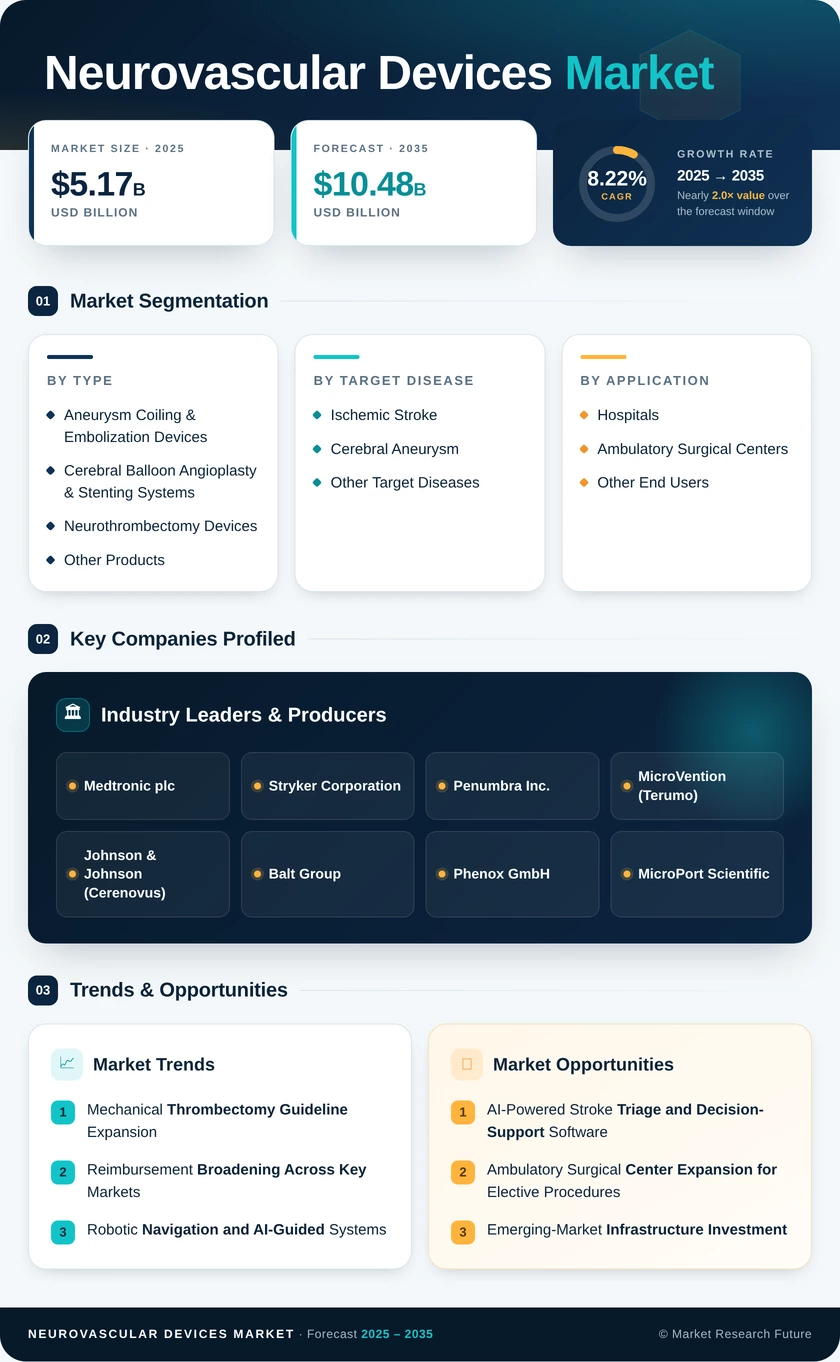
Segmentation Quick Reference
| Dimension | Sub-Segments | Dominant Segment (2025) | Fastest Growing Segment (2026–2035) |
| By Product | Aneurysm Coiling & Embolization Devices; Cerebral Balloon Angioplasty & Stenting Systems; Neurothrombectomy Devices; Other Products | Aneurysm Coiling & Embolization Devices | Neurothrombectomy Devices |
| By Target Disease | Ischemic Stroke; Cerebral Aneurysm; Other Target Diseases | Ischemic Stroke | Cerebral Aneurysm |
| By End User | Hospitals; Ambulatory Surgical Centers; Other End Users | Hospitals | Ambulatory Surgical Centers |
| By Geography | North America; Europe; Asia-Pacific; South America; Middle East & Africa | North America | Asia-Pacific |
Market Segmentation Overview
By Product
| Sub-Segment | Key Trend |
| Aneurysm Coiling & Embolization Devices | Shift toward softer-fill detachable coils with 360-degree deployment visibility for complex wide-necked aneurysms |
| Cerebral Balloon Angioplasty & Stenting Systems | Growing use of symptomatic intracranial atherosclerotic stenosis following SAMMPRIS follow-up data re-evaluation |
| Neurothrombectomy Devices | Large-bore aspiration catheters and stent retrievers competing for first-line acute ischemic stroke treatment |
| Other Products | Diagnostic micro-catheters and vascular access sheaths supporting upstream procedural workflows |
The product landscape is defined by a clear split between the established dominance of aneurysm coiling and embolization devices and the rapid clinical momentum behind neurothrombectomy platforms. Device innovation centers on improving first-pass effect rates and reducing procedural complexity to enable broader adoption in non-academic hospital settings.
By Target Disease
| Sub-Segment | Key Trend |
| Ischemic Stroke | An extended thrombectomy window (up to 24 hours) dramatically expands the eligible patient populations |
| Cerebral Aneurysm | Population-screening programs and incidental detection are driving elective flow-diverter and coiling demand |
| Other Target Diseases | Arteriovenous malformation embolization and dural fistula treatment are gaining dedicated device attention |
Ischemic stroke commands the largest disease-segment share, reflecting both epidemiological scale and the strength of guideline-backed intervention protocols. Cerebral aneurysm interventions are accelerating as screening programs in high-prevalence populations surface treatable cases earlier in the clinical pathway.
By End User
| Sub-Segment | Key Trend |
| Hospitals | Tertiary comprehensive stroke centers remain the primary procedural setting, supported by advanced imaging and ICU infrastructure |
| Ambulatory Surgical Centers | Payer approvals for outpatient elective neurovascular procedures are opening a new high-growth channel |
| Other End Users | Research institutions and military medical facilities contribute to a niche demand for specialized platforms |
Hospital dominance reflects the inherent complexity and acuity of neurovascular interventions. The ambulatory surgical center channel is the principal growth story, as reimbursement approvals and safety data for elective procedures accumulate, shifting lower-acuity case volumes toward cost-efficient outpatient settings.