Next Generation Biometrics Market
Next Generation Biometrics Market Summary
As per MRFR analysis, the Next Generation Biometrics Market Size was estimated at 185.19 USD Billion in 2024. The Next Generation Biometrics industry is projected to grow from 220.46 USD Billion in 2025 to 1589.45 USD Billion by 2035, exhibiting a compound annual growth rate (CAGR) of 21.83% during the forecast period 2025 - 2035.
Key Market Trends & Highlights
The Next Generation Biometrics Market is poised for substantial growth driven by technological advancements and increasing security concerns.
- The integration of Artificial Intelligence is transforming biometric systems, enhancing their accuracy and efficiency.
- North America remains the largest market, while Asia-Pacific is emerging as the fastest-growing region in the biometrics landscape.
- Access Control continues to dominate the market, whereas Identity Verification is witnessing rapid growth due to rising security needs.
- Technological advancements and the rising demand for enhanced security solutions are key drivers propelling market expansion.
Market Size & Forecast
| 2024 Market Size | 185.19 (USD Billion) |
| 2035 Market Size | 1589.45 (USD Billion) |
| CAGR (2025 - 2035) | 21.83% |
Major Players
NEC Corporation (JP), Thales Group (FR), Gemalto (FR), IDEMIA (FR), HID Global (US), Fujitsu (JP), Safran (FR), Aware Inc. (US), MorphoTrust USA (US)
Next Generation Biometrics Market Trends
The Next Generation Biometrics Market is currently experiencing a transformative phase, characterized by rapid advancements in technology and increasing adoption across various sectors. The next generation biometrics market is experiencing steady growth, driven by increasing demand for advanced identity verification solutions across government, banking, healthcare, and enterprise applications. This market encompasses a wide array of biometric modalities, including facial recognition, fingerprint scanning, iris recognition, and voice recognition, among others. The integration of artificial intelligence and machine learning into biometric systems is enhancing accuracy and efficiency, thereby driving demand. Furthermore, the growing emphasis on security and privacy in both public and private sectors is propelling the need for robust biometric solutions. As organizations seek to streamline operations and improve user experiences, the Next Generation Biometrics Market is poised for substantial growth. Adoption within the next generation biometrics market is supported by the integration of AI, machine learning, and multimodal biometric technologies that enhance accuracy and security.
In addition to technological advancements, regulatory frameworks and standards are evolving to address privacy concerns associated with biometric data. Governments and organizations are increasingly focusing on establishing guidelines that ensure ethical use and protection of personal information. This trend indicates a shift towards more responsible deployment of biometric technologies, fostering consumer trust. As the market continues to mature, collaboration between technology providers, regulatory bodies, and end-users will likely play a crucial role in shaping the future landscape of the Next Generation Biometrics Market. Comprehensive next generation biometrics market analysis highlights rising deployment of behavioral biometrics, contactless authentication, and continuous identity verification systems.
Integration of Artificial Intelligence
The incorporation of artificial intelligence into biometric systems is revolutionizing the Next Generation Biometrics Market. AI enhances the accuracy and efficiency of biometric recognition processes, allowing for real-time analysis and improved user experiences. This trend indicates a shift towards more intelligent systems that can learn and adapt over time, potentially increasing their effectiveness in various applications.
Emphasis on Privacy and Security
As biometric technologies become more prevalent, there is a growing emphasis on privacy and security concerns. Consumers and organizations alike are increasingly aware of the implications of biometric data collection and storage. This trend suggests that companies in the Next Generation Biometrics Market are prioritizing the development of solutions that ensure data protection and comply with regulatory standards.
Expansion into Emerging Markets
The Next Generation Biometrics Market is witnessing expansion into emerging markets, where the demand for advanced security solutions is on the rise. This trend indicates a growing recognition of the value of biometric technologies in enhancing security and streamlining processes in regions that are increasingly adopting digital solutions.
Next Generation Biometrics Market Drivers
Rising Demand for Enhanced Security
The Global Next Generation Biometrics Market Industry is experiencing a surge in demand for advanced security solutions. Organizations across various sectors, including finance, healthcare, and government, are increasingly adopting biometric technologies to mitigate security risks. For instance, biometric authentication methods such as facial recognition and fingerprint scanning are becoming standard practices in securing sensitive data. This heightened focus on security is projected to drive the market's growth, with the industry expected to reach 185.2 USD Billion in 2024. As cyber threats evolve, the need for robust biometric systems becomes more pressing, indicating a strong trajectory for the Global Next Generation Biometrics Market Industry.
Growing Consumer Awareness and Acceptance
Consumer awareness regarding the benefits of biometric technologies is rising, positively influencing the Global Next Generation Biometrics Market Industry. As individuals become more familiar with biometric authentication methods, such as mobile facial recognition and fingerprint scanning, acceptance rates are increasing. This shift is evident in the widespread adoption of biometric features in smartphones and personal devices, which enhances user convenience and security. The growing consumer trust in biometric systems is likely to drive market growth, as businesses recognize the need to integrate these technologies into their offerings. This trend suggests a favorable outlook for the Global Next Generation Biometrics Market Industry.
Emerging Applications in Diverse Industries
The versatility of biometric technologies is leading to their adoption across various industries, thereby driving the Global Next Generation Biometrics Market Industry. Sectors such as retail, healthcare, and transportation are exploring innovative applications of biometrics to enhance customer experience and operational efficiency. For instance, retail stores are utilizing facial recognition to personalize shopping experiences, while healthcare facilities are implementing biometric systems for patient identification and record management. This diversification of applications is expected to contribute to the market's growth, with a projected CAGR of 22.0% from 2025 to 2035. The expanding use cases indicate a dynamic future for the Global Next Generation Biometrics Market Industry.
Increasing Adoption in Government Initiatives
Governments worldwide are increasingly implementing biometric systems for identity verification and security purposes, significantly impacting the Global Next Generation Biometrics Market Industry. Initiatives such as national ID programs and border control systems leverage biometric technologies to enhance security and streamline processes. For instance, several countries have adopted biometric passports, which incorporate fingerprint and facial recognition features to improve traveler identification. This trend is likely to accelerate market growth as governments seek to bolster national security and improve service efficiency. The anticipated expansion of government applications indicates a robust future for the Global Next Generation Biometrics Market Industry.
Technological Advancements in Biometric Systems
Innovations in biometric technologies are propelling the Global Next Generation Biometrics Market Industry forward. The integration of artificial intelligence and machine learning into biometric systems enhances their accuracy and efficiency. For example, AI-driven facial recognition systems can now identify individuals with remarkable precision, even in challenging environments. These advancements not only improve user experience but also expand the applicability of biometric solutions across various sectors. As these technologies continue to evolve, they are expected to attract significant investments, contributing to the market's projected growth to 1650.0 USD Billion by 2035. The ongoing technological evolution suggests a promising future for the Global Next Generation Biometrics Market Industry.
Market Segment Insights
By Application: Access Control (Largest) vs. Identity Verification (Fastest-Growing)
The Next Generation Biometrics Market is segmented into various applications, including Access Control, Time and Attendance, Identity Verification, Financial Transactions, and Healthcare. Among these, Access Control holds the largest share, which emphasizes its critical role in securing physical and digital spaces. Identity Verification, while representing a smaller portion, is the fastest-growing segment, attributed to the increasing demand for secure and efficient verification processes across industries.
Access Control (Dominant) vs. Identity Verification (Emerging)
Access Control is a well-established segment in the Next Generation Biometrics Market, serving as a primary solution for securing entry points in both physical and digital environments. Its dominance is supported by technological advancements, such as facial recognition and fingerprint scanning, which enhance security levels. On the other hand, Identity Verification is emerging rapidly due to the increasing need for authenticated access in various sectors, including finance and healthcare. This segment is driven by the proliferation of online services and the digital transformation of traditional processes, necessitating reliable identity validation methods.
By Technology: Fingerprint Recognition (Largest) vs. Facial Recognition (Fastest-Growing)
In the Next Generation Biometrics Market, the segment values are diverse, with Fingerprint Recognition holding the largest market share due to its widespread adoption across various industries for secure access control. It has established itself as a reliable technology widely implemented in mobile devices and security systems. Following closely, Facial Recognition has emerged as the fastest-growing segment, driven by increasing demands in security and surveillance applications. The integration of AI and machine learning technologies has significantly enhanced its accuracy and efficiency, leading to a rapid rise in deployment across multiple sectors. The growth trends for the Next Generation Biometrics Market indicate a robust expansion trajectory, primarily fueled by advancements in technology and rising security concerns. As organizations seek enhanced authentication processes, the demand for Fingerprint and Facial Recognition technologies continues to soar. Notably, advancements in deep learning algorithms are making Facial Recognition more sophisticated, propelling it forward as a key player in this segment. Additionally, increasing investments in smart cities and IoT devices are anticipated to further drive the adoption of behavioral biometrics, augmenting the overall market's growth.
Technology: Fingerprint Recognition (Dominant) vs. Facial Recognition (Emerging)
Fingerprint Recognition has long been considered the dominant technology in the Next Generation Biometrics Market, owing to its proven reliability and ease of integration into existing systems. Its application spans across multiple platforms, including smartphones, laptops, and access control systems in physical and digital security. This technology leverages unique biometric patterns of individuals, ensuring secure and efficient authentication processes. In contrast, Facial Recognition is emerging as a transformative solution, particularly in sectors like retail, law enforcement, and secure transactions. It utilizes advanced algorithms that detect facial features and analyze them for identification purposes. The rapid growth of this segment is largely attributed to technological advancements that have increased the speed and accuracy of biometric matching, making it a compelling choice for organizations looking to enhance their security protocols.
By End Use: Government (Largest) vs. Healthcare (Fastest-Growing)
The Next Generation Biometrics Market displays a diverse distribution among key end-use sectors, with the Government segment taking the lead in terms of market share. This segment benefits from increasing investments in security and surveillance systems, as governments globally prioritize public safety and national security. Following closely is the Healthcare segment, which, while smaller in overall share, is rapidly expanding as health organizations adopt biometrics for patient identification and management solutions.
Government: Security Applications (Dominant) vs. Healthcare: Patient Identification (Emerging)
The Government sector represents the dominant application area for Next Generation Biometrics, focusing primarily on security applications such as access control and surveillance. This dominance is driven by stringent security regulations and the growing need for robust identification systems. In contrast, the Healthcare sector, categorized as an emerging segment, is gaining traction due to the increasing utilization of biometric solutions for accurate patient identification and secure record access. The adoption of biometrics in healthcare enhances operational efficiency and reduces fraud, making it an appealing choice for healthcare providers.
Regional Insights
North America : Market Leader in Innovation
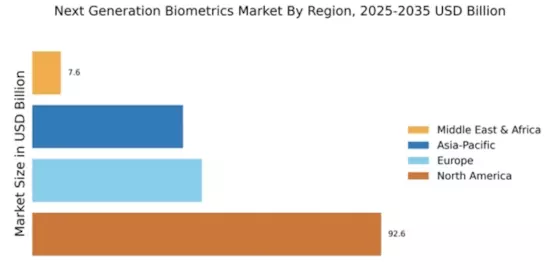
North America is poised to maintain its leadership in the Next Generation Biometrics Market, holding a significant market share of 92.6% as of 2024. The region's growth is driven by increasing demand for advanced security solutions across various sectors, including finance, healthcare, and government. Regulatory support for biometric technologies, particularly in identity verification and fraud prevention, further fuels this expansion. The integration of AI and machine learning in biometric systems is also a key trend, enhancing accuracy and user experience. The competitive landscape in North America is robust, featuring key players such as HID Global, NEC Corporation, and Aware Inc. These companies are at the forefront of innovation, developing cutting-edge biometric solutions that cater to diverse applications. The U.S. remains the largest market, with Canada and Mexico also contributing to regional growth. The presence of established tech firms and startups alike fosters a dynamic environment for advancements in biometric technologies.
Europe : Emerging Market with Regulations
Europe is witnessing a growing interest in the Next Generation Biometrics Market, with a market size of €45.0 million. The region's growth is propelled by stringent regulations aimed at enhancing security and privacy, particularly in the EU. The General Data Protection Regulation (GDPR) has set a precedent for data protection, influencing the adoption of biometric technologies for secure identification and access control. Additionally, the increasing need for seamless user experiences in digital services is driving demand for biometric solutions. Leading countries in Europe include Germany, France, and the UK, where companies like Thales Group and IDEMIA are making significant strides. The competitive landscape is characterized by a mix of established firms and innovative startups, all vying for market share. The European market is also seeing collaborations between tech companies and government agencies to develop secure biometric systems that comply with regulatory standards.
Asia-Pacific : Rapid Growth in Technology Adoption
Asia-Pacific is rapidly emerging as a significant player in the Next Generation Biometrics Market, with a market size of $40.0 million. The region's growth is driven by increasing urbanization, rising security concerns, and the adoption of smart technologies. Countries like China, Japan, and India are leading the charge, with governments investing heavily in biometric systems for national security and public safety. The demand for contactless biometric solutions has surged, particularly in the wake of the COVID-19 pandemic, further propelling market growth. The competitive landscape in Asia-Pacific is diverse, featuring key players such as Fujitsu and BioID. These companies are leveraging advanced technologies to develop innovative biometric solutions tailored to local needs. The region is also witnessing collaborations between private firms and government entities to enhance security infrastructure, making it a hotbed for biometric innovation and deployment.
Middle East and Africa : Emerging Market with Potential
The Middle East and Africa (MEA) region is gradually emerging in the Next Generation Biometrics Market, with a market size of $7.59 million. The growth is primarily driven by increasing security concerns and the need for efficient identity management systems. Governments in the region are investing in biometric technologies to enhance border security and streamline public services. The rising adoption of smart city initiatives is also contributing to the demand for advanced biometric solutions, as urban areas seek to improve safety and efficiency. Leading countries in the MEA region include the UAE and South Africa, where local firms are beginning to develop and implement biometric systems. The competitive landscape is still developing, with opportunities for both established companies and new entrants. As the region continues to invest in technology and infrastructure, the potential for growth in the biometric market remains significant.
Key Players and Competitive Insights
In October 2025, Safran (France) launched a new biometric identification system that utilizes advanced facial recognition technology. This system is designed for high-security environments, such as airports and government facilities. The introduction of this technology underscores Safran's commitment to innovation and its ability to respond to the growing demand for robust security solutions. By enhancing its product portfolio, Safran is likely to strengthen its competitive position in the biometrics sector. In September 2025, Aware Inc. (US) expanded its biometric software solutions to include enhanced liveness detection features. This move is particularly relevant as the market increasingly prioritizes security against spoofing attacks. Aware Inc.'s focus on improving the reliability of its biometric systems may provide a competitive advantage, as organizations seek to implement more secure identification methods. This strategic enhancement reflects a broader trend in the industry towards prioritizing security and user trust. As of December 2025, the competitive trends in the Next Generation Biometrics Market are heavily influenced by digitalization, AI integration, and sustainability initiatives. Strategic alliances are becoming increasingly vital, as companies recognize the need to collaborate to stay ahead in a rapidly changing environment. The shift from price-based competition to a focus on innovation and technology is evident, with companies investing in R&D to differentiate their offerings. Moving forward, competitive differentiation will likely hinge on the ability to deliver reliable, cutting-edge solutions that meet the evolving needs of consumers and businesses alike.
Key Companies in the Next Generation Biometrics Market include
Industry Developments
- Q2 2024: Thales launches new contactless biometric payment card Thales announced the launch of a new generation of contactless biometric payment cards, integrating advanced fingerprint authentication technology to enhance security and user convenience.
- Q2 2024: IDEMIA and Microsoft partner to advance digital identity solutions IDEMIA entered a strategic partnership with Microsoft to integrate next-generation biometric authentication into Microsoft's digital identity platforms, aiming to improve security for enterprise and government clients.
- Q2 2024: NEC Corporation opens new biometric R&D center in Singapore NEC Corporation inaugurated a new research and development facility in Singapore focused on advancing biometric authentication technologies, including facial and iris recognition.
- Q3 2024: Fujitsu launches palm vein authentication solution for enterprise security Fujitsu introduced a new palm vein authentication system designed for secure access control in corporate environments, leveraging contactless biometric technology.
- Q3 2024: BIO-key International secures contract with US government agency for biometric authentication BIO-key International announced it has been awarded a contract by a US government agency to deploy its next-generation biometric authentication solutions for secure access to sensitive systems.
- Q3 2024: Suprema Inc. unveils AI-powered facial recognition terminal Suprema Inc. launched a new AI-powered facial recognition terminal, offering enhanced speed and accuracy for access control and time attendance applications.
- Q4 2024: Aware, Inc. appoints new Chief Technology Officer to lead biometric innovation Aware, Inc. announced the appointment of a new Chief Technology Officer, tasked with driving the company's next-generation biometric product development.
- Q4 2024: Precise Biometrics raises $20 million in Series B funding Precise Biometrics completed a $20 million Series B funding round to accelerate the development and commercialization of its next-generation biometric authentication solutions.
- Q1 2025: HID Global acquires biometric security startup Invixium HID Global announced the acquisition of Invixium, a biometric security startup specializing in advanced facial and fingerprint recognition technologies.
- Q1 2025: Siemens AG launches integrated biometric access control platform Siemens AG introduced a new integrated access control platform featuring multi-modal biometric authentication, targeting critical infrastructure and enterprise clients.
- Q2 2025: IDEMIA wins contract to supply biometric border control systems to European airport IDEMIA secured a contract to provide next-generation biometric border control systems at a major European airport, enhancing passenger processing and security.
- Q2 2025: Fingerprint Cards AB partners with major smartphone manufacturer for in-display biometric sensors Fingerprint Cards AB announced a partnership with a leading smartphone manufacturer to supply in-display biometric sensors for upcoming mobile devices.
Future Outlook
Next Generation Biometrics Market Future Outlook
The Next Generation Biometrics Market is projected to grow at 21.83% CAGR from 2025 to 2035, driven by technological advancements, increasing security concerns, and demand for seamless user experiences.
New opportunities lie in:
- Integration of biometric authentication in mobile payment systems. Development of AI-driven biometric analytics for enhanced security. Expansion of biometric solutions in healthcare for patient identification.
By 2035, the market is expected to be robust, driven by innovation and widespread adoption. The next generation biometrics market is benefiting from growing concerns around fraud prevention, data security, and the need for seamless user authentication experiences.
Market Segmentation
Next Generation Biometrics Market End Use Outlook
- Government
- Banking and Financial Services
- Healthcare
- Retail
- Transportation
Next Generation Biometrics Market Technology Outlook
- Fingerprint Recognition
- Facial Recognition
- Iris Recognition
- Voice Recognition
- Behavioral Biometrics
Next Generation Biometrics Market Application Outlook
- Access Control
- Time and Attendance
- Identity Verification
- Financial Transactions
- Healthcare
Report Scope
| MARKET SIZE 2024 | 185.19(USD Billion) |
| MARKET SIZE 2025 | 220.46(USD Billion) |
| MARKET SIZE 2035 | 1589.45(USD Billion) |
| COMPOUND ANNUAL GROWTH RATE (CAGR) | 21.83% (2025 - 2035) |
| REPORT COVERAGE | Revenue Forecast, Competitive Landscape, Growth Factors, and Trends |
| BASE YEAR | 2024 |
| Market Forecast Period | 2025 - 2035 |
| Historical Data | 2019 - 2024 |
| Market Forecast Units | USD Billion |
| Key Companies Profiled | NEC Corporation (JP), Thales Group (FR), Gemalto (FR), IDEMIA (FR), HID Global (US), Fujitsu (JP), Safran (FR), Aware Inc. (US), MorphoTrust USA (US) |
| Segments Covered | Application, Technology, End Use |
| Key Market Opportunities | Integration of artificial intelligence enhances accuracy and efficiency in the Next Generation Biometrics Market. |
| Key Market Dynamics | Technological advancements drive competitive forces, enhancing security and user experience in the Next Generation Biometrics Market. |
| Countries Covered | North America, Europe, APAC, South America, MEA |
Market Highlights
FAQs
What is the projected market valuation of the Next Generation Biometrics Market by 2035?
The projected market valuation for the Next Generation Biometrics Market by 2035 is 1589.45 USD Billion.
What was the overall market valuation of the Next Generation Biometrics Market in 2024?
The overall market valuation of the Next Generation Biometrics Market in 2024 was 185.19 USD Billion.
What is the expected CAGR for the Next Generation Biometrics Market during the forecast period 2025 - 2035?
The expected CAGR for the Next Generation Biometrics Market during the forecast period 2025 - 2035 is 21.83%.
Which application segment had the highest valuation in the Next Generation Biometrics Market in 2024?
The Identity Verification application segment had the highest valuation in the Next Generation Biometrics Market in 2024, at 55.56 USD Billion.
What are the key players in the Next Generation Biometrics Market?
Key players in the Next Generation Biometrics Market include NEC Corporation, Thales Group, Gemalto, IDEMIA, HID Global, Fujitsu, Safran, Aware Inc., and BioID.
Which technology segment is projected to grow the most by 2035?
The Facial Recognition technology segment is projected to grow the most by 2035, with a valuation of 460.0 USD Billion.
What was the valuation of the Banking and Financial Services end-use segment in 2024?
How does the projected growth of the Next Generation Biometrics Market compare across different end-use segments?
What is the valuation of the Behavioral Biometrics technology segment in 2024?
Which company is likely to lead the Next Generation Biometrics Market in terms of innovation?
Research Approach
Secondary Research
The secondary research process involved comprehensive analysis of cybersecurity frameworks, national identity databases, defense & homeland security publications, and authoritative technology standardization bodies. Key sources included the US Department of Homeland Security (DHS), National Institute of Standards and Technology (NIST), Federal Bureau of Investigation (FBI) Biometric Center of Excellence, US Department of Defense (DoD) Biometrics Identity Management Agency, European Union Agency for Cybersecurity (ENISA), European Border and Coast Guard Agency (Frontex), International Civil Aviation Organization (ICAO), International Organization for Standardization (ISO/IEC JTC 1/SC 37), Biometric Institute, National Cyber Security Centre (UK), Canadian Centre for Cyber Security, Australian Cyber Security Centre, National Identity Authority databases from key markets, and central bank digital identity reports. These sources were used to collect adoption statistics, compliance standards, security protocol data, integration trends, and competitive landscape analysis for fingerprint recognition, facial recognition, iris scanning, voice authentication, and multimodal biometric systems.
Primary Research
Qualitative and quantitative insights were obtained by interviewing supply-side and demand-side stakeholders during the primary research process. The supply-side sources consist of CEOs, CTOs, VPs of Engineering, product leaders, and government sales directors from biometric technology manufacturers, algorithm developers, and system integrators. The demand-side sources included chief security officers (CSOs), IT directors from banking and financial institutions, defense procurement officers, border control agency directors, healthcare system administrators, and enterprise security architects. The primary research validated technology segmentation, confirmed AI integration roadmaps, and collected insights on regulatory compliance dynamics, pricing models, and deployment patterns.
Primary Respondent Breakdown:
By Designation: C-level Primaries (32%), Director Level (31%), Others (37%)
By Region: North America (38%), Europe (25%), Asia-Pacific (28%), Rest of World (9%)
Market Size Estimation
Global market valuation was derived through revenue mapping and deployment volume analysis. The methodology included:
Identification of 50+ key technology providers across North America, Europe, Asia-Pacific, and Middle East & Africa
Product mapping across hardware (scanners, sensors, cameras), software (algorithms, platforms), and services (integration, maintenance)
Technology segmentation across fingerprint, facial recognition, iris recognition, palm vein, voice recognition, and behavioral biometrics
Analysis of reported and modeled annual revenues specific to biometric solution portfolios
Coverage of manufacturers and service providers representing 72-78% of global market share in 2024
Extrapolation using bottom-up (deployment volume × ASP by country/sector) and top-down (vendor revenue validation) approaches to derive segment-specific valuations across BFSI, government, defense, and healthcare verticals
Kindly complete the form below to receive a free sample of this Report
Customer Stories
“This is really good guys. Excellent work on a tight deadline. I will continue to use you going forward and recommend you to others. Nice job”
“Thanks. It’s been a pleasure working with you, please use me as reference with any other Intel employees.”
“Thanks for sending the report it gives us a good global view of the Betaïne market.”
“Thank you, this will be very helpful for OQS.”
“We found the report very insightful! we found your research firm very helpful. I'm sending this email to secure our future business.”
“I am very pleased with how market segments have been defined in a relevant way for my purposes (such as "Portable Freezers & refrigerators" and "last-mile"). In general the report is well structured. Thanks very much for your efforts.”
“I have been reading the first document or the study, ,the Global HVAC and FP market report 2021 till 2026. Must say, good info! I have not gone in depth at all parts, but got a good indication of the data inside!”
“We got the report in time, we really thank you for your support in this process. I also thank to all of your team as they did a great job.”