
Top Industry Leaders in the Oil Gas Cloud Applications Market
Oil and Gas Cloud Applications Market: Dive into the Latest News and Updates
The oil and gas industry, long associated with roughnecks and rigs, is experiencing a digital revolution. Gone are the days of paper logs and siloed data; cloud-based applications are now streamlining operations, boosting efficiency, and unlocking new insights from valuable data streams.
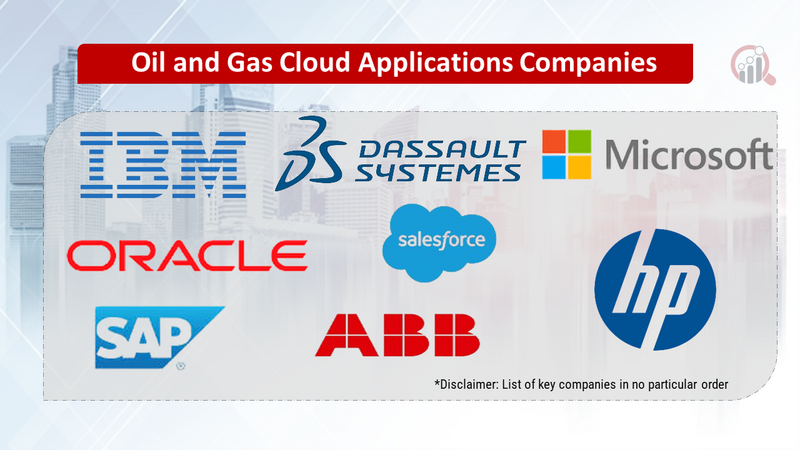
Some of Oil and Gas Cloud Applications Companies Listed Below:
- IBM Corporation (US)
- Oracle Corporation (US)
- Microsoft Corporation (US)
- SAP SE(Germany)
- Salesforce (US)
- Aspentech (US)
- Bentley Systems (US)
- Dassault Systèmes (France)
- HPE(US)
- ABB (Switzerland)
- Infor (US)
- Sage Software Solutions (India)
- Risk Edge Solutions (India)
- Workday (US)
- Quorum Software (US)
Strategic Playbook: Drilling for Efficiency in the Cloud
To win in this competitive market, players are honing their strategies:
- Focus on Security and Compliance: Ensuring robust data security measures, access control, and compliance with industry regulations like API 6A and HIPPA is paramount for building trust and mitigating risks.
- Interoperability and Standardization: Promoting open standards and seamless integration with existing field and production equipment fosters data exchange and collaborative workflows.
- Scalability and Flexibility: Offering scalable cloud solutions adaptable to different company sizes, operational needs, and geographic locations increases market reach and customer satisfaction.
- Data-driven Insights and Analytics: Integrating AI and machine learning capabilities for real-time data analysis, predictive maintenance, and optimization of drilling, production, and reservoir management processes creates significant value.
Market Share Dynamics: Beyond Barrels of Oil
Analyzing market share in this complex landscape requires careful consideration of several factors:
- Breadth and Depth of Solutions: Offering a comprehensive suite of cloud applications catering to diverse needs, from field operations to financial management and supply chain optimization, holds an advantage.
- Regional Focus and Adaptation: Adapting solutions to meet specific regulatory requirements and operational challenges in different oil and gas regions expands market reach.
- Partnerships and Collaborations: Building strong partnerships with oil and gas companies, technology providers, and service providers creates a robust ecosystem and facilitates resource sharing.
- Focus on Innovation and R&D: Continuously investing in research and development to stay ahead of the curve with cutting-edge technologies like AI, blockchain, and IoT secures a competitive edge.
New Blood on the Horizon: Transforming the Oilfield
Innovative startups are making waves with their disruptive approaches:
- AI-powered Drilling Optimization: Leveraging AI to analyze real-time drilling data, optimize rig operations, and predict potential drilling problems enhances efficiency and reduces costs.
- Predictive Maintenance and Asset Management: Integrating AI and IoT sensors for predictive maintenance of wellheads, pipelines, and other equipment minimizes downtime and optimizes asset utilization.
- Digital Twins and Real-time Simulation: Creating digital twins of oil and gas assets and real-time simulations enables virtual testing, process optimization, and improved risk management.
- Blockchain-based Supply Chain and Traceability: Utilizing blockchain technology to track oil and gas provenance, ensure regulatory compliance, and promote transparency in the supply chain.
Investment Boom: Fueling the Digital Transformation
The Oil and Gas Cloud Applications Market is attracting significant investment:
- Venture Capital Focus: VC firms are actively backing promising startups developing innovative AI-powered solutions, predictive maintenance tools, and blockchain-based applications for the oil and gas industry.
- Private Equity Plays: Established cloud application providers and oilfield services companies are attracting PE interest due to their stable revenue streams and potential for further growth within the digitalization wave.
- Strategic Partnerships and Acquisitions: Collaborations and acquisitions between cloud providers, oil and gas companies, and technology startups are accelerating market expansion and technology development.
Latest Company Updates:
June 6:
- Security in focus: Major cloud providers announce enhanced security features specifically designed for oil and gas data and infrastructure.
- Remote operations gain traction: Cloud-based solutions enable real-time monitoring and control of assets, boosting efficiency and safety in remote locations.
June 13:
- AI and ML take center stage: Oil and gas companies tap into AI and ML capabilities in the cloud for enhanced reservoir modeling, predictive maintenance, and seismic analysis.
- Concerns and opportunities: Experts discuss ethical considerations of AI in oil and gas exploration and production.
June 20:
- Sustainability drives innovation: Cloud-based platforms support environmental monitoring, emission reduction strategies, and carbon capture initiatives.
- Collaboration for efficiency: Cloud solutions facilitate data sharing and collaboration across the oil and gas value chain, streamlining workflows and optimizing resource utilization.

















