Optical Sorter Market

Key Players: TOMRA Systems ASA, Bühler Group, Key Technology (Duravant), Satake Corporation, Sesotec GmbH, Steinert GmbH, Pellenc ST, National Recovery Technologies (BHS)

Optical Sorter Market

Optical Sorter Market Size, Share and Research Report By Technology (Camera Solutions, Near-Infrared (NIR), X-Ray Transmission, Hyperspectral Imaging, Laser Sorting), By Platform (Belt, Freefall, Chute / Lane), By End-User Industry (Food Processing, Recycling, Mining, Pharmaceuticals) and By Region (North America, Europe, South America, Asia Pacific, Middle East and Africa) - Industry Forecast to 2035.
ID: MRFR/SEM/4276-HCR
100 Pages
Ankit Gupta
Last Updated: June 22, 2026

Optical Sorter Market Summary

The Optical Sorter Market reached USD 3.65 billion in 2025 and is projected to climb from USD 3.96 billion in 2026 to USD 8.31 billion by 2035, expanding at an 8.6% CAGR during the forecast window. Two catalysts anchor this trajectory: tightening food safety mandates under the FDA's New Era of Smarter Food Safety Blueprint [2] and Extended Producer Responsibility (EPR) frameworks rolling across EU member states and Southeast Asia that demand higher purity grades for recycled plastics and metals [3]. Capital expenditure incentives in India's Production Linked Incentive (PLI) scheme and the U.S. Inflation Reduction Act have further accelerated procurement cycles for automated optical classification equipment. 

A technology shift is reshaping the Optical Sorter Market landscape. Legacy single-spectrum camera systems are giving way to AI-enhanced hyperspectral and near-infrared sorting machines capable of detecting sub-millimeter contaminants invisible to conventional sensors. BloombergNEF estimates that machine vision sorting systems attracted over USD 1.2 billion in venture and strategic funding between 2022 and 2024, with deep-learning defect recognition modules now embedded in roughly 38% of new belt-line installations [4]. Color-based optical sorting platforms have also benefited, as food grain optical sorters in South Asia and sub-Saharan Africa now process throughputs 40% higher than mechanical predecessors.

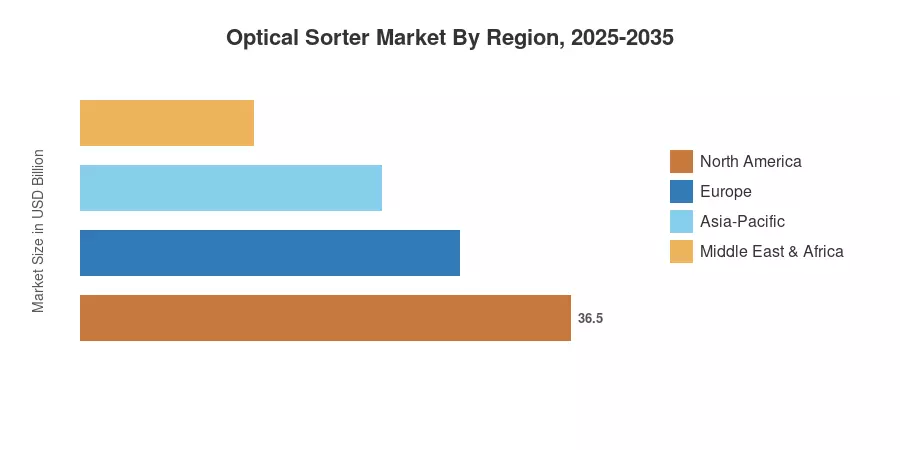
North America commanded a 36.2% revenue share of the Optical Sorter Market in 2025, driven by USDA and EPA compliance spending. Asia-Pacific is the fastest-growing region at an 11.2% CAGR, propelled by rising automation in China's recycling sector and India's grain processing modernization. Europe holds the second-largest share at roughly 27%, underpinned by circular-economy legislation and deposit-return schemes. As sustainability regulations tighten globally, procurement of high-throughput machine vision sorting systems is set to accelerate across every major end-use vertical through 2035.


Key Report Takeaways

• By Technology

  • Camera-based systems captured 36.5% of the Optical Sorter Market share in 2025, reflecting widespread adoption of color-based optical sorting across food and recycling lines
  • Near-infrared sorting machines are projected to register a 10.4% CAGR through 2035, the fastest among all technology segments, as hyperspectral capabilities expand into mining and textile recovery

• By Platform

  • Belt-based configurations accounted for 58.2% of the Optical Sorter Market in 2025, favored for their scalability in high-volume food grain optical sorters and municipal recycling facilities


• By End-User Industry

  • Belt-based configurations accounted for 58.2% of the Optical Sorter Market in 2025, favored for their scalability in high-volume food grain optical sorters and municipal recycling facilities
  • Food processing held a 62.0% revenue share in 2025; the recycling end-user segment is forecast to grow at an 11.2% CAGR, driven by EPR mandates requiring automated optical classification of post-consumer waste streams

• By Region

  • North America led the Optical Sorter Market with 36.2% of global revenue in 2025
  • Asia-Pacific is expected to post the highest regional CAGR of 11.2% through 2035, supported by government investment in food grain optical sorters and circular-economy infrastructure


Market Size and Forecast (2021–2035)

MRFR's proprietary estimation framework triangulates bottom-up revenue analysis across 120+ OEMs and system integrators with top-down macro benchmarks from industry associations, import/export databases, and verified procurement records.
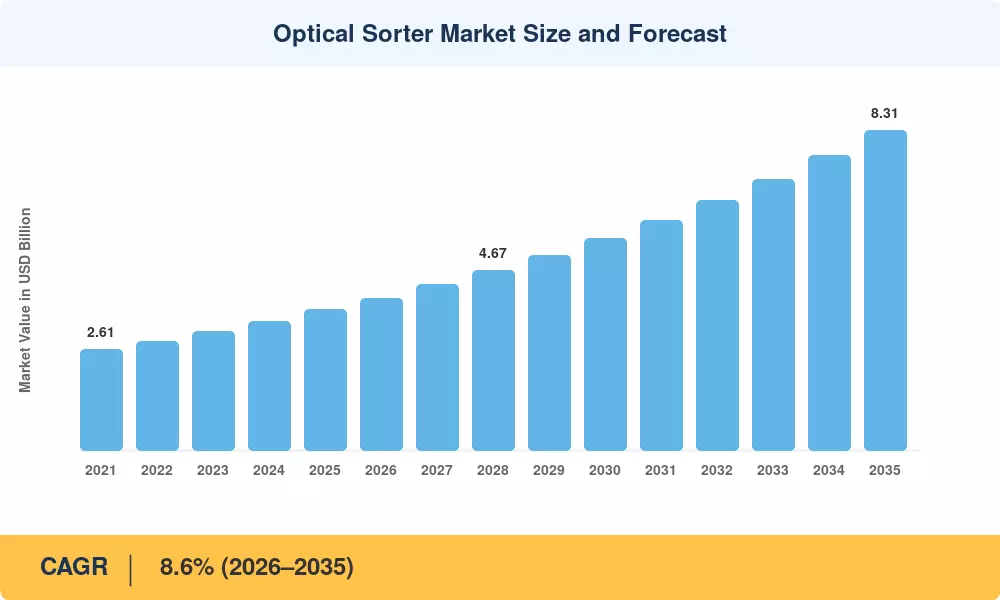
Optical Sorter Market Size and Forecast
Our Impact
Enabled $4.3B Revenue Impact for Fortune 500 and Leading Multinationals
Partnering with 2000+ Global Organizations Each Year
30K+ Citations by Top-Tier Firms in the Industry

Driver Impact Analysis

Driver ~% Impact on CAGR Geographic Relevance Impact Timeline
Tightening food safety regulations (FSMA, EU Reg 2021/382) 18–22% Global Short-term
EPR & circular-economy mandates 15–18% Europe, Asia-Pacific Medium-term
AI & hyperspectral imaging integration 14–17% Global Medium-term
Falling sensor & processor costs 10–13% Global Long-term
Labor shortages in manufacturing hubs 10–12% North America, Europe Short-term
Government capex subsidies (PLI, IRA) 8–10% Asia-Pacific, North America Medium-term
Deposit-return scheme expansion 6–8% Europe, Oceania Long-term


Regulatory Push for Safer Food Supply Chains

The FDA's New Era of Smarter Food Safety initiative allocated USD 68 million in fiscal 2024 for tech-enabled traceability and contaminant detection, directly benefiting the Optical Sorter Market by incentivizing processors to replace manual inspection with automated optical classification [2].

Extended Producer Responsibility and Circular-Economy Legislation

In France, India, and South Korea, EPR regimes currently oblige packaging companies to pay for recycling infrastructure that meets high purity requirements. In 2024, capital investment connected to EPR in sorting technology increased by 31% year-over-year based on data from the OECD, with the majority of new installations at material recovery facilities being near-infrared sorting machines and color-based optical sorting systems [3]. This legislative wave is expanding the Optical Sorter Market in developed as well as developing countries.


AI-Driven Hyperspectral Imaging Diffusion

Deep-learning algorithms applied to hyperspectral sensor data now enable real-time classification of 200+ material types at belt speeds exceeding 4 m/s. A 2024 study found that AI-infused food grain optical sorters reduced false-rejection rates by 52% compared with rule-based systems, directly improving yield economics for processors and spurring upgrade cycles across the Optical Sorter Market [4].

Persistent Labor Shortages

The U.S. Bureau of Labor Statistics reported 560,000 unfilled manufacturing positions in early 2025, a figure that has remained stubbornly elevated since 2022 [13]. Automated optical classification lines reduce headcount requirements on inspection stations by 60–75%, making the return-on-investment case compelling within 18 months for high-throughput food and recycling operators.


Restraints Impact Analysis

Restraint ~% Negative Impact Geographic Relevance Impact Timeline
High upfront capital cost –8 to –10% Emerging markets Short-term
Integration complexity with legacy lines –6 to –8% Global Medium-term
Shortage of trained service technicians –5 to –7% Asia-Pacific, MEA Medium-term
Material variability in mixed-waste streams –4 to –6% Global Long-term
Data privacy and IP concerns in AI modules –2 to –4% Europe, North America Long-term


Capital Intensity and ROI Uncertainty

A fully designed belt-based near-infrared sorting equipment for a mid-size recycling operation can cost USD 350,000-800,000, which is a barrier for small and mid-tier operators in South America and Africa [15]. Emerging leasing models and sorting-as-a-service offers are limited in terms of geographic coverage, limiting the Optical Sorter Market in price-sensitive countries.


Legacy-Line Integration Challenges

Many food processing companies had conveyor and grading systems installed before the year 2010. These lines require custom mechanical connections and communication-protocol bridging for retrofitting with machine vision sorting systems, adding 25-40% to project cost and three to six months to implementation schedules [16]. This friction slows upgrading cycles and restricts the rate of adoption of automated optical categorization in brownfield plants.


Optical Sorter Market Opportunities

Textile-to-Fiber Recycling Expansion

The EU's Strategy for Sustainable Textiles targets mandatory separate collection of textiles by 2025, creating a greenfield vertical for near-infrared sorting machines capable of distinguishing polyester, cotton, and blended fibers at high speed [11]. Early movers in the Optical Sorter Market stand to capture a segment projected to reach USD 400 million by 2030

Sorting-as-a-Service (SaaS) Business Models

Color-based optical sorting platforms are connected to the cloud, providing real-time performance data to OEM dashboards and allowing for pay-per-ton or subscription models, reducing up-front capital hurdles. This model matches well small processors in Asia-Pacific and South America looking for food grain optical sorters with no hefty balance sheet commitment


Emerging-Market Grain and Mineral Processing

In India, the PLI scheme for food processing funded INR 109 billion (~ USD 1.3 billion) for technology upgrades, and priority capital items included automated optical classification equipment [10]. Another untapped demand for compact machine vision sorting systems that improve ore-grade recovery is the artisanal mining sector in Sub-Saharan Africa


Data Monetization and Predictive Maintenance

Sorting-line telemetry generates millions of classification data points daily. Aggregating this data enables predictive maintenance, yield optimization, and benchmarking services that create recurring revenue streams for OEMs, a model already piloted by leading Optical Sorter Market players

Pharmaceutical and Nutraceutical Quality Control

Stringent Good Manufacturing Practice (GMP) requirements in pharmaceutical packaging are driving adoption of X-ray and hyperspectral machine vision sorting systems for capsule, tablet, and blister-pack inspection — a niche that could add USD 250 million in addressable revenue by 2032


Optical Sorter Market Future Outlook

AI-Autonomous Sorting Lines

By 2030, fully autonomous sorting cells — combining robotic pick-and-place arms with hyperspectral near-infrared sorting machines — are expected to handle 45% of new municipal recycling installations globally [4]. The Optical Sorter Market will benefit as OEMs bundle AI software subscriptions with hardware, increasing lifetime contract values by 35–50%.

Platform Convergence and Modular Architectures

Belt, chute, and free-fall configurations are converging into modular platforms that can be reconfigured for different material streams within hours. This flexibility appeals to contract recyclers and co-packing food processors, expanding the addressable base for machine vision sorting systems and color-based optical sorting equipment across mid-market operators.

Sustainability Reporting and ESG Compliance

The EU's Corporate Sustainability Reporting Directive (CSRD) and the SEC's proposed climate-disclosure rules will compel manufacturers to document material-recovery rates with auditable data [21]. Automated optical classification platforms that generate verifiable purity certificates will become compliance-critical infrastructure, reinforcing demand in the Optical Sorter Market through 2035.

Electrification and Energy-Efficiency Mandates

The IEA projects global electricity demand will rise 40% by 2035 [22]. OEMs are responding with low-power LED illumination arrays and energy-harvesting conveyor drives that cut sorting-line power consumption by 25%, an important differentiator as carbon-pricing regimes expand. Energy-efficient food grain optical sorters and near-infrared sorting machines will command pricing premiums in carbon-taxed jurisdictions.


Optical Sorter Market Segmentation

By Technology

Segment Key Metric Primary Demand Driver
Camera Solutions 36.5% share (2025) Color-based optical sorting for food grading
Near-Infrared (NIR) 10.4% CAGR (2026–2035) Polymer identification in recycling
X-Ray Transmission USD 0.51 Billion (2025) Density-based foreign-body detection
Hyperspectral Imaging 12.1% CAGR (2026–2035) Multi-material mineral classification
Laser Sorting USD 0.18 Billion (2025) Precision seed and grain grading


Camera solutions dominate the Optical Sorter Market because of their versatility and lower sensor cost. Color-based optical sorting using RGB and multispectral cameras remains the go-to solution for food grain optical sorters where visual defect detection — discoloration, shape irregularity, and foreign matter — drives rejection decisions. Near-infrared sorting machines are gaining ground rapidly; their ability to classify polymers by chemical composition makes them indispensable for recycling operators targeting 95%+ purity in PET and HDPE bales. The fastest uptake for automated optical classification in the NIR category is occurring in European material recovery facilities responding to EPR mandates

By Platform

Segment Key Metric Primary Demand Driver
Belt 58.2% share (2025) High-throughput food and recycling lines
Freefall 10.7% CAGR (2026–2035) Grain and seed gravity-fed processing
Chute / Lane USD 0.32 Billion (2025) Small-particle nut and spice sorting


Belt-based machine vision sorting systems remain the backbone of the Optical Sorter Market, processing material on flat conveyors at speeds up to 5 m/s. Food grain optical sorters in free-fall configurations are the fastest-growing platform, offering compact footprints suited to rice mills and pulse-processing plants across South Asia and Southeast Asia.

By End-User Industry

Segment Key Metric Primary Demand Driver
Food Processing 62.0% share (2025) FSMA, FSSAI, and EU hygiene mandates
Recycling 11.2% CAGR (2026–2035) EPR, deposit-return, circular-economy goals
Mining USD 0.29 Billion (2025) Ore pre-concentration and water reduction
Pharmaceuticals 12.6% CAGR (2026–2035) GMP compliance, capsule inspection


Food processing remains the largest end-user vertical in the Optical Sorter Market, where automated optical classification is now standard for nut, grain, fruit, and seafood quality control. The recycling segment is expanding fastest as municipalities and private waste-management firms invest in near-infrared sorting machines to comply with tightening purity standards for recycled materials


Regional Market Share Analysis

Region Key Metric Primary Investment Themes
North America 36.2% revenue share (2025) Food safety compliance, recycling mandates, labor substitution
Europe USD 0.99 Billion (2025) EPR, deposit-return schemes, circular economy
Asia-Pacific 11.2% CAGR (2026–2035) Grain modernization, recycling infrastructure buildout
South America USD 0.26 Billion (2025) Mining beneficiation, agricultural exports
Middle East & Africa 9.4% CAGR (2026–2035) Mining automation, food import quality controls
Total USD 3.65 Billion (2025)

The Optical Sorter Market exhibits distinct regional dynamics shaped by regulatory regimes, industrial maturity, and commodity flows.


North America

Country Key Metric Key Driver
US 74% of regional share FDA FSMA enforcement, IRA-funded recycling
Canada 8.8% CAGR Provincial EPR programs for plastics
Mexico USD 0.08 Billion (2025) Agri-export quality compliance, nearshoring


The United States drives the Optical Sorter Market in this region through a combination of strict FSMA enforcement and IRA Section 45X credits that partially offset sorting-equipment procurement [2]. Canada's provincial EPR mandates for plastic packaging have tripled automated optical classification installations in Ontario and British Columbia since 2022, while Mexico's expanding avocado and berry export sector increasingly requires food grain optical sorters to meet USDA import tolerances.

Europe

Country Key Metric Key Driver
Germany 24% of regional share Circular economy act, automotive recycling
UK 9.5% CAGR Deposit-return scheme rollout
France USD 0.14 Billion (2025) AGEC law mandating recycled-content targets
Italy 12% of regional share Olive and grain processing modernization
Spain 8.3% CAGR Citrus and horticultural sorting upgrades
Nordic Countries USD 0.08 Billion (2025) Advanced waste-to-energy pre-sorting
Russia 7.1% CAGR Mining-sector near-infrared sorting machines
Rest of Europe USD 0.09 Billion (2025) Cross-border recycling harmonization


Germany remains the anchor of the Optical Sorter Market in Europe, where the Kreislaufwirtschaftsgesetz (Circular Economy Act) mandates minimum recycled-content thresholds that drive demand for color-based optical sorting in PET and HDPE lines [3]. The UK's delayed, but now-confirmed, deposit-return scheme is expected to double machine vision sorting systems procurement for reverse-vending infrastructure through 2028.

Asia-Pacific

Country Key Metric Key Driver
China 34% of the regional share National Sword policy follow-on, domestic recycling push
India 13.2% CAGR PLI food-processing scheme, grain quality mandates
Japan USD 0.11 Billion (2025) Precision agriculture, container recycling
South Korea 10.5% CAGR EPR packaging compliance, e-waste sorting
ASEAN USD 0.09 Billion (2025) Rice and palm oil sorting modernization
Rest of Asia-Pacific 9.8% CAGR Mining and mineral processing


Asia-Pacific is the fastest-growing theater in the Optical Sorter Market, led by China's aggressive expansion of domestic recycling capacity following National Sword import restrictions [7]. India's food grain optical sorters segment is scaling rapidly as FSSAI quality standards tighten and PLI subsidies reduce effective equipment cost by up to 25% [10].

South America

Country Key Metric Key Driver
Brazil 61% of regional share Coffee and soybean export grading
Argentina 8.0% CAGR Grain and seed processing automation
Rest of South America USD 0.04 Billion (2025) Mining and fruit-sorting applications


Brazil dominates the Optical Sorter Market in South America thanks to its large-scale coffee and soybean export infrastructure, where color-based optical sorting is now a baseline quality requirement for premium-grade shipments [19].

Middle East & Africa

Country Key Metric Key Driver
Saudi Arabia 28% of the regional share Vision 2030 food security investment
UAE 10.1% CAGR Waste-management modernization
South Africa USD 0.04 Billion (2025) Mining ore-grade optimization
Egypt 8.7% CAGR Grain import inspection automation
Rest of MEA USD 0.05 Billion (2025) Mineral beneficiation, agricultural upgrades


Saudi Arabia's Vision 2030 food-security pillar has channeled over USD 500 million into cold-chain and processing infrastructure, including automated optical classification systems for imported grains and dates [20]. South Africa's mining sector is adopting machine vision sorting systems for diamond and platinum-group ore pre-concentration, reducing water usage by up to 30%.


Optical Sorter Market By Region, 2025-2035

Competitive Benchmarking

The Optical Sorter Market exhibits medium concentration, with the top five players accounting for an estimated 48–55% of global revenue. The Herfindahl–Hirschman Index (HHI) sits in the 900–1,100 range, indicating a moderately competitive structure. Asian entrants are intensifying pressure with lower-priced, AI-infused platforms, while Western incumbents invest in deep-learning upgrades and service-contract lock-ins to defend installed bases.

Company Est. Revenue Share Range Key Offerings Strategic Positioning
TOMRA Systems ASA ~14–17% AUTOSORT, INNOSORT near-infrared sorting machines Global leader in food and recycling sorting
Bühler Group ~10–13% SORTEX series color-based optical sorting Dominant in food grain optical sorters
Key Technology (Duravant) ~6–9% VERYX machine vision sorting systems Strong in processed vegetables and nuts
Satake Corporation ~5–8% FMS belt sorters, PEARLEST rice sorters Leading rice and grain sorter in Asia
Sesotec GmbH ~4–6% FLAKE PURIFIER, SPECTRUM NIR Recycling and plastics specialist
Steinert GmbH ~3–5% UniSort, KSS combination systems Mining and e-waste automated optical classification
Pellenc ST ~3–5% Mistral+, CONNECT series European recycling-facility leader
National Recovery Technologies (BHS) ~2–4% SpydIR, InPlayer infrared sorters North American MRF specialist
Allgaier Group ~2–3% MSORT color-based optical sorting Mid-tier food and industrial sorter
CP Group ~2–3% Intelligent sorting and robotics Integrated recycling-line solutions

Recent News & Developments

  • Bühler Group (January 2025): Opened a dedicated Optical Sorting Innovation Center in Bangalore to customize food grain optical sorters for South Asian rice and pulse processors [24].
  • Key Technology (June 2024): Acquired a Spanish machine-vision startup specializing in citrus and berry sorting, expanding its automated optical classification portfolio in Southern Europe [26].
  • India FSSAI (April 2024): Released updated standards mandating optical inspection of wheat and rice at registered mills above 50 TPD capacity, catalyzing procurement of color-based optical sorting equipment [10].
  • Steinert GmbH (February 2024): Unveiled a combined sensor platform integrating X-ray, NIR, and 3D cameras in a single machine vision sorting system for e-waste pre-processing [27].
  • U.S. EPA (December 2023): Announced USD 275 million in recycling infrastructure grants under the Bipartisan Infrastructure Law, with optical sorting equipment eligible as a priority capital category [28].

Optical Sorter Market Report Scope

Parameter Detail
Market Scope Global Optical Sorter Market by technology, platform, end-user industry, and region
Study Period 2021–2035
CAGR 8.6% (2026–2035)
Market Size (2025) USD 3.65 Billion
Market Size (2035) USD 8.31 Billion
Fastest Growing Segments Near-infrared sorting machines (technology); Recycling (end-user); Asia-Pacific (region)
Companies Profiled TOMRA, Bühler, Key Technology, Satake, Sesotec, Steinert, Pellenc ST, NRT/BHS, Allgaier, CP Group
Valuation Currency USD Billion


FAQs

What payback period should buyers expect for a mid-size optical sorting line?

Most belt-based installations in the Optical Sorter Market achieve payback within 14–22 months, depending on throughput volume and labor-cost offset. Leasing and sorting-as-a-service models can shorten the effective break-even further [15].

How do near-infrared sorting machines compare with X-ray systems for plastics recycling?

NIR excels at polymer-type identification by chemical signature, while X-ray detects density differences and hidden contaminants. Recycling facilities increasingly deploy both in sequence within their Optical Sorter Market configurations [8].

What maintenance cadence is recommended for high-throughput food grain optical sorters?

OEMs typically recommend quarterly sensor calibration and semi-annual ejector-valve servicing. Predictive-maintenance platforms using machine vision sorting systems and telemetry can extend intervals by 20–30%.

Are compact free-fall sorters viable for artisanal mining operations?

Yes — compact freefall units priced under USD 120,000 now target small-scale ore processors in the Optical Sorter Market, delivering 85–90% classification accuracy for gemstone and PGM pre-concentration.

How does the EU AI Act affect automated optical classification systems?

The EU AI Act classifies industrial sorting AI as limited-risk, requiring transparency documentation but not pre-market conformity assessment. OEMs must log decision-audit trails for regulatory review [18].

What role do hyperspectral sensors play in the evolving Optical Sorter Market?

Hyperspectral sensors capture 200+ wavelength bands simultaneously, enabling the identification of material composition invisible to standard cameras. They are the backbone of next-generation near-infrared sorting machines for textiles and minerals [4].

Can existing belt sorters be retrofitted with AI-based machine vision sorting systems?

Most post-2015 belt platforms accept modular AI camera upgrades via standard communication buses. Retrofit projects in the Optical Sorter Market typically cost 30–45% less than full-line replacement [16].    
Author
Author
Author Profile
Ankit Gupta LinkedIn
Team Lead - Research
Ankit Gupta is a seasoned market intelligence and strategic research professional with over six plus years of experience in the ICT and Semiconductor industries. With academic roots in Telecom, Marketing, and Electronics, he blends technical insight with business strategy. Ankit has led 200+ projects, including work for Fortune 500 clients like Microsoft and Rio Tinto, covering market sizing, tech forecasting, and go-to-market strategies. Known for bridging engineering and enterprise decision-making, his insights support growth, innovation, and investment planning across diverse technology markets.

Research Approach


Secondary Research

The secondary research process involved comprehensive analysis of regulatory databases, industry associations, peer-reviewed engineering journals, and authoritative industrial organizations. Key sources included:

Regulatory & Standards Bodies:

US Food & Drug Administration (FDA) – Food safety regulations for automated processing equipment

European Food Safety Authority (EFSA) – Food contact materials and processing equipment standards

Occupational Safety and Health Administration (OSHA) – Industrial machinery safety standards

International Organization for Standardization (ISO) – ISO 9001 (quality management), ISO 14001 (environmental management), and ISO 22000 (food safety management systems)

European Committee for Standardization (CEN) – Machinery safety standards (EN 60204-1, EN ISO 13849)

American National Standards Institute (ANSI) – Safety requirements for industrial automation

Industry Associations & Trade Organizations:

Food Processing Suppliers Association (FPSA) – Processing equipment market intelligence

Association for Packaging and Processing Technologies (PMMI) – Industry trends and technology adoption data

Institute of Scrap Recycling Industries (ISRI) – Recycling industry equipment statistics

National Mining Association (NMA) – Mining technology adoption reports

European Federation of Food Science and Technology (EFFoST) – Food processing innovation trends

International Association of Food Protection (IAFP) – Food safety technology standards

Government & Statistical Databases:

United States Department of Agriculture (USDA) – Food processing statistics and grain production data

National Agricultural Statistics Service (NASS) – Crop production and processing facility data

US Geological Survey (USGS) – Mining industry statistics and mineral processing data

Environmental Protection Agency (EPA) – Waste management and recycling facility databases

Eurostat – European industrial production statistics and machinery investment data

National Bureau of Statistics of China – Manufacturing and food processing industry metrics

Japan Ministry of Agriculture, Forestry and Fisheries – Food processing technology adoption

Statistics Canada – Mining and food processing equipment imports/exports

Academic & Research Institutions:

IEEE Xplore Digital Library – Industrial automation and machine vision research

ScienceDirect (Elsevier) – Food engineering and separation technology journals

SpringerLink – Sensors and optical engineering publications

ASABE (American Society of Agricultural and Biological Engineers) – Technical papers on grain handling and processing

Society for Mining, Metallurgy & Exploration (SME) – Mineral processing technology research

SPIE Digital Library – Optical engineering and photonics applications

Commercial & Industry Intelligence:

Mordor Intelligence – Industrial automation market reports

Grand View Research – Food processing equipment analytics

Fortune Business Insights – Sorting and separation technology assessments

MarketsandMarkets – Machine vision and inspection systems data

Freedonia Group – Industrial machinery market studies

Interact Analysis – Industrial automation market intelligence

These sources were used to collect equipment shipment statistics, technology adoption rates, regulatory compliance requirements, pricing benchmarks, and competitive landscape analysis for optical sorting platforms (freefall, belt, lane, hybrid) and detection technologies (cameras, NIR, lasers, hyperspectral).


Primary Research

Qualitative and quantitative insights were obtained by interviewing supply-side and demand-side stakeholders during the primary research process. The supply-side sources consisted of CEOs, VPs of Engineering, Product Development leaders, and Sales Directors from optical sorter manufacturers and component suppliers. Demand-side sources consist of procurement leads from food processing facilities, material recovery facilities (MRFs), mining operations, and recycling centers, as well as plant managers, operations directors, and quality control managers.

Primary research validated market segmentation across platforms (freefall, belt, lane, hybrid), confirmed technology development roadmaps, and gathered insights on adoption barriers, ROI expectations, maintenance requirements, and after-sales service dynamics.

Primary Respondent Breakdown:

Tier 1 = >USD 5B annual revenue

Tier 2 = USD 500M-5B annual revenue

By Designation: C-level Executives (28%), Director Level (32%), Manager Level (25%), Others (15%)

By Region: North America (32%), Europe (30%), Asia-Pacific (28%), Rest of World (10%)

By Industry Vertical: Food Processing (42%), Recycling & Waste Management (31%), Mining & Minerals (18%), Pharmaceuticals & Others (9%)


Market Size Estimation

Global market valuation was derived through revenue mapping and unit shipment analysis. The methodology included:

Identification of 50+ key manufacturers across North America, Europe, Asia-Pacific, and Latin America specializing in optical sorting platforms and detection technologies

Product mapping across freefall sorters, belt sorters, lane sorters, and hybrid platforms with camera, NIR, laser, and hyperspectral detection capabilities

Analysis of reported and modeled annual revenues specific to optical sorting equipment portfolios, including hardware sales, software licenses, and service contracts

Coverage of manufacturers representing 75-80% of global market share in 2024

Cross-validation using bottom-up (unit shipments × ASP by platform type and region) and top-down (manufacturer revenue aggregation and validation) approaches to derive segment-specific valuations across food processing, recycling, and mining applications

The triangulation of secondary data, primary interviews, and proprietary analyst modeling ensured robust market sizing with ±5% margin of error at the global level and ±8% at regional segment levels.

Download Free Sample

Kindly complete the form below to receive a free sample of this Report

Download PDF ×

We do not share your information with anyone. However, we may send you emails based on your report interest from time to time. You may contact us at any time to opt-out.
















