SEGMENTATION QUICK REFERENCE
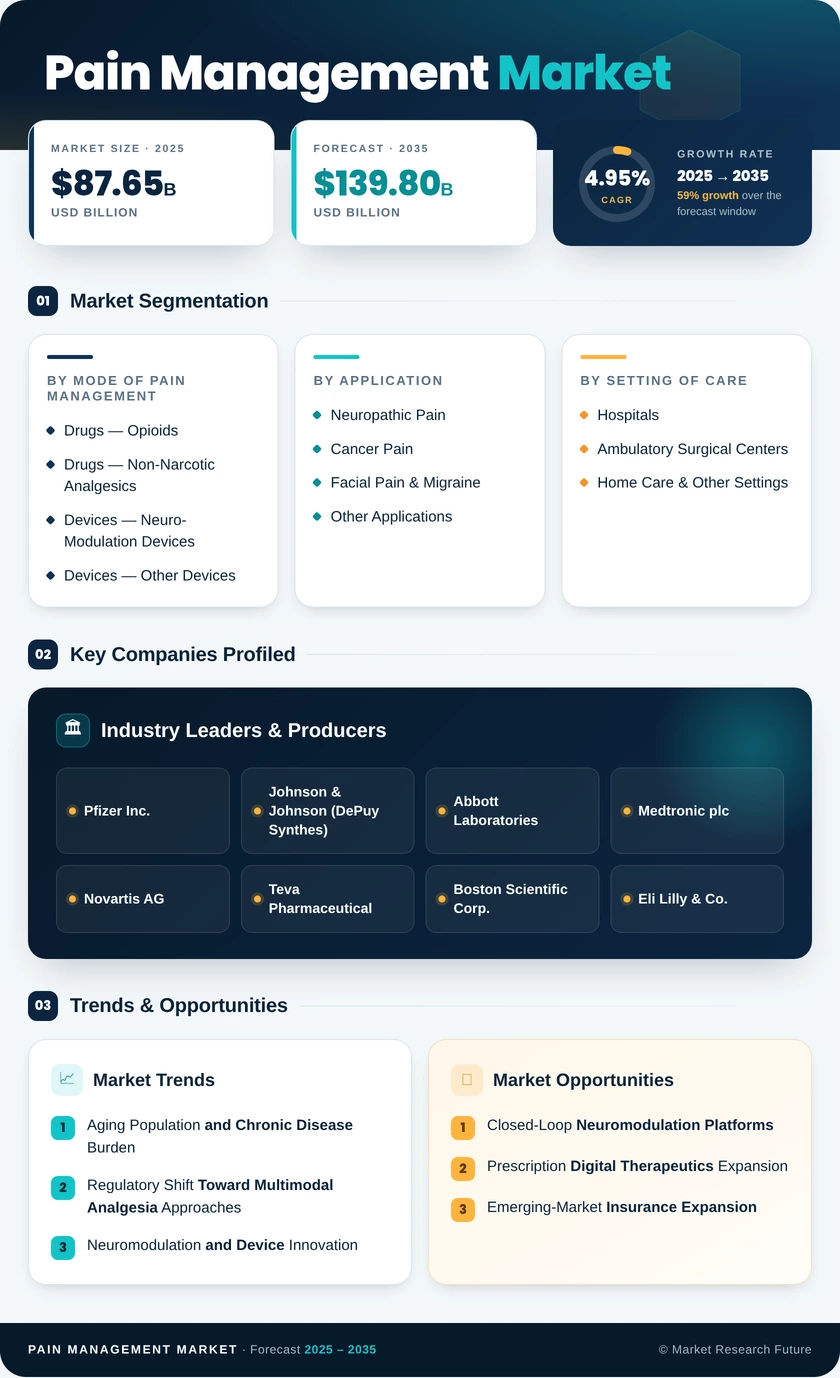
| Dimension | Sub-Segments | Dominant Segment | Fastest Growing Segment |
| Mode of Pain Management | Drugs (Opioids, Non-Narcotic Analgesics); Devices (Neuro-Modulation Devices, Other Devices) | Drugs — Opioids | Devices — Neuro-Modulation Devices |
| Application | Neuropathic Pain; Cancer Pain; Facial Pain & Migraine; Other Applications | Neuropathic Pain | Facial Pain & Migraine |
| Setting of Care | Hospitals; Ambulatory Surgical Centers; Home Care & Other Settings | Hospitals | Home Care & Other Settings |
| Geography | North America; Europe; Asia-Pacific; South America; Middle East & Africa | North America | Asia-Pacific |
MARKET SEGMENTATION OVERVIEW
By Mode of Pain Management
| Sub-Segment | Key Trend |
| Drugs — Opioids | Declining prescription volumes in developed markets are offset by sustained palliative care demand |
| Drugs — Non-Narcotic Analgesics | CGRP inhibitors and COX-2 selective agents are driving share gains as first-line therapies |
| Devices — Neuro-Modulation Devices | Closed-loop AI-adaptive spinal cord stimulators redefining durable pain relief standards |
| Devices — Other Devices | Portable TENS and radiofrequency ablation units are expanding home-care access |
The mode of pain management dimension reflects a structural shift from pharmacological dependence toward device-based and hybrid treatment models. Drug revenues remain dominant by absolute value, but device growth rates outpace pharmaceuticals by a factor of two, signaling a rebalancing of the Pain Management Market over the forecast period.
By Application
| Sub-Segment | Key Trend |
| Neuropathic Pain | The global diabetes epidemic is sustaining high treatment volumes across all care settings |
| Cancer Pain | Longer oncology survival is creating chronic rather than acute pain management needs |
| Facial Pain & Migraine | CGRP-class biologics and non-invasive neurostimulation are driving rapid commercial expansion |
| Other Applications | Musculoskeletal and post-operative pain anchoring baseline demand |
Application-level dynamics are shaped by epidemiological trends and therapeutic innovation cycles. Neuropathic pain retains the largest share due to the sheer prevalence of diabetic peripheral neuropathy, while the facial pain and migraine segment benefits from a rich clinical pipeline and favorable reimbursement dynamics.
By Setting of Care
| Sub-Segment | Key Trend |
| Hospitals | Complex interventional procedures and acute pain episodes concentrate revenue in inpatient settings |
| Ambulatory Surgical Centers | CMS reimbursement parity and lower overhead are driving procedure migration from hospitals |
| Home Care & Other Settings | Digital therapeutics and wearable neuromodulation enabling chronic pain management outside institutions |
The care-setting dimension captures the decentralization trend reshaping the Pain Management Market. Hospitals retain dominance for complex procedures, but the fastest growth accrues to home-care settings where digital platforms and portable devices enable continuous chronic pain therapy management.