×
Request Free Sample ×

Kindly complete the form below to receive a free sample of this Report

* Please use a valid business email

Leading companies partner with us for data-driven Insights

clients tt-cursor
Hero Background

PET Packaging Market

ID: MRFR/PCM/1247-HCR
129 Pages
Snehal Singh
October 2025

PET Packaging Market Research Report By Application (Bottles, Containers, Trays, Films, Labels), By End Use (Food and Beverage, Personal Care, Pharmaceuticals, Household Products), By Product Type (Rigid Packaging, Flexible Packaging, Semi-Rigid Packaging), By Raw Material (Virgin PET, Recycled PET, Biodegradable PET) and By Regional (North America, Europe, South America, Asia Pacific, Middle East and Africa) - Forecast to 2035

Share:
Download PDF ×

We do not share your information with anyone. However, we may send you emails based on your report interest from time to time. You may contact us at any time to opt-out.

PET Packaging Market Infographic
Purchase Options

PET Packaging Market Summary

As per MRFR analysis, the PET Packaging Market Size was estimated at 43162.5 USD Billion in 2024. The PET Packaging industry is projected to grow from 45018.49 USD Billion in 2025 to 68585.76 USD Billion by 2035, exhibiting a compound annual growth rate (CAGR) of 4.3 during the forecast period 2025 - 2035.

Key Market Trends & Highlights

The PET Packaging Market is experiencing a transformative shift towards sustainability and innovation.

  • The market is increasingly driven by a focus on sustainability, with companies adopting eco-friendly practices.
  • North America remains the largest market for PET packaging, while Asia-Pacific is recognized as the fastest-growing region.
  • Bottles dominate the PET packaging segment, yet trays are emerging as the fastest-growing category.
  • Key market drivers include sustainability initiatives and the rapid growth of e-commerce, enhancing consumer convenience.

Market Size & Forecast

2024 Market Size 43162.5 (USD Billion)
2035 Market Size 68585.76 (USD Billion)
CAGR (2025 - 2035) 4.3%

Major Players

Alpla Werke Alwin Lehner GmbH & Co KG (AT), Amcor plc (AU), Berry Global Inc. (US), Mondi Group plc (GB), Sealed Air Corporation (US), Plastipak Holdings, Inc. (US), SABIC (SA), Krones AG (DE), Constantia Flexibles Group GmbH (AT)

PET Packaging Market Trends

The PET Packaging Market is currently experiencing a dynamic evolution, driven by various factors that influence consumer preferences and industry practices. The increasing emphasis on sustainability appears to be a pivotal force, as manufacturers strive to develop eco-friendly solutions that minimize environmental impact. This shift is reflected in the growing demand for recycled PET materials, which not only reduce waste but also align with the global push towards circular economy principles. Furthermore, advancements in technology are facilitating innovations in design and functionality, enabling producers to create packaging that is not only visually appealing but also enhances product preservation and user convenience. In addition to sustainability, the PET Packaging Market is witnessing a notable trend towards lightweight packaging solutions. This approach not only reduces material usage but also lowers transportation costs, thereby appealing to both manufacturers and consumers. The rise of e-commerce has further accelerated the need for durable yet lightweight packaging options that can withstand the rigors of shipping. As the market continues to evolve, it is likely that these trends will shape the future landscape of PET packaging, fostering a more sustainable and efficient industry.

Sustainability Focus

The emphasis on sustainable practices is reshaping the PET Packaging Market. Companies are increasingly adopting eco-friendly materials and processes, aiming to reduce their carbon footprint and enhance recyclability.

Lightweight Packaging Solutions

There is a growing trend towards lightweight packaging in the PET sector. This approach not only conserves resources but also minimizes shipping costs, appealing to both manufacturers and consumers.

Technological Innovations

Advancements in technology are driving innovations within the PET Packaging Market. New techniques and materials are being developed to improve packaging performance, aesthetics, and functionality.

PET Packaging Market Drivers

Market Growth Projections

The Global PET Packaging Market Industry is poised for substantial growth, with projections indicating a market value of 59.7 USD Billion by 2035. This growth trajectory is underpinned by various factors, including increasing consumer demand for sustainable packaging solutions and advancements in manufacturing technologies. The anticipated CAGR of 3.52% from 2025 to 2035 reflects the industry's resilience and adaptability in meeting evolving market needs. As companies continue to innovate and respond to consumer preferences, the PET packaging sector is likely to experience robust expansion, solidifying its position in the global packaging landscape.

Sustainability Initiatives

The Global PET Packaging Market Industry is increasingly driven by sustainability initiatives as consumers and manufacturers prioritize eco-friendly solutions. With a growing emphasis on reducing plastic waste, companies are adopting recycled PET (rPET) materials. This shift not only addresses environmental concerns but also aligns with regulatory frameworks promoting sustainable packaging. For instance, the European Union's directives on single-use plastics have prompted a surge in demand for sustainable packaging options. As a result, the market is projected to reach 40.8 USD Billion in 2024, reflecting the industry's commitment to sustainability and innovation.

Technological Advancements

Technological advancements play a crucial role in enhancing the efficiency and functionality of the Global PET Packaging Market Industry. Innovations such as improved manufacturing processes and the development of smart packaging solutions are transforming the landscape. For instance, advancements in blow molding technology enable the production of lighter and more robust PET containers, reducing material usage while maintaining performance. Additionally, the integration of digital printing technologies allows for customized packaging solutions, catering to diverse consumer preferences. These technological developments are likely to sustain the market's growth trajectory, contributing to a projected CAGR of 3.52% from 2025 to 2035.

Regulatory Support for Recycling

Regulatory support for recycling initiatives is a key driver of the Global PET Packaging Market Industry. Governments worldwide are implementing policies that encourage recycling and the use of recycled materials in packaging. For instance, several countries have established targets for increasing the recycling rates of PET products, fostering a circular economy. This regulatory environment not only promotes sustainable practices but also enhances the market's appeal to environmentally conscious consumers. As a result, the demand for rPET is likely to surge, further propelling the market's growth and contributing to its projected value of 40.8 USD Billion in 2024.

Rising Demand in Food and Beverage Sector

The food and beverage sector significantly influences the Global PET Packaging Market Industry, as PET is favored for its lightweight, durability, and barrier properties. The increasing consumption of packaged foods and beverages, particularly in emerging economies, drives the demand for PET packaging solutions. For example, the convenience of PET bottles for soft drinks and water has led to a notable rise in their usage. This trend is expected to contribute to the market's growth, with projections indicating a value of 59.7 USD Billion by 2035, highlighting the sector's pivotal role in shaping the PET packaging landscape.

Consumer Preferences for Lightweight Packaging

Consumer preferences are shifting towards lightweight packaging solutions, which significantly impacts the Global PET Packaging Market Industry. Lightweight PET packaging not only reduces transportation costs but also minimizes the carbon footprint associated with logistics. As consumers become more environmentally conscious, the demand for lighter packaging options is expected to rise. This trend is particularly evident in the beverage industry, where lightweight PET bottles are increasingly preferred over traditional glass or heavier plastic alternatives. Consequently, this shift is anticipated to bolster the market's growth, aligning with the industry's overall trajectory towards sustainability and efficiency.
Market Segment Insights

By Application: Bottles (Largest) vs. Trays (Fastest-Growing)

In the PET packaging market, the application segment is predominantly represented by bottles, which hold the largest share. Bottles are widely used across various industries, particularly beverages and personal care products. Following bottles, containers and films also contribute significantly, though they are not as dominant. Trays, although currently a smaller segment, are rapidly gaining traction, especially in the food packaging area, which is becoming increasingly more important to consumers and manufacturers alike.

Bottles (Dominant) vs. Trays (Emerging)

Bottles have established themselves as the dominant application in the PET packaging market due to their versatility, lightweight nature, and ability to preserve product integrity. They are utilized extensively in the beverage industry, ranging from soft drinks to bottled water, and in personal care items such as shampoos and lotions. On the other hand, trays are emerging as a significant player in the market, primarily driven by the food packaging industry. Their ability to offer convenience and sustainability is appealing to consumers, driving growth in this segment. As food delivery services and ready-to-eat meals gain popularity, the demand for trays is expected to continue rising, positioning them as an essential application in the PET packaging landscape.

By End Use: Food and Beverage (Largest) vs. Pharmaceuticals (Fastest-Growing)

The PET packaging market for end use segments is predominantly led by the food and beverage industry, which holds a significant market share. As consumers increasingly seek convenience in packaging, particularly for ready-to-drink beverages and packaged foods, this segment continues to flourish. Personal care products also contribute to the substantial share, reflecting consumer preferences for aesthetically pleasing and functional packaging solutions. In contrast, the pharmaceuticals segment is emerging as the fastest-growing end use category. This growth is driven by a rising demand for quality and secure packaging to preserve medication efficacy. The need for compliant, safe, and visually appealing packaging solutions further stimulates growth in this vital segment, reflecting an increased focus on health and well-being among consumers.

Food and Beverage: Dominant vs. Pharmaceuticals: Emerging

The Food and Beverage sector is the cornerstone of the PET packaging market, characterized by its robust demand for lightweight and durable packaging solutions. This segment's dominance can be attributed to the shift towards packaged convenience in meal preparation and consumption. Brands are increasingly utilizing PET for its excellent barrier properties and recyclability. Conversely, the Pharmaceuticals segment is gaining traction as an emerging player in the market. With an emphasis on product integrity and safety, pharmaceutical packaging professionals are focusing on innovations that comply with stringent regulatory requirements. Enhanced technology in PET production allows for customization, such as child-resistant features and tamper-evident designs, catering to consumer safety and trust.

By Material Type: Recycled PET (Largest) vs. Virgin PET (Fastest-Growing)

In the PET Packaging Market, the segment of Recycled PET holds the largest share, reflecting a significant focus on sustainable packaging solutions. This growing preference for recycled materials is driven by environmental concerns, with consumers and brands alike prioritizing sustainability in their packaging choices. Virgin PET, on the other hand, is recognized as the fastest-growing segment, appealing to manufacturers seeking high-performance packaging with reliable material properties, particularly in applications where product integrity is crucial. The growth trends in this segment are largely attributed to rising environmental regulations and increasing demand for green packaging solutions. Companies are investing in advanced recycling technologies and innovative product designs to enhance the performance of recycled PET while ensuring compliance with industry standards. Additionally, the push towards a circular economy is driving investments in alternatives like Biodegradable PET and Coated PET, which cater to niche markets and evolving consumer preferences, ultimately reshaping the landscape of the PET packaging sector.

Recycled PET (Dominant) vs. Biodegradable PET (Emerging)

Recycled PET remains the dominant force in the PET Packaging Market due to its established infrastructure, lower production costs, and growing consumer acceptance. Its ability to reduce waste and reliance on virgin materials positions it favorably in a market increasingly obsessed with sustainability. In contrast, Biodegradable PET is an emerging player aimed at addressing the environmental issues associated with conventional plastics. While its market share is currently smaller, it is gaining traction among environmentally-conscious consumers and brands seeking to minimize their ecological footprint. The development of biodegradable alternatives is driven by technological advancements and consumer demand for innovative, eco-friendly packaging solutions, setting the stage for potential growth in the coming years.

By Production Process: Injection Molding (Largest) vs. Blow Molding (Fastest-Growing)

In the PET packaging market, the production process is primarily dominated by injection molding, which holds the largest market share among the various manufacturing methods. This technique is favored due to its efficiency, ability to produce intricate designs, and suitability for high-volume production. Subsequently, blow molding and thermoforming also contribute significantly to the market, with blow molding particularly gaining traction due to its versatility in creating hollow containers.

Injection Molding (Dominant) vs. Blow Molding (Emerging)

Injection molding remains a dominant player in the PET packaging market, known for producing a wide range of bottle shapes and sizes with superior precision and minimal wastage. This method allows for faster production cycles and improved design capabilities, making it ideal for industries requiring mass production. On the other hand, blow molding is emerging rapidly, especially in the manufacturing of lightweight containers. It leverages lesser material without compromising strength, attracting manufacturers focusing on sustainability. The increasing demand for lightweight, eco-friendly packaging solutions is fuelling blow molding’s growth, positioning it as a valuable competitor in the market.

Get more detailed insights about PET Packaging Market

Regional Insights

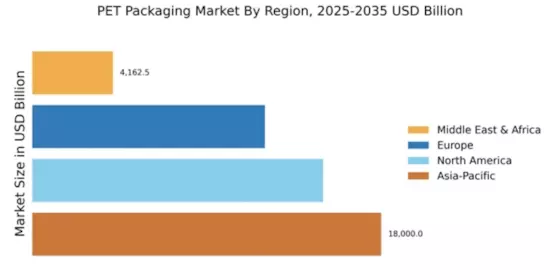
The PET Packaging Market is projected to witness substantial growth across various regions. In 2023, North America holds a significant market share, valued at 15.0 USD Billion, and is expected to grow to 20.5 USD Billion by 2032, showcasing its dominance in the industry. Europe follows, with a valuation of 10.0 USD Billion in 2023, anticipated to reach 14.0 USD Billion in 2032, driven by increasing demand for sustainable packaging solutions.

In the APAC region, the market is valued at 10.5 USD Billion, with growth to 16.0 USD Billion anticipated, benefiting from rapid industrialization and urbanization.South America demonstrates a smaller yet notable presence, valued at 2.0 USD Billion in 2023 and expected to reach 2.5 USD Billion by 2032. Meanwhile, the MEA region, valued at 2.49 USD Billion in 2023, is projected to experience a decrease, becoming valued at 1.0 USD Billion by 2032, underscoring varying market dynamics.

The PET Packaging Market revenue reflects diverse regional performance influenced by distinct economic factors and consumer preferences, with North America holding a majority share as it adapts to the increasing focus on environmentally friendly packaging solutions.

Key Players and Competitive Insights

The PET Packaging Market is currently characterized by a dynamic competitive landscape, driven by increasing demand for sustainable packaging solutions and innovations in material technology. Key players such as Amcor plc (AU), Berry Global Inc. (US), and Alpla Werke Alwin Lehner GmbH & Co KG (AT) are strategically positioning themselves to capitalize on these trends. Amcor plc (AU) has focused on enhancing its sustainability initiatives, aiming for 100% of its packaging to be recyclable or reusable by 2025. This commitment not only aligns with The PET Packaging position against competitors. Similarly, Berry Global Inc. (US) has been investing in advanced recycling technologies, which could potentially reduce its reliance on virgin materials and enhance its product offerings in the eco-conscious segment. Alpla Werke Alwin Lehner GmbH & Co KG (AT) has also been expanding its operations in emerging markets, indicating a strategic focus on regional growth and diversification.

The business tactics employed by these companies reflect a trend towards localizing manufacturing and optimizing supply chains to enhance efficiency and responsiveness to market demands. The competitive structure of the PET Packaging Market appears moderately fragmented, with several key players exerting influence over various segments. This fragmentation allows for a diverse range of products and innovations, although it also intensifies competition among established and emerging firms.

In November 2025, Amcor plc (AU) announced a partnership with a leading technology firm to develop a new line of biodegradable PET packaging. This strategic move is likely to position Amcor at the forefront of sustainable packaging solutions, appealing to environmentally conscious consumers and businesses alike. The collaboration may also enhance Amcor's R&D capabilities, enabling faster innovation cycles and improved product offerings.

In October 2025, Berry Global Inc. (US) launched a new initiative aimed at increasing the use of post-consumer recycled content in its packaging products. This initiative not only reflects a commitment to sustainability but also addresses growing regulatory pressures regarding plastic waste. By enhancing its product portfolio with recycled materials, Berry Global could strengthen its competitive edge and appeal to a broader customer base.

In September 2025, Alpla Werke Alwin Lehner GmbH & Co KG (AT) expanded its production facility in Eastern Europe, focusing on increasing capacity for sustainable PET solutions. This expansion is indicative of Alpla's strategy to meet rising demand in the region while also enhancing its operational efficiency. The move may allow Alpla to better serve its customers and respond to market trends more effectively.

As of December 2025, the PET Packaging Market is witnessing significant trends such as digitalization, sustainability, and the integration of AI technologies. These trends are reshaping competitive dynamics, with strategic alliances becoming increasingly important for innovation and market penetration. The shift from price-based competition to a focus on technological advancement and supply chain reliability is evident. Companies that prioritize innovation and sustainability are likely to differentiate themselves in this evolving landscape, suggesting a future where competitive advantage hinges on the ability to adapt to changing consumer preferences and regulatory environments.

Key Companies in the PET Packaging Market market include

Industry Developments

Recent developments in the PET Packaging Market have showcased significant shifts within key companies such as Coca-Cola, PepsiCo, and Nestle as they ramp up sustainable packaging efforts in response to increasing environmental regulations and consumer demand for eco-friendly products. Companies like Alpla and Greiner Packaging have introduced innovative recycling technologies aimed at increasing the use of recycled PET and reducing plastic waste. Meanwhile, DAK Americas and Indorama Ventures have been expanding their production capacities, driven by a rise in demand for lightweight materials and sustainable packaging solutions.

In terms of mergers and acquisitions, notable activity includes SABIC's acquisition of specific operations within the petrochemical sector to enhance its position in the PET market, as well as a strategic partnership formed between Amcor and Eastman Chemical aimed at furthering advancements in sustainable packaging technology. Growth in valuations for companies involved in the PET sector has been notable, reflecting market optimism and an accelerated transition towards greener manufacturing practices. This competitive landscape underscores the critical nature of partnerships and innovation in driving future growth within the PET Packaging Market.

Future Outlook

PET Packaging Market Future Outlook

The PET Packaging Market is projected to grow at a 4.3% CAGR from 2024 to 2035, driven by sustainability initiatives, technological advancements, and increasing consumer demand for convenience.

New opportunities lie in:

  • Expansion into biodegradable PET alternatives
  • Investment in advanced recycling technologies
  • Development of smart packaging solutions for enhanced consumer engagement

By 2035, the PET Packaging Market is expected to achieve robust growth, driven by innovation and sustainability.

Market Segmentation

PET Packaging Market End Use Outlook

  • Food and Beverage
  • Personal Care
  • Pharmaceuticals
  • Household Products
  • Industrial

PET Packaging Market Application Outlook

  • Bottles
  • Containers
  • Films
  • Sheets
  • Trays

PET Packaging Market Material Type Outlook

  • Recycled PET
  • Virgin PET
  • Biodegradable PET
  • Multi-layer PET
  • Coated PET

PET Packaging Market Production Process Outlook

  • Injection Molding
  • Blow Molding
  • Thermoforming
  • Extrusion
  • Stretch Blow Molding

Report Scope

MARKET SIZE 202443162.5(USD Billion)
MARKET SIZE 202545018.49(USD Billion)
MARKET SIZE 203568585.76(USD Billion)
COMPOUND ANNUAL GROWTH RATE (CAGR)4.3% (2024 - 2035)
REPORT COVERAGERevenue Forecast, Competitive Landscape, Growth Factors, and Trends
BASE YEAR2024
Market Forecast Period2025 - 2035
Historical Data2019 - 2024
Market Forecast UnitsUSD Billion
Key Companies ProfiledAlpla Werke Alwin Lehner GmbH & Co KG (AT), Amcor plc (AU), Berry Global Inc. (US), Mondi Group plc (GB), Sealed Air Corporation (US), Plastipak Holdings, Inc. (US), SABIC (SA), Krones AG (DE), Constantia Flexibles Group GmbH (AT)
Segments CoveredApplication, End Use, Material Type, Production Process
Key Market OpportunitiesGrowing demand for sustainable and recyclable solutions in the PET Packaging Market presents significant opportunities.
Key Market DynamicsRising consumer demand for sustainable packaging drives innovation and competition in the PET packaging sector.
Countries CoveredNorth America, Europe, APAC, South America, MEA

Market Highlights

Author
Snehal Singh
Assistant Manager - Research

High acumen in analyzing complex macro & micro markets with more than 6 years of work experience in the field of market research. By implementing her analytical skills in forecasting and estimation into market research reports, she has expertise in Packaging, Construction, and Equipment domains. She handles a team size of 20-25 resources and ensures smooth running of the projects, associated marketing activities, and client servicing.

Leave a Comment

FAQs

What is the projected CAGR for the PET Packaging Market from 2024 to 2035?

PET Packaging Market is expected to grow with a CAGR of 4.3% in the period 2025-2035

Which region is anticipated to dominate the PET Packaging Market by 2035?

North America is anticipated to dominate the PET Packaging Market, valued at 20.5 USD Billion in 2035.

What will be the market value for PET Bottles in 2035?

The market value for PET Bottles is expected to reach USD 68585.76 Billion in 2035

Who are the key players in the PET Packaging Market?

Key players in the PET Packaging Market include companies like Alpla, CocaCola, and Amcor.

Which region is expected to experience significant growth in the PET Packaging Market?

The APAC region is expected to experience significant growth, with an anticipated market size of 16.0 USD Billion in 2035.

What will be the market value of PET Labels by 2035?

The market value of PET Labels is expected to reach USD 68585.76 Billion by 2035.

What challenges may impact the PET Packaging Market's growth?

Challenges such as raw material price fluctuations and environmental regulations may impact market growth.

Download Free Sample

Kindly complete the form below to receive a free sample of this Report

Compare Licence

×
Features License Type
Single User Multiuser License Enterprise User
Price $4,950 $5,950 $7,250
Maximum User Access Limit 1 User Upto 10 Users Unrestricted Access Throughout the Organization
Free Customization
Direct Access to Analyst
Deliverable Format
Platform Access
Discount on Next Purchase 10% 15% 15%
Printable Versions