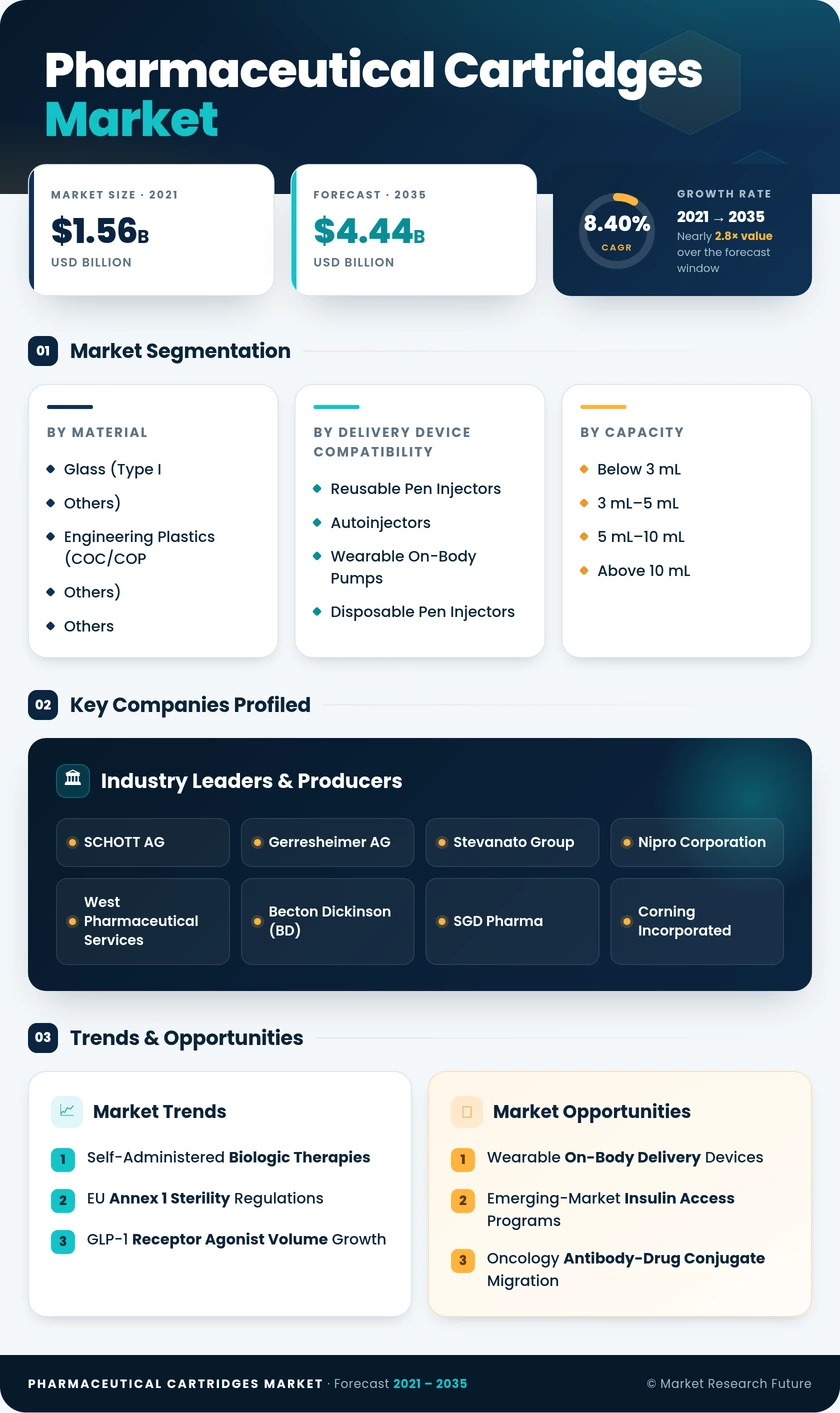
Segmentation Quick Reference
| Dimension | Sub-Segments | Dominant Segment | Fastest Growing Segment |
| Material | Glass (Type I and Others); Engineering Plastics (COC/COP and Others); Others | Glass | Engineering Plastics |
| Delivery Device Compatibility | Reusable Pen Injectors; Autoinjectors; Wearable On-Body Pumps; Disposable Pen Injectors | Reusable Pen Injectors | Wearable On-Body Pumps |
| Capacity | Below 3 mL; 3 mL–5 mL; 5 mL–10 mL; Above 10 mL | Below 3 mL | Above 10 mL |
| Therapeutic Area | Diabetes; Oncology; Autoimmune Diseases; Ophthalmology; Others | Diabetes | Oncology |
| End User | Pharmaceutical Cartridges Market Companies; CMOs/CDMOs; Research Institutions | Pharmaceutical Cartridges Market Companies | CMOs/CDMOs |
| Geography | North America; Europe; Asia-Pacific; South America; Middle East & Africa | North America | Asia-Pacific |
Market Segmentation Overview
By Material
| Sub-Segment | Key Trend |
| Glass (Type I Borosilicate and Others) | Continued dominance driven by regulatory acceptance and dimensional standardization for pen injector platforms |
| Engineering Plastics (COC/COP and Others) | Accelerating adoption for wearable devices and cold-chain applications due to break resistance and weight reduction |
| Others | Niche growth in hybrid coated cartridges and silicone-oil-free interior treatments |
Glass Type I borosilicate cartridges remain the default specification for insulin pens and most biologic delivery devices. Engineering plastics are carving out high-growth niches where glass breakage poses safety or logistical risks, particularly in home-use wearable on-body delivery systems.
By Delivery Device Compatibility
| Sub-Segment | Key Trend |
| Reusable Pen Injectors | Dominant platform sustained by the global installed base of insulin pens exceeding 500 million devices |
| Autoinjectors | Growing as biologic self-administration expands beyond insulin into immunology and oncology |
| Wearable On-Body Pumps | Fastest-growing device interface driven by large-volume (>3 mL) biologic formulations |
| Disposable Pen Injectors | Cost-competitive option gaining traction in price-sensitive emerging markets |
Reusable pen injectors anchor the largest share of cartridge demand, while wearable on-body pumps represent the most dynamic growth vector as drug formulations increasingly exceed the volumetric limits of traditional pen devices.
By Capacity
| Sub-Segment | Key Trend |
| Below 3 mL | Standard format for insulin and most small-molecule injectables |
| 3 mL–5 mL | Mid-volume format gaining share with GLP-1 and monoclonal antibody therapies |
| 5 mL–10 mL | Expanding format for high-viscosity biologics and combination therapies |
| Above 10 mL | Fastest-growing capacity tier aligned with on-body pump delivery systems |
Sub-3 mL cartridges dominate unit volumes, but the shift toward high-concentration biologic formulations is driving outsized growth in larger capacity tiers, particularly the above-10 mL segment designed for wearable devices.
By Therapeutic Area
| Sub-Segment | Key Trend |
| Diabetes | Largest therapeutic segment driven by global insulin pen cartridge consumption |
| Oncology | Fastest-growing segment as antibody-drug conjugates migrate to subcutaneous cartridge delivery |
| Autoimmune Diseases | Steady demand from TNF-inhibitor and interleukin-inhibitor pen platforms |
| Ophthalmology | Emerging cartridge-device combinations for sustained intravitreal delivery |
| Others | Includes hormonal therapies, rare diseases, and vaccine reconstitution applications |
Diabetes maintains the largest volume share, but oncology is rapidly scaling as pharmaceutical companies reformulate IV-administered ADCs for cartridge-compatible subcutaneous injection.
By End User
| Sub-Segment | Key Trend |
| Pharmaceutical Cartridges Market Companies | In-house fill-finish operations consume the majority of cartridge output globally |
| CMOs/CDMOs | Fastest-growing end-user segment driven by the outsourcing of biologic fill-finish operations |
| Research Institutions | Small but stable demand for clinical-trial-grade cartridge supply |
Large pharmaceutical companies dominate procurement, but the structural shift toward outsourced fill-finish manufacturing is positioning CMOs and CDMOs as the most dynamic demand channel for cartridge suppliers through 2035.