Pharmaceutical Isolator Market

Key Players: SKAN AG, Getinge AB, Comecer S.p.A., Fedegari Group, Dec Group, Esco Pharma, Azbil Telstar, Germfree Laboratories

Pharmaceutical Isolator Market

Pharmaceutical Isolator Market Research Report Information By Type (Open Isolator and Closed Isolator), By Product Type (Sterility Test Isolator, Process Isolator, and Decontamination Pass Box), By Product Class (ISO Class 3 and ISO Class 5), By Application (Sterility Testing, Sampling/ Weighing/Distribution, Animal Laboratories, Aseptic Tissue Handling/Microbiology Testing/Pathogenic Sampling, Defiltration and Drying, and Others), By End User (BioPharma/Cell & Gene Therapy Companies, Academic & Research Institutes, Hospitals, and Contract Research Organization & Contract Manufacturing Organization) And By Region (North America, Europe, Asia-Pacific, And Rest Of The World) โ€“Market Forecast Till 2035
ID: MRFR/Pharma/3262-CR
117 Pages
Vikita Thakur, Rahul Gotadki
Last Updated: June 22, 2026

Pharmaceutical Isolator Market Summary

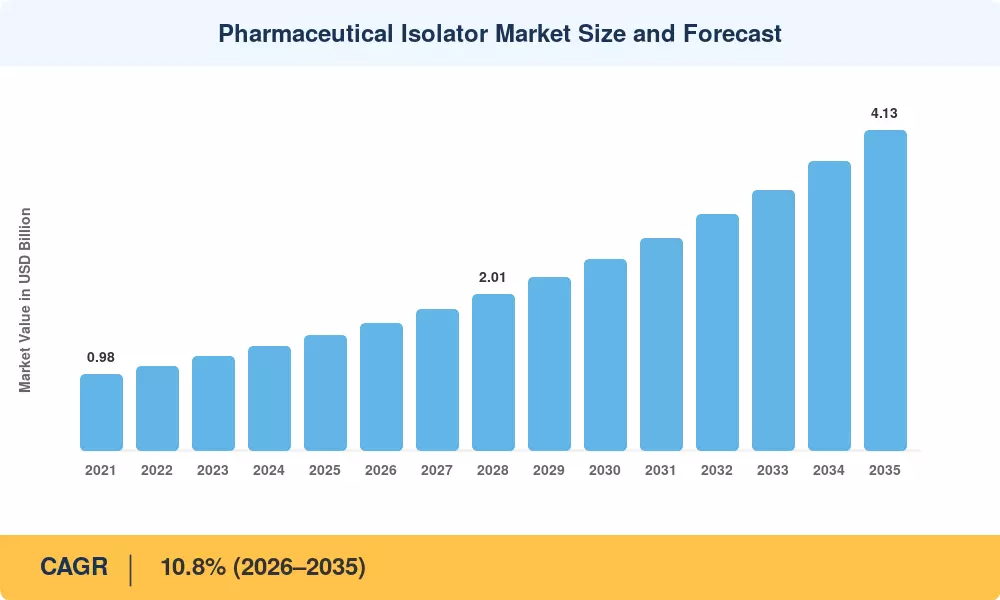
The Global Pharmaceutical Isolator Market size was valued at USD 1.48 Billion in 2025, and the market is projected to reach USD 4.13 Billion by 2035, registering a CAGR of 10.8% during the forecast period 2026โ€“2035.ย This growth trajectory reflects the pharmaceutical industry's accelerating shift toward contamination-free manufacturing environments, underpinned by tightening global regulatory frameworks. The revised EU GMP Annex 1, which took effect in August 2023, mandates enhanced contamination control strategies for sterile product manufacturing โ€” a regulatory catalyst that has driven capital expenditure toward isolator-based production lines across both established and emerging drug manufacturers [1].

A pronounced technology transition is reshaping this space. Legacy open-architecture cleanroom setups โ€” long the industry default โ€” are giving way to closed and restricted-access barrier systems that deliver Grade A environments within smaller footprints and at lower operating costs. The Pharmaceutical Research and Manufacturers of America (PhRMA) reported that its member companies invested USD 102.3 billion in R&D during 2021 alone, with cumulative investment exceeding USD 1.1 Trillion since 2000 [2]. A meaningful share of these R&D dollars now flows into sterile processing infrastructure, including isolator procurement.

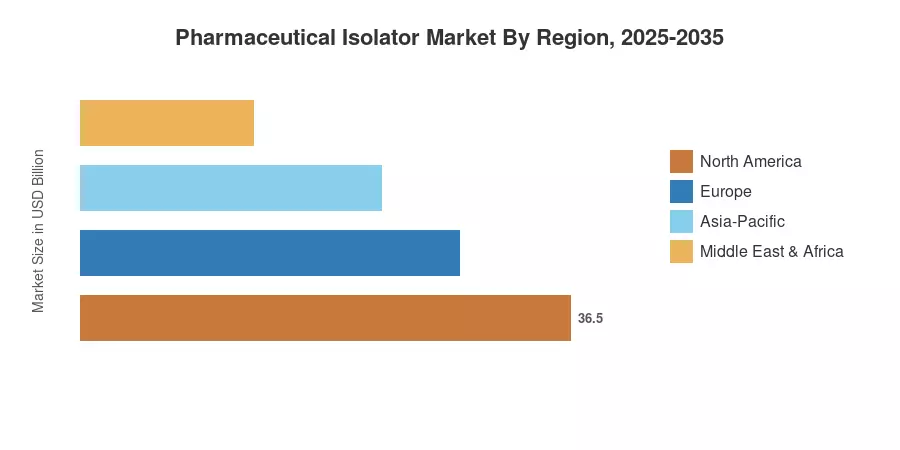
North America commands the largest share of the Pharmaceutical Isolator Market at approximately 38% of global revenue, driven by stringent FDA sterility standards and a concentrated base of biologics manufacturers. Asia-Pacific represents the fastest-growing region with a CAGR exceeding 12.4%, fueled by expanding contract manufacturing capacity in China and India. Europe holds the second-largest position, contributing roughly 29% of market revenue through its robust generic and biosimilar production ecosystem. The Pharmaceutical Isolator Market is set for sustained double-digit expansion as regulatory pressure, biologics pipelines, and facility modernization converge through 2035.

ย 

Key Report Takeaways

โ€ข By Type

  • Closed Isolator Systems account for the dominant share of the Pharmaceutical Isolator Market, representing approximately 62% of global revenue in 2025 โ€” reflecting industry preference for superior containment assurance.
  • Open Isolator Systems are projected to register a CAGR of 9.6% through 2035, gaining traction in non-sterile weighing and dispensing applications.

โ€ข By Application

  • Aseptic Isolators represent the largest application segment, valued at USD 0.67 Billion in 2025, driven by biologics and injectable drug manufacturing demand.
  • Containment Isolators are expanding at the fastest pace within this dimension, underpinned by the rising production of high-potency active pharmaceutical ingredients (HPAPIs).

โ€ข By Region

  • North America leads the Pharmaceutical Isolator Market with a 38% revenue share, anchored by FDA regulatory rigor and a high concentration of biopharmaceutical fill-finish facilities.
  • Asia-Pacific is the fastest-growing regional market, expected to surpass USD 1.08 billion by 2035 as contract development and manufacturing organizations (CDMOs) scale capacity.

ย 

Pharmaceutical Isolator Market Size and Forecast (2021โ€“2035)

Market sizing is based on a triangulated methodology combining bottom-up revenue estimates from key isolator manufacturers, top-down validation against pharmaceutical capital expenditure benchmarks, and cross-referencing with industry data from the sources. All forecast projections use a compound annual growth rate model calibrated to the 2026โ€“2035 window.

Pharmaceutical Isolator Market Size and Forecast
Our Impact
Enabled $4.3B Revenue Impact for Fortune 500 and Leading Multinationals
Partnering with 2000+ Global Organizations Each Year
30K+ Citations by Top-Tier Firms in the Industry

Driver Impact Analysis

Driver ~% Impact on CAGR Geographic Relevance Impact Timeline
Stringent sterility regulations (EU Annex 1, FDA guidance) ~22% Global Short-term (โ‰ค2 yr)
Biologics and biosimilar pipeline expansion ~20% North America, Europe Medium-term (2โ€“4 yr)
Rising HPAPI and ADC manufacturing ~16% Global Medium-term (2โ€“4 yr)
Cell and gene therapy facility buildouts ~14% North America, Asia-Pacific Long-term (โ‰ฅ4 yr)
CDMO capacity expansion in emerging economies ~12% Asia-Pacific, South America Medium-term (2โ€“4 yr)
Rapid bio-decontamination and automation advances ~9% Europe, North America Long-term (โ‰ฅ4 yr)
Pandemic preparedness and vaccine readiness investments ~7% Global Short-term (โ‰ค2 yr)

ย 

Regulatory Tightening as the Primary Demand Catalyst

With the introduction of the contamination control strategy (CCS) requirement in August 2023, the updated EU GMP Annex 1 forced producers to use closed processing facilities. Isolators directly address compliance deficiencies in facilities that previously relied on traditional cleanroom operations. In a similar vein, enhanced barrier isolation is emphasized as a recommended method to reduce operator intervention in critical zones in the FDA's established cGMP guidance on sterile medicinal products made via aseptic processing. According to industry projections, between 2024 and 2028, global cleanroom and isolator retrofit spending might reach USD 2.8 billion due to Annex 1 compliance alone [1].

ย 

Biologics Pipeline Fueling Aseptic Demand

Approximately 31% of all FDA innovative medicine approvals in 2023 were biologics, and the pipeline is still expanding [5]. The majority of these goods need aseptic fill-finish procedures, where isolators provide a proven benefit over traditional classified settings. Each new commercial biologic or biosimilar usually requires dedicated sterile filling capacity, which translates into continuous isolator procurement cycles for the Pharmaceutical Isolator Market through 2035. The worldwide biologics market exceeded USD 480 billion in 2024.

ย 

HPAPI Manufacturing Driving Containment Demand

High-potency active pharmaceutical ingredients demand occupational exposure limits below 10 ยตg/mยณ, necessitating containment-grade isolators throughout weighing, dispensing, and formulation stages. The global HPAPI market grew at roughly 9.5% annually between 2020 and 2024, with antibody-drug conjugates (ADCs) representing a particularly active subsegment. Each new ADC manufacturing suite typically requires two to four containment isolators, creating a predictable multiplier effect on the Pharmaceutical Isolator Market.

Cell and Gene Therapy Facility Investments

Over 2,000 cell and gene therapies were in clinical development globally as of early 2025, according to the Alliance for Regenerative Medicine [7]. These therapies require highly controlled, patient-specific manufacturing under Grade A conditions โ€” ideal for small-footprint, single-batch isolator configurations. Facility construction announcements from leading CDMOs in the United States, Singapore, and South Korea signal a multi-year investment cycle that directly benefits isolator suppliers.

ย 

Restraints Impact Analysis

The estimated negative impact percentages below represent the degree to which each restraint constrains overall market growth. They are directional and qualitative rather than precisely additive.

Restraint ~% Negative Impact Geographic Relevance Impact Timeline
High upfront capital cost and long payback periods ~28% Global (especially SMEs) Short-term (โ‰ค2 yr)
Validation complexity and extended commissioning timelines ~24% Global Medium-term (2โ€“4 yr)
Skilled operator shortage for isolator environments ~20% Asia-Pacific, South America Medium-term (2โ€“4 yr)
Physical space and retrofit constraints in legacy facilities ~16% Europe, North America Long-term (โ‰ฅ4 yr)
Glove integrity management and breach risk ~12% Global Short-term (โ‰ค2 yr)

ย 

Capital Intensity Barriers for Small and Mid-Sized Firms

Depending on configuration, line speed, and containment grade, a fully validated, production-scale pharmaceutical isolator systemโ€”which includes stringent installation qualification (IQ), operational qualification (OQ), and performance qualification (PQ)โ€”requires a capital outlay of between USD 2 million and more than USD 7 million per unit [10]. This enormous upfront cost competes fiercely with other site infrastructure improvements for small and mid-sized pharmaceutical enterprises, often postponing the adoption of modern isolators by 18 to 24 months. Leasing and isolator-as-a-service models are beginning to break through this barrier, but their wider market penetration is still in its infancy.

ย 

Validation Complexity and Commissioning Delays

Isolator qualification protocols typically span 6โ€“12 months from factory acceptance testing to full operational release, creating significant lead-time challenges for manufacturers facing urgent production timelines [11]. Each modification to gassing cycles, transfer systems, or glove configurations triggers revalidation, adding cost and schedule risk. This complexity acts as a friction point for the Pharmaceutical Isolator Market, particularly in fast-moving therapeutic areas where speed to clinic matters.

Workforce Readiness Gaps

Operating isolator-based production lines requires specialized training in gas decontamination cycles, environmental monitoring, glove integrity testing, and transfer validation โ€” competencies that conventional cleanroom operators may lack [12]. This skills gap is especially acute in rapidly expanding manufacturing regions across Southeast Asia and Latin America, where pharma workforce development infrastructure trails behind facility investment.

ย 

Pharmaceutical Isolator Market Opportunities

Single-Use and Disposable Isolator Technologies

The convergence of single-use bioprocessing with isolator design presents a high-growth opportunity. Pre-sterilized, gamma-irradiated isolator bags and disposable transfer sleeves reduce decontamination cycle times and eliminate cleaning validation burden. Several equipment manufacturers are investing in modular disposable isolator platforms targeting clinical-scale manufacturing.

Emerging Market Facility Buildouts

A historic โ‚น15,000 crore (about USD 1.8+ billion) budgetary framework is provided by India's Production Linked Incentive (PLI) program for pharmaceuticals, which drives significant commercial volume across biopharmaceuticals and complicated therapies [15]. Similar emphasis is placed on domestic biopharmaceutical self-sufficiency in China's 14th Five-Year Plan. High-end containment platforms, like advanced isolators and restricted access barrier systems (RABS), can be integrated from the start rather than retrofitted, thanks to these policy-driven market stimuli, which generate massive waves of private greenfield facility construction. This is a structural advantage for the Asia-Pacific pharmaceutical isolator market.

ย 

Isolator-as-a-Service and Lifecycle Revenue Models

Equipment vendors are piloting subscription-based models that bundle isolator hardware, validation services, preventive maintenance, spare glove supply, and environmental monitoring into annualized contracts. This approach lowers customer entry barriers while generating predictable recurring revenue for suppliers โ€” a business model transformation with potential to accelerate adoption among cost-sensitive CDMOs.

Radiopharmaceutical and Theranostic Manufacturing

The rapid clinical development of radiopharmaceuticals (Lu-177 DOTATATE, Ac-225 therapies) requires shielded, contained isolator environments for both hot-cell operations and final dispensing. With over 300 radiopharmaceutical clinical trials active globally in 2025, this niche represents a premium-margin expansion avenue for specialized isolator providers [16].

Digital Integration and Predictive Maintenance

Embedding IoT sensors for real-time particle counting, differential pressure monitoring, and glove integrity tracking within isolator platforms creates data monetization opportunities. Predictive maintenance algorithms can reduce unplanned downtime by an estimated 30โ€“40%, and the resulting operational data supports regulatory audit readiness.

ย 

Pharmaceutical Isolator Market Future Outlook

Automation and Robotic Integration in Isolator Environments

Robotic arms for vial handling, stopper placement, and capping within isolator chambers are moving from pilot installations to commercial deployment. By reducing human intervention inside the isolator, these systems minimize the primary contamination vector โ€” personnel-shed particles โ€” while increasing throughput by an estimated 25โ€“35% [8]. The Pharmaceutical Isolator Market will see automation become a standard rather than a premium feature by the early 2030s, reshaping competitive positioning around software and integration capability.

Modular and Podular Facility Architectures

The pharmaceutical industry's pivot toward modular cleanroom pods โ€” factory-built, pre-validated production units shipped as complete enclosures โ€” aligns naturally with isolator technology. Prefabricated isolator suites reduce facility commissioning from 18 months to as little as 6 months, addressing the speed-to-market pressure that biologics and cell therapy developers face [9]. This architectural shift could expand the addressable market for the Pharmaceutical Isolator Market by bringing isolator-grade manufacturing to geographies currently lacking conventional cleanroom infrastructure.

Sustainability and Energy Efficiency Mandates

Due to HVAC and air handling needs, traditional cleanroom operations use 10โ€“100 times more energy per square meter than typical commercial buildings [17]. Isolators significantly reduce the categorized volume that needs conditioned air, resulting in a 40โ€“60% decrease in energy usage for each batch. The energy efficiency argument for isolators enhances the economic case beyond simple regulatory compliance as pharmaceutical companies deal with growing ESG disclosure obligations and Scope 2 emissions targets.

ย 

Personalized Medicine and Small-Batch Manufacturing

The personalized medicine paradigm โ€” autologous cell therapies, patient-specific dosing, companion diagnosticโ€“linked treatments โ€” demands manufacturing flexibility that large-scale cleanrooms cannot economically deliver. Compact, rapidly decontaminated isolators suited for batch sizes of one to fifty units are emerging as the enabling infrastructure for this therapeutic category. The Pharmaceutical Isolator Market stands to benefit structurally as personalized therapies transition from clinical to commercial stages through the late 2020s and early 2030s.

ย 

Pharmaceutical Isolator Market Segmentation

By Type

Segment Key Metric Primary Demand Driver
Closed Isolator Systems ~62% market share (2025) Sterile manufacturing compliance
Open Isolator Systems 9.6% CAGR (2026โ€“2035) Weighing and dispensing applications

ย 

Closed Isolator Systems dominate the Pharmaceutical Isolator Market because they provide the highest level of environmental separation between the operator and the product, meeting Grade A conditions without reliance on surrounding classified environments. These systems are the default choice for aseptic fill-finish, sterile API handling, and any application where absolute containment is non-negotiable. Pharmaceutical companies investing in new biologics production lines overwhelmingly specify closed systems to future-proof regulatory compliance.

Open Isolator Systems, while offering lower containment assurance, are gaining adoption in less critical process steps such as non-sterile weighing, sampling, and packaging operations. Their lower cost and simpler validation requirements make them attractive for facilities transitioning from open-bench operations, particularly in price-sensitive emerging markets.

By Application

Segment Key Metric Primary Demand Driver
Aseptic Isolators USD 0.67 Billion (2025) Injectable biologics and sterile manufacturing
Containment Isolators 12.1% CAGR (2026โ€“2035) HPAPI and ADC production growth
Others ~14% market share (2025) Testing, sampling, transfer applications

ย 

Aseptic Isolators command the largest revenue position within the Pharmaceutical Isolator Market, driven by the global expansion of injectable drug manufacturing. The biologic drug pipeline โ€” spanning monoclonal antibodies, fusion proteins, and mRNA-based therapeutics โ€” requires aseptic filling under validated Grade A conditions, where isolators outperform conventional restricted access barrier systems (RABS) on contamination control metrics. Regulatory preference for isolator technology in sterile processing further reinforces this segment's dominance.

Containment Isolators represent the fastest-growing application segment, propelled by the surge in HPAPI production. The ADC therapeutic class alone has over 100 candidates in late-stage clinical development globally as of 2025, and each manufacturing process requires containment-grade equipment for handling cytotoxic payloads.

By End User

Segment Key Metric Primary Demand Driver
Pharmaceutical and Biotechnology Companies ~68% market share (2025) Commercial-scale production needs
Research Laboratories 11.5% CAGR (2026โ€“2035) Growing R&D spending, clinical-scale manufacturing
Others USD 0.07 Billion (2025) Academic institutions, regulatory labs

ย 

Pharmaceutical and Biotechnology Companies represent the core customer base for the Pharmaceutical Isolator Market, accounting for the majority of equipment procurement driven by commercial manufacturing requirements and regulatory mandates. Large pharma companies increasingly standardize on isolator-based production for new facility builds, while biotech firms entering commercial manufacturing adopt isolators to meet FDA and EMA sterility expectations from inception.

Research Laboratories are growing as an end-user segment as R&D activity shifts toward potent compounds and advanced therapies that demand controlled handling environments, even at bench and pilot scale. The blurring line between clinical and commercial manufacturing in cell and gene therapy further drives laboratory-grade isolator procurement.

ย 

Regional Market Share Analysis

Region Key Metric Primary Investment Themes
North America ~38% market share (2025) FDA compliance, biologics fill-finish
Europe ~29% market share (2025) Annex 1 compliance, biosimilar production
Asia-Pacific 12.4% CAGR (2026โ€“2035) CDMO expansion, greenfield builds
South America USD 0.09 Billion (2025) PLI-style incentives, vaccine hubs
Middle East & Africa 8.7% CAGR (2026โ€“2035) Healthcare infrastructure, local manufacturing
Total USD 1.48 Billion (2025) โ€”

The Pharmaceutical Isolator Market exhibits distinct regional dynamics shaped by regulatory maturity, manufacturing infrastructure density, and therapeutic pipeline concentration. North America and Europe collectively account for approximately two-thirds of global revenue, while Asia-Pacific is rapidly closing the gap.

ย 

North America

Country Key Metric Key Driver
US ~78% of regional revenue FDA sterile guidance, large-molecule pipeline
Canada 9.2% CAGR Biologics manufacturing incentives
Mexico USD 0.03 Billion (2025) Nearshoring pharma production

ย 

The United States dominates North America's Pharmaceutical Isolator Market through its concentration of biologics manufacturers and a regulatory framework that increasingly favors isolator-based aseptic processing over traditional cleanrooms. The FDA's emphasis on contamination risk reduction in sterile injectable production โ€” reinforced through multiple warning letters targeting inadequate environmental controls โ€” has created a compliance-driven procurement cycle. Canada's emerging biomanufacturing strategy and Mexico's growing role as a nearshore contract production hub add incremental regional demand.

Europe

Country Key Metric Key Driver
Germany ~24% of regional revenue Precision pharma manufacturing heritage
UK 11.3% CAGR Cell therapy hub expansion
France USD 0.05 Billion (2025) Biosimilar production investments
Italy ~12% of regional revenue Pharmaceutical machinery export cluster
Spain 9.8% CAGR Generic drug manufacturing
Nordic Countries USD 0.04 Billion (2025) Biopharma research facilities
Russia 8.2% CAGR Domestic pharma self-sufficiency policy
Rest of Europe ~11% of regional revenue Diversified manufacturing base

ย 

Europe's Pharmaceutical Isolator Market is shaped primarily by the EU GMP Annex 1 revision, which mandates contamination control strategies across all sterile manufacturing facilities [1]. Germany and Italy serve as both major consumers and manufacturing hubs for isolator equipment, while the UK has emerged as a center for cell and gene therapy production requiring specialized isolator configurations. The region's strong biosimilar industry โ€” projected to see over 50 new product launches between 2025 and 2030 โ€” sustains steady demand for aseptic fill-finish isolators.

Asia-Pacific

Country Key Metric Key Driver
China ~36% of regional revenue Domestic biopharma self-sufficiency push
India 13.6% CAGR PLI scheme, vaccine manufacturing scale
Japan USD 0.06 Billion (2025) Advanced therapy manufacturing
South Korea 12.8% CAGR Biosimilar export-oriented production
ASEAN ~9% of regional revenue Emerging CDMO destinations
Rest of Asia-Pacific 10.2% CAGR Diversified pharmaceutical growth

ย 

Asia-Pacific represents the fastest-growing opportunity in the Pharmaceutical Isolator Market. China's biopharma ambitions under the 14th Five-Year Plan are driving substantial greenfield facility investments, with multiple isolator-equipped production suites commissioned in Suzhou, Shanghai, and Wuhan industrial parks. India's PLI scheme has catalyzed over USD 6 billion in committed pharmaceutical infrastructure spending, translating directly into isolator procurement for sterile injectable and vaccine production lines [15]. South Korea's position as the world's largest biosimilar exporter creates recurring equipment demand.

South America

Country Key Metric Key Driver
Brazil ~58% of regional revenue Domestic vaccine production (Fiocruz, Butantan)
Argentina 9.4% CAGR Biopharmaceutical export growth
Rest of South America USD 0.01 Billion (2025) Early-stage pharma infrastructure

ย 

Brazil anchors the South American Pharmaceutical Isolator Market through government-backed vaccine production programs at institutions like Fiocruz and Instituto Butantan. Argentina's growing biopharmaceutical export sector and government incentives for local manufacturing add secondary demand, though the overall regional market remains nascent relative to established geographies.

Middle East & Africa

Country Key Metric Key Driver
Saudi Arabia ~31% of regional revenue Vision 2030 healthcare manufacturing
UAE 10.4% CAGR Free-zone pharma hub development
South Africa USD 0.01 Billion (2025) Vaccine self-sufficiency initiatives
Egypt 8.9% CAGR Generic manufacturing capacity growth
Rest of MEA ~22% of regional revenue Distributed infrastructure development

ย 

Saudi Arabia's Vision 2030 healthcare industrialization program and the UAE's free-zone pharmaceutical manufacturing strategy are the primary growth engines for the Pharmaceutical Isolator Market in this region. South Africa's post-pandemic investment in domestic vaccine manufacturing โ€” including the WHO mRNA technology transfer hub โ€” introduces targeted isolator demand for sterile fill-finish operations.

ย 

Pharmaceutical Isolator Market By Region, 2025-2035

Competitive Benchmarking

The Pharmaceutical Isolator Market operates with moderate concentration, with the top five players accounting for an estimated 45โ€“52% of global revenue. The Herfindahl-Hirschman Index (HHI) falls in the moderately concentrated range (~1,400โ€“1,600), reflecting a core group of European-headquartered specialists flanked by diversified pharmaceutical equipment conglomerates and regional niche providers. Competition centers on system customization, validation support services, and lifecycle performance rather than price alone.

Company Est. Revenue Share Range Key Offerings Strategic Positioning
SKAN AG ~10โ€“14% Aseptic isolators, robotic fill-finish systems Premium integration, Swiss engineering
Getinge AB ~8โ€“12% DPTE transfer, containment, and aseptic systems Broad sterile workflow ecosystem
Comecer S.p.A. ~7โ€“10% Nuclear and pharma isolators, VaxISO platform Radiopharmaceutical and vaccine niche
Fedegari Group ~5โ€“8% Integrated isolator-autoclave systems Sterilization process integration
Dec Group ~4โ€“7% Powder containment, PTS transfer systems High-potency compound specialization
Esco Pharma ~4โ€“6% Compounding and cleanroom isolators Asia-Pacific market leadership
Azbil Telstar ~3โ€“6% Freeze-drying isolators, turnkey solutions Lyophilization integration
Germfree Laboratories ~3โ€“5% Mobile and modular isolator suites Flexible deployment solutions
NuAire Inc. ~2โ€“4% Biological safety and compounding isolators Cost-effective laboratory segment
Steriline S.r.l. ~2โ€“4% Robotic aseptic filling isolators Automation-forward positioning

ย 

ย 

Recent News & Developments

  • SKAN AG (March 2025): Launched the next-generation isolator platform featuring integrated robotic vial handling and reduced bio-decontamination cycle times to under 25 minutes, targeting high-throughput biologics manufacturing [18].
  • European Commission (August 2023): EU GMP Annex 1 entered full enforcement, mandating contamination control strategies for all sterile pharmaceutical manufacturing sites across EU member states โ€” the single most significant regulatory driver for the Pharmaceutical Isolator Market [1].
  • Comecer S.p.A. (November 2024): Expanded its VaxISO product line with a new downstream processing isolator designed for mRNA vaccine formulation and fill-finish operations [19].

ย 

  • Esco Pharma (January 2025): Opened a new manufacturing facility in Bintan, Indonesia, to serve growing Asia-Pacific demand for pharmaceutical isolators and cleanroom equipment [21].
  • FDA (September 2024): Released updated draft guidance on sterile drug products manufacturing, reinforcing preference for closed processing systems, including isolators for aseptic operations [22].
  • Dec Group (April 2024): Introduced an enhanced powder transfer system compatible with high-containment isolators rated for OEL below 1 ยตg/mยณ, addressing ADC manufacturing requirements [23].
  • Germfree Laboratories (July 2024): Delivered mobile cleanroom-isolator units to two emerging-market vaccine manufacturers under WHO-sponsored technology transfer agreements [24].

ย 

Pharmaceutical Isolator Market Report Scope

Parameter Detail
Market Scope Global Pharmaceutical Isolator Market โ€” hardware, integration services, and aftermarket
Study Period 2021โ€“2035
CAGR (Forecast Period) 10.8% (2026โ€“2035)
Base Year Market Size USD 1.48 Billion (2025)
Forecast Endpoint USD 4.13 Billion (2035)
Fastest Growing Segment Containment Isolators (By Application); Asia-Pacific (By Region)
Companies Profiled SKAN AG, Getinge AB, Comecer, Fedegari, Dec Group, Esco Pharma, Azbil Telstar, Germfree, NuAire, Steriline
Valuation Currency USD Billion
CAGR Driver Disclaimer Impact percentages in Sections 4โ€“5 are directional indicators, not additive to aggregate CAGR

ย 

ย 

FAQs

How do pharmaceutical isolators compare to RABS for new facility investments?

Isolators deliver 10โ€“100x lower contamination rates than RABS and eliminate dependence on surrounding room classification. Higher upfront costs are offset by reduced HVAC and gowning expenses over a 10-year lifecycle [10].

What is the typical lead time from order to validated operation for a custom isolator?

Custom pharmaceutical isolator procurement through validated operation typically spans 12โ€“18 months, including design, fabrication, FAT, SAT, and full IQ/OQ/PQ qualification protocols [11].

Which decontamination method is preferred for modern pharmaceutical isolators?

Vaporized hydrogen peroxide (VHP) dominates at over 85% adoption due to rapid cycle times, material compatibility, and regulatory acceptance. Chlorine dioxide remains a niche alternative for specific applications [14].

How are isolator suppliers adapting to the growing radiopharmaceutical segment?

Suppliers integrate lead-glass shielding, remote manipulators, and specialized waste transfer ports into isolator designs. This premium segment commands 30โ€“40% price premiums over standard aseptic units [16].

What role do isolators play in compounding pharmacies?

USP <797> and USP <800> standards increasingly require isolator use for hazardous drug compounding and sterile preparation. Hospital pharmacy isolator adoption has grown approximately 15% annually since 2022 [22].

How does modular isolator design reduce the total cost of ownership?

Modular platforms enable standardized qualification packages, shared spare-parts inventories, and faster revalidation after process changes โ€” collectively reducing lifecycle costs by an estimated 20โ€“30% versus bespoke systems [9].

What cybersecurity considerations apply to digitally connected isolator systems?

IoT-enabled isolators require validated network segmentation, encrypted data logging, and compliance with FDA 21 CFR Part 11 for electronic records. Cybersecurity risk assessments are becoming part of standard procurement specifications [8]. ย  ย 
Author
Author
Author Profile
Vikita Thakur LinkedIn
Senior Research Analyst
She holds an experience of about 5+ years in market research and business consulting projects for sectors such as life sciences, medical devices, and healthcare IT. She possesses a robust background in data analysis, market estimation, competitive intelligence, pipeline analysis market trend identification, and consumer behavior insights. Her expertise lies in technical Sales support, client interaction and project management, designing and implementing market research studies, conducting competitive analysis, and synthesizing complex data into actionable recommendations that drive business growth.
Co-Author
Co-Author Profile
Rahul Gotadki LinkedIn
Research Manager
He holds an experience of about 9+ years in Market Research and Business Consulting, working under the spectrum of Life Sciences and Healthcare domains. Rahul conceptualizes and implements a scalable business strategy and provides strategic leadership to the clients. His expertise lies in market estimation, competitive intelligence, pipeline analysis, customer assessment, etc.

Research Approach

ย 

Secondary Research

The secondary research process involved comprehensive analysis of pharmaceutical regulatory databases, GMP guidelines, peer-reviewed engineering journals, sterile manufacturing publications, and authoritative health technology organizations. Key sources included the US Food & Drug Administration (FDA) Center for Drug Evaluation and Research (CDER) and Center for Biologics Evaluation and Research (CBER), European Medicines Agency (EMA) Good Manufacturing Practice Guidelines, International Society for Pharmaceutical Engineering (ISPE), Parenteral Drug Association (PDA), United States Pharmacopeia (USP), International Organization for Standardization (ISO 14644 cleanroom standards), National Institute for Occupational Safety and Health (NIOSH), Occupational Safety and Health Administration (OSHA) containment guidelines, International Council for Harmonisation (ICH) Q7-Q10 guidelines, Pharmaceutical Inspection Co-operation Scheme (PIC/S), and national health ministry reports from key markets including Health Canada, MHRA (UK), PMDA (Japan), and NMPA (China). These sources were used to collect GMP inspection data, regulatory compliance requirements for aseptic processing, sterile manufacturing statistics, contamination control standards, cleanroom classification trends, and market landscape analysis for open isolators, closed isolators, sterility testing equipment, and containment systems.

ย 

Primary Research

To gather both qualitative and quantitative insights, supply-side and demand-side stakeholders were interviewed during the primary research phase. Managing directors, vice presidents of engineering, and heads of aseptic systems were among the supply-side sources. Heads of product development, regulatory affairs, and commercial directors from manufacturers of pharmaceutical isolators, suppliers of cleanroom technology, integrators of automation systems, and original equipment manufacturers of containment solutions. Chief Manufacturing Officers, Directors of Quality Assurance, Heads of Aseptic Manufacturing, Heads of Sterility Assurance, and procurement leads from biopharma companies, cell and gene therapy manufacturers, CDMOs/CMOs, academic research institutes, and hospital pharmacy compounding centers were among the demand-side sources. Primary research confirmed automation integration timelines, validated market segmentation across isolator types and product classes, and collected information on aseptic filling and sterility testing adoption patterns, pricing strategies for isolator systems versus traditional cleanrooms, and compliance dynamics with changing GMP Annex 1 requirements.

Primary Respondent Breakdown:

By Designation: C-level Primaries (30%), Director Level (35%), Others (35%)

By Region: North America (38%), Europe (28%), Asia-Pacific (25%), Rest of World (9%)

ย 

Market Size Estimation

Global market valuation was derived through revenue mapping and installation base analysis. The methodology included:

Identification of 45+ key manufacturers across North America, Europe, Asia-Pacific, and Latin America specializing in containment isolators, aseptic processing isolators, and sterility test workstations

Product mapping across open isolators, closed isolators, sterility test isolators, process isolators (filling lines, sampling/weighing), and decontamination pass boxes

Analysis of reported and modeled annual revenues specific to pharmaceutical isolator portfolios, including hardware sales, installation services, and validation support

Coverage of manufacturers representing 70-75% of global market share in 2024, including major players in barrier isolation technology for biopharmaceutical manufacturing

Extrapolation using bottom-up (installation volume ร— average selling price by country/region, segmented by ISO class and application) and top-down (manufacturer revenue validation and service contract analysis) approaches to derive segment-specific valuations for sterility testing, aseptic manufacturing, and cell & gene therapy applications

Download Free Sample

Kindly complete the form below to receive a free sample of this Report

Download PDF ×

We do not share your information with anyone. However, we may send you emails based on your report interest from time to time. You may contact us at any time to opt-out.