×
Request Free Sample ×

Kindly complete the form below to receive a free sample of this Report

Leading companies partner with us for data-driven Insights

clients tt-cursor
Hero Background

Pine Components Market

ID: MRFR/PCM/61743-CR
200 Pages
Varsha More
August 2025

Pine Components Market Research Report Information By Product Type (Finger-Jointed Pine, Laminated Pine (Glue-Laminated Timber / Glulam)), By Application (Window Frames, Door Frames, Furniture Components, Mouldings & Trims, Structural Components, Interior Paneling), By End-Use Industry (Construction (Residential & Commercial), Furniture Manufacturing, Joinery Workshops, DIY/Consumer Use) , By Grade / Quality ( Clear Grade, Industrial Grade, Knotty Grade) , By Treatment (Untreated, Pressure Treated, Heat Treated, Primed / Painted... read more

Share:
Download PDF ×

We do not share your information with anyone. However, we may send you emails based on your report interest from time to time. You may contact us at any time to opt-out.

Pine Components Market Infographic
Purchase Options

Pine Components Market Summary

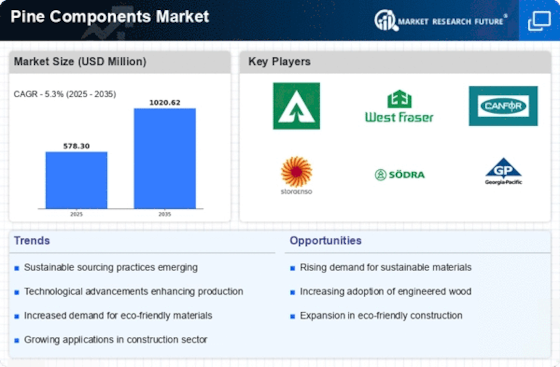
As per MRFR analysis, the Pine Components Market Size was estimated at 578.3 USD Million in 2024. The Pine Components industry is projected to grow from 608.95 USD Million in 2025 to 1020.62 USD Million by 2035, exhibiting a compound annual growth rate (CAGR) of 5.3 during the forecast period 2025 - 2035.

Key Market Trends & Highlights

The Pine Components Market is experiencing a dynamic shift towards sustainability and technological innovation.

  • North America remains the largest market for pine components, driven by robust construction activities and consumer demand.
  • The Asia-Pacific region is emerging as the fastest-growing market, fueled by increasing urbanization and infrastructure development.
  • Finger-jointed pine continues to dominate the market, while laminated pine is witnessing rapid growth due to its enhanced durability and aesthetic appeal.
  • Sustainability initiatives and rising construction activities are key drivers propelling the demand for window frames and door frames in the pine components market.

Market Size & Forecast

2024 Market Size 578.3 (USD Million)
2035 Market Size 1020.62 (USD Million)
CAGR (2025 - 2035) 5.3%

Major Players

Weyerhaeuser (US), West Fraser Timber Co. Ltd. (CA), Canfor Corporation (CA), Stora Enso (FI), Södra (SE), Georgia-Pacific LLC (US), Metsa Group (FI), Klausner Group (DE), Interfor Corporation (CA)

Pine Components Market Trends

The Pine Components Market is currently experiencing a dynamic evolution, driven by various factors that influence demand and supply. The increasing preference for sustainable materials in construction and furniture manufacturing is notable. As consumers become more environmentally conscious, the shift towards renewable resources like pine wood appears to gain momentum. This trend is further supported by government initiatives promoting sustainable forestry practices, which may enhance the availability of pine components in the market. Additionally, the versatility of pine wood, characterized by its lightweight nature and ease of processing, positions it favorably across multiple applications, including interior design and cabinetry. Moreover, the Pine Components Market seems to be influenced by technological advancements in production processes. Innovations in wood treatment and preservation techniques could potentially extend the lifespan and durability of pine products, making them more appealing to manufacturers and consumers alike. Furthermore, the rise of e-commerce platforms facilitates broader access to pine components, allowing small businesses and individual consumers to engage with the market more easily. As these trends unfold, the Pine Components Market is likely to witness a transformation that aligns with contemporary consumer preferences and technological progress.

Sustainability Focus

The emphasis on sustainable practices is reshaping the Pine Components Market. As environmental awareness grows, consumers increasingly seek products made from renewable resources. This shift encourages manufacturers to adopt eco-friendly sourcing and production methods, thereby enhancing the appeal of pine components.

Technological Advancements

Innovations in wood processing and treatment technologies are influencing the Pine Components Market. Enhanced preservation techniques may improve the durability and aesthetic qualities of pine products, making them more attractive to a wider range of applications.

E-commerce Growth

The expansion of online retail platforms is transforming how consumers access pine components. This trend allows for greater market reach, enabling small businesses and individual buyers to easily procure pine products, thus broadening the market's customer base.

Pine Components Market Drivers

E-commerce Expansion

The expansion of e-commerce is significantly impacting the Pine Components Market. With the rise of online shopping, consumers are increasingly seeking convenient access to a variety of pine products. This trend is prompting manufacturers and retailers to enhance their online presence and streamline distribution channels. Recent statistics indicate that e-commerce sales in the home improvement sector have grown by 25% over the past year. As a result, companies that effectively leverage e-commerce platforms are likely to capture a larger share of the Pine Components Market. This shift not only broadens market reach but also enhances customer engagement through personalized shopping experiences.

Technological Innovations

Technological innovations are reshaping the Pine Components Market, driving efficiency and product quality. Advanced manufacturing techniques, such as automated cutting and precision milling, are enabling producers to optimize resource use and reduce waste. Furthermore, the integration of digital technologies, including artificial intelligence and machine learning, is enhancing supply chain management and customer engagement. Data indicates that companies investing in technology are experiencing productivity increases of up to 20%. As these innovations continue to evolve, they are expected to play a crucial role in meeting the rising demand for high-quality pine components, thereby influencing market dynamics.

Sustainability Initiatives

The Pine Components Market is increasingly influenced by sustainability initiatives. As consumers become more environmentally conscious, there is a growing demand for sustainably sourced pine products. This shift is prompting manufacturers to adopt eco-friendly practices, such as responsible forestry and reduced carbon footprints. According to recent data, the market for sustainable wood products is projected to grow at a compound annual growth rate of 6.5% over the next five years. This trend not only enhances brand reputation but also aligns with regulatory pressures aimed at promoting sustainable practices. Consequently, companies that prioritize sustainability in their operations are likely to gain a competitive edge in the Pine Components Market.

Rising Construction Activities

The Pine Components Market is experiencing a surge in demand due to rising construction activities. As urbanization accelerates, there is an increasing need for building materials, particularly in residential and commercial sectors. Data suggests that the construction industry is projected to grow by 4.2% annually, which directly impacts the demand for pine components used in framing, flooring, and cabinetry. This growth is further fueled by government initiatives aimed at infrastructure development, which are likely to sustain the momentum in the Pine Components Market. Consequently, manufacturers are adapting their production strategies to meet the evolving needs of the construction sector.

Consumer Preferences for Aesthetics

Consumer preferences for aesthetics are shaping the Pine Components Market, as buyers increasingly seek visually appealing products. The natural beauty of pine, characterized by its unique grain patterns and warm tones, is becoming a preferred choice for interior design. This trend is particularly evident in the furniture and cabinetry sectors, where aesthetic appeal plays a crucial role in purchasing decisions. Market analysis indicates that products emphasizing design and craftsmanship are witnessing higher demand, with a projected growth rate of 5% in the premium segment. As manufacturers respond to these preferences, the Pine Components Market is likely to see a diversification of product offerings that cater to aesthetic sensibilities.


Market Segment Insights

By Product Type: Finger-Jointed Pine (Largest) vs. Laminated Pine (Fastest-Growing)

The Pine Components Market reveals a clear distinction in market share between Finger-Jointed Pine and Laminated Pine. Finger-Jointed Pine holds a significant position as the largest segment, driven by its versatile applications in construction and furniture making. In contrast, Laminated Pine has emerged rapidly, tapping into the increasing demand for engineered wood products. This segment is experiencing heightened interest due to its strength, stability, and aesthetic appeal, making it a preferred choice for modern architectural designs.

Pine Components Market: Finger-Jointed Pine (Dominant) vs. Laminated Pine (Emerging)

Finger-Jointed Pine is recognized as a dominant force in the Pine Components Market, characterized by its structural integrity and cost-effectiveness. It is widely used in both residential and commercial applications, offering excellent performance in load-bearing structures. Meanwhile, Laminated Pine is an emerging segment that has gained traction due to its innovative manufacturing processes. This engineered wood product not only enhances design flexibility but also meets sustainability concerns, appealing to environmentally conscious consumers. As the market for eco-friendly materials grows, Laminated Pine's advanced properties are driving its rapid adoption, positioning it as a strong contender to challenge traditional offerings.

By Application: Window Frames (Largest) vs. Door Frames (Fastest-Growing)

Among the various application segments within the Pine Components Market, Window Frames hold the largest share due to their fundamental role in construction and home improvement projects. The preference for aesthetically pleasing and durable window frames has bolstered their market position, making them a staple in both residential and commercial buildings. Following closely are Door Frames, which showcase rapid growth driven by increased construction activities and renovation projects as the demand for energy-efficient doors escalates. In terms of growth trends, Door Frames have emerged as the fastest-growing segment, fueled by the rising emphasis on energy-efficient solutions and sustainable building practices. The trend towards customizable and innovative door frame designs is attracting a wider customer base, contributing to this growth. Moreover, urbanization and infrastructure development are projected to significantly enhance the application of various pine components, especially in regions witnessing a construction boom.

Window Frames (Dominant) vs. Furniture Components (Emerging)

Window Frames are positioned as the dominant application within the Pine Components Market due to their critical importance in both structural integrity and aesthetic appeal. They are preferred for their natural insulation properties, versatility, and alignment with contemporary design trends. Meanwhile, Furniture Components have emerged as a dynamic segment, showing potential for significant growth as consumer preferences evolve towards sustainable and locally sourced materials. These components are increasingly used in custom furniture designs and items that require durable yet attractive finishes. The combination of sustainability concerns and the customization trend is pushing Furniture Components to establish a firmer foothold in the market, indicating a shift in consumer priorities towards functional and eco-friendly solutions.

By End-Use Industry: Construction (Largest) vs. DIY/Consumer Use (Fastest-Growing)

In the Pine Components Market, the 'End-Use Industry' segment exhibits a diverse landscape, with construction—both residential and commercial—emerging as the dominant force in terms of market share. The furniture manufacturing sector closely follows, leveraging the aesthetic appeal and sustainability of pine components. Meanwhile, joinery workshops and DIY/consumer use have carved out notable positions, appealing to niche markets where craftsmanship and personal expression are valued. This distribution highlights construction’s stronghold while signaling potential growth areas in other segments. Growth trends within the Pine Components Market are significantly influenced by the rising demand for sustainable and eco-friendly building materials, particularly in the construction sector. This trend is bolstering investments in residential and commercial projects, thus sustaining growth. DIY and consumer use segments are witnessing a surge fueled by increased home improvement activities and the popularity of self-made furniture. Furthermore, the growing awareness of sustainable sourcing is expected to elevate pine components' market trajectory, enhancing their appeal in varied consumer segments.

Construction (Dominant) vs. DIY/Consumer Use (Emerging)

The construction sector stands as the dominant player within the Pine Components Market, driven by its extensive applications in residential and commercial construction projects. Its reliance on sustainable materials aligns well with current architectural trends favoring eco-friendly practices. Meanwhile, the DIY/consumer use segment is emerging robustly, thanks to a cultural shift towards personalized home improvement projects. This segment thrives on consumer creativity and the rising trend of crafting, leading to a greater demand for high-quality pine components. Both segments reflect an evolving landscape, with construction maintaining its dominance while DIY continues to capture the interest of an increasingly engaged consumer base.

By Grade / Quality: Clear Grade (Largest) vs. Knotty Grade (Fastest-Growing)

The Pine Components Market is segmented primarily into three grades: Clear Grade, Industrial Grade, and Knotty Grade. Clear Grade holds the largest share in this segment due to its high demand in quality-conscious applications such as furniture and cabinetry. Industrial Grade follows, catering primarily to construction and utility purposes. Knotty Grade, often overlooked, is quickly gaining traction thanks to its affordability and aesthetic appeal in rustic designs, thus capturing a growing consumer base who are conscious of cost without compromising on style.

Clear Grade: Dominant vs. Knotty Grade: Emerging

Clear Grade is recognized for its superior quality, making it the dominant player in the Pine Components Market. This grade is characterized by its smooth surface and minimal blemishes, which are preferred in high-end applications like furniture and cabinetry. On the other hand, Knotty Grade is emerging as a popular choice, driven by its rustic charm and cost-effectiveness. It appeals to budget-conscious consumers who appreciate its unique visual appeal despite the presence of knots. The demand for Knotty Grade is increasing as trends towards sustainable and reclaimed wood gain momentum, making both grades crucial in their respective niches.

By Treatment: Pressure Treated (Largest) vs. Heat Treated (Fastest-Growing)

In the Pine Components Market, the Treatment segment consists of various categories, including Untreated, Pressure Treated, Heat Treated, and Primed/Painted. Among these categories, Pressure Treated pine components maintain the largest market share, attributed to their durability and resistance to decay in outdoor applications. Conversely, while Untreated components hold a steady position, they lack the protective features that treated wood offers, leading to a smaller market share compared to their treated counterparts. The growth trends within the Pine Components Market are significantly influenced by increased demand for sustainable and long-lasting materials. Heat Treated pine components are emerging rapidly due to rising environmental consciousness and regulations against pest transport, leading to their status as the fastest-growing segment. The ongoing advancements in treatment technologies also contribute to the enhanced appeal of treated wood products, driving their growth in various construction and landscaping applications.

Pressure Treated (Dominant) vs. Heat Treated (Emerging)

Pressure Treated pine components are considered the dominant choice in the market due to their superior resistance to insects, moisture, and decay, making them ideal for outdoor construction projects. This durability leads to their widespread use in decking, fencing, and other outdoor applications, providing a long-lasting solution for consumers. On the other hand, Heat Treated pine components are gaining recognition as an emerging alternative, especially for those seeking eco-friendly options. They involve a process that eliminates pests without harmful chemicals, appealing to environmentally-conscious builders. As sustainability trends continue to rise, the Heat Treated segment is expected to see substantial growth, carving out a niche market among actively green-certified projects.

By Distribution Channel: Online Platforms (Largest) vs. Retail (Fastest-Growing)

The Pine Components Market demonstrates a competitive distribution landscape, with Online Platforms leading the channel share due to enhanced convenience and accessibility for consumers. Retail channels, particularly hardware and building supply stores, maintain a significant presence, catering to traditional buyers who prefer direct product inspection. Direct Sales and Distributors/Wholesalers play vital roles in specific sectors, integrating personalized service and bulk purchasing options, yet their market shares are comparatively smaller than the digital offerings. In recent years, the growth trend for Online Platforms has surged, driven by the increasing preference for e-commerce and a shift towards digital purchasing. Meanwhile, Retail has emerged as the fastest-growing segment, benefiting from rising DIY trends and consumers seeking local sourcing options. The evolution of distribution strategies enhances overall market penetration and portfolio diversity for businesses in the Pine Components Market.

Retail (Dominant) vs. Distributors (Emerging)

Within the Pine Components Market, Retail channels are currently dominant due to their ability to connect directly with end-users, offering immediate access and a tactile purchasing experience. Hardware and building supply stores attract customers looking for quality assurance and comprehensive product selection. In contrast, Distributors/Wholesalers represent an emerging segment, appealing to businesses seeking bulk procurement and logistical support. Their growing significance lies in product accessibility and customer relationship management, positioning them as key players in enhancing supply efficiency and reaching diverse market segments. As the market evolves, both channels will be essential in meeting varied consumer demands and sustaining growth.

Get more detailed insights about Pine Components Market

Regional Insights

North America : Leading Market for Pine Components Market

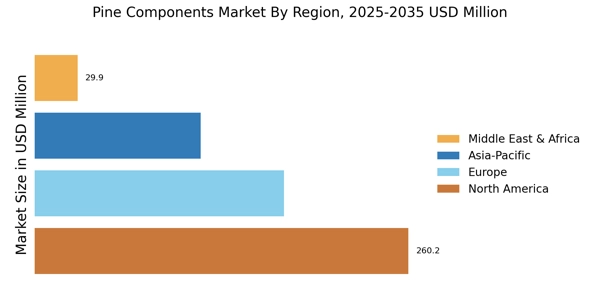
North America is the largest market for pine components, holding approximately 45% of the global market share. The region's growth is driven by a robust construction sector, increasing demand for sustainable building materials, and favorable regulations promoting forestry management. The U.S. and Canada are the primary contributors, with significant investments in sustainable forestry practices and technology. The competitive landscape is dominated by key players such as Weyerhaeuser, Georgia-Pacific, and Canfor Corporation. These companies leverage advanced technologies and sustainable practices to enhance production efficiency. The presence of established supply chains and a focus on eco-friendly products further strengthen their market position, making North America a pivotal region in the pine components market.

Europe : Sustainable Practices in Focus

Europe is witnessing a growing demand for pine components, accounting for approximately 30% of the global market share. The region's growth is fueled by stringent regulations promoting sustainable forestry and eco-friendly construction practices. Countries like Sweden and Finland lead the market, supported by government initiatives aimed at enhancing forest management and reducing carbon footprints. The competitive landscape features major players such as Stora Enso and Södra, who are at the forefront of sustainable practices. The presence of advanced technology in production processes and a strong emphasis on innovation further bolster the market. The European market is characterized by a collaborative approach among stakeholders to promote sustainability and efficiency in the pine components sector.

Asia-Pacific : Emerging Market with Potential

Asia-Pacific is emerging as a significant player in the pine components market, holding around 20% of the global market share. The region's rapid urbanization and increasing construction activities are key drivers of demand. Countries like China and Australia are leading the market, supported by government initiatives to boost infrastructure development and sustainable forestry practices. The competitive landscape is evolving, with local players gaining traction alongside established companies. The presence of key players such as Interfor Corporation and Klausner Group enhances market dynamics. The region is witnessing a shift towards sustainable practices, with an increasing focus on eco-friendly materials in construction, positioning Asia-Pacific for substantial growth in the coming years.

Middle East and Africa : Resource-Rich Yet Challenging Market

The Middle East and Africa region holds approximately 5% of The Pine Components Market share. Despite challenges such as regulatory hurdles and limited forest resources, the region is witnessing a gradual increase in demand driven by construction and infrastructure projects. Countries like South Africa are leading the market, supported by initiatives to promote sustainable forestry and timber usage. The competitive landscape is characterized by a mix of local and international players. Companies are increasingly focusing on sustainable practices to meet regulatory requirements and consumer demand. The presence of key players is growing, but the market still faces challenges related to resource availability and regulatory compliance, which could impact future growth prospects.

Pine Components Market Regional Image

Key Companies in the Pine Components Market market include

Future Outlook

Pine Components Market Future Outlook

The Pine Components Market is projected to grow at a 5.3% CAGR from 2024 to 2035, driven by increasing demand for sustainable materials and technological advancements.

New opportunities lie in:

  • Expansion into eco-friendly product lines targeting green construction projects.
  • Development of advanced manufacturing techniques to enhance product durability.
  • Strategic partnerships with construction firms to secure long-term supply contracts.

By 2035, the Pine Components Market is expected to achieve robust growth, solidifying its position in the global market.

Market Segmentation

Pine Components Market Treatment Outlook

  • Untreated
  • Pressure Treated
  • Heat Treated
  • Primed / Painted

Pine Components Market Application Outlook

  • Window Frames
  • Door Frames
  • Furniture Components
  • Mouldings & Trims
  • Structural Components
  • Interior Paneling

Pine Components Market Product Type Outlook

  • Finger-Jointed Pine
  • Laminated Pine (Glue-Laminated Timber / Glulam)

Pine Components Market Grade / Quality Outlook

  • Clear Grade
  • Industrial Grade
  • Knotty Grade

Pine Components Market End-Use Industry Outlook

  • Construction (Residential & Commercial)
  • Furniture Manufacturing
  • Joinery Workshops
  • DIY/Consumer Use

Pine Components Market Distribution Channel Outlook

  • Direct Sales
  • Retail (Hardware & Building Supply Stores)
  • Online Platforms
  • Distributors / Wholesalers

Report Scope

MARKET SIZE 2024578.3(USD Million)
MARKET SIZE 2025608.95(USD Million)
MARKET SIZE 20351020.62(USD Million)
COMPOUND ANNUAL GROWTH RATE (CAGR)5.3% (2024 - 2035)
REPORT COVERAGERevenue Forecast, Competitive Landscape, Growth Factors, and Trends
BASE YEAR2024
Market Forecast Period2025 - 2035
Historical Data2019 - 2024
Market Forecast UnitsUSD Million
Key Companies ProfiledMarket analysis in progress
Segments CoveredMarket segmentation analysis in progress
Key Market OpportunitiesGrowing demand for sustainable building materials enhances opportunities in the Pine Components Market.
Key Market DynamicsRising demand for sustainable building materials drives innovation and competition in the Pine Components Market.
Countries CoveredNorth America, Europe, APAC, South America, MEA

Leave a Comment

FAQs

What is the current valuation of the Pine Components Market as of 2024?

The Pine Components Market was valued at 578.3 USD Million in 2024.

What is the projected market valuation for the Pine Components Market in 2035?

The market is projected to reach a valuation of 1020.62 USD Million by 2035.

What is the expected CAGR for the Pine Components Market during the forecast period 2025 - 2035?

The expected CAGR for the Pine Components Market during the forecast period 2025 - 2035 is 5.3%.

Which companies are considered key players in the Pine Components Market?

Key players in the market include Weyerhaeuser, West Fraser Timber Co. Ltd., Canfor Corporation, and others.

What are the main product types in the Pine Components Market and their valuations?

The main product types include Finger-Jointed Pine valued between 230.0 and 400.0 USD Million and Laminated Pine valued between 348.3 and 620.62 USD Million.

What applications dominate the Pine Components Market?

Dominant applications include Structural Components valued between 150.0 and 280.0 USD Million and Furniture Components valued between 120.0 and 220.0 USD Million.

Download Free Sample

Kindly complete the form below to receive a free sample of this Report

Compare Licence

×
Features License Type
Single User Multiuser License Enterprise User
Price $4,950 $5,950 $7,250
Maximum User Access Limit 1 User Upto 10 Users Unrestricted Access Throughout the Organization
Free Customization
Direct Access to Analyst
Deliverable Format
Platform Access
Discount on Next Purchase 10% 15% 15%
Printable Versions