×
Request Free Sample ×

Kindly complete the form below to receive a free sample of this Report

* Please use a valid business email

Leading companies partner with us for data-driven Insights

clients tt-cursor
Hero Background

Polyethylene Naphthalate Market

ID: MRFR/CnM/4464-HCR
100 Pages
Anshula Mandaokar
October 2025

Polyethylene Naphthalate (PEN) Market Research Report Information: by Manufacturing Process (Acid and Ester), by Application (Beverage Bottling, Food Packaging, Electronics, Rubber Tires, and Others), and by Region - Forecast till 2035

Share:
Download PDF ×

We do not share your information with anyone. However, we may send you emails based on your report interest from time to time. You may contact us at any time to opt-out.

Polyethylene Naphthalate Market Infographic
Purchase Options

Polyethylene Naphthalate Market Summary

As per MRFR analysis, the Polyethylene Naphthalate Market Size was estimated at 3.9 USD Million in 2024. The Polyethylene Naphthalate industry is projected to grow from 4.07 in 2025 to 6.27 by 2035, exhibiting a compound annual growth rate (CAGR) of 4.42 during the forecast period 2025 - 2035.

Key Market Trends & Highlights

The Polyethylene Naphthalate Market is poised for robust growth driven by sustainability and technological advancements.

  • North America remains the largest market for Polyethylene Naphthalate, driven by its extensive use in packaging applications.
  • Asia-Pacific is emerging as the fastest-growing region, reflecting a surge in demand for innovative materials.
  • The film segment continues to dominate the market, while the sheet segment is witnessing rapid growth due to diverse applications.
  • Rising demand in the packaging sector and regulatory support for sustainable materials are key drivers propelling market expansion.

Market Size & Forecast

2024 Market Size 3.9 (USD Million)
2035 Market Size 6.27 (USD Million)
CAGR (2025 - 2035) 4.42%

Major Players

Mitsubishi Gas Chemical (JP), BASF SE (DE), Eastman Chemical Company (US), Teijin Limited (JP), Invista (US), SK Chemicals (KR), Kraton Corporation (US), SABIC (SA)

Polyethylene Naphthalate Market Trends

The Polyethylene Naphthalate Market is currently experiencing a notable transformation, driven by various factors that influence its growth trajectory. This polymer, recognized for its superior thermal stability and mechanical properties, is increasingly being utilized in applications such as packaging, electronics, and automotive components. The demand for lightweight and durable materials is propelling manufacturers to explore innovative uses of polyethylene naphthalate, thereby expanding its market reach. Furthermore, the rising emphasis on sustainability and eco-friendly materials is prompting companies to invest in research and development, aiming to enhance the recyclability and environmental impact of this polymer. In addition to these developments, the Polyethylene Naphthalate Market is witnessing a shift towards advanced manufacturing techniques. The integration of automation and smart technologies is streamlining production processes, potentially leading to increased efficiency and reduced costs. As industries continue to evolve, the adaptability of polyethylene naphthalate to meet diverse requirements positions it favorably in the competitive landscape. Overall, the market appears poised for growth, with ongoing innovations and a focus on sustainability likely to shape its future dynamics.

Sustainability Initiatives

The Polyethylene Naphthalate Market is increasingly influenced by sustainability initiatives. Companies are prioritizing eco-friendly practices, leading to the development of biodegradable and recyclable variants of this polymer. This trend reflects a broader commitment to reducing environmental impact and meeting consumer demand for sustainable products.

Technological Advancements

Technological advancements are playing a crucial role in the evolution of the Polyethylene Naphthalate Market. Innovations in production techniques, such as enhanced polymerization processes, are improving the efficiency and quality of polyethylene naphthalate. These advancements may lead to cost reductions and expanded application possibilities.

Growing Application Scope

The application scope of polyethylene naphthalate is broadening across various industries. Its use in packaging, electronics, and automotive sectors is expanding, driven by the material's desirable properties. This growing versatility suggests a robust future for the Polyethylene Naphthalate Market as new applications are continually explored.

Polyethylene Naphthalate Market Drivers

Market Growth Projections

The Global Polyethylene Naphthalate Market Industry is projected to experience substantial growth over the next decade. With a market value anticipated to reach 980.6 USD Million by 2035 and a CAGR of 10.34% from 2025 to 2035, the industry is on a promising trajectory. This growth is driven by various factors, including increased demand for lightweight materials, advancements in manufacturing technologies, and the expansion of applications across multiple sectors. As industries continue to innovate and adapt to changing consumer preferences, the Global Polyethylene Naphthalate Market Industry is likely to thrive, presenting opportunities for stakeholders.

Diverse Applications Across Industries

The versatility of polyethylene naphthalate across various industries significantly contributes to the growth of the Global Polyethylene Naphthalate Market Industry. Its applications span from packaging and automotive to textiles and electronics, highlighting its adaptability to meet diverse market needs. This broad applicability ensures a steady demand, as industries increasingly recognize the benefits of using polyethylene naphthalate in their products. The ongoing diversification of applications is likely to sustain market momentum, reinforcing the position of polyethylene naphthalate as a key material in the Global Polyethylene Naphthalate Market Industry.

Rising Demand for Lightweight Materials

The Global Polyethylene Naphthalate Market Industry experiences a surge in demand for lightweight materials across various sectors, particularly in automotive and packaging. As manufacturers seek to enhance fuel efficiency and reduce emissions, the lightweight properties of polyethylene naphthalate become increasingly appealing. This trend is underscored by the automotive industry's commitment to sustainability, with a projected market value of 332.3 USD Million in 2024. The shift towards lightweight materials not only contributes to environmental goals but also aligns with consumer preferences for eco-friendly products, thereby driving growth in the Global Polyethylene Naphthalate Market Industry.

Advancements in Manufacturing Technologies

Technological advancements in the production of polyethylene naphthalate are poised to enhance efficiency and reduce costs within the Global Polyethylene Naphthalate Market Industry. Innovations in polymerization processes and recycling technologies are enabling manufacturers to produce high-quality polyethylene naphthalate more sustainably. These advancements not only improve the material's properties but also contribute to lower production costs, making it more competitive against alternative materials. As the industry embraces these technologies, the potential for market expansion increases, suggesting a promising outlook for the Global Polyethylene Naphthalate Market Industry in the coming years.

Sustainability Initiatives and Regulations

The Global Polyethylene Naphthalate Market Industry is increasingly shaped by sustainability initiatives and regulatory frameworks aimed at reducing plastic waste. Governments worldwide are implementing stringent regulations to promote the use of recyclable and environmentally friendly materials. Polyethylene naphthalate, being recyclable, positions itself as a favorable alternative to traditional plastics. This regulatory push not only enhances the market's appeal but also encourages manufacturers to innovate and adopt sustainable practices. As a result, the Global Polyethylene Naphthalate Market Industry is likely to witness accelerated growth, driven by the alignment of industry practices with global sustainability goals.

Growth in Electronics and Electrical Applications

The Global Polyethylene Naphthalate Market Industry is significantly influenced by the expansion of the electronics and electrical sectors. Polyethylene naphthalate's excellent thermal stability and electrical insulation properties make it an ideal choice for various applications, including flexible printed circuits and insulation materials. As the demand for advanced electronic devices continues to rise, the market is expected to grow substantially. By 2035, the market could reach approximately 980.6 USD Million, reflecting a robust CAGR of 10.34% from 2025 to 2035. This growth is indicative of the increasing reliance on high-performance materials in the electronics industry, further propelling the Global Polyethylene Naphthalate Market Industry.
Market Segment Insights

By Application: Film (Largest) vs. Sheet (Fastest-Growing)

In the Polyethylene Naphthalate (PEN) market, the application segment reveals a notable distribution of market share across various product categories. The film segment currently holds the largest share, leveraging its diverse applications in packaging, electronics, and industrial uses. Close behind, the sheet segment offers substantial value particularly in sectors where high-performance materials are required. Both segments are essential to the overall growth trajectory of the PEN market, showcasing different capabilities and performance outcomes that meet various industrial demands. The growth trends within the PEN application segment are being propelled by several factors. The film category is experiencing consistent demand due to its superior barrier properties and lightweight characteristics, essential for modern packaging solutions. Conversely, the sheet segment is emerging rapidly, fueled by its increasing adoption in aerospace and automotive industries where strength and weight efficiency are critical. These underlying drivers indicate a promising future for both categories as industries evolve toward sustainable and high-performance materials.

Film (Dominant) vs. Sheet (Emerging)

The film segment of the Polyethylene Naphthalate market is characterized by its versatility and unique properties that cater to a variety of applications, including packaging and electronics. Its dominance is attributed to excellent moisture and chemical resistance, making it a preferred choice for manufacturers seeking durability and reliability. On the other hand, the sheet segment, while currently considered emerging, is gaining traction due to its compelling properties that support industrial applications such as automotive and aviation. This transition is driven by a growing need for lightweight yet strong materials, paving the way for increased adoption of PEN sheets. As innovations continue to surface, both segments are poised for significant developments that could reshape their market positioning.

By End Use: Packaging (Largest) vs. Automotive (Fastest-Growing)

In the Polyethylene Naphthalate Market, the packaging segment accounts for a significant market share, driven by the increasing demand for efficient and versatile packaging solutions. This segment is favored for its lightweight and durability, making it suitable for a variety of products ranging from food items to consumer goods. Following closely, automotive applications are gaining traction, reflecting a growing trend towards the utilization of advanced materials that enhance performance and efficiency in vehicles. The electronics segment is also noteworthy, as it explores innovative uses of Polyethylene Naphthalate in manufacturing sophisticated electronic devices. Textiles and construction are smaller segments but are expected to grow as manufacturers recognize the benefits of using this material in specialized applications.

Packaging (Dominant) vs. Automotive (Emerging)

The packaging segment in the Polyethylene Naphthalate Market is renowned for its dominance due to its ability to provide exceptional barrier properties, making it ideal for preserving product quality. It is widely used in bottling, food packaging, and high-performance applications, capitalizing on sustainability trends and consumer preferences for recyclable materials. On the other hand, the automotive segment is emerging rapidly, driven by the industry's shift towards lightweight composites that enhance fuel efficiency. This segment focuses on parts that reduce weight while maintaining structural integrity. As technological advancements progress, both segments will adapt, with packaging continually innovating in design and functionality and automotive applications striving for performance enhancements and sustainability.

By Type: Polyethylene Naphthalate Film (Largest) vs. Polyethylene Naphthalate Fiber (Fastest-Growing)

The Polyethylene Naphthalate Market is primarily divided into four key segments: Polyethylene Naphthalate Film, Polyethylene Naphthalate Fiber, Polyethylene Naphthalate Resin, and Polyethylene Naphthalate Coating. Among these, Polyethylene Naphthalate Film holds the largest market share, driven by its wide-ranging applications in packaging, electronics, and automotive industries. Polyethylene Naphthalate Fiber, on the other hand, is emerging as a significant force in the market, increasingly adopted for its excellent strength and thermal stability, thus contributing to an evolving dynamic in the competitive landscape. The growth trends in the Polyethylene Naphthalate Market are heavily influenced by the rising demand for high-performance materials across various sectors. The film segment is benefitting from the continuous shift towards more sustainable packaging solutions that utilize durable yet recyclable materials. Meanwhile, the fiber segment is witnessing rapid expansion owing to its increasing applications in textiles and composites, fueled by technological advancements and heightened consumer awareness regarding quality and sustainability. This duality in market behavior illustrates the complex dynamics at play within the Polyethylene Naphthalate space.

Polyethylene Naphthalate Film (Dominant) vs. Polyethylene Naphthalate Fiber (Emerging)

Polyethylene Naphthalate Film is characterized by its superior optical clarity, chemical resistance, and mechanical strength, making it the dominant player in the Polyethylene Naphthalate market. It plays a crucial role in various applications, including flexible packaging and high-temperature electronics. As businesses lean towards creating more sustainable and high-performance packaging solutions, the film segment stands firm in meeting these criteria. Conversely, Polyethylene Naphthalate Fiber, although emerging, is gaining traction due to its exceptional durability and lightweight characteristics. This segment is particularly valuable in the textile and industrial sectors, where high-performance materials are essential. The increasing innovations in fiber technology are likely to propel its market share, making it a key area to watch for future growth.

By Processing Technique: Extrusion (Largest) vs. Injection Molding (Fastest-Growing)

In the Polyethylene Naphthalate Market, the processing technique segment exhibits a varied distribution of shares among its categories. Extrusion leads this segment due to its widespread application and cost-effectiveness in producing large volumes of product. Injection molding, while not as large as extrusion, is one of the fastest-growing techniques in this market, driven by the increasing demand for complex shapes and high precision in manufacturing. As a result, the share of injection molding is steadily rising, reflecting a shift in preference among manufacturers. The growth trends within the processing technique segment are significantly influenced by advancements in technology and increasing applications of Polyethylene Naphthalate in various end-user industries. Factors such as rising consumer preferences for lightweight and durable materials are propelling the adoption of these processing techniques. Additionally, the push for sustainability and recycling in manufacturing processes is fostering innovations that enhance the appeal of both extrusion and injection molding processes, presenting new opportunities for market growth.

Extrusion (Dominant) vs. Blow Molding (Emerging)

Extrusion stands as the dominant processing technique in the Polyethylene Naphthalate Market, primarily due to its efficiency in producing uniform and continuous shapes, ideal for various applications. This method is extensively utilized in packaging, films, and fibers, leveraging its capability to cater to large production volumes at reduced costs. On the other hand, blow molding is considered an emerging technique within this segment, rapidly gaining traction due to its suitability for creating hollow objects such as bottles and containers. The flexibility, scalability, and ability to produce intricate designs with varied wall thicknesses position blow molding as a promising technique. This development is further supported by consumer trends favoring lightweight and reusable packaging solutions, which encourage market players to invest in blow molding technologies.

By Distribution Channel: Direct Sales (Largest) vs. Online Sales (Fastest-Growing)

In the Polyethylene Naphthalate Market, the distribution channel analysis indicates that Direct Sales holds the largest share, showcasing robust engagement with end-users. This channel allows for personalized interaction and direct feedback from customers, fostering stronger relationships and loyalty. In contrast, Online Sales is emerging as the fastest-growing segment, driven by the increasing reliance on e-commerce platforms for procurement and the convenience they offer to businesses and consumers alike. The growth trends in the distribution channels reflect a significant shift in how companies are reaching their target audiences. The online segment is expanding rapidly, fueled by advancements in digital marketing strategies and the proliferation of online retail platforms. Factors such as the ongoing digital transformation and changes in consumer purchasing behavior are propelling Online Sales forward, while Direct Sales continues to consolidate its dominance among established stakeholders in the market.

Direct Sales (Dominant) vs. Distributors (Emerging)

In the context of the Polyethylene Naphthalate Market, Direct Sales is characterized by the manufacturer’s direct engagement with customers, allowing for tailored solutions and immediate service response. This approach is particularly effective in building strong customer relationships and ensuring a constant feedback loop for product improvements. On the other hand, Distributors are becoming an emerging force by leveraging their established networks to enhance market reach. They play a crucial role in bridging manufacturers with diverse customers, especially in regions where manufacturers may not have a strong presence. The adaptability and flexibility provided by Distributors make them vital in addressing specific regional demands and preferences, thus contributing to their growing relevance in the market.

Get more detailed insights about Polyethylene Naphthalate Market

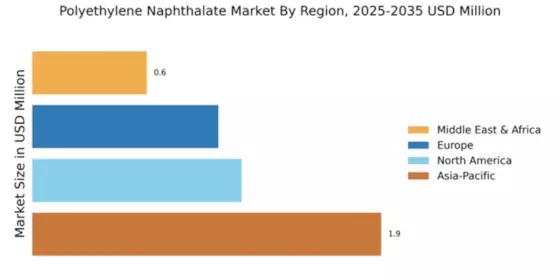
Regional Insights

North America : Stable Growth Environment

The North American Polyethylene Naphthalate market is projected to reach $0.78 billion by 2025, driven by increasing demand in packaging and automotive sectors. Regulatory support for sustainable materials is enhancing market dynamics, with a focus on reducing environmental impact. The region's market share reflects a stable growth trajectory, supported by innovations in recycling technologies and material efficiency. Leading countries like the US and Canada are at the forefront of this market, with key players such as Eastman Chemical Company and Invista driving advancements. The competitive landscape is characterized by strategic partnerships and investments in R&D, ensuring a robust supply chain. The presence of established companies fosters innovation, positioning North America as a significant player in The Polyethylene Naphthalate.

Europe : Innovation and Sustainability Focus

Europe's Polyethylene Naphthalate market is expected to reach $0.93 billion by 2025, fueled by stringent regulations promoting sustainable practices. The region's commitment to reducing carbon emissions and enhancing recycling capabilities is a key driver of market growth. With a market share that reflects a strong emphasis on eco-friendly materials, Europe is leading the charge in sustainable packaging solutions. Countries like Germany, France, and the UK are pivotal in this landscape, with major players such as BASF SE and Teijin Limited investing heavily in sustainable technologies. The competitive environment is marked by innovation and collaboration among industry leaders, ensuring that Europe remains at the forefront of the Polyethylene Naphthalate market. "The European Union aims to make all plastic packaging recyclable by 2030," emphasizes the commitment to sustainability.

Asia-Pacific : Dominant Market Player

The Asia-Pacific region dominates the Polyethylene Naphthalate market, projected to reach $2.34 billion by 2025. This growth is driven by rapid industrialization, increasing consumer demand, and significant investments in manufacturing capabilities. The region's market share reflects its pivotal role in global supply chains, particularly in electronics and automotive sectors, where lightweight and durable materials are essential. Leading countries such as China, Japan, and South Korea are home to major players like Mitsubishi Gas Chemical and SK Chemicals. The competitive landscape is characterized by aggressive expansion strategies and technological advancements, ensuring that Asia-Pacific remains a powerhouse in the Polyethylene Naphthalate market. The presence of a robust manufacturing base further solidifies its market leadership.

Middle East and Africa : Emerging Market Potential

The Middle East and Africa's Polyethylene Naphthalate market is anticipated to reach $0.85 billion by 2025, driven by increasing demand in packaging and textiles. The region's market share is gradually expanding, supported by investments in infrastructure and manufacturing capabilities. Regulatory frameworks are evolving to promote sustainable practices, enhancing the market's growth potential. Countries like South Africa and the UAE are emerging as key players in this market, with local and international companies exploring opportunities for expansion. The competitive landscape is characterized by a mix of established firms and new entrants, fostering innovation and collaboration. As the region continues to develop, the Polyethylene Naphthalate market is poised for significant growth.

Key Players and Competitive Insights

The Polyethylene Naphthalate Market is currently characterized by a dynamic competitive landscape, driven by increasing demand for high-performance materials across various sectors, including packaging, electronics, and automotive. Key players such as Mitsubishi Gas Chemical (Japan), BASF SE (Germany), and Eastman Chemical Company (US) are strategically positioned to leverage their technological advancements and extensive product portfolios. Mitsubishi Gas Chemical (Japan) focuses on innovation in polymer technology, while BASF SE (Germany) emphasizes sustainability in its production processes. Eastman Chemical Company (US) is actively pursuing partnerships to enhance its market reach, collectively shaping a competitive environment that prioritizes innovation and sustainability.

The market structure appears moderately fragmented, with several players vying for market share through localized manufacturing and optimized supply chains. This fragmentation allows for a diverse range of products and applications, although the influence of major companies remains significant. The collective strategies of these key players indicate a trend towards consolidation, as companies seek to enhance their operational efficiencies and market presence.

In November 2025, BASF SE (Germany) announced a strategic partnership with a leading packaging firm to develop sustainable packaging solutions utilizing polyethylene naphthalate. This collaboration is expected to enhance BASF's product offerings while addressing the growing consumer demand for eco-friendly materials. The strategic importance of this partnership lies in its potential to position BASF as a leader in sustainable packaging, aligning with global trends towards environmental responsibility.

In October 2025, Eastman Chemical Company (US) unveiled a new production facility dedicated to the manufacturing of high-performance polyethylene naphthalate. This facility is anticipated to increase production capacity by 30%, enabling Eastman to meet the rising demand in the electronics sector. The establishment of this facility underscores Eastman's commitment to innovation and its proactive approach to capturing market opportunities.

In September 2025, Mitsubishi Gas Chemical (Japan) launched a new line of polyethylene naphthalate products specifically designed for the automotive industry. This strategic move aims to cater to the increasing demand for lightweight and durable materials in automotive applications. By diversifying its product range, Mitsubishi Gas Chemical is likely to strengthen its competitive position in a rapidly evolving market.

As of December 2025, the competitive trends in the Polyethylene Naphthalate Market are increasingly defined by digitalization, sustainability, and the integration of advanced technologies such as AI. Strategic alliances are becoming more prevalent, as companies recognize the need to collaborate in order to innovate and respond to market demands effectively. The shift from price-based competition to a focus on innovation, technology, and supply chain reliability is evident, suggesting that future competitive differentiation will hinge on the ability to adapt to these emerging trends.

Key Companies in the Polyethylene Naphthalate Market market include

Industry Developments

One of the top manufacturing companies in the US, DuPont Teijin Films has reintroduced Kaladex® polyethylene naphthalate (PEN) high-performance polyester films, which were first manufactured in 1992 at its facility in Dumfries, Scotland, and are now commercially available. Kaladex® PEN films have a higher glass transition temperature than PET and outperform PET in terms of long-term aging performance at high temperatures. Other inherent properties include greater dimensional stability and stiffness than PET.

The India Engineering Center (IEC), a new R&D and engineering facility for Thermo Fisher Scientific, has been inaugurated in Hyderabad. Thermo Fisher's newly expanded India Engineering Center (IEC) is part of Thermo Fisher's R&D Center of Excellence in India and will create 140 new jobs in the region. Thermo Fisher Scientific invests more than $1.4 billion in research and development each year. Furthermore, the facility will attract top talent and create job opportunities in Telangana.

Intended Audience

    • Polyethylene naphthalate Manufacturers
    • Traders and distributors of polyethylene naphthalate
    • Research and development institutes
    • Potential investors
    • Raw material suppliers
    • Nationalized laboratory

Future Outlook

Polyethylene Naphthalate Market Future Outlook

The Polyethylene Naphthalate Market is projected to grow at a 4.42% CAGR from 2024 to 2035, driven by increasing demand in packaging, electronics, and automotive sectors.

New opportunities lie in:

  • Development of high-performance PET films for electronics applications.
  • Expansion into sustainable packaging solutions using recycled materials.
  • Investment in advanced manufacturing technologies to enhance production efficiency.

By 2035, the Polyethylene Naphthalate Market is expected to achieve robust growth, driven by innovation and sustainability.

Market Segmentation

Polyethylene Naphthalate Market Type Outlook

  • Polyethylene Naphthalate Film
  • Polyethylene Naphthalate Fiber
  • Polyethylene Naphthalate Resin
  • Polyethylene Naphthalate Coating

Polyethylene Naphthalate Market End Use Outlook

  • Packaging
  • Automotive
  • Electronics
  • Textiles
  • Construction

Polyethylene Naphthalate Market Application Outlook

  • Film
  • Sheet
  • Fiber
  • Resin
  • Coating

Polyethylene Naphthalate Market Distribution Channel Outlook

  • Direct Sales
  • Distributors
  • Online Sales
  • Retail

Polyethylene Naphthalate Market Processing Technique Outlook

  • Extrusion
  • Injection Molding
  • Blow Molding
  • Thermoforming

Report Scope

MARKET SIZE 20243.9(USD Million)
MARKET SIZE 20254.07(USD Million)
MARKET SIZE 20356.27(USD Million)
COMPOUND ANNUAL GROWTH RATE (CAGR)4.42% (2024 - 2035)
REPORT COVERAGERevenue Forecast, Competitive Landscape, Growth Factors, and Trends
BASE YEAR2024
Market Forecast Period2025 - 2035
Historical Data2019 - 2024
Market Forecast UnitsUSD Million
Key Companies ProfiledMitsubishi Gas Chemical (JP), BASF SE (DE), Eastman Chemical Company (US), Teijin Limited (JP), Invista (US), SK Chemicals (KR), Kraton Corporation (US), SABIC (SA)
Segments CoveredApplication, End Use, Type, Processing Technique, Distribution Channel
Key Market OpportunitiesGrowing demand for sustainable packaging solutions drives innovation in the Polyethylene Naphthalate Market.
Key Market DynamicsRising demand for sustainable packaging drives innovation and competition in the Polyethylene Naphthalate market.
Countries CoveredNorth America, Europe, APAC, South America, MEA

Market Highlights

Author
Anshula Mandaokar
Team Lead - Research

Anshula Mandaokar holds an academic degree in Chemical Engineering and has been contributing to the field for more than 5 years. She has expertise in Market Research and Business Consulting and serves as a Team Lead for a reputed Market Research firm under the Chemicals and Materials domain spectrum. She has worked on multiple projects, generating explicit results in a quick turnaround time. Her understanding of data interpretation justifies her role as a leader.

Leave a Comment

FAQs

What is PEN?

PEN is a polyester that can be manufactured from ethylene glycol. It is mainly used in packaging applications.

What are the major applications of PEN?

Major applications of PEN include beverage bottling, food packaging, electronics, rubber tires, and others.

What is the major driver for the market?

The growing demand for food packaging is the major driver for the PEN market.

Which is the leading regional market?

North America is the dominant regional segment of the global PEN market.

What are the leading market players?

Leading players in the PEN market include Toray, DuPont Teijin, and Sumitomo, among others.

Download Free Sample

Kindly complete the form below to receive a free sample of this Report

Compare Licence

×
Features License Type
Single User Multiuser License Enterprise User
Price $4,950 $5,950 $7,250
Maximum User Access Limit 1 User Upto 10 Users Unrestricted Access Throughout the Organization
Free Customization
Direct Access to Analyst
Deliverable Format
Platform Access
Discount on Next Purchase 10% 15% 15%
Printable Versions