×
Request Free Sample ×

Kindly complete the form below to receive a free sample of this Report

* Please use a valid business email

Leading companies partner with us for data-driven Insights

clients tt-cursor
Hero Background

Polymer Concrete Market

ID: MRFR/CnM/4553-HCR
100 Pages
Anshula Mandaokar
October 2025

Polymer Concrete Market Research Report Information By Class (PC, PMC, PIC), Type of Polymer (Epoxy, Polyester, Vinyl, Acrylate), Application (Asphalt Pavement, Building & Maintenance, Industrial Tanks, Prefabricated Drainage Channels), And Region- Forecast till 2035

Share:
Download PDF ×

We do not share your information with anyone. However, we may send you emails based on your report interest from time to time. You may contact us at any time to opt-out.

Polymer Concrete Market Infographic
Purchase Options

Polymer Concrete Market Summary

As per MRFR analysis, the Polymer Concrete Market Size was estimated at 18.31 USD Million in 2024. The Polymer Concrete industry is projected to grow from 21.87 USD Million in 2025 to 129.25 USD Million by 2035, exhibiting a compound annual growth rate (CAGR) of 19.44 during the forecast period 2025 - 2035.

Key Market Trends & Highlights

The Polymer Concrete Market is experiencing robust growth driven by sustainability and technological advancements.

  • North America remains the largest market for polymer concrete, driven by extensive construction activities.
  • Asia-Pacific is identified as the fastest-growing region, reflecting increasing infrastructure investments.
  • The construction segment dominates the market, while the industrial segment is witnessing rapid growth.
  • Key market drivers include sustainability initiatives and the growing demand for repair and rehabilitation.

Market Size & Forecast

2024 Market Size 18.31 (USD Million)
2035 Market Size 129.25 (USD Million)
CAGR (2025 - 2035) 19.44%

Major Players

Sika AG (CH), BASF SE (DE), Fosroc International Ltd (GB), GCP Applied Technologies Inc (US), Cemex S.A.B. de C.V. (MX), LafargeHolcim Ltd (CH), Duraamen Engineered Products Inc (US), Polymer Concrete Solutions (US)

Polymer Concrete Market Trends

The Polymer Concrete Market is currently experiencing a notable transformation, driven by advancements in material science and increasing demand for durable construction solutions. This market encompasses a variety of applications, including infrastructure, flooring, and precast products, which are gaining traction due to their superior performance characteristics. The unique properties of polymer concrete, such as enhanced resistance to chemicals and moisture, are appealing to industries seeking longevity and sustainability in their projects. As environmental concerns rise, the market is likely to witness a shift towards eco-friendly formulations, which could further stimulate growth and innovation. In addition, the Polymer Concrete Market is characterized by a growing interest in research and development initiatives aimed at improving product formulations and expanding application areas. Collaborations between manufacturers and research institutions appear to be fostering a culture of innovation, leading to the introduction of novel products that meet specific industry needs. Furthermore, the increasing urbanization and infrastructure development in emerging economies may provide additional opportunities for market expansion. Overall, the Polymer Concrete Market seems poised for continued evolution, with a focus on sustainability and performance enhancement driving future trends.

Sustainability Initiatives

The Polymer Concrete Market is witnessing a trend towards sustainability, as manufacturers increasingly prioritize eco-friendly materials and processes. This shift is driven by growing environmental awareness and regulatory pressures, prompting companies to develop formulations that minimize ecological impact while maintaining performance.

Technological Advancements

Technological innovations are reshaping the Polymer Concrete Market, with new production techniques and materials enhancing product quality and application versatility. These advancements enable the creation of polymer concrete solutions that are not only more durable but also tailored to meet specific industry requirements.

Expansion in Application Areas

The market is experiencing an expansion in application areas, as industries recognize the benefits of polymer concrete in various sectors. From infrastructure projects to decorative flooring, the versatility of polymer concrete is leading to increased adoption across diverse fields, indicating a broadening scope for future growth.

Polymer Concrete Market Drivers

Market Growth Projections

The Global Polymer Concrete Market Industry is projected to experience substantial growth over the next decade. With an anticipated market value of 551.6 USD Million in 2024, the industry is set to expand significantly, reaching approximately 1,096.9 USD Million by 2035. This growth trajectory indicates a compound annual growth rate of 6.45% from 2025 to 2035. Such projections reflect the increasing adoption of polymer concrete across various sectors, driven by its unique properties and the rising demand for durable and sustainable construction materials. The market's evolution suggests a promising future for polymer concrete in the global construction landscape.

Environmental Sustainability Initiatives

Environmental sustainability initiatives significantly influence the Global Polymer Concrete Market Industry. As global awareness of environmental issues increases, the construction industry is shifting towards more sustainable practices. Polymer concrete, which can incorporate recycled materials and reduce waste, aligns with these sustainability goals. Furthermore, its energy-efficient production processes contribute to lower carbon footprints compared to traditional concrete. This alignment with environmental standards not only enhances the appeal of polymer concrete but also encourages its adoption in various construction projects. Consequently, the market is expected to grow as more stakeholders prioritize sustainability in their material choices.

Growing Awareness of Polymer Concrete Benefits

Growing awareness of the benefits of polymer concrete is driving the Global Polymer Concrete Market Industry forward. Stakeholders in the construction sector are increasingly recognizing the advantages of polymer concrete, such as its resistance to moisture, chemicals, and temperature fluctuations. This awareness is particularly pronounced among engineers and architects who seek innovative solutions for challenging construction environments. As educational initiatives and industry collaborations promote the use of polymer concrete, its adoption is likely to increase. This trend may lead to a more robust market presence, further solidifying polymer concrete's role in modern construction practices.

Increasing Infrastructure Development Projects

The Global Polymer Concrete Market Industry benefits from the increasing number of infrastructure development projects worldwide. Governments and private sectors are investing heavily in infrastructure to support economic growth and urbanization. Polymer concrete's unique properties, such as rapid curing times and high durability, make it an ideal material for various applications, including roads, bridges, and precast elements. This trend is particularly evident in developing regions, where infrastructure needs are escalating. As the market evolves, it is anticipated that the demand for polymer concrete will rise, contributing to a projected market value of 1,096.9 USD Million by 2035.

Technological Advancements in Polymer Concrete

Technological advancements play a pivotal role in shaping the Global Polymer Concrete Market Industry. Innovations in formulation and application techniques enhance the performance characteristics of polymer concrete, making it more appealing for various construction applications. For instance, the development of high-performance polymer resins allows for improved bonding and curing processes, which can lead to faster project completion times. These advancements not only improve the material's properties but also contribute to cost-effectiveness in construction. As a result, the market is poised for growth, with projections indicating a compound annual growth rate of 6.45% from 2025 to 2035.

Rising Demand for Durable Construction Materials

The Global Polymer Concrete Market Industry experiences a notable surge in demand for durable construction materials, driven by the need for longevity and resilience in infrastructure projects. As urbanization accelerates, the construction sector increasingly seeks materials that can withstand harsh environmental conditions. Polymer concrete, known for its superior strength and resistance to chemicals, emerges as a preferred choice. In 2024, the market is projected to reach 551.6 USD Million, reflecting a growing recognition of polymer concrete's benefits in enhancing the lifespan of structures. This trend is likely to continue, with the market expected to expand significantly in the coming years.
Market Segment Insights

By Application: Construction (Largest) vs. Infrastructure (Fastest-Growing)

The Application segment of the Polymer Concrete Market is primarily characterized by its varied uses in Construction, Infrastructure, Repair, and Precast Products. Among these, Construction holds the largest share, owing to the growing demand for durable and sustainable building materials. In contrast, Infrastructure is emerging as a significant component with increasing governmental investments in public projects, thereby enhancing its market presence. The growth trends within this segment are driven by the need for advanced materials that can withstand extreme conditions. The ongoing expansion of urban infrastructure and the rising focus on repair and maintenance of deteriorating structures create a robust demand for polymer concrete. Additionally, innovations and technological advancements in polymer formulations contribute positively to market expansion, ensuring a competitive edge in both construction and infrastructural applications.

Repair (Dominant) vs. Precast Products (Emerging)

Within the Application segment of the Polymer Concrete Market, Repair is seen as the dominant value due to its critical role in maintaining and restoring existing structures. The effectiveness of polymer concrete in extending the lifespan of aged infrastructure drives its popularity in repair applications. On the other hand, Precast Products are emerging as a significant player in the market, gaining traction for their efficiency and cost-effectiveness in construction processes. Precast applications utilize polymer concrete for producing elements that are manufactured off-site and then transported for assembly, which minimizes on-site construction time. This synergy of durability in Repair and innovative approaches in Precast Products highlights their diverse applications and importance in the polymer concrete landscape.

By End Use: Residential (Largest) vs. Industrial (Fastest-Growing)

In the Polymer Concrete Market, the end-use segment is primarily dominated by the residential sector. This segment benefits from the increasing construction of residential buildings, driven by urbanization and the rising demand for durable materials that can withstand varying climatic conditions. Commercial applications also hold a significant share, focusing on aesthetics and functional properties, yet the residential segment leads the way with substantial demand. On the other hand, the industrial end-use segment is the fastest-growing category, powered by a surge in infrastructure development and industrial applications requiring high-performance concrete solutions. As manufacturers and contractors seek advanced materials for projects, polymer concrete's properties such as enhanced durability, flexibility, and resistance to chemicals position it favorably in this accelerating market trend.

Residential (Dominant) vs. Industrial (Emerging)

The residential sector stands out as the dominant end-use segment in the Polymer Concrete Market, largely due to the rapid growth in housing demands and the preference for modern building materials. This segment is characterized by its need for materials that provide aesthetic appeal while also delivering strength and durability. With increasing awareness about the benefits of polymer concrete, such as its lightweight and high-performance characteristics, the residential market is expected to grow steadily. Conversely, the industrial segment is emerging as a significant player, driven by the need for robust construction materials capable of withstanding harsh operational conditions. Industries, such as manufacturing and warehousing, are beginning to recognize the advantages of polymer concrete including chemical resistance and lower maintenance costs, which makes it an appealing choice for a variety of applications. This segment's rapid growth can be attributed to a broader trend of modernization and the evolving requirements for high-tech construction materials.

By Type: Polymer Modified Concrete (Largest) vs. Polymer Concrete Overlay (Fastest-Growing)

In the Polymer Concrete Market, the segment values exhibit varied market share distribution with Polymer Modified Concrete leading as the most significant segment. Its widespread application in construction and infrastructure projects drives its large market share. On the other hand, Polymer Concrete Overlay, while smaller in comparison, is rapidly gaining traction due to its increasing adoption among contractors seeking efficient and durable surface solutions. This dynamic is indicative of a shifting preference toward innovative repair and enhancement methods in concrete technology.

Polymer Modified Concrete (Dominant) vs. Polymer Concrete Overlay (Emerging)

Polymer Modified Concrete stands as a dominant force within the Polymer Concrete Market, known for its enhanced mechanical properties and resistance to environmental factors. This segment benefits from its broad applicability in heavy construction, including bridges and highways. Conversely, Polymer Concrete Overlay is emerging as a pivotal segment, appreciated for its ability to restore and protect existing concrete surfaces. With a growing emphasis on sustainability and cost-effectiveness, this overlay solution is favored in renovation projects, highlighting a shift towards more innovative and effective concrete treatments that meet modern construction demands.

By Formulation: Epoxy Based (Largest) vs. Polyester Based (Fastest-Growing)

The formulation segment of the Polymer Concrete Market demonstrates varied market share distribution among its key constituents. Epoxy-based formulations maintain a significant lead due to their exceptional adhesion, mechanical properties, and overall durability, making them the preferred choice across various applications. In contrast, polyester-based formulations are gaining traction rapidly, appealing to sectors seeking a cost-effective solution with relatively good performance. Vinyl ester-based formulations, while present, are carving out their niche primarily in specialized applications, contributing less toward the overall market share but still showcasing unique advantages.

Formulation: Epoxy Based (Dominant) vs. Polyester Based (Emerging)

Epoxy-based polymer concrete formulations are recognized for their superior mechanical strength, chemical resistance, and weather durability, positioning them as the dominant choice in construction, repair, and maintenance projects. Their extensive usage can be attributed to their high-performance characteristics, which meet stringent specifications in demanding environments. Conversely, polyester-based formulations emerge as a competitive alternative, particularly in applications where cost constraints are prevalent. These formulations offer satisfactory performance, making them an attractive option for projects that prioritize budget flexibility, which leads to their rapid growth in the market.

By Curing Method: Water Curing (Largest) vs. Heat Curing (Fastest-Growing)

In the Polymer Concrete Market, the curing method segment is primarily dominated by Water Curing, which has established itself as the largest share holder due to its efficacy in enhancing the mechanical properties and durability of polymer concrete. Air Curing, while viable, lags behind in terms of overall adoption, leading to Water Curing's strong position as the preferred choice for many applications. Heat Curing, although currently smaller in market share, presents an emerging alternative that is increasingly capturing attention for specific high-performance applications.

Curing Method: Water Curing (Dominant) vs. Heat Curing (Emerging)

Water Curing is regarded as the dominant curing method in the Polymer Concrete Market, primarily due to its ability to promote optimal hydration, which ultimately leads to enhanced strength and longevity of the material. This method is widely adopted in various construction applications, credited for supporting the integrity and durability of polymer-based products. Conversely, Heat Curing is gaining traction as an emerging method, driven by technological advancements that allow for faster curing times and improved mechanical properties. While it currently occupies a niche position, growing interest in high-performance and rapid construction applications positions Heat Curing as a significant trend setter, promising to reduce project timeframes while enhancing the quality of polymer concrete.

Get more detailed insights about Polymer Concrete Market

Regional Insights

North America : Market Leader in Polymer Concrete

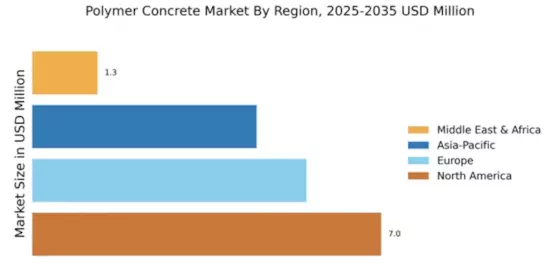
North America is poised to maintain its leadership in the Polymer Concrete market, holding a significant share of 7.0 in 2024. The region's growth is driven by increasing infrastructure investments, stringent regulations promoting sustainable construction, and a rising demand for durable materials. The adoption of advanced technologies in construction is further propelling market expansion, making it a hub for innovation in polymer concrete applications. The United States stands out as the leading country in this sector, with major players like Sika AG, BASF SE, and GCP Applied Technologies Inc. actively contributing to market growth. The competitive landscape is characterized by a focus on product innovation and strategic partnerships. As companies invest in R&D, the market is expected to witness enhanced product offerings, catering to diverse construction needs.

Europe : Emerging Market with Growth Potential

Europe is experiencing a notable rise in the Polymer Concrete market, with a market size of 5.5 in 2024. The growth is fueled by increasing construction activities, particularly in green building initiatives, and regulatory frameworks that emphasize sustainability. The European Union's commitment to reducing carbon emissions is driving demand for eco-friendly construction materials, positioning polymer concrete as a viable solution for modern infrastructure needs. Leading countries such as Germany, France, and the UK are at the forefront of this market, with key players like BASF SE and LafargeHolcim Ltd. dominating the landscape. The competitive environment is marked by innovation and collaboration among industry stakeholders, ensuring a steady supply of advanced polymer concrete solutions. As the market evolves, the focus on sustainability will continue to shape product development and market strategies.

Asia-Pacific : Rapid Growth in Emerging Economies

The Asia-Pacific region is witnessing rapid growth in the Polymer Concrete market, with a market size of 4.0 in 2024. This growth is driven by urbanization, increasing infrastructure development, and a rising demand for durable construction materials. Governments in countries like China and India are investing heavily in infrastructure projects, creating a favorable environment for polymer concrete applications. Regulatory support for sustainable construction practices is also a key driver of market expansion. China and India are the leading countries in this region, with a growing presence of key players such as Duraamen Engineered Products Inc and Polymer Concrete Solutions. The competitive landscape is evolving, with local manufacturers emerging alongside established global players. As the market matures, innovation and cost-effective solutions will be crucial for capturing market share and meeting the diverse needs of the construction industry.

Middle East and Africa : Emerging Market with Untapped Potential

The Middle East and Africa region is gradually emerging in the Polymer Concrete market, with a market size of 1.81 in 2024. The growth is primarily driven by increasing construction activities, particularly in the Gulf Cooperation Council (GCC) countries, where infrastructure development is a priority. Additionally, the region's focus on sustainable building practices is creating opportunities for polymer concrete applications, supported by favorable government regulations. Countries like the UAE and South Africa are leading the charge, with a growing number of local and international players entering the market. The competitive landscape is characterized by a mix of established companies and new entrants, all vying for a share of this burgeoning market. As the region continues to develop, the demand for innovative and sustainable construction materials will drive further growth in the polymer concrete sector.

Key Players and Competitive Insights

The Polymer Concrete Market is currently characterized by a dynamic competitive landscape, driven by increasing demand for durable and sustainable construction materials. Key players are actively engaging in strategic initiatives to enhance their market positioning. For instance, Sika AG (CH) has been focusing on innovation and product development, particularly in the realm of environmentally friendly polymer concrete solutions. Meanwhile, BASF SE (DE) is leveraging its extensive research capabilities to introduce advanced formulations that improve performance and reduce environmental impact. These strategies, alongside others from major players like GCP Applied Technologies Inc (US) and LafargeHolcim Ltd (CH), collectively shape a competitive environment that emphasizes sustainability and technological advancement.

In terms of business tactics, companies are increasingly localizing manufacturing to reduce lead times and optimize supply chains. This approach not only enhances operational efficiency but also allows for better responsiveness to regional market demands. The market structure appears moderately fragmented, with several key players holding substantial market shares while also facing competition from smaller, specialized firms. The collective influence of these major companies is significant, as they set industry standards and drive innovation.

In November 2025, GCP Applied Technologies Inc (US) announced a strategic partnership with a leading construction firm to develop a new line of polymer concrete products tailored for infrastructure projects. This collaboration is expected to enhance GCP's market reach and solidify its position as a leader in innovative construction solutions. The partnership underscores the importance of collaboration in addressing specific market needs and advancing product offerings.

In October 2025, LafargeHolcim Ltd (CH) launched a new eco-friendly polymer concrete product line aimed at reducing carbon emissions during production. This initiative aligns with global sustainability goals and positions the company as a frontrunner in the green construction materials sector. The strategic importance of this launch lies in its potential to attract environmentally conscious clients and comply with increasingly stringent regulations.

In September 2025, Sika AG (CH) expanded its production capacity in North America, responding to the growing demand for polymer concrete in the region. This expansion not only enhances Sika's ability to meet local market needs but also reflects a broader trend of companies investing in regional capabilities to ensure supply chain reliability. Such moves are indicative of a shift towards localized production in the industry.

As of December 2025, current competitive trends in the Polymer Concrete Market are heavily influenced by digitalization, sustainability, and the integration of AI technologies. Strategic alliances are becoming increasingly vital, as companies seek to pool resources and expertise to innovate more effectively. The competitive differentiation is likely to evolve from traditional price-based competition to a focus on innovation, technology, and supply chain reliability, suggesting a transformative shift in how companies position themselves in the market.

Key Companies in the Polymer Concrete Market market include

Industry Developments

  • Q2 2024: BASF Launches New Polymer Concrete Market Admixture for Infrastructure Applications BASF announced the launch of a new polymer concrete admixture designed to enhance durability and chemical resistance in infrastructure projects, targeting bridge and tunnel construction sectors.
  • Q1 2024: Sika Opens New Polymer Concrete Market Production Facility in Texas Sika AG inaugurated a new manufacturing facility in Texas dedicated to the production of advanced polymer concrete products, aiming to meet growing demand in North America’s infrastructure market.
  • Q3 2024: RPM International Acquires Specialty Polymer Concrete Market Producer in Europe RPM International announced the acquisition of a leading European manufacturer specializing in polymer concrete solutions for industrial flooring and drainage systems.
  • Q2 2025: Wacker Chemie AG Announces Strategic Partnership with Chinese Construction Firm for Polymer Concrete Market Development Wacker Chemie AG entered a strategic partnership with a major Chinese construction company to co-develop next-generation polymer concrete materials for large-scale infrastructure projects in Asia.
  • Q1 2025: Dow Unveils Eco-Friendly Polymer Concrete Market Binder at International Construction Expo Dow introduced a new environmentally friendly polymer binder for concrete at a major industry expo, emphasizing reduced carbon footprint and improved recyclability.
  • Q4 2024: Cemex Ventures Invests in Polymer Concrete Market Startup for Sustainable Urban Drainage Cemex Ventures announced an investment in a startup developing polymer concrete solutions for sustainable urban drainage systems, aiming to address climate resilience in cities.
  • Q2 2024: Holcim Launches High-Performance Polymer Concrete Market for Marine Applications Holcim launched a new line of high-performance polymer concrete products specifically engineered for marine and coastal infrastructure, offering enhanced resistance to saltwater corrosion.
  • Q3 2025: Saint-Gobain Acquires U.S. Polymer Concrete Market Manufacturer to Expand Infrastructure Portfolio Saint-Gobain completed the acquisition of a U.S.-based polymer concrete manufacturer, strengthening its position in the North American infrastructure and industrial flooring markets.
  • Q1 2025: Mapei Appoints New Head of Polymer Concrete Market Division Mapei announced the appointment of a new executive to lead its global polymer concrete division, signaling a renewed focus on innovation and market expansion.
  • Q2 2024: CRH plc Secures Major Contract for Polymer Concrete Market Road Barriers in Europe CRH plc secured a significant contract to supply polymer concrete road barriers for a major European highway project, citing the material’s superior impact resistance and longevity.
  • Q4 2024: Votorantim Cimentos Launches Polymer Concrete Market Product Line in Brazil Votorantim Cimentos introduced a new range of polymer concrete products for industrial and infrastructure applications in Brazil, aiming to capture market share in Latin America.
  • Q3 2024: Heidelberg Materials Announces Joint Venture for Polymer Concrete Market Recycling Technology Heidelberg Materials formed a joint venture with a technology firm to develop and commercialize recycling solutions for polymer concrete waste, targeting circular economy goals.

Future Outlook

Polymer Concrete Market Future Outlook

The Polymer Concrete Market is projected to grow at a 19.44% CAGR from 2024 to 2035, driven by increasing demand for durable construction materials and innovative applications.

New opportunities lie in:

  • Development of eco-friendly polymer concrete formulations
  • Expansion into emerging markets with infrastructure needs
  • Integration of smart technologies for real-time monitoring in construction

By 2035, the Polymer Concrete Market is expected to achieve substantial growth, driven by innovation and strategic market expansion.

Market Segmentation

Polymer Concrete Market Type Outlook

  • Polymer Modified Concrete
  • Polymer Concrete Overlay
  • Polymer Concrete Repair

Polymer Concrete Market End Use Outlook

  • Residential
  • Commercial
  • Industrial

Polymer Concrete Market Application Outlook

  • Construction
  • Infrastructure
  • Repair
  • Precast Products

Polymer Concrete Market Formulation Outlook

  • Epoxy Based
  • Polyester Based
  • Vinyl Ester Based

Polymer Concrete Market Curing Method Outlook

  • Air Curing
  • Water Curing
  • Heat Curing

Report Scope

MARKET SIZE 202418.31(USD Million)
MARKET SIZE 202521.87(USD Million)
MARKET SIZE 2035129.25(USD Million)
COMPOUND ANNUAL GROWTH RATE (CAGR)19.44% (2024 - 2035)
REPORT COVERAGERevenue Forecast, Competitive Landscape, Growth Factors, and Trends
BASE YEAR2024
Market Forecast Period2025 - 2035
Historical Data2019 - 2024
Market Forecast UnitsUSD Million
Key Companies ProfiledSika AG (CH), BASF SE (DE), Fosroc International Ltd (GB), GCP Applied Technologies Inc (US), Cemex S.A.B. de C.V. (MX), LafargeHolcim Ltd (CH), Duraamen Engineered Products Inc (US), Polymer Concrete Solutions (US)
Segments CoveredApplication, End Use, Type, Formulation, Curing Method
Key Market OpportunitiesGrowing demand for sustainable construction materials drives innovation in the Polymer Concrete Market.
Key Market DynamicsRising demand for durable construction materials drives innovation and competition in the Polymer Concrete Market.
Countries CoveredNorth America, Europe, APAC, South America, MEA

Market Highlights

Author
Anshula Mandaokar
Team Lead - Research

Anshula Mandaokar holds an academic degree in Chemical Engineering and has been contributing to the field for more than 5 years. She has expertise in Market Research and Business Consulting and serves as a Team Lead for a reputed Market Research firm under the Chemicals and Materials domain spectrum. She has worked on multiple projects, generating explicit results in a quick turnaround time. Her understanding of data interpretation justifies her role as a leader.

Leave a Comment

FAQs

What is polymer concrete?

Polymer concrete is a concrete formulation using a polymer as a binder to enable enhanced binding and strength.

What are the major types of polymer concrete?

Major types of polymer concrete include polymer concrete, polymer modified concrete, and polymer impregnated concrete.

What is the major driver for the market?

The growing construction industry is likely to be the major driver for the global polymer concrete market.

Which is the leading regional market?

North America held the largest share in the global polymer concrete market in 2017.

What are the leading market players?

Leading players in the polymer concrete market include Sika AG, MAPEI Corporation, and Dudick Inc., among others.

What is the market size of the polymer concrete industry?

The polymer concrete market value was at USD 448.1 million in the year 2019 and it is expected to surpass the market value of over USD 750 million by the year 2035 while registering a CAGR of 7.9% during the forecast period.

Download Free Sample

Kindly complete the form below to receive a free sample of this Report

Compare Licence

×
Features License Type
Single User Multiuser License Enterprise User
Price $4,950 $5,950 $7,250
Maximum User Access Limit 1 User Upto 10 Users Unrestricted Access Throughout the Organization
Free Customization
Direct Access to Analyst
Deliverable Format
Platform Access
Discount on Next Purchase 10% 15% 15%
Printable Versions