Polyphenylene Sulfide Market
Polyphenylene Sulfide Market Summary
As per MRFR analysis, the Polyphenylene Sulfide Market Size was estimated at 2118.75 USD Million in 2024. The Polyphenylene Sulfide industry is projected to grow from 2255.84 USD Million in 2025 to 4222.6 USD Million by 2035, exhibiting a compound annual growth rate (CAGR) of 6.47% during the forecast period 2025 - 2035.
Key Market Trends & Highlights
The Polyphenylene Sulfide Market is poised for substantial growth driven by diverse applications and technological advancements.
- North America remains the largest market for Polyphenylene Sulfide, primarily due to its extensive use in automotive applications.
- The Asia-Pacific region is emerging as the fastest-growing market, fueled by increasing demand in electrical and electronics sectors.
- The automotive segment continues to dominate, while the fuel cells segment is rapidly gaining traction as a key growth area.
- Rising demand in electronics and innovations in manufacturing processes are significant drivers propelling market expansion.
Market Size & Forecast
| 2024 Market Size | 2118.75 (USD Million) |
| 2035 Market Size | 4222.6 (USD Million) |
| CAGR (2025 - 2035) | 6.47% |
Major Players
Toray Industries (JP), Solvay (BE), DIC Corporation (JP), BASF (DE), Kaneka Corporation (JP), Mitsubishi Gas Chemical Company (JP), SABIC (SA), Huntsman Corporation (US), RTP Company (US)
Polyphenylene Sulfide Market Trends
The Polyphenylene Sulfide Market is currently experiencing a notable transformation, driven by increasing demand across various industries. This high-performance thermoplastic is recognized for its exceptional chemical resistance, thermal stability, and mechanical strength, making it suitable for applications in automotive, electronics, and aerospace sectors. As industries increasingly prioritize materials capable of withstanding extreme temperatures and harsh chemical environments, the demand within the polyphenylene sulfide PPS market continues to expand. Furthermore, the trend towards lightweight materials in manufacturing processes is likely to bolster the market, as polyphenylene sulfide offers a viable alternative to traditional materials.
In addition to its mechanical properties, the polyphenylene sulfide resin market is also influenced by advancements in processing technologies. Innovations in production methods are enhancing the efficiency and cost-effectiveness of polyphenylene sulfide, thereby expanding its accessibility to a broader range of applications. As a result, the polyphenylene sulfide composite market is gaining traction, particularly where reinforced PPS materials provide superior durability and lifecycle performance. Overall, the Polyphenylene Sulfide Market appears poised for growth, driven by evolving industry needs and technological advancements.
Rising Demand in Automotive Applications
The automotive sector is increasingly adopting polyphenylene sulfide due to its lightweight nature and ability to withstand high temperatures. This trend suggests a shift towards more efficient and durable materials in vehicle manufacturing. As fuel efficiency standards and electric vehicle development accelerate globally, demand within the polyphenylene sulfide PPS market is expected to strengthen further.
Technological Advancements in Production
Innovations in production techniques are likely to improve the properties of polyphenylene sulfide, making it more versatile. Enhanced manufacturing processes may lead to better quality and lower costs, potentially expanding its market reach.
Focus on Sustainability
There is a growing emphasis on sustainable practices within the Polyphenylene Sulfide Market. Companies are exploring eco-friendly production methods and recycling options, which may resonate with consumers and drive market growth.
Polyphenylene Sulfide Market Drivers
Increasing Focus on Sustainability
The Global Polyphenylene Sulfide Market Industry is increasingly influenced by the growing focus on sustainability and environmental responsibility. Manufacturers are under pressure to adopt eco-friendly materials and processes, leading to a heightened interest in polyphenylene sulfide due to its recyclability and reduced environmental impact compared to traditional materials. This shift is prompting companies to invest in sustainable practices, which may enhance the market's appeal. As global regulations become more stringent regarding material usage and waste management, polyphenylene sulfide is positioned to play a crucial role in meeting these new standards.
Rising Demand in Automotive Sector
The Global Polyphenylene Sulfide Market Industry is experiencing a notable surge in demand driven by the automotive sector. As manufacturers increasingly seek lightweight and high-performance materials, polyphenylene sulfide is emerging as a preferred choice due to its excellent thermal stability and chemical resistance. In 2024, the market is projected to reach 2.09 USD Billion, with automotive applications accounting for a significant share. This trend is likely to continue as the industry shifts towards electric vehicles, which require advanced materials for components such as connectors and housings, thereby enhancing the overall market potential.
Expanding Applications in Aerospace
The Global Polyphenylene Sulfide Market Industry is poised for growth as the aerospace sector increasingly adopts polyphenylene sulfide for various applications. The material's lightweight nature and exceptional thermal and chemical resistance make it suitable for components such as fuel systems and structural parts. As the aerospace industry continues to innovate and seek materials that enhance performance while reducing weight, polyphenylene sulfide is likely to gain traction. This trend is expected to contribute to the overall market growth, aligning with the projected increase from 2.09 USD Billion in 2024 to 4.22 USD Billion by 2035.
Advancements in Manufacturing Technologies
The Global Polyphenylene Sulfide Market Industry is benefiting from advancements in manufacturing technologies that enhance the production efficiency and quality of polyphenylene sulfide. Innovations such as improved polymerization processes and additive manufacturing techniques are enabling manufacturers to produce high-performance materials with tailored properties. This evolution not only reduces production costs but also expands the range of applications for polyphenylene sulfide across various industries. As these technologies continue to develop, they are likely to drive market growth, allowing for greater adoption in sectors such as aerospace and medical devices.
Growth in Electronics and Electrical Applications
The Global Polyphenylene Sulfide Market Industry is witnessing substantial growth fueled by the electronics and electrical sectors. The material's superior electrical insulation properties and thermal stability make it ideal for manufacturing components such as circuit boards and connectors. As the demand for miniaturization and efficiency in electronic devices increases, polyphenylene sulfide is becoming increasingly relevant. The market is expected to expand significantly, with projections indicating a growth from 2.09 USD Billion in 2024 to 4.22 USD Billion by 2035, reflecting a compound annual growth rate of 6.61% from 2025 to 2035.
Market Segment Insights
By Application: Automotive (Largest) vs. Electrical and Electronics (Fastest-Growing)
In the Polyphenylene Sulfide market, the application segment is diverse, with automotive accounting for the largest share. This segment utilizes PPS for its lightweight, thermal stability, and chemical resistance, making it essential for automotive components such as fuel systems, connectors, and sensors. Electrical and Electronics, although smaller currently, is rapidly gaining traction due to the increasing demand for high-performance materials in electronic applications, which require materials that withstand high temperatures and provide excellent dielectric properties.
Automotive: Dominant vs. Electrical and Electronics: Emerging
The automotive application of Polyphenylene Sulfide stands as a dominant force, leveraging its unique properties such as high thermal resistance and exceptional dimensional stability. This has allowed it to replace traditional materials in critical automotive components, contributing to weight reduction and improved performance. On the other hand, the Electrical and Electronics segment is emerging rapidly, driven by the push towards more compact and efficient electronic devices where PPS can provide enhanced thermal management and insulation. As manufacturers seek to innovate, the demand for PPS within this realm is expected to rise sharply, bolstering its market presence.
By End Use: Internal Combustion Engine (Largest) vs. Fuel Cells (Fastest-Growing)
The Polyphenylene Sulfide (PPS) market sees significant segmentation in its 'End Use' category, with Internal Combustion Engines commanding the largest share due to their extensive application in automotive and machinery sectors. Internal Combustion Engines utilize PPS for its thermal stability and chemical resistance, making it the preferred choice among manufacturers. Meanwhile, Fuel Cells are rapidly gaining traction, accounting for a smaller but increasingly important share of the segment as technological advancements improve their efficiency and cost-effectiveness. Growth trends indicate a clear shift toward cleaner energy solutions, positioning Fuel Cells as the fastest-growing segment within the Polyphenylene Sulfide market. As the automotive industry transitions towards electric and hybrid vehicles, the reliance on lighter, durable materials like PPS for Fuel Cell applications is projected to rise. This transition is further driven by governmental regulations promoting eco-friendly technologies and the increasing demand for sustainable energy sources that utilize PPS, given its favorable properties.
Internal Combustion Engine: Dominant vs. Fuel Cells: Emerging
Internal Combustion Engines remain the dominant segment in the Polyphenylene Sulfide market, primarily driven by their robust applications in traditional automotive manufacturing. PPS utilized in these engines offers significant advantages such as enhanced durability, resistance to high temperatures, and reduced weight, contributing to overall vehicle efficiency. On the other hand, Fuel Cells are emerging as a competitive segment due to the thrust towards sustainable energy solutions. While still behind in market share, Fuel Cells leverage PPS for their lightweight and temperature-resistant properties, crucial for enhancing overall performance. The rapid developments in this area suggest that Fuel Cells may redefine market dynamics in the coming years as manufacturers increasingly seek sustainable solutions and innovative materials like PPS.
By Form: Granules (Largest) vs. Powder (Fastest-Growing)
In the Polyphenylene Sulfide Market, Granules hold the largest share, serving as a preferred choice for many applications due to their versatility and ease of processing. They are commonly used in automotive, electrical, and industrial sectors, facilitating high demand and market presence. Conversely, the Powder form has emerged as the fastest-growing segment, appealing to niche applications where fine particle size is vital for enhanced performance and compatibility with various manufacturing processes.
Granules (Dominant) vs. Powder (Emerging)
Granules are predominantly leading the Polyphenylene Sulfide Market due to their advantageous properties such as high thermal stability, chemical resistance, and excellent molding capabilities. They are extensively utilized in molded components across multiple industries, making them a staple in the market. On the other hand, Powder variations are increasingly finding their place in specialized applications such as additive manufacturing and coating processes, where fine-tuned characteristics can be achieved. This market segment is characterized by innovative uses and scalability, indicating a growing trend as manufacturers explore new possibilities in materials science.
By Processing Method: Injection Molding (Largest) vs. 3D Printing (Fastest-Growing)
In the Polyphenylene Sulfide (PPS) market, the processing method segment comprises various techniques such as Injection Molding, Extrusion, Compression Molding, 3D Printing, and Blow Molding. Among these, Injection Molding stands out as the largest in terms of market share, attributed to its widespread usage in producing complex and precise parts across industries. On the other hand, 3D Printing is capturing increasing attention, particularly for prototyping and small-scale production, marking its rapid ascension in market relevance.
Injection Molding: Dominant vs. 3D Printing: Emerging
Injection Molding is a highly regarded processing method in the Polyphenylene Sulfide market, known for its efficiency in creating detailed and durable components. This technique enables high-volume production with minimal material waste, making it economically viable for manufacturers addressing diverse applications, from automotive to electronics. Conversely, 3D Printing represents an emerging method, gaining traction for its ability to produce customized parts quickly and cost-effectively. It offers unique advantages for innovation and rapid prototyping, appealing to segments seeking flexibility and reduced lead times, hence its designation as the fastest-growing approach.
Regional Insights
North America : Innovation and Demand Growth
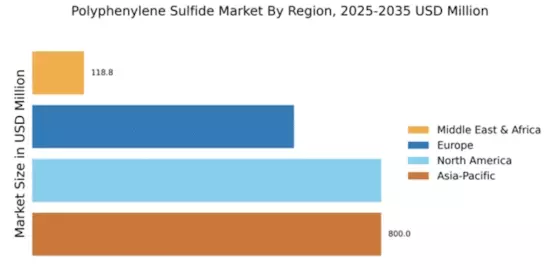
The North American Polyphenylene Sulfide market is projected to reach $800.0 million by December 2025, driven by increasing demand in automotive and electronics sectors. Regulatory support for advanced materials and sustainability initiatives are key growth catalysts. The region's focus on innovation and technology adoption further enhances market potential, with a growing emphasis on lightweight and high-performance materials. Leading countries like the US and Canada dominate the market, with major players such as Huntsman Corporation and RTP Company establishing a strong foothold. The competitive landscape is characterized by strategic partnerships and investments in R&D, ensuring a robust supply chain. The presence of established manufacturers and a growing number of startups contribute to a dynamic market environment.
Europe : Sustainability and Innovation Focus
Europe's Polyphenylene Sulfide market is expected to reach $600.0 million by December 2025, fueled by stringent environmental regulations and a shift towards sustainable materials. The automotive and aerospace industries are significant demand drivers, as manufacturers seek lightweight and durable components. Regulatory frameworks promoting eco-friendly practices are pivotal in shaping market dynamics, enhancing the appeal of Polyphenylene Sulfide as a material of choice. Germany, France, and the UK are leading countries in this market, with key players like BASF and Solvay driving innovation. The competitive landscape is marked by collaborations and technological advancements, ensuring a steady supply of high-quality products. The presence of established companies alongside emerging players fosters a vibrant ecosystem, positioning Europe as a leader in the Polyphenylene Sulfide market.
Asia-Pacific : Dominant Market Leader
Asia-Pacific is poised to maintain its position as the largest Polyphenylene Sulfide market, with a projected size of $800.0 million by December 2025. The region's rapid industrialization and growing automotive sector are key growth drivers. Increasing investments in infrastructure and technology, coupled with favorable government policies, are expected to further boost demand for high-performance materials like Polyphenylene Sulfide. Japan, China, and South Korea are the leading countries in this market, with major players such as Toray Industries and DIC Corporation playing a crucial role. The competitive landscape is characterized by a mix of established companies and innovative startups, fostering a dynamic environment. The presence of strong manufacturing capabilities and a focus on R&D ensure that Asia-Pacific remains at the forefront of the Polyphenylene Sulfide market.
Middle East and Africa : Emerging Market Potential
The Middle East and Africa (MEA) Polyphenylene Sulfide market is projected to reach $118.75 million by December 2025, driven by increasing industrial activities and demand for advanced materials. The region's focus on diversifying its economy and investing in manufacturing sectors is expected to create significant growth opportunities. Regulatory support for innovation and sustainability is also contributing to market expansion, making it an attractive destination for investment. Countries like South Africa and the UAE are leading the way in adopting Polyphenylene Sulfide for various applications. The competitive landscape is evolving, with both local and international players vying for market share. The presence of key manufacturers and a growing interest in high-performance materials are set to drive the market forward, positioning MEA as a promising region for Polyphenylene Sulfide.
Key Players and Competitive Insights
In November Toray Industries (Japan) announced the launch of a new line of high-performance Polyphenylene Sulfide products designed specifically for the automotive sector. This strategic move is likely to enhance Toray's market presence and cater to the growing demand for lightweight and durable materials in vehicle manufacturing. By focusing on the automotive industry, Toray positions itself to capitalize on the ongoing trends towards electric vehicles and advanced manufacturing techniques.
In October Solvay (Belgium) unveiled its latest initiative aimed at reducing the carbon footprint of its Polyphenylene Sulfide production processes. This initiative, which includes the implementation of renewable energy sources and waste reduction strategies, underscores Solvay's commitment to sustainability. Such actions not only enhance the company's reputation but also align with global regulatory trends favoring environmentally friendly practices, potentially attracting a broader customer base.
In September BASF (Germany) entered into a strategic partnership with a leading technology firm to develop AI-driven solutions for optimizing its Polyphenylene Sulfide manufacturing processes. This collaboration is expected to enhance operational efficiency and reduce production costs, positioning BASF as a frontrunner in the integration of advanced technologies within the market. The partnership reflects a broader trend towards digitalization, which is becoming increasingly vital in maintaining competitive advantage.
As of December the Polyphenylene Sulfide Market is witnessing significant trends such as digitalization, sustainability, and the integration of AI technologies. Strategic alliances among key players are shaping the competitive landscape, fostering innovation and collaboration. The shift from price-based competition to a focus on technological advancement and supply chain reliability is evident, suggesting that future competitive differentiation will hinge on the ability to innovate and adapt to evolving market demands.
Key Companies in the Polyphenylene Sulfide Market include
Industry Developments
- Q2 2024: Toray Industries announces new polyphenylene sulfide production facility in Thailand Toray Industries revealed plans to open a new PPS manufacturing plant in Rayong, Thailand, aiming to expand its supply capacity for automotive and electronics customers in Southeast Asia.
- Q1 2024: Solvay signs strategic partnership with Hyundai Motors for PPS supply Solvay entered a multi-year agreement to supply polyphenylene sulfide materials to Hyundai Motors, supporting the automaker’s push for lightweight, heat-resistant components in electric vehicles.
- Q2 2024: Kureha Corporation expands PPS resin production capacity in Japan Kureha Corporation announced the completion of a major expansion at its Iwaki plant, increasing annual PPS resin output by 20% to meet rising demand from automotive and electronics sectors.
- Q3 2024: Celanese acquires specialty PPS business from Daicel Corporation Celanese finalized the acquisition of Daicel’s specialty polyphenylene sulfide business, strengthening its portfolio in high-performance engineering plastics for industrial and automotive applications.
- Q2 2024: SK Chemicals launches new eco-friendly PPS grade for EV battery components SK Chemicals introduced a new grade of polyphenylene sulfide designed for electric vehicle battery modules, featuring improved recyclability and thermal stability.
- Q1 2025: DIC Corporation wins major PPS supply contract with Bosch DIC Corporation secured a multi-year contract to supply PPS compounds to Bosch for use in advanced automotive electronics and sensor housings.
- Q2 2025: Toray Industries receives regulatory approval for expanded PPS plant in Malaysia Toray Industries obtained Malaysian government approval to double the capacity of its PPS resin facility in Penang, supporting growth in regional electronics manufacturing.
- Q3 2024: Solvay launches high-flow PPS resin for 5G infrastructure applications Solvay unveiled a new high-flow polyphenylene sulfide resin tailored for 5G base station components, offering enhanced processability and heat resistance.
- Q4 2024: Kureha Corporation appoints new CEO to lead global PPS business Kureha Corporation named Hiroshi Tanaka as CEO, tasking him with accelerating international expansion of the company’s PPS product line.
- Q2 2025: Celanese announces $100 million investment in PPS R&D center in Germany Celanese committed $100 million to establish a new research and development center focused on polyphenylene sulfide innovations for automotive and aerospace customers.
- Q1 2024: DIC Corporation launches flame-retardant PPS compound for EV charging stations DIC Corporation introduced a new flame-retardant PPS compound designed for use in electric vehicle charging infrastructure, meeting stringent safety standards.
- Q3 2025: SK Chemicals partners with LG Chem to develop PPS-based composites for battery enclosures SK Chemicals and LG Chem announced a joint development agreement to create PPS-based composite materials for next-generation battery enclosures in electric vehicles.
Future Outlook
Polyphenylene Sulfide Market Future Outlook
The Polyphenylene Sulfide Market is projected to grow at a 6.47% CAGR from 2025 to 2035, driven by increasing demand in automotive, electronics, and aerospace sectors.
New opportunities lie in:
- Development of high-performance PPS composites for automotive applications. Expansion into emerging markets with tailored PPS solutions. Investment in recycling technologies for sustainable PPS production.
By 2035, the Polyphenylene Sulfide Market is expected to achieve robust growth and enhanced market positioning.
Market Segmentation
Polyphenylene Sulfide Market Form Outlook
- Granules
- Powder
- Films
- Sheets
- Composite
Polyphenylene Sulfide Market End Use Outlook
- Internal Combustion Engine
- Fuel Cells
- Pumps
- Valves
- Connectors
Polyphenylene Sulfide Market Application Outlook
- Automotive
- Electrical and Electronics
- Industrial
- Aerospace
- Medical
Polyphenylene Sulfide Market Processing Method Outlook
- Injection Molding
- Extrusion
- Compression Molding
- 3D Printing
- Blow Molding
Report Scope
| MARKET SIZE 2024 | 2118.75(USD Million) |
| MARKET SIZE 2025 | 2255.84(USD Million) |
| MARKET SIZE 2035 | 4222.6(USD Million) |
| COMPOUND ANNUAL GROWTH RATE (CAGR) | 6.47% (2025 - 2035) |
| REPORT COVERAGE | Revenue Forecast, Competitive Landscape, Growth Factors, and Trends |
| BASE YEAR | 2024 |
| Market Forecast Period | 2025 - 2035 |
| Historical Data | 2019 - 2024 |
| Market Forecast Units | USD Million |
| Key Companies Profiled | Toray Industries (JP), Solvay (BE), DIC Corporation (JP), BASF (DE), Kaneka Corporation (JP), Mitsubishi Gas Chemical Company (JP), SABIC (SA), Huntsman Corporation (US), RTP Company (US) |
| Segments Covered | Application, End Use, Form, Processing Method |
| Key Market Opportunities | Growing demand for lightweight, high-performance materials in automotive and electronics sectors drives Polyphenylene Sulfide Market opportunities. |
| Key Market Dynamics | Rising demand for lightweight materials drives innovation and competition in the Polyphenylene Sulfide market. |
| Countries Covered | North America, Europe, APAC, South America, MEA |
Market Highlights
FAQs
What is the projected market valuation of the Polyphenylene Sulfide market by 2035?
The Polyphenylene Sulfide market is projected to reach a valuation of 4222.6 USD Million by 2035.
What was the market valuation of Polyphenylene Sulfide in 2024?
In 2024, the overall market valuation of Polyphenylene Sulfide was 2118.75 USD Million.
What is the expected CAGR for the Polyphenylene Sulfide market during the forecast period 2025 - 2035?
The expected CAGR for the Polyphenylene Sulfide market during the forecast period 2025 - 2035 is 6.47%.
Which companies are considered key players in the Polyphenylene Sulfide market?
Key players in the Polyphenylene Sulfide market include Toray Industries, Solvay, DIC Corporation, BASF, SABIC, Mitsubishi Chemical, Kraton Corporation, RTP Company, and PolyOne Corporation.
What are the primary applications of Polyphenylene Sulfide and their market valuations?
The primary applications include Automotive (800.0 - 1600.0 USD Million), Electrical and Electronics (600.0 - 1200.0 USD Million), Industrial (400.0 - 800.0 USD Million), Aerospace (200.0 - 400.0 USD Million), and Medical (118.75 - 222.6 USD Million).
How does the Polyphenylene Sulfide market perform in the automotive sector?
The automotive sector is projected to generate between 800.0 and 1600.0 USD Million in the Polyphenylene Sulfide market.
What are the different forms of Polyphenylene Sulfide and their respective market valuations?
The forms include Granules (800.0 - 1600.0 USD Million), Powder (600.0 - 1200.0 USD Million), Sheets (300.0 - 600.0 USD Million), Films (250.0 - 500.0 USD Million), and Composite (168.75 - 322.6 USD Million).
What processing methods are utilized in the Polyphenylene Sulfide market?
The processing methods include Injection Molding (800.0 - 1600.0 USD Million), Extrusion (600.0 - 1200.0 USD Million), Compression Molding (400.0 - 800.0 USD Million), 3D Printing (200.0 - 400.0 USD Million), and Blow Molding (118.75 - 222.6 USD Million).
What end-use applications are driving the demand for Polyphenylene Sulfide?
End-use applications driving demand include Internal Combustion Engine (600.0 - 1200.0 USD Million), Fuel Cells (400.0 - 800.0 USD Million), Pumps and Valves (300.0 - 600.0 USD Million), Connectors (500.0 - 1000.0 USD Million), and Insulation (318.75 - 622.6 USD Million).
How does the Polyphenylene Sulfide market outlook appear for the next decade?
The outlook for the Polyphenylene Sulfide market appears positive, with a projected growth to 4222.6 USD Million by 2035, driven by various applications and processing methods.
Research Approach
Secondary Research
The secondary research process involved comprehensive analysis of chemical industry databases, regulatory filings, peer-reviewed polymer science journals, technical publications, and authoritative industry organizations. Key sources included the US Environmental Protection Agency (EPA), European Chemicals Agency (ECHA), National Institute of Standards and Technology (NIST), American Chemistry Council (ACC), Society of Plastics Engineers (SPE), International Organization for Standardization (ISO), German Institute for Standardization (DIN), Japan Chemical Industry Association (JCIA), China Petroleum and Chemical Industry Federation (CPCIF), International Energy Agency (IEA), US Department of Energy (DOE) Advanced Manufacturing Office, EU Horizon Europe Research Database, National Science Foundation (NSF) Engineering Research Centers, and national trade statistics from US International Trade Commission (USITC), Eurostat, and UN Comtrade. These sources were used to collect production capacity data, regulatory compliance requirements, material safety studies, automotive lightweighting trends, electronics miniaturization patterns, and competitive landscape analysis for unfilled, filled, and reinforced polyphenylene sulfide grades across granules, powder, and sheet forms.
Primary Research
As part of the initial research process, stakeholders from both the supply and demand sides were interviewed to get both qualitative and quantitative information. CEOs, VPs of Manufacturing, R&D heads, and marketing directors from PPS resin manufacturers, compounders, and OEM suppliers were some of the supply-side sources. Demand-side sources included purchasing directors from Tier 1 car suppliers, companies that make electrical parts, aerospace engineers, industrial equipment designers, and materials scientists from the transportation and electronics industries. Primary research confirmed market segmentation, confirmed timelines for capacity growth, and gathered information on how metals and other engineering plastics are substituted, how prices change, and how to make the supply chain more resilient.
Primary Respondent Breakdown:
By Designation: C-level Primaries (32%), Director Level (30%), Others (38%)
By Region: North America (32%), Europe (30%), Asia-Pacific (33%), Rest of World (5%)
Market Size Estimation
Global market valuation was derived through production capacity analysis and end-use consumption mapping. The methodology included:
Identification of 30+ key manufacturers and compounders across North America, Europe, Asia-Pacific, and Latin America
Product mapping across unfilled, filled (glass/mineral), and reinforced (carbon fiber) PPS grades
Analysis of reported and modeled annual revenues specific to PPS polymer and compound portfolios
Coverage of manufacturers representing 75-80% of global production capacity in 2024
Extrapolation using bottom-up (end-use industry consumption × ASP by region) and top-down (manufacturer revenue validation) approaches to derive segment-specific valuations for automotive, electrical & electronics, industrial, aerospace, and medical applications
Kindly complete the form below to receive a free sample of this Report
Customer Stories
“This is really good guys. Excellent work on a tight deadline. I will continue to use you going forward and recommend you to others. Nice job”
“Thanks. It’s been a pleasure working with you, please use me as reference with any other Intel employees.”
“Thanks for sending the report it gives us a good global view of the Betaïne market.”
“Thank you, this will be very helpful for OQS.”
“We found the report very insightful! we found your research firm very helpful. I'm sending this email to secure our future business.”
“I am very pleased with how market segments have been defined in a relevant way for my purposes (such as "Portable Freezers & refrigerators" and "last-mile"). In general the report is well structured. Thanks very much for your efforts.”
“I have been reading the first document or the study, ,the Global HVAC and FP market report 2021 till 2026. Must say, good info! I have not gone in depth at all parts, but got a good indication of the data inside!”
“We got the report in time, we really thank you for your support in this process. I also thank to all of your team as they did a great job.”