×
Hero Background
English
Chinese
French
Japanese
Korean
German
Spanish

Polypropylene Catalyst Market Share

ID: MRFR/CnM/5012-HCR
100 Pages
Priya Nagrale
October 2025

Polypropylene Catalyst Market Research Report Information by Product Type (Ziegler-Natta, Metallocene), Manufacturing Process (Bulk Process, Gas-Phase Process), Application (Films, Fibers, Tubes), End-Use Industry (Automotive, Packaging), Region—Forecast till 2035

Share:
Download PDF ×

We do not share your information with anyone. However, we may send you emails based on your report interest from time to time. You may contact us at any time to opt-out.

Polypropylene Catalyst Market Infographic
Purchase Options

Market Share

Polypropylene Catalyst Market Share Analysis

The Polypropylene Catalyst Market, one of the important segments in general chemical industry, is driven by many market share positioning strategies which are dynamic in nature. Polypropylene, a ubiquitous polymer, is widely used for packaging, automotive applications, textiles and other industries. This segmented market, however, calls for different approaches as companies try to gain and retain their market share.

One of the popular strategies is to stress on the technology innovation. Companies will invest much money in research and development to come up with cutting-edge catalyst technology that improves both the precision and the quality of polypropylene production. Being on the cutting edge of innovation can help companies to stand out, offering those who seek solutions that are not only superior but also environmentally friendly. This strategy achieves not only the gain of a significant market share but also the brand position as an advance technology industry leader.

However, in the Polypropylene Catalyst Market, one of the important strategic positioning approaches is forming strategic alliances and partnerships. Many firms cooperate with suppliers of raw materials, research institutions and sometimes their competitors in order to obtain synergies and share their combined knowledge. Synergies can culminate in catalytic formulations that are newly developed, manufacturing that is enhanced, and cost-effective solutions. By forming strategic alliances, businesses are able to broaden their market reach, share knowledge, and tackle problems jointly, thus ensuring global market position.

Cost leadership is an important aspect of marketing share positioning in the Polypropylene Catalyst Market. Those companies whose products are good quality and at a competitive price mostly gets this edge. This strategy needs a strong emphasis on operational efficiency, economies of scale, and an effective supply chain. Through cost leadership companies can attract cost-conscious customers and procure a greater market share, especially in price-oriented segments of the industry.

Market segmentation is one of the significant strategies that Polypropylene Catalyst Market uses. Organizations can prioritize certain application sectors or geographic regions where the need for polypropylene is higher. Through the development and targeted marketing that meet the unique needs of different market segments, companies are able to get considerable share in the specific niches. This tactic maximizes the utilization of resources and helps to keep up with the consumers' demands.

Author
Priya Nagrale
Senior Research Analyst

With an experience of over five years in market research industry (Chemicals & Materials domain), I gather and analyze market data from diverse sources to produce results, which are then presented back to a client. Also, provide recommendations based on the findings. As a Senior Research Analyst, I perform quality checks (QC) for market estimations, QC for reports, and handle queries and work extensively on client customizations. Also, handle the responsibilities of client proposals, report planning, report finalization, and execution

Leave a Comment

FAQs

What are major applications of polypropylene catalysts?

Polypropylene catalysts are used in the production of polypropylene by the polymerization reaction. It is used in applications such as films & tubes, packaging, and automotive parts.

Which is the largest segment in the global polypropylene catalysts market?

The Ziegler–Natta catalyst segment is estimated to remain largest segment in the global polypropylene catalysts market throughout the review period.

Which region holds the largest share in the global polypropylene catalyst market?

North America holds the largest share in the global Polypropylene catalyst market followed by Europe and Asia Pacific, respectively.

Who are the top players in the global Polypropylene catalyst market?

Clariant (Switzerland), LyondellBasell Industries Holdings BV (Netherlands), Mitsui Chemicals, Inc. (Japan), Japan Polypropylene Corporation (Japan), China Petrochemical Corporation (China), Reliance Industries Limited (India), Univation Technologies, LLC (US), SABIC (Saudi Arabia), and W.R. Grace & Co.-Conn. (US), are some of the major players operating in the global Polypropylene catalyst market.

What are the key growth strategies of polypropylene catalyst industry players?

Strategic initiatives such as mergers & acquisitions, collaborations, expansion, and technology/ product launch are some of the growth strategies that players operating in the global polypropylene catalyst market adopt to gain a larger competitive advantage.

Market Summary

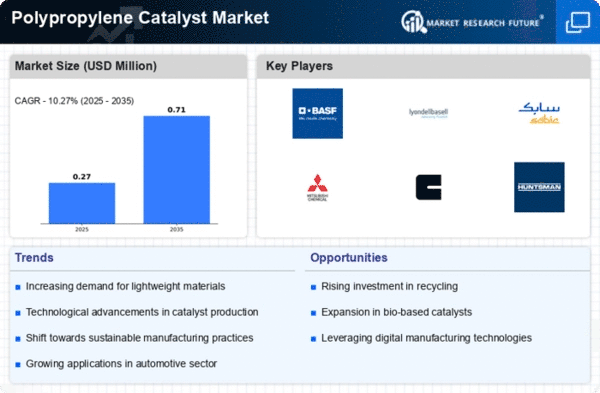
As per MRFR analysis, the Polypropylene Catalyst Market Size was estimated at 0.243 USD Million in 2024. The Polypropylene Catalyst industry is projected to grow from 0.268 in 2025 to 0.712 by 2035, exhibiting a compound annual growth rate (CAGR) of 10.27 during the forecast period 2025 - 2035.

Key Market Trends & Highlights

The Polypropylene Catalyst Market is poised for robust growth driven by sustainability and technological advancements.

  • The market is experiencing a notable shift towards sustainability, influencing catalyst development and application.
  • North America remains the largest market for polypropylene catalysts, while Asia-Pacific is recognized as the fastest-growing region.
  • In terms of segments, polypropylene production dominates the market, whereas polymerization is emerging as the fastest-growing segment.
  • Key drivers include the rising demand for polypropylene products and regulatory support for sustainable practices, particularly in the automotive and packaging sectors.

Market Size & Forecast

2024 Market Size 0.243 (USD Million)
2035 Market Size 0.712 (USD Million)
CAGR (2025 - 2035) 10.27%
Largest Regional Market Share in 2024 Asia-Pacific

Major Players

<p>BASF (DE), LyondellBasell (US), SABIC (SA), Mitsubishi Chemical (JP), Clariant (CH), Huntsman (US), Evonik Industries (DE), W.R. Grace (US), INEOS (GB)</p>

Market Trends

The Polypropylene Catalyst Market is currently experiencing a dynamic evolution, driven by advancements in catalyst technology and increasing demand for polypropylene across various industries. The shift towards more sustainable and efficient production methods appears to be influencing the development of innovative catalysts that enhance the polymerization process. As manufacturers strive to meet stringent environmental regulations, the focus on catalysts that minimize waste and energy consumption is becoming more pronounced. Furthermore, the growing automotive and packaging sectors are likely to propel the demand for polypropylene, thereby impacting the catalyst market positively. In addition, the Polypropylene Catalyst Market seems to be characterized by a trend towards collaboration among key players, which may foster the development of novel catalyst solutions. Partnerships between chemical companies and research institutions could lead to breakthroughs in catalyst efficiency and performance. Moreover, the increasing adoption of advanced technologies, such as artificial intelligence and machine learning, in catalyst design and optimization is anticipated to reshape the landscape of this market. Overall, the Polypropylene Catalyst Market is poised for growth, driven by innovation and a commitment to sustainability.

Sustainability Focus

The emphasis on environmentally friendly production processes is reshaping the Polypropylene Catalyst Market. Manufacturers are increasingly seeking catalysts that reduce emissions and energy consumption, aligning with global sustainability goals.

Technological Advancements

Innovations in catalyst technology are driving efficiency in polypropylene production. Enhanced catalyst formulations and processes are likely to improve yield and reduce operational costs, making them more attractive to producers.

Collaborative Development

Partnerships between industry players and research institutions are fostering innovation in the Polypropylene Catalyst Market. Such collaborations may lead to the creation of advanced catalysts that meet evolving market demands.

Polypropylene Catalyst Market Market Drivers

Rising Demand for Polypropylene Products

The Global Polypropylene Catalyst Market Industry is experiencing a surge in demand for polypropylene products, driven by their extensive applications in packaging, automotive, and consumer goods. As industries increasingly prioritize lightweight and durable materials, polypropylene's favorable properties make it a preferred choice. In 2024, the market is projected to reach 1.85 USD Billion, reflecting the growing consumption of polypropylene in various sectors. This trend is likely to continue, as the global push for sustainable and efficient materials further propels the demand for polypropylene, thereby enhancing the role of catalysts in production processes.

Market Segment Insights

By Application: Polypropylene Production (Largest) vs. Polymerization (Fastest-Growing)

<p>In the Polypropylene Catalyst Market, the application segments showcase distinct roles with varying market shares. Polypropylene Production holds the largest share, driven by its extensive use in manufacturing diverse polypropylene products. Complementing this, Polymerization is emerging as the fastest-growing segment, motivated by advancements in catalyst technologies that enhance efficiency and product quality. Additives and Catalyst Recovery, while essential, rank lower in market contribution compared to these two leading applications.</p>

<p>Polypropylene Production (Dominant) vs. Polymerization (Emerging)</p>

<p>Polypropylene Production stands as the dominant application within the Polypropylene Catalyst Market, owing to its critical role in the production of packaging materials, automotive components, and textiles. Its well-established processes are bolstered by innovative catalytic solutions that optimize yield and reduce waste. In contrast, Polymerization is positioned as an emerging application, fueled by new technologies that improve the polymerization process's efficiency and effectiveness. As manufacturers seek greener and more efficient processes, this segment is gaining traction, showcasing advancements that promise to enhance product viability while catering to evolving market demands.</p>

By End Use Industry: Packaging (Largest) vs. Automotive (Fastest-Growing)

<p>The Polypropylene Catalyst Market displays significant distribution among various end-use industries, with the packaging sector leading in market share. This dominance can be attributed to the increasing demand for flexible packaging solutions, which are favored for their light weight and durability. In contrast, the automotive industry holds a noteworthy position, benefiting from the rising trend of lightweight materials in vehicles, thus enhancing fuel efficiency and reducing emissions.</p>

<p>Packaging (Dominant) vs. Automotive (Emerging)</p>

<p>The packaging sector remains the dominant end-use industry in the Polypropylene Catalyst Market due to its essential role in food preservation and consumer goods. Packaging solutions utilizing polypropylene catalysts are preferred for their superior barrier properties and recyclability. On the other hand, the automotive industry is an emerging player, capitalizing on advancements in automotive design and sustainability initiatives. The shift towards electric vehicles and energy-efficient designs is driving the demand for lightweight polypropylene applications, positioning this segment for rapid growth as manufacturers seek eco-friendly and cost-effective materials.</p>

By Catalyst Type: Ziegler-Natta (Largest) vs. Metallocene (Fastest-Growing)

<p>In the Polypropylene Catalyst Market, Ziegler-Natta catalysts hold the largest share, being the most traditional and widely used technology in the production of polypropylene. Their proven reliability and efficiency make them a preferred choice among manufacturers, sustaining their dominance in the sector. On the other hand, Metallocene catalysts, though a smaller portion of the market, are rapidly gaining traction due to their ability to produce polypropylene with specific properties that enhance product performance and innovation.</p>

<p>Catalyst Type: Ziegler-Natta (Dominant) vs. Metallocene (Emerging)</p>

<p>Ziegler-Natta catalysts are known for their established history and efficiency in polypropylene production. They facilitate a high degree of control over molecular weight and polymer branching, enabling the production of diverse polypropylene grades. This dominance, however, is currently being challenged by the emerging Metallocene catalysts, which offer enhanced precision in polymer modification. The unique ability of Metallocene catalysts to tailor the polymer's properties leads to high-performance applications in various sectors, such as packaging and automotive, making them increasingly attractive to manufacturers seeking competitive advantages.</p>

By Process Technology: Bulk Polymerization (Largest) vs. Slurry Polymerization (Fastest-Growing)

<p>In the Polypropylene Catalyst Market, the market share is prominently held by the Bulk Polymerization method, which continues to dominate the scene due to its efficiency in producing high-quality polypropylene. Gas Phase Polymerization also commands a significant share but is primarily favored for specific applications. Slurry Polymerization, while currently smaller in comparison, is gaining traction as manufacturers look for versatile and adaptive processes to meet dynamic market demands. The growth trends in the Polypropylene Catalyst Market highlight a shift towards Slurry Polymerization, recognized for its ability to handle a wider range of polypropylene grades and blends, thus attracting investments. Importantly, technological advancements and increased demand for lightweight and durable materials are propelling all three processes forward, yet Slurry Polymerization is catching up rapidly as industries focus on sustainable and efficient production methods.</p>

<p>Bulk Polymerization (Dominant) vs. Slurry Polymerization (Emerging)</p>

<p>Bulk Polymerization stands as a dominant force in the Polypropylene Catalyst Market, lauded for its streamlined process and ability to produce high yields with lower energy consumption. This method's efficiency, combined with well-established technology, makes it the preferred choice among manufacturers aiming for consistency and quality in polypropylene production. On the contrary, Slurry Polymerization is positioned as an emerging competitor, gaining popularity due to its flexibility in producing various polypropylene grades. This adaptability makes Slurry Polymerization increasingly attractive, particularly in response to evolving market demands for innovative materials. As companies strive to enhance their production capabilities, Slurry Polymerization is expected to capture greater market share, driven by its potential to cater to diverse applications.</p>

By Formulation Type: Homopolymer (Largest) vs. Copolymers (Fastest-Growing)

<p>In the Polypropylene Catalyst Market, the formulation type segment is characterized by three distinct categories: Homopolymer, Copolymers, and Blends. Among these, Homopolymer holds the largest market share due to its widespread applications across various industries, including packaging and automotive. Copolymers, while smaller in market share, are emerging strongly, fueled by increasing demand from sectors that require specialized properties in their formulations.</p>

<p>Homopolymer (Dominant) vs. Copolymers (Emerging)</p>

<p>Homopolymers dominate the Polypropylene Catalyst Market owing to their robust performance and cost-effectiveness in numerous applications. They are widely used due to their excellent tensile strength and heat resistance. Conversely, Copolymers are gaining traction as they offer enhanced properties, such as improved impact resistance and flexibility. Their tailored characteristics make them suitable for automotive parts and advanced packaging solutions, positioning Copolymers as the emerging choice among manufacturers. The growing emphasis on sustainable and high-performance materials is likely to further justify the shift towards Copolymers.</p>

Get more detailed insights about Polypropylene Catalyst Market Research Report – Forecast to 2035

Regional Insights

North America : Stable Growth Environment

The North American polypropylene catalyst market is projected to grow steadily, driven by increasing demand from the automotive and packaging sectors. With a market size of $0.06 billion, the region benefits from robust regulatory frameworks that promote sustainable practices. The focus on recycling and eco-friendly materials is expected to further enhance market dynamics, aligning with global sustainability goals. Leading countries such as the US and Canada are home to major players like LyondellBasell and Huntsman, which are investing in innovative catalyst technologies. The competitive landscape is characterized by strategic partnerships and collaborations aimed at enhancing product offerings. As the market evolves, the presence of established companies will play a crucial role in shaping future trends.

Europe : Innovation and Sustainability Focus

Europe's polypropylene catalyst market, valued at $0.07 billion, is witnessing a transformation driven by innovation and sustainability initiatives. Regulatory frameworks, such as the European Green Deal, are catalyzing investments in advanced catalyst technologies. The region's commitment to reducing carbon emissions and promoting circular economy practices is expected to significantly influence market growth. Countries like Germany, France, and Italy are leading the charge, with key players such as BASF and Clariant spearheading research and development efforts. The competitive landscape is marked by a strong emphasis on eco-friendly solutions, positioning Europe as a leader in sustainable catalyst technologies. This focus on innovation is likely to attract further investments and enhance market competitiveness.

Asia-Pacific : Dominant Market Leader

Asia-Pacific is the largest market for polypropylene catalysts, with a market size of $0.1 billion, reflecting its dominant position in the global landscape. The region's growth is fueled by rapid industrialization, increasing demand for packaging materials, and a shift towards advanced manufacturing processes. Regulatory support for petrochemical industries further enhances market prospects, making it a key player in the global supply chain. China, Japan, and India are at the forefront, with major companies like SABIC and Mitsubishi Chemical leading the market. The competitive environment is characterized by aggressive expansion strategies and technological advancements. As the region continues to innovate, it is expected to maintain its leadership position in the polypropylene catalyst market.

Middle East and Africa : Emerging Market Potential

The Middle East and Africa (MEA) region, with a market size of $0.01 billion, is emerging as a potential hub for polypropylene catalyst production. The growth is driven by increasing investments in petrochemical projects and favorable government policies aimed at boosting local manufacturing. The region's rich hydrocarbon resources provide a competitive advantage, positioning it for future growth in the catalyst market. Countries like Saudi Arabia and the UAE are leading the way, with companies such as SABIC making significant contributions to market development. The competitive landscape is evolving, with new entrants and established players vying for market share. As the region capitalizes on its resources, it is poised for substantial growth in the polypropylene catalyst sector.

Key Players and Competitive Insights

The Polypropylene Catalyst Market is currently characterized by a dynamic competitive landscape, driven by innovation, sustainability, and strategic partnerships. Key players such as BASF (DE), LyondellBasell (US), and SABIC (SA) are actively shaping the market through their distinct operational focuses. BASF (DE) emphasizes innovation in catalyst technology, aiming to enhance efficiency and reduce environmental impact. LyondellBasell (US) is pursuing regional expansion, particularly in emerging markets, to capitalize on growing demand. Meanwhile, SABIC (SA) is focusing on sustainability initiatives, aligning its product offerings with global environmental standards. Collectively, these strategies contribute to a competitive environment that is increasingly focused on technological advancement and sustainable practices.

In terms of business tactics, companies are localizing manufacturing and optimizing supply chains to enhance operational efficiency. The market structure appears moderately fragmented, with several key players exerting influence over their respective segments. This fragmentation allows for a diverse range of products and innovations, although the presence of dominant players like BASF (DE) and LyondellBasell (US) suggests a competitive hierarchy that shapes market dynamics.

In November 2025, BASF (DE) announced the launch of a new line of advanced polypropylene catalysts designed to improve production efficiency by 15%. This strategic move is significant as it not only reinforces BASF's commitment to innovation but also positions the company to meet the increasing demand for high-performance materials in various applications. The introduction of these catalysts is likely to enhance BASF's competitive edge in the market, particularly in regions where efficiency is paramount.

In October 2025, LyondellBasell (US) completed the acquisition of a regional catalyst manufacturer, which is expected to bolster its market presence in Asia. This acquisition is strategically important as it allows LyondellBasell to leverage local expertise and expand its product offerings, thereby enhancing its competitive positioning in a rapidly growing market. The integration of this new entity is anticipated to streamline operations and improve supply chain efficiencies.

In September 2025, SABIC (SA) launched a sustainability initiative aimed at reducing carbon emissions from its polypropylene production processes by 30% by 2030. This initiative underscores SABIC's commitment to environmental stewardship and aligns with global trends towards sustainability. By prioritizing eco-friendly practices, SABIC is likely to attract environmentally conscious customers and strengthen its market position in an increasingly competitive landscape.

As of December 2025, current competitive trends in the Polypropylene Catalyst Market are heavily influenced by digitalization, sustainability, and the integration of AI technologies. Strategic alliances among key players are shaping the landscape, fostering innovation and collaboration. The shift from price-based competition to a focus on technological advancement and supply chain reliability is evident. Companies that prioritize innovation and sustainability are likely to differentiate themselves in the evolving market, suggesting a future where competitive advantage is increasingly tied to technological prowess and environmental responsibility.

Key Companies in the Polypropylene Catalyst Market market include

Industry Developments

December 2021

- W.R.Grace and the co has declared the successful start-up business of the two 400KTA UNIPOL PP process technology lines at the oriental energy in China

In October 2021

– Lummus technology and their partner has got a large contract in India which has the chance of growing the Polypropylene Catalyst Market.

Future Outlook

Polypropylene Catalyst Market Future Outlook

<p>The Polypropylene Catalyst Market is projected to grow at a 10.27% CAGR from 2024 to 2035, driven by increasing demand for lightweight materials and advancements in catalyst technology.</p>

New opportunities lie in:

  • <p>Development of advanced metallocene catalysts for enhanced polymer properties.</p>
  • <p>Expansion into emerging markets with tailored catalyst solutions.</p>
  • <p>Investment in sustainable catalyst technologies to meet regulatory demands.</p>

<p>By 2035, the market is expected to achieve robust growth, positioning itself as a leader in catalyst innovation.</p>

Market Segmentation

Polypropylene Catalyst Market Application Outlook

  • Polypropylene Production
  • Polymerization
  • Additives
  • Catalyst Recovery

Polypropylene Catalyst Market Catalyst Type Outlook

  • Ziegler-Natta Catalyst
  • Metallocene Catalyst
  • Single-Site Catalyst
  • Supported Catalyst

Polypropylene Catalyst Market End Use Industry Outlook

  • Automotive
  • Packaging
  • Textiles
  • Consumer Goods

Polypropylene Catalyst Market Formulation Type Outlook

  • Homopolymer
  • Copolymers
  • Blends

Polypropylene Catalyst Market Process Technology Outlook

  • Bulk Polymerization
  • Gas Phase Polymerization
  • Slurry Polymerization

Report Scope

MARKET SIZE 20240.243(USD Million)
MARKET SIZE 20250.268(USD Million)
MARKET SIZE 20350.712(USD Million)
COMPOUND ANNUAL GROWTH RATE (CAGR)10.27% (2024 - 2035)
REPORT COVERAGERevenue Forecast, Competitive Landscape, Growth Factors, and Trends
BASE YEAR2024
Market Forecast Period2025 - 2035
Historical Data2019 - 2024
Market Forecast UnitsUSD Million
Key Companies ProfiledBASF (DE), LyondellBasell (US), SABIC (SA), Mitsubishi Chemical (JP), Clariant (CH), Huntsman (US), Evonik Industries (DE), W.R. Grace (US), INEOS (GB)
Segments CoveredApplication, End Use Industry, Catalyst Type, Process Technology, Formulation Type
Key Market OpportunitiesAdvancements in catalyst technology enhance polypropylene production efficiency and sustainability in the Polypropylene Catalyst Market.
Key Market DynamicsTechnological advancements in catalyst formulations drive competition and enhance polypropylene production efficiency.
Countries CoveredNorth America, Europe, APAC, South America, MEA

FAQs

What are major applications of polypropylene catalysts?

Polypropylene catalysts are used in the production of polypropylene by the polymerization reaction. It is used in applications such as films &amp; tubes, packaging, and automotive parts.

Which is the largest segment in the global polypropylene catalysts market?

The Ziegler–Natta catalyst segment is estimated to remain largest segment in the global polypropylene catalysts market throughout the review period.

Which region holds the largest share in the global polypropylene catalyst market?

North America holds the largest share in the global Polypropylene catalyst market followed by Europe and Asia Pacific, respectively.

Who are the top players in the global Polypropylene catalyst market?

Clariant (Switzerland), LyondellBasell Industries Holdings BV (Netherlands), Mitsui Chemicals, Inc. (Japan), Japan Polypropylene Corporation (Japan), China Petrochemical Corporation (China), Reliance Industries Limited (India), Univation Technologies, LLC (US), SABIC (Saudi Arabia), and W.R. Grace &amp; Co.-Conn. (US), are some of the major players operating in the global Polypropylene catalyst market.

What are the key growth strategies of polypropylene catalyst industry players?

Strategic initiatives such as mergers &amp; acquisitions, collaborations, expansion, and technology/ product launch are some of the growth strategies that players operating in the global polypropylene catalyst market adopt to gain a larger competitive advantage.

  1. Executive Summary
  2. Market Introduction
    1. Market Definition
    2. Scope of the Study
    3. List of Assumptions
    4. Market Structure
  3. Market Research Methodology
    1. Research
    2. Process
    3. Primary Research
    4. Secondary Research
    5. Market
    6. Size Estimation
    7. Forecast Model
  4. Market Dynamics of Global Polypropylene
    1. Catalyst Market
    2. Introduction
    3. Drivers
    4. Restraints
    5. Opportunities
    6. Challenges
    7. Trends/Technology
  5. Market
    1. Factor Analysis of Global Polypropylene Catalyst Market
    2. Supply Chain Analysis
      1. Raw Material Suppliers
      2. Manufacturers/Producers
      3. End Users
    3. Distributors/Retailers/Wholesalers/E-Commerce
    4. Porter’s
      1. Threat of New Entrants
      2. Bargaining Power
      3. Bargaining Power of Suppliers
      4. Threat of Substitutes
      5. Intensity of Competitive Rivalry
    5. Five Forces Analysis
    6. of Buyers
  6. Global Polypropylene Catalyst
  7. Market, by Product Type
    1. Introduction
    2. Ziegler-Natta Catalyst
      1. Market Estimates & Forecast, 2020−2027
      2. Market Estimates
    3. & Forecast, by Region, 2020−2027
    4. Metallocene Catalyst
      1. Market Estimates &
    5. Market Estimates & Forecast, 2020−2027
    6. Forecast, by Region, 2020−2027
    7. Others
      1. Market Estimates
      2. Market Estimates & Forecast, by Region,
    8. & Forecast, 2020−2027
  8. Global Polypropylene Catalyst Market, by Manufacturing Process
    1. Introduction
    2. Bulk Process
      1. Market Estimates & Forecast,
      2. Market Estimates & Forecast, by Region, 2020−2027
    3. Gas-Phase Process
      1. Market Estimates & Forecast, 2020−2027
      2. Market Estimates & Forecast, by Region, 2020−2027
    4. Others
      1. Market Estimates & Forecast, 2020−2027
      2. Market Estimates
    5. & Forecast, by Region, 2020−2027
  9. Global Polypropylene Catalyst
  10. Market, by Application
    1. Introduction
    2. Films
      1. Market Estimates
      2. Market Estimates & Forecast, by Region,
    3. & Forecast, 2020−2027
    4. Fibers
      1. Market Estimates & Forecast, 2020−2027
      2. Market Estimates & Forecast, by Region, 2020−2027
    5. Tubes
      1. Market Estimates & Forecast, 2020−2027
      2. Market Estimates
    6. & Forecast, by Region, 2020−2027
    7. Injection-Molded Products
      1. Market Estimates & Forecast, 2020−2027
      2. Market Estimates
    8. & Forecast, by Region, 2020−2027
    9. Others
      1. Market Estimates
      2. Market Estimates & Forecast, by Region,
    10. & Forecast, 2020−2027
  11. Global Polypropylene Catalyst Market, by End-Use Industry
    1. Introduction
    2. Automotive
      1. Market Estimates & Forecast,
      2. Market Estimates & Forecast, by Region, 2020−2027
    3. Packaging
      1. Market Estimates & Forecast, 2020−2027
  12. Market Estimates & Forecast, by Region, 2020−2027
    1. Medical
      1. Market Estimates & Forecast, 2020−2027
      2. Market Estimates
    2. & Forecast, by Region, 2020−2027
    3. Chemicals
      1. Market
      2. Market Estimates & Forecast,
    4. Estimates & Forecast, 2020−2027
    5. by Region, 2020−2027
    6. Others
      1. Market Estimates & Forecast,
      2. Market Estimates & Forecast, by Region, 2020−2027
  13. Global Polypropylene Catalyst Market, by Region
    1. Introduction
    2. North America
      1. Market Estimates & Forecast, 2020−2027
      2. Market Estimates & Forecast, by Product Type, 2020−2027
  14. Market Estimates & Forecast, by Manufacturing Process, 2020−2027
  15. Market Estimates & Forecast, by Application, 2020−2027
    1. Estimates & Forecast, by End-Use Industry, 2020−2027
    2. Estimates & Forecast, by Product Type, 2020−2027
    3. Estimates & Forecast, by Manufacturing Process, 2020−2027
  16. Market
  17. US
  18. Market Estimates & Forecast, 2020−2027
  19. Market
  20. Market
  21. Market Estimates & Forecast, by Application, 2020−2027
    1. Estimates & Forecast, by End-Use Industry, 2020−2027
    2. Estimates & Forecast, by Product Type, 2020−2027
    3. Estimates & Forecast, by Manufacturing Process, 2020−2027
  22. Market
  23. Canada
  24. Market Estimates & Forecast, 2020−2027
  25. Market
  26. Market
  27. Market Estimates & Forecast, by Application, 2020−2027
    1. Estimates & Forecast, by End-Use Industry, 2020−2027
    2. & Forecast, by Product Type, 2020−2027
    3. Forecast, by Manufacturing Process, 2020−2027
    4. & Forecast, by Application, 2020−2027
    5. Forecast, by End-Use Industry, 2020−2027
    6. Market Estimates & Forecast, 2020−2027
    7. & Forecast, by Product Type, 2020−2027
    8. & Forecast, by Manufacturing Process, 2020−2027
    9. & Forecast, by Application, 2020−2027
    10. Forecast, by End-Use Industry, 2020−2027
    11. Market Estimates & Forecast, 2020−2027
    12. & Forecast, by Product Type, 2020−2027
    13. & Forecast, by Manufacturing Process, 2020−2027
    14. & Forecast, by Application, 2020−2027
    15. Forecast, by End-Use Industry, 2020−2027
    16. Estimates & Forecast, 2020−2027
    17. by Product Type, 2020−2027
    18. by Manufacturing Process, 2020−2027
    19. by Application, 2020−2027
    20. End-Use Industry, 2020−2027
    21. & Forecast, 2020−2027
    22. Product Type,2020−2027
    23. Process, 2020−2027
  28. Market
    1. Europe
      1. Market Estimates & Forecast, 2020−2027
      2. Market Estimates
      3. Market Estimates &
      4. Market Estimates
      5. Market Estimates &
      6. Germany
      7. France
      8. Italy
      9. Spain
      10. UK
      11. Russia
      12. Rest of Europe
    2. Asia-Pacific
      1. Market Estimates & Forecast, 2020−2027
      2. Market Estimates & Forecast, by Product Type, 2020−2027
  29. Market Estimates & Forecast, by Manufacturing Process, 2020−2027
  30. Market Estimates & Forecast, by Application, 2020−2027
    1. Estimates & Forecast, by End-Use Industry, 2020−2027
    2. Estimates & Forecast, by Product Type, 2020−2027
    3. Estimates & Forecast, by Manufacturing Process, 2020−2027
  31. Market
  32. China
  33. Market Estimates & Forecast, 2020−2027
  34. Market
  35. Market
  36. Market Estimates & Forecast, by Application, 2020−2027
    1. Estimates & Forecast, by End-Use Industry, 2020−2027
    2. Estimates & Forecast, by Product Type, 2020−2027
    3. Estimates & Forecast, by Manufacturing Process, 2020−2027
  37. Market
  38. India
  39. Market Estimates & Forecast, 2020−2027
  40. Market
  41. Market
  42. Market Estimates & Forecast, by Application, 2020−2027
    1. Estimates & Forecast, by End-Use Industry, 2020−2027
    2. Estimates & Forecast, by Product Type, 2020−2027
    3. Estimates & Forecast, by Manufacturing Process, 2020−2027
  43. Market
  44. Japan
  45. Market Estimates & Forecast, 2020−2027
  46. Market
  47. Market
  48. Market Estimates & Forecast, by Application, 2020−2027
    1. Estimates & Forecast, by End-Use Industry, 2020−2027
    2. & New Zealand
  49. Market
  50. Australia
  51. Market Estimates & Forecast, 2020−2027
  52. Market Estimates & Forecast, by Product Type, 2020−2027
  53. Market Estimates & Forecast, by Manufacturing Process, 2020−2027
  54. Market Estimates & Forecast, by Application, 2020−2027
  55. Market Estimates & Forecast, by End-Use Industry, 2020−2027
    1. Rest of Asia-Pacific
  56. Market Estimates & Forecast, 2020−2027
  57. Market Estimates & Forecast, by Product Type, 2020−2027
  58. Market Estimates & Forecast, by Manufacturing Process, 2020−2027
  59. Market Estimates & Forecast, by Application, 2020−2027
  60. Market Estimates & Forecast, by End-Use Industry, 2020−2027
    1. Middle East & Africa
      1. Market Estimates & Forecast, 2020−2027
      2. Market Estimates & Forecast, by Product Type, 2020−2027
  61. Market Estimates & Forecast, by Manufacturing Process, 2020−2027
  62. Market Estimates & Forecast, by Application, 2020−2027
    1. Estimates & Forecast, by End-Use Industry, 2020−2027
    2. Arabia
  63. Market
  64. Saudi
  65. Market Estimates & Forecast, 2020−2027
  66. Market Estimates & Forecast, by Product Type, 2020−2027
  67. Market Estimates & Forecast, by Manufacturing Process, 2020−2027
  68. Market Estimates & Forecast, by Application, 2020−2027
    1. Estimates & Forecast, by End-Use Industry, 2020−2027
    2. Estimates & Forecast, by Product Type, 2020−2027
    3. Estimates & Forecast, by Manufacturing Process, 2020−2027
  69. Market
  70. Israel
  71. Market Estimates & Forecast, 2020−2027
  72. Market
  73. Market
  74. Market Estimates & Forecast, by Application, 2020−2027
    1. Estimates & Forecast, by End-Use Industry, 2020−2027
    2. Africa
  75. Market
  76. South
  77. Market Estimates & Forecast, 2020−2027
  78. Market Estimates & Forecast, by Product Type, 2020−2027
  79. Market Estimates & Forecast, by Manufacturing Process, 2020−2027
  80. Market Estimates & Forecast, by Application, 2020−2027
    1. Estimates & Forecast, by End-Use Industry, 2020−2027
    2. Estimates & Forecast, by Product Type, 2020−2027
    3. Estimates & Forecast, by Manufacturing Process, 2020−2027
  81. Market
  82. Turkey
  83. Market Estimates & Forecast, 2020−2027
  84. Market
  85. Market
  86. Market Estimates & Forecast, by Application, 2020−2027
  87. Market Estimates & Forecast, by End-Use Industry, 2020−2027
    1. Rest of the Middle East & Africa
    2. Process, 2020−2027
  88. Market Estimates & Forecast,
  89. Market Estimates & Forecast, by Product Type,
  90. Market Estimates & Forecast, by Manufacturing
  91. Market Estimates & Forecast, by Application,
  92. Market Estimates & Forecast, by End-Use Industry,
    1. Latin America
      1. Market Estimates & Forecast,
      2. Market Estimates & Forecast, by Product Type, 2020−2027
      3. Market Estimates & Forecast, by Manufacturing Process, 2020−2027
      4. Market Estimates & Forecast, by Application, 2020−2027
  93. Market Estimates & Forecast, by End-Use Industry, 2020−2027
    1. Brazil
  94. Market Estimates & Forecast, 2020−2027
  95. Market Estimates & Forecast, by Product Type, 2020−2027
  96. Market Estimates & Forecast, by Manufacturing Process, 2020−2027
  97. Market Estimates & Forecast, by Application, 2020−2027
    1. Estimates & Forecast, by End-Use Industry, 2020−2027
    2. Estimates & Forecast, by Product Type, 2020−2027
    3. Estimates & Forecast, by Manufacturing Process, 2020−2027
  98. Market
  99. Argentina
  100. Market Estimates & Forecast, 2020−2027
  101. Market
  102. Market
  103. Market Estimates & Forecast, by Application, 2020−2027
    1. Estimates & Forecast, by End-Use Industry, 2020−2027
    2. Estimates & Forecast, by Product Type, 2020−2027
    3. Estimates & Forecast, by Manufacturing Process, 2020−2027
  104. Market
  105. Mexico
  106. Market Estimates & Forecast, 2020−2027
  107. Market
  108. Market
  109. Market Estimates & Forecast, by Application, 2020−2027
    1. Estimates & Forecast, by End-Use Industry, 2020−2027
    2. of Latin America
  110. Market
  111. Rest
  112. Market Estimates & Forecast, 2020−2027
  113. Market Estimates & Forecast, by Product Type, 2020−2027
  114. Market Estimates & Forecast, by Manufacturing Process, 2020−2027
  115. Market Estimates & Forecast, by Application, 2020−2027
  116. Market Estimates & Forecast, by End-Use Industry, 2020−2027
  117. Company
    1. Landscape
    2. Introduction
    3. Market Strategy
    4. Key Development
    5. Analysis (Expansion/Merger & Acquisitions/Joint Venture/New Product Development/Agreement/Investment)
  118. Company Profiles
    1. LyondellBasell Industries Holdings BV
      1. Financial Updates
      2. Product/Business Segment
      3. Strategy
      4. Key Developments
      5. SWOT Analysis
    2. Company Overview
    3. Overview
    4. Clariant
      1. Company Overview
      2. Financial Updates
      3. Strategy
      4. Key Developments
      5. SWOT Analysis
    5. Product/Business Segment Overview
    6. Mitsui Chemicals, Inc.
      1. Company Overview
      2. Financial Updates
      3. Product/Business Segment Overview
      4. Key Developments
      5. SWOT Analysis
    7. Strategy
    8. China
      1. Company Overview
      2. Financial Updates
      3. Product/Business Segment Overview
      4. Strategy
      5. SWOT Analysis
    9. Petrochemical Corporation
    10. Key Developments
    11. Japan Polypropylene Corporation
      1. Company Overview
      2. Financial Updates
      3. Product/Business
      4. Strategy
      5. Key Developments
    12. Segment Overview
    13. SWOT Analysis
    14. Mitsubishi Chemical Corporation
      1. Company Overview
      2. Financial Updates
      3. Product/Business Segment Overview
      4. Key Developments
      5. SWOT Analysis
    15. Strategy
    16. Reliance
      1. Company Overview
      2. Financial Updates
      3. Product/Business Segment Overview
      4. Strategy
      5. Key
      6. SWOT Analysis
    17. Industries Limited
    18. Developments
    19. SABIC
      1. Company Overview
      2. Financial Updates
      3. Product/Business Segment Overview
      4. Key Developments
      5. SWOT Analysis
    20. Strategy
    21. Univation
      1. Company Overview
      2. Financial Updates
      3. Product/Business Segment Overview
      4. Strategy
      5. Key
      6. SWOT Analysis
    22. Technologies, LLC
    23. Developments
    24. W.R. Grace & Co.-Conn.
      1. Company Overview
      2. Financial Updates
      3. Product/Business
      4. Strategy
      5. Key Developments
    25. Segment Overview
    26. SWOT Analysis
  119. Conclusion
  120. LIST OF TABLES
  121. Global
    1. Polypropylene Catalyst Market: by Region, 2020−2027
  122. North America:
  123. Polypropylene Catalyst Market, by Country, 2020−2027
  124. Europe:
  125. Polypropylene Catalyst Market, by Country, 2020−2027
  126. Asia-Pacific:
    1. Polypropylene Catalyst Market. by Country, 2020−2027
  127. Middle East
  128. & Africa: Polypropylene Catalyst Market, by Country, 2020−2027
    1. Table
  129. Latin America: Polypropylene Catalyst Market, by Country, 2020−2027
    1. Table
  130. Global Polypropylene Catalyst Product Type Market, by Regions, 2020−2027
  131. North America: Polypropylene Catalyst Product Type Market, by Country,
  132. Europe: Polypropylene Catalyst Product Type Market,
    1. by Country, 2020−2027
    2. Table10 Asia-Pacific: Polypropylene Catalyst Product
  133. Type Market, by Country, 2020−2027
    1. Table11 Middle East & Africa:
  134. Polypropylene Catalyst Product Type Market, by Country, 2020−2027
    1. Table12
  135. Latin America: Polypropylene Catalyst Product Type Market, by Country, 2020−2027
  136. Table13 Global Polypropylene Catalyst Manufacturing Process Market, by Regions,
    1. Table14 North America: Polypropylene Catalyst Manufacturing
  137. Process Market, by Country, 2020−2027
    1. Table15 Europe: Polypropylene Catalyst
  138. Manufacturing Process Market, by Country, 2020−2027
    1. Table16 Asia-Pacific:
  139. Polypropylene Catalyst Manufacturing Process Market, by Country, 2020−2027
    1. Table17 Middle East & Africa: Polypropylene Catalyst Manufacturing Process
  140. Market, by Country, 2020−2027
    1. Table18 Latin America: Polypropylene Catalyst
  141. Manufacturing Process Market, by Country, 2020−2027
    1. Table19 Global Polypropylene
  142. Catalyst Application Market, by Regions, 2020−2027
    1. Table20 North America:
  143. Polypropylene Catalyst Application Market, by Country, 2020−2027
    1. Table21
  144. Europe: Polypropylene Catalyst Application Market, by Country, 2020−2027
  145. Table22 Asia-Pacific: Polypropylene Catalyst Application Market, by Country, 2020−2027
    1. Table23 Middle East & Africa: Polypropylene Catalyst Application Market, by
    2. Country, 2020−2027
    3. Table24 Latin America: Polypropylene Catalyst Application
  146. Market, by Country, 2020−2027
    1. Table25 Global Polypropylene Catalyst End-Use
  147. Industry Market, by Regions, 2020−2027
    1. Table26 North America: Polypropylene
  148. Catalyst End-Use Industry Market, by Country, 2020−2027
    1. Table27 Europe:
  149. Polypropylene Catalyst End-Use Industry Market, by Country, 2020−2027
    1. Table28
  150. Asia-Pacific: Polypropylene Catalyst End-Use Industry Market, by Country, 2020−2027
    1. Table29 Middle East & Africa: Polypropylene Catalyst End-Use Industry Market,
    2. by Country, 2020−2027
    3. Table30 Latin America: Polypropylene Catalyst by
  151. End-Use Industry Market, by Country, 2020-2027
    1. Table31 Global Product Type
  152. Market, by Region, 2020−2027
    1. Table32 Global Manufacturing Process Market,
    2. by Region, 2020−2027
  153. Table33 Global Application Market, by Region, 2020−2027
  154. Table34 Global End-Use Industry Market, by Region, 2020−2027
    1. Table35
  155. North America: Polypropylene Catalyst Market, by Country, 2020−2027
    1. Table36
  156. North America: Polypropylene Catalyst Market, by Product Type, 2020−2027
  157. Table37 North America: Polypropylene Catalyst Market, by Manufacturing Process,
  158. Table38 North America: Polypropylene Catalyst Market, by Application,
  159. Table39 North America: Polypropylene Catalyst Market, by End-Use
    1. Industry, 2020−2027
    2. Table40 Europe: Polypropylene Catalyst Market, by
    3. Country, 2020−2027
    4. Table41 Europe: Polypropylene Catalyst Market, by
    5. Product Type, 2020−2027
    6. Table42 Europe: Polypropylene Catalyst Market,
    7. by Manufacturing Process, 2020−2027
    8. Table43 Europe: Polypropylene Catalyst
  160. Market, by Application, 2020−2027
    1. Table44 Europe: Polypropylene Catalyst
  161. Market, by End-Use Industry, 2020−2027
    1. Table45 Asia-Pacific: Polypropylene
  162. Catalyst Market, by Country, 2020−2027
    1. Table46 Asia-Pacific: Polypropylene
  163. Catalyst Market, by Product Type, 2020−2027
    1. Table47 Asia-Pacific: Polypropylene
  164. Catalyst Market, by Manufacturing Process, 2020−2027
    1. Table48 Asia-Pacific:
  165. Polypropylene Catalyst Market, by Application, 2020−2027
    1. Table49 Asia-Pacific:
  166. Polypropylene Catalyst Market, by End-Use Industry, 2020−2027
    1. Table50
  167. Middle East & Africa: Polypropylene Catalyst Market, by Country, 2020−2027
  168. Table51 Middle East & Africa: Polypropylene Catalyst Market, by Product Type,
    1. Table52 Middle East & Africa: Polypropylene Catalyst Market,
    2. by Manufacturing Process, 2020−2027
    3. Table53 Middle East & Africa:
  169. Polypropylene Catalyst Market, by Application, 2020−2027
    1. Table54 Middle
  170. East & Africa: Polypropylene Catalyst Market, by End-Use Industry, 2020−2027
  171. Table55 Latin America: Polypropylene Catalyst Market, by Country, 2020−2027
  172. Table56 Latin America: Polypropylene Catalyst Market, by Product Type, 2020−2027
  173. Table57 Latin America: Polypropylene Catalyst Market, by Manufacturing Process,
  174. Table58 Latin America: Polypropylene Catalyst Market, by Application,
  175. Table59 Latin America: Polypropylene Catalyst Market, by End-Use
    1. Industry, 2020−2027
  176. LIST OF FIGURES
  177. Global Polypropylene
    1. Catalyst Market Segmentation
  178. Forecast Research Methodology
    1. FIGURE
  179. Five Forces Analysis of Global Polypropylene Catalyst Market
  180. Value
    1. Chain of Global Polypropylene Catalyst Market
  181. Share of Global Polypropylene
  182. Catalyst Market in 2020, by Country
  183. Global Polypropylene Catalyst
    1. Market, 2020−2027,
  184. Global Polypropylene Catalyst Market Size,
    1. by Product Type, 2020
  185. Share of Global Polypropylene Catalyst Market,
    1. by Product Type, 2020−2027
  186. Global Polypropylene Catalyst Market
    1. Size, by Manufacturing Process, 2020
    2. FIGURE10 Share of Global Polypropylene
  187. Catalyst Market, by Manufacturing Process, 2020−2027
    1. FIGURE11 Global
  188. Polypropylene Catalyst Market Size, by Application, 2020
    1. FIGURE12 Share of
  189. Global Polypropylene Catalyst Market, by Application, 2020−2027
    1. FIGURE13
  190. Global Polypropylene Catalyst Market Size, by End-Use Industry, 2020
    1. FIGURE14
  191. Share of Global Polypropylene Catalyst Market, by End-Use Industry, 2020−2027

Polypropylene Catalyst Market Segmentation

Market Segmentation Overview

  • Detailed segmentation data will be available in the full report
  • Comprehensive analysis by multiple parameters
  • Regional and country-level breakdowns
  • Market size forecasts by segment
Infographic

Free Sample Request

Kindly complete the form below to receive a free sample of this Report

Get Free Sample

Customer Strories

Compare Licence

×
Features License Type
Single User Multiuser License Enterprise User
Price $4,950 $5,950 $7,250
Maximum User Access Limit 1 User Upto 10 Users Unrestricted Access Throughout the Organization
Free Customization
Direct Access to Analyst
Deliverable Format
Platform Access
Discount on Next Purchase 10% 15% 15%
Printable Versions