×
Request Free Sample ×

Kindly complete the form below to receive a free sample of this Report

* Please use a valid business email

Leading companies partner with us for data-driven Insights

clients tt-cursor
Hero Background

Polyvinyl Alcohol Fiber Market

ID: MRFR/CnM/5823-CR
111 Pages
Chitranshi Jaiswal
May 2025

Polyvinyl Alcohol Fiber Market Research Report Information By Application (Textile and Apparel, Filter and Non-woven, Ropes and Fishing Nets, Construction and Paper), By Type (Water-soluble Fiber and High Strength Modulus Fiber) And By Region (North America, Europe, Asia-Pacific, And Rest Of The World) –Market Forecast Till 2035

Share:
Download PDF ×

We do not share your information with anyone. However, we may send you emails based on your report interest from time to time. You may contact us at any time to opt-out.

Polyvinyl Alcohol Fiber Market Infographic
Purchase Options

Polyvinyl Alcohol Fiber Market Summary

As per MRFR analysis, the Polyvinyl Alcohol Fiber Market Size was estimated at 0.56 USD Billion in 2024. The Polyvinyl Alcohol Fiber industry is projected to grow from 0.5841 in 2025 to 0.89 by 2035, exhibiting a compound annual growth rate (CAGR) of 4.3 during the forecast period 2025 - 2035.

Key Market Trends & Highlights

The Polyvinyl Alcohol Fiber Market is currently experiencing a robust growth trajectory driven by sustainability and technological advancements.

  • North America remains the largest market for polyvinyl alcohol fiber, reflecting a strong demand across various industries.
  • Asia-Pacific is emerging as the fastest-growing region, propelled by increasing industrialization and consumer awareness.
  • The textile and apparel segment dominates the market, while the filter and non-woven segment is witnessing rapid growth.
  • Sustainability initiatives and technological innovations are key drivers, enhancing the appeal of polyvinyl alcohol fibers in diverse applications.

Market Size & Forecast

2024 Market Size 0.56 (USD Billion)
2035 Market Size 0.89 (USD Billion)
CAGR (2025 - 2035) 4.3%

Major Players

Kuraray Co., Ltd. (JP), Nippon Synthetic Chemical Industry Co., Ltd. (JP), Honeywell International Inc. (US), Fujian Qianjin Chemical Co., Ltd. (CN), Kangde Xin Composite Material Group Co., Ltd. (CN), Kraton Corporation (US), Kangaroo Manufacturing (US), Kumar Industries (IN)

Polyvinyl Alcohol Fiber Market Trends

The Polyvinyl Alcohol Fiber Market is currently experiencing a notable evolution, driven by various factors that influence its demand and application across multiple industries. This fiber, known for its unique properties such as high tensile strength, chemical resistance, and biodegradability, is increasingly being utilized in textiles, construction, and medical applications. The growing emphasis on sustainable materials is likely to propel the market forward, as manufacturers seek alternatives to traditional synthetic fibers. Furthermore, advancements in production technologies may enhance the quality and performance of polyvinyl alcohol fibers, making them more appealing to end-users. In addition to sustainability, the Polyvinyl Alcohol Fiber Market is also shaped by the rising demand for high-performance materials in various sectors. Industries such as automotive and aerospace are exploring the potential of these fibers for lightweight and durable components. Moreover, the increasing focus on research and development is expected to yield innovative applications, further expanding the market's reach. As the global landscape continues to evolve, the Polyvinyl Alcohol Fiber Market appears poised for growth, driven by both environmental considerations and technological advancements.

Sustainability Focus

The emphasis on eco-friendly materials is becoming increasingly pronounced within the Polyvinyl Alcohol Fiber Market. As consumers and industries alike prioritize sustainability, the demand for biodegradable and environmentally responsible fibers is likely to rise. This trend may encourage manufacturers to innovate and develop new applications that align with green initiatives.

Technological Advancements

Ongoing advancements in production techniques are expected to enhance the properties of polyvinyl alcohol fibers. Innovations in manufacturing processes could lead to improved performance characteristics, making these fibers more attractive for various applications. This trend may also facilitate the exploration of new markets and uses.

Diverse Applications

The versatility of polyvinyl alcohol fibers is driving their adoption across a range of industries. From textiles to construction and medical uses, the potential applications appear to be expanding. This diversification may contribute to a broader market presence and increased demand as industries recognize the benefits of these fibers.

Polyvinyl Alcohol Fiber Market Drivers

Regulatory Support

Regulatory frameworks promoting the use of sustainable materials are influencing the Polyvinyl Alcohol Fiber Market positively. Governments are implementing policies that encourage the adoption of biodegradable and eco-friendly materials, which aligns with the properties of polyvinyl alcohol fibers. This regulatory support not only fosters innovation but also incentivizes manufacturers to transition towards more sustainable practices. As a result, companies are likely to invest in research and development to enhance the performance of polyvinyl alcohol fibers, thereby expanding their market presence. The anticipated increase in regulatory measures aimed at reducing plastic waste could further bolster the demand for polyvinyl alcohol fibers, potentially leading to a market growth rate of around 10% in the upcoming years.

Rising Consumer Awareness

The growing awareness among consumers regarding environmental issues is significantly impacting the Polyvinyl Alcohol Fiber Market. As consumers become more informed about the environmental implications of their purchases, there is a marked shift towards products that are sustainable and biodegradable. This trend is particularly evident in the textile and packaging sectors, where consumers are actively seeking alternatives to conventional synthetic fibers. The demand for eco-friendly products is expected to drive manufacturers to prioritize the development of polyvinyl alcohol fibers, which are perceived as a responsible choice. Market Research Future indicates that consumer preference for sustainable materials could lead to a substantial increase in the market share of polyvinyl alcohol fibers, with projections suggesting a growth rate of approximately 11% over the next few years.

Technological Innovations

Technological advancements play a pivotal role in shaping the Polyvinyl Alcohol Fiber Market. Innovations in fiber production techniques, such as advanced spinning methods and improved polymerization processes, have led to enhanced fiber properties, including increased strength and durability. These improvements enable the fibers to be utilized in a wider array of applications, from medical textiles to construction materials. Furthermore, the integration of smart technologies, such as IoT and AI, into manufacturing processes is expected to optimize production efficiency and reduce waste. As a result, the market is likely to witness a surge in demand for high-performance polyvinyl alcohol fibers, with projections indicating a potential market growth of 15% over the next five years.

Sustainability Initiatives

The increasing emphasis on sustainability within the Polyvinyl Alcohol Fiber Market is driving demand for eco-friendly materials. As industries seek to reduce their carbon footprint, the biodegradable nature of polyvinyl alcohol fibers becomes a compelling alternative to traditional synthetic fibers. This shift is evident in sectors such as textiles and packaging, where companies are actively pursuing sustainable practices. The market for biodegradable fibers is projected to grow significantly, with estimates suggesting a compound annual growth rate of over 10% in the coming years. This trend not only aligns with consumer preferences for environmentally responsible products but also encourages manufacturers to innovate and invest in sustainable production methods, thereby enhancing the overall appeal of the Polyvinyl Alcohol Fiber Market.

Diverse End-Use Applications

The versatility of polyvinyl alcohol fibers is a significant driver for the Polyvinyl Alcohol Fiber Market. These fibers find applications across various sectors, including textiles, automotive, and construction. In the textile industry, they are increasingly used in the production of non-woven fabrics, which are gaining popularity due to their lightweight and durable characteristics. Additionally, the automotive sector is adopting polyvinyl alcohol fibers for their lightweight properties, contributing to fuel efficiency. The construction industry also benefits from these fibers, as they enhance the strength and durability of concrete. With the expansion of applications, the market is projected to grow at a rate of approximately 12% annually, reflecting the increasing recognition of polyvinyl alcohol fibers' benefits.
Market Segment Insights

By Application: Textile and Apparel (Largest) vs. Filter and Non-woven (Fastest-Growing)

In the Polyvinyl Alcohol Fiber Market, the application segment is primarily dominated by the Textile and Apparel industry, which captures the largest share due to its extensive use in clothing and textiles. The Filter and Non-woven category is rapidly gaining traction as well, recognized for its innovative applications in filtration and health-related products, thus marking its importance in the market. Other segments like Ropes and Fishing Nets, Construction, and Paper also play significant roles but are not as dominant as the top two.

Textile and Apparel: Dominant vs. Filter and Non-woven: Emerging

Textile and Apparel continues to be the dominant application in the Polyvinyl Alcohol Fiber Market, driven by the need for high-performance fabrics and environmentally sustainable materials. This segment benefits from the increasing consumer demand for lightweight and durable garments, providing manufacturers with opportunities for innovation. On the other hand, the Filter and Non-woven segment is emerging as a key player, fueled by rising health and hygiene concerns, particularly post-pandemic. This segment showcases versatility in usage, including for personal protective equipment (PPE) and filtration systems, highlighting its growth potential and adaptability to market trends.

By Type: Water-soluble Fiber (Largest) vs. High Strength Modulus Fiber (Fastest-Growing)

In the Polyvinyl Alcohol Fiber Market, the distribution of market share between Water-soluble Fiber and High Strength Modulus Fiber has shown distinct trends. Water-soluble Fibers account for a significant portion of market share, primarily due to their versatile applications in industries such as textiles, packaging, and agriculture. In contrast, High Strength Modulus Fibers, while smaller in terms of share, are gaining traction as industries seek stronger and more durable materials for demanding applications.

Technology: Water-soluble Fiber (Dominant) vs. High Strength Modulus Fiber (Emerging)

Water-soluble Fiber is recognized for its superior solubility and versatility, making it a dominant player in the Polyvinyl Alcohol Fiber Market. This fiber is extensively used in areas such as textile applications, water-soluble packaging, and pharmaceutical products. Conversely, High Strength Modulus Fiber is emerging rapidly, designed for applications that require enhanced strength and performance. Industries such as automotive and construction are increasingly integrating this fiber into their products to achieve superior mechanical properties. As sustainability concerns rise, both types of fibers are evolving, with Water-soluble Fibers focusing on biodegradability and High Strength Modulus Fibers being engineered for performance and longevity.

Get more detailed insights about Polyvinyl Alcohol Fiber Market

Regional Insights

North America : Innovation and Demand Surge

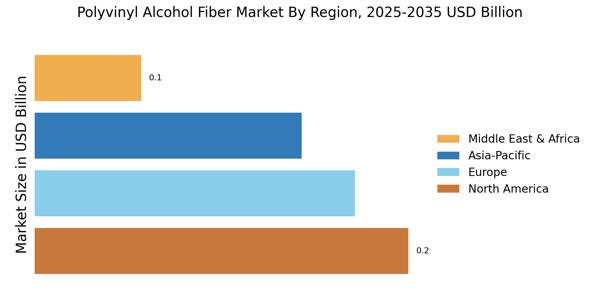
North America is witnessing significant growth in the Polyvinyl Alcohol Fiber Market, driven by increasing demand in various applications such as textiles, packaging, and construction. The region holds approximately 35% of the global market share, making it the largest market. Regulatory support for sustainable materials and innovations in fiber technology are key growth catalysts, enhancing market dynamics and attracting investments. The United States and Canada are the leading countries in this region, with major players like Honeywell International Inc. and Kraton Corporation driving competition. The presence of advanced manufacturing facilities and a focus on R&D further strengthen the market landscape. As companies innovate and expand their product offerings, the competitive environment is expected to intensify, fostering growth and collaboration among industry stakeholders.

Europe : Sustainability and Innovation Focus

Europe is emerging as a significant player in the Polyvinyl Alcohol Fiber Market, driven by stringent environmental regulations and a strong focus on sustainability. The region accounts for approximately 30% of the global market share, making it the second-largest market. Regulatory frameworks promoting eco-friendly materials and innovations in fiber production are key drivers of growth, encouraging investments in sustainable practices and technologies. Leading countries in this region include Germany, France, and the UK, where companies like Kuraray Co., Ltd. and Nippon Synthetic Chemical Industry Co., Ltd. are prominent. The competitive landscape is characterized by a mix of established players and innovative startups, all striving to meet the growing demand for sustainable fibers. As the market evolves, collaboration among stakeholders will be crucial to drive advancements and maintain a competitive edge.

Asia-Pacific : Rapid Industrial Growth and Demand

Asia-Pacific is rapidly becoming a powerhouse in the Polyvinyl Alcohol Fiber Market, fueled by industrial growth and increasing demand from sectors such as textiles and automotive. The region holds approximately 25% of the global market share, driven by countries like China and India, which are witnessing a surge in manufacturing activities and investments in fiber technology. Regulatory support for industrial growth and sustainability initiatives are also contributing to market expansion. China is the leading country in this region, with companies like Fujian Qianjin Chemical Co., Ltd. and Kangde Xin Composite Material Group Co., Ltd. playing significant roles. The competitive landscape is marked by a mix of domestic and international players, all vying for market share. As the region continues to industrialize, the demand for Polyvinyl Alcohol Fiber Market is expected to grow, presenting opportunities for innovation and collaboration among industry leaders.

Middle East and Africa : Emerging Markets and Opportunities

The Middle East and Africa region is witnessing gradual growth in the Polyvinyl Alcohol Fiber Market, driven by increasing industrialization and demand for advanced materials. The region currently holds about 10% of the global market share, with potential for expansion as countries invest in infrastructure and manufacturing capabilities. Regulatory frameworks are evolving to support sustainable practices, which could further enhance market dynamics in the coming years. Leading countries in this region include South Africa and the UAE, where local manufacturers are beginning to explore the benefits of Polyvinyl Alcohol Fiber Market. The competitive landscape is still developing, with opportunities for both local and international players to establish a presence. As the market matures, collaboration and innovation will be key to unlocking the full potential of this emerging market.

Polyvinyl Alcohol Fiber Market Regional Image

Key Players and Competitive Insights

The Polyvinyl Alcohol Fiber Market is currently characterized by a dynamic competitive landscape, driven by increasing demand across various sectors such as textiles, construction, and packaging. Key players are actively engaging in strategies that emphasize innovation, sustainability, and regional expansion. For instance, Kuraray Co., Ltd. (Japan) has positioned itself as a leader in the market by focusing on the development of high-performance fibers that cater to specialized applications. Similarly, Honeywell International Inc. (US) is leveraging its technological expertise to enhance product offerings, thereby strengthening its market presence. These strategic initiatives collectively contribute to a competitive environment that is increasingly focused on meeting diverse customer needs while navigating regulatory challenges.

In terms of business tactics, companies are increasingly localizing manufacturing to reduce lead times and optimize supply chains. This approach appears to be particularly effective in a moderately fragmented market where several players vie for market share. The collective influence of key players, such as Nippon Synthetic Chemical Industry Co., Ltd. (Japan) and Fujian Qianjin Chemical Co., Ltd. (China), suggests a trend towards consolidation, as companies seek to enhance operational efficiencies and expand their geographical reach.

In August 2025, Kuraray Co., Ltd. (Japan) announced the launch of a new line of eco-friendly polyvinyl alcohol fibers aimed at the textile industry. This strategic move not only aligns with global sustainability trends but also positions Kuraray as a frontrunner in providing innovative solutions that meet the growing demand for environmentally responsible products. The introduction of these fibers is likely to enhance the company's competitive edge, particularly among environmentally conscious consumers.

In September 2025, Honeywell International Inc. (US) unveiled a partnership with a leading textile manufacturer to develop advanced PVA-based composites. This collaboration is indicative of Honeywell's commitment to integrating cutting-edge technology into its product offerings. By combining expertise in materials science with manufacturing capabilities, this partnership is expected to yield innovative solutions that could redefine applications in various industries, thereby enhancing Honeywell's market position.

Moreover, in July 2025, Kangde Xin Composite Material Group Co., Ltd. (China) expanded its production capacity by investing in a new facility dedicated to polyvinyl alcohol fiber manufacturing. This strategic investment reflects the company's ambition to meet the rising demand in both domestic and international markets. By increasing production capabilities, Kangde Xin is likely to strengthen its supply chain and improve its competitive stance in the global market.

As of October 2025, the Polyvinyl Alcohol Fiber Market is witnessing trends that emphasize digitalization, sustainability, and the integration of artificial intelligence in production processes. Strategic alliances are becoming increasingly pivotal, as companies recognize the value of collaboration in driving innovation and enhancing operational efficiencies. The competitive landscape is shifting from a focus on price-based competition to one that prioritizes technological advancements and supply chain reliability. This evolution suggests that future differentiation will hinge on the ability to innovate and adapt to changing market demands.

Key Companies in the Polyvinyl Alcohol Fiber Market market include

Industry Developments

March 2021: Eastman Chemical Company invested in its manufacturing facility in Springfield, Massachusetts, to expand and improve its extrusion capabilities for the production of interlayer product lines.

Future Outlook

Polyvinyl Alcohol Fiber Market Future Outlook

The Polyvinyl Alcohol Fiber Market is projected to grow at a 4.3% CAGR from 2024 to 2035, driven by increasing demand in textiles, construction, and biodegradable materials.

New opportunities lie in:

  • Expansion into biodegradable packaging solutions
  • Development of high-performance PVA fibers for industrial applications
  • Investment in R&D for innovative fiber blends and composites

By 2035, the market is expected to solidify its position as a leader in sustainable fiber solutions.

Market Segmentation

Polyvinyl Alcohol Fiber Market Type Outlook

  • Water-soluble Fiber
  • High Strength Modulus Fiber

Polyvinyl Alcohol Fiber Market Application Outlook

  • Textile and Apparel
  • Filter and Non-woven
  • Ropes and Fishing Nets
  • Construction
  • Paper

Report Scope

MARKET SIZE 20240.56(USD Billion)
MARKET SIZE 20250.5841(USD Billion)
MARKET SIZE 20350.89(USD Billion)
COMPOUND ANNUAL GROWTH RATE (CAGR)4.3% (2024 - 2035)
REPORT COVERAGERevenue Forecast, Competitive Landscape, Growth Factors, and Trends
BASE YEAR2024
Market Forecast Period2025 - 2035
Historical Data2019 - 2024
Market Forecast UnitsUSD Billion
Key Companies ProfiledMarket analysis in progress
Segments CoveredMarket segmentation analysis in progress
Key Market OpportunitiesGrowing demand for sustainable textiles drives innovation in the Polyvinyl Alcohol Fiber Market.
Key Market DynamicsRising demand for sustainable textiles drives innovation and competition in the Polyvinyl Alcohol Fiber market.
Countries CoveredNorth America, Europe, APAC, South America, MEA

Market Highlights

Author
Chitranshi Jaiswal
Research Analyst Level I

In her 3 years of experience in the market research field, she has handled critical cross-domain projects. She has an in-depth knowledge of market estimation & analysis, problem-solving, primary as well as secondary research, and team management.She holds an engineering degree and is an MBA professional from a well-known university, capable of evaluating the market and competitive conditions. An exceptional strategist with excellent communication skills and a passion for delivering cutting-edge & practical insights for the market. Proficient in multi-tasking, and can successfully deal with competing demands, while maintaining complete confidentiality. Generated business through active client and project development, networking, and high-quality responses. Her knowledge and skills have helped in making solid business decisions, securing funding from investors, and avoiding business failures.

Leave a Comment

FAQs

What is the projected market valuation for the Polyvinyl Alcohol Fiber Market in 2035?

The projected market valuation for the Polyvinyl Alcohol Fiber Market in 2035 is expected to reach 0.89 USD Billion.

What was the market valuation of the Polyvinyl Alcohol Fiber Market in 2024?

The market valuation of the Polyvinyl Alcohol Fiber Market was 0.56 USD Billion in 2024.

What is the expected CAGR for the Polyvinyl Alcohol Fiber Market from 2025 to 2035?

The expected CAGR for the Polyvinyl Alcohol Fiber Market during the forecast period 2025 - 2035 is 4.3%.

Which companies are considered key players in the Polyvinyl Alcohol Fiber Market?

Key players in the Polyvinyl Alcohol Fiber Market include Kuraray Co., Ltd., Nippon Synthetic Chemical Industry Co., Ltd., and Honeywell International Inc.

What are the main application segments of the Polyvinyl Alcohol Fiber Market?

The main application segments include Textile and Apparel, Filter and Non-woven, Ropes and Fishing Nets, Construction, and Paper.

What was the valuation of the Textile and Apparel segment in 2024?

The valuation of the Textile and Apparel segment was 0.2 USD Billion in 2024.

Download Free Sample

Kindly complete the form below to receive a free sample of this Report

Compare Licence

×
Features License Type
Single User Multiuser License Enterprise User
Price $4,950 $5,950 $7,250
Maximum User Access Limit 1 User Upto 10 Users Unrestricted Access Throughout the Organization
Free Customization
Direct Access to Analyst
Deliverable Format
Platform Access
Discount on Next Purchase 10% 15% 15%
Printable Versions