Author

Rahul Gotadki

Positron Emission Tomography Devices Market Research Report By Product Type (Integrated PET Systems, PET/CT Systems, PET/MRI Systems), By Application (Oncology, Cardiology, Neurology, Infectious Diseases), By End User (Hospitals, Diagnostic Imaging Centers, Research Institutes), By Technology (Time-of-Flight PET, Digital PET, Analog PET) and By Regional (North America, Europe, South America, Asia Pacific, Middle East and Africa) - Growth & Industry Forecast 2025 To 2035
As per Market Research Future analysis, the Positron Emission Tomography Devices Market Size was estimated at 3.96 USD Billion in 2024. The Positron Emission Tomography Devices industry is projected to grow from 4.245 USD Billion in 2025 to 8.499 USD Billion by 2035, exhibiting a compound annual growth rate (CAGR) of 7.19% during the forecast period 2025 - 2035
The Positron Emission Tomography Devices Market is experiencing robust growth driven by technological advancements and increasing demand for early diagnosis.
| 2024 Market Size | 3.96 (USD Billion) |
| 2035 Market Size | 8.499 (USD Billion) |
| CAGR (2025 - 2035) | 7.19% |
Siemens Healthineers (DE), GE Healthcare (US), Philips Healthcare (NL), Canon Medical Systems (JP), Elekta (SE), Medtronic(US), United Imaging Healthcare (CN), Nuclear Imaging (US), Hitachi Medical Corporation (JP)
Our Impact
Enabled $4.3B Revenue Impact for Fortune 500 and Leading Multinationals
Partnering with 2000+ Global Organizations Each Year
30K+ Citations by Top-Tier Firms in the Industry
The Positron Emission Tomography Devices Market is currently experiencing a transformative phase, driven by advancements in technology and increasing demand for precise diagnostic tools. The integration of artificial intelligence and machine learning into imaging systems appears to enhance the accuracy and efficiency of PET scans, thereby improving patient outcomes. Furthermore, the growing prevalence of chronic diseases necessitates the adoption of advanced imaging modalities, which could lead to a broader acceptance of PET devices in clinical settings. As healthcare providers seek to optimize diagnostic processes, the Positron Emission Tomography Devices Market is likely to expand, reflecting a shift towards more personalized medicine. In addition, the rising focus on early disease detection and monitoring is propelling the market forward. Innovations in radiopharmaceuticals and the development of hybrid imaging systems may further augment the capabilities of PET technology. This evolution suggests a promising future for the Positron Emission Tomography Devices Market, as stakeholders invest in research and development to enhance imaging quality and reduce operational costs. Overall, the market landscape appears dynamic, with various factors influencing growth and adoption across different regions and healthcare systems.
Recent innovations in imaging technology are reshaping the Positron Emission Tomography Devices Market. The incorporation of artificial intelligence and machine learning is enhancing image processing and analysis, leading to improved diagnostic accuracy. These advancements may facilitate quicker and more reliable interpretations of PET scans, thereby benefiting both clinicians and patients.
The growing emphasis on early detection of diseases is driving the Positron Emission Tomography Devices Market. As healthcare systems prioritize preventive care, the need for advanced imaging techniques becomes more pronounced. PET devices are increasingly recognized for their ability to identify conditions at earlier stages, which could lead to better treatment outcomes.
The emergence of hybrid imaging technologies, such as PET/CT and PET/MRI, is influencing the Positron Emission Tomography Devices Market. These systems combine the strengths of different imaging modalities, offering comprehensive diagnostic capabilities. The integration of multiple imaging techniques may enhance the overall effectiveness of PET devices, attracting more healthcare facilities to adopt these advanced solutions.
The Positron Emission Tomography Devices Market is significantly influenced by the rising incidence of cancer worldwide. As cancer remains one of the leading causes of mortality, the demand for effective diagnostic tools is paramount. PET scans are particularly valuable in oncology for detecting tumors, assessing treatment responses, and monitoring disease progression. According to recent statistics, the number of new cancer cases is expected to reach nearly 30 million by 2040, which underscores the urgent need for advanced imaging technologies. This increasing prevalence is likely to drive investments in PET devices, as healthcare systems strive to enhance their diagnostic capabilities and improve patient outcomes.
The Positron Emission Tomography Devices Market is poised for growth due to the expanding geriatric population. As individuals age, the likelihood of developing chronic diseases, including cancer and neurological disorders, increases. PET imaging plays a crucial role in the early detection and management of these conditions. The World Health Organization projects that the number of people aged 60 years and older will double from 12% to 22% of the global population by 2050. This demographic shift is expected to elevate the demand for PET devices, as healthcare providers seek to address the unique health challenges faced by older adults. Consequently, the industry is likely to see a significant uptick in device utilization.
The Positron Emission Tomography Devices Market is experiencing a surge in technological advancements that enhance imaging capabilities. Innovations such as time-of-flight PET and improved detector technologies are leading to higher resolution images and reduced scan times. These advancements not only improve diagnostic accuracy but also increase patient throughput in clinical settings. The integration of artificial intelligence in image analysis further streamlines workflows, allowing for quicker decision-making. As a result, healthcare providers are increasingly adopting these advanced systems, contributing to a projected market growth rate of approximately 7% annually over the next few years. This trend indicates a robust demand for cutting-edge PET devices, positioning the industry for sustained expansion.
The Positron Emission Tomography Devices Market is experiencing growth due to the expansion of healthcare infrastructure in various regions. Investments in hospitals and diagnostic centers are increasing, particularly in emerging markets where access to advanced medical technologies is limited. Governments and private entities are recognizing the importance of enhancing healthcare facilities to improve patient care. This expansion is likely to lead to a higher adoption rate of PET devices, as healthcare providers seek to offer comprehensive diagnostic services. Furthermore, the establishment of specialized cancer treatment centers is expected to drive demand for PET imaging, as these facilities require advanced diagnostic tools to support their clinical objectives.
The Positron Emission Tomography Devices Market is benefiting from the growing emphasis on personalized medicine. This approach tailors treatment plans based on individual patient characteristics, including genetic profiles and specific disease markers. PET imaging is instrumental in this paradigm, as it provides detailed insights into metabolic processes and tumor biology. The integration of PET scans in clinical trials and routine practice is becoming more prevalent, as they facilitate the identification of suitable candidates for targeted therapies. This trend is expected to drive demand for advanced PET devices, as healthcare providers aim to enhance treatment efficacy and minimize adverse effects, thereby fostering a more patient-centered approach to care.
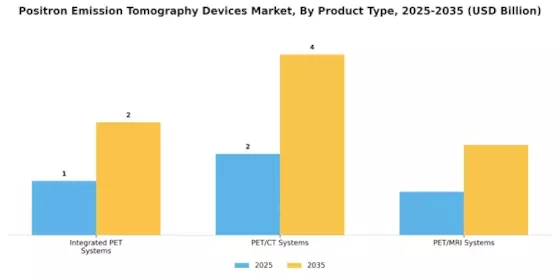
In the Positron Emission Tomography (PET) Devices Market, the segment distribution is characterized by PET/CT Systems holding the largest market share. This segment is favored for its ability to provide comprehensive diagnostic information through both functional and anatomical imaging, making it indispensable in various clinical settings. On the other hand, Integrated PET Systems are quickly gaining traction, positioning themselves as a significant player in the market due to their compact design and enhanced imaging capabilities, appealing particularly to smaller healthcare facilities.
Technology: PET/CT Systems (Dominant) vs. Integrated PET Systems (Emerging)
PET/CT Systems have established themselves as the dominant force in the market, widely used for oncology, cardiology, and neurology due to their superior imaging capabilities that integrate metabolic and anatomical data. Their versatility and reliability in clinical applications ensure their continued adoption across a range of healthcare facilities. Conversely, Integrated PET Systems are emerging as a competitive alternative, boasting advanced technology that allows for more streamlined operations and improved patient throughput. Their compact form factor makes them appealing for point-of-care environments, indicating a shift towards more flexible imaging solutions that are rapidly gaining acceptance.
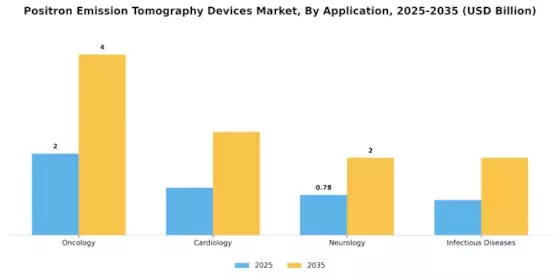
The Positron Emission Tomography (PET) devices market is significantly shaped by its application sectors, with oncology leading the charge in market share. Oncology utilizes PET devices extensively for tumor detection, staging, and treatment monitoring, thus asserting its dominance. In contrast, the cardiology segment is witnessing rapid growth as more healthcare facilities adopt PET imaging for diagnosing heart conditions, reflecting a changing landscape in clinical practices. As medical applications expand, these segments are evolving and significantly impacting overall market dynamics. The growth trends in the PET devices market reveal a robust shift towards specialized imaging technologies. In oncology, advancements in radiopharmaceuticals and enhanced imaging techniques have bolstered its stronghold. In cardiology, the increasing prevalence of cardiovascular diseases is driving demand for precise imaging tools, which are essential in patient management. Neurology and infectious diseases are emerging niches that also contribute to the market, albeit at a slower pace compared to the frontrunners. The interplay of technological innovation and clinical demand will shape future growth trajectories in this segment.
Oncology (Dominant) vs. Neurology (Emerging)
In the Pet devices market, the oncology application stands as the dominant force, primarily due to its extensive use in diagnosing, staging, and monitoring various types of cancers. Oncological PET imaging provides accurate and detailed insights, enabling personalized treatment strategies and improved patient outcomes. Meanwhile, neurology, though still an emerging segment, is gaining traction as PET technology evolves. Neurological applications include diagnosing conditions such as Alzheimer's and other neurodegenerative disorders, which require precise imaging capabilities. Despite its current status as emerging, the neurology segment is projected to grow significantly as awareness increases and research into brain health progresses, offering opportunities for innovation in imaging technologies.
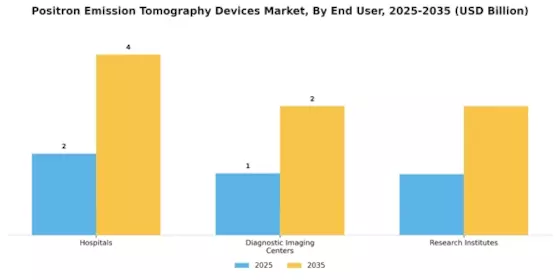
In the Positron Emission Tomography Devices Market, hospitals currently hold the largest market share, primarily due to their extensive use of PET devices for diagnostic imaging and treatmentplanning. As the primary users of these devices, they are equipped with the necessary infrastructure and trained professionals to operate advanced PET systems. Conversely, diagnostic imaging centers are experiencing rapid growth, fueled by the increasing demand for outpatient imaging services and the rise of private healthcare facilities.
Hospitals (Dominant) vs. Research Institutes (Emerging)
Hospitals represent the dominant force in the Positron Emission Tomography Devices Market, as they incorporate PET technology into their diagnostic and therapeutic processes, offering a range of services to patients. Their prominence is enhanced by continuous investment in advanced imaging technologies, ensuring they stay at the forefront of clinical practice. On the other hand, research institutes serve as an emerging segment, leveraging PET for cutting-edge research and drug development. These institutes are increasingly collaborating with pharmaceutical companies, driving innovation in PET applications. This dual focus on clinical and research utilities underscores the versatility of PET technology in both commercial and academic settings.
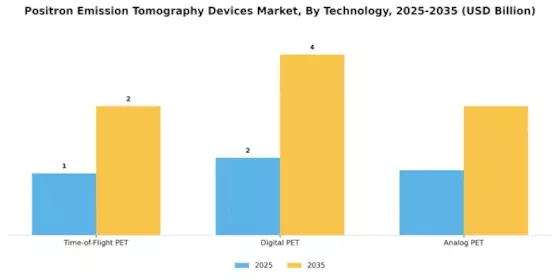
In the Positron Emission Tomography Devices Market, the distribution of market share among different technological segments reveals Digital PET as the largest segment, driven by its advanced imaging capabilities and widespread adoption in clinical settings. Analog PET, while still utilized, has been overshadowed by newer technologies and is gradually losing market share as healthcare facilities upgrade to digital systems. In contrast, Time-of-Flight PET, although smaller in overall market share, is rapidly gaining traction due to its enhanced speed and accuracy in imaging, making it a preferred choice for many medical professionals. Growth trends in the technology segment are significantly influenced by the continuous advancements in imaging technology and the rising demand for precise diagnostic tools. Digital PET technology is experiencing robust growth as healthcare providers seek to enhance diagnostic capabilities and streamline workflow efficiencies. Meanwhile, Time-of-Flight PET is emerging as a favorite among radiologists, attributed to its improved sensitivity and resolution, which are crucial for accurate disease detection, signaling a notable shift in market dynamics as practitioners prioritize advanced features.
Technology: Digital PET (Dominant) vs. Time-of-Flight PET (Emerging)
Digital PET technology represents the dominant force in the Positron Emission Tomography Devices Market, boasting superior image quality and user-friendly integration with other diagnostic tools. Hospitals and research institutions are increasingly adopting Digital PET due to its ability to deliver detailed images that enhance diagnostic accuracy while reducing scan times. In contrast, Time-of-Flight PET is emerging with innovative features, positioning itself as a key player in advancing diagnostic procedures. This technology enhances imaging speed and precision, benefiting patient outcomes by allowing quicker and more accurate diagnoses. Both technologies reflect the industry's shift towards high-performance imaging solutions that meet the growing demand for effective and efficient healthcare diagnostics.
Get more detailed insights about Positron Emission Tomography Devices Market Request Free Sample
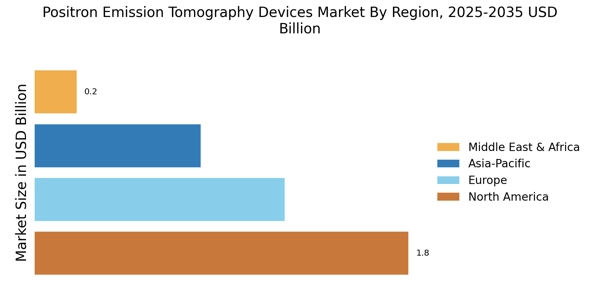
The Regional segment of the Global Positron Emission Tomography Devices Market is significant, showcasing robust valuations across various regions. In 2024, the North America segment was valued at 1.293 USD Billion, dominating the market due to advanced healthcare infrastructure and high adoption rates of cutting-edge diagnostic technologies. Following is Europe, with a valuation of 0.878 USD Billion in 2024, benefiting from a strong emphasis on patient care and increased investment in healthcare technologies.
The APAC region, valued at 0.743 USD Billion, is experiencing rapid growth, bolstered by rising healthcare expenditures and a growing elderly population, which contributes to the demand for advanced medical imaging.South America, with a valuation of 0.479 USD Billion, is showing potential for growth as healthcare access improves, although it currently holds a smaller market share. The Middle East and Africa (MEA) region, valued at 0.567 USD Billion, presents opportunities for market expansion due to increasing healthcare initiatives and advancements in medical technologies.
The cumulative statistics of these regions highlight how the strategic focus on healthcare advancements drives market growth within the Global Positron Emission Tomography Devices Market.
The Global Positron Emission Tomography Devices Market is a dynamic sector within the healthcare and medical imaging industry, characterized by rapid technological advancements and increasing demand for advanced diagnostic tools. As healthcare providers strive to enhance their diagnostic capabilities and patient outcomes, the competitive landscape is marked by the presence of several key players who contribute to the development and innovation of PET devices. These companies focus on expanding their product portfolios, improving the efficiency of imaging techniques, and integrating advanced technologies such as artificial intelligence and data analytics into PET systems.Collaborations, partnerships, and strategic acquisitions are commonplace as firms aim to bolster their market positions and better serve the growing needs of healthcare facilities worldwide. Northwest Medical Physics stands out in the Global Positron Emission Tomography Devices Market due to its strong commitment to providing high-quality consulting and medical physics services. The company is known for its expertise in radiation safety and quality assurance, ensuring that PET devices operate within optimal parameters to deliver accurate imaging results. Their comprehensive approach includes providing clinical support, training for healthcare professionals, and staying abreast of regulatory requirements impacting PET devices.This commitment to excellence allows Northwest Medical Physics to build solid relationships with healthcare institutions, ultimately strengthening their market presence. The company's focus on patient safety and adherence to best practices in medical physics positions it as a valued partner in the growing field of imaging technology. Carestream Health is another noteworthy player in the positron emission tomography market, known for its innovative imaging solutions and commitment to enhancing diagnostic imaging procedures. The company provides advanced PET/CT imaging systems, which are designed to improve cancer detection and monitoring through enhanced image quality and rapid scanning capabilities.Carestream Health leverages its strong market presence to emphasize technological advancements, such as integration of cloud-based solutions for data management and implementation of advanced image processing techniques. The company’s strengths lie in its ability to adapt to market demands, as evidenced by strategic mergers and acquisitions that have expanded its product offerings and geographical reach. By continually focusing on research and development and addressing global healthcare challenges, Carestream Health maintains a competitive stance in the ever-evolving PET device landscape.


Recent developments in the Global Positron Emission Tomography Devices Market indicate a growing emphasis on technological advancements and strategic collaborations among key players. Companies such as GE Healthcare, Siemens Healthineers, and Canon Medical Systems are leading innovation efforts, introducing state-of-the-art PET imaging systems equipped with enhanced sensitivity and resolution. In October 2023, GE Healthcare launched an advanced PET scanneraimed at improving diagnostic accuracy and patient outcomes.
Additionally, Siemens Healthineers announced its collaboration with Eli Lilly to develop integrated PET imaging solutions for personalized medicine.The market has seen notable mergers and acquisitions, as evidenced by Philips Healthcare acquiring a smaller imaging technology firm in August 2023 to bolster its product portfolio and accelerate Research and Development initiatives. Similarly, in September 2023, Carestream Health joined forces with MediLumine to enhance its offerings in nuclear medicine imaging.
Over the past two years, the market has witnessed a substantial valuation increase, with a reported growth rate of around 8% annually, spurred by rising incidences of chronic diseases and the increasing adoption of hybrid imaging technologies. This evolving landscape is providing significant opportunities and challenges for companies operating within the Global Positron Emission Tomography Devices Market.
The Positron Emission Tomography Devices Market is projected to grow at a 7.19% CAGR from 2025 to 2035, driven by technological advancements, increasing cancer prevalence, and rising healthcare expenditure.
New opportunities lie in:
By 2035, the market is expected to achieve substantial growth, solidifying its position as a critical diagnostic tool.
| MARKET SIZE 2024 | 3.96(USD Billion) |
| MARKET SIZE 2025 | 4.245(USD Billion) |
| MARKET SIZE 2035 | 8.499(USD Billion) |
| COMPOUND ANNUAL GROWTH RATE (CAGR) | 7.19% (2025 - 2035) |
| REPORT COVERAGE | Revenue Forecast, Competitive Landscape, Growth Factors, and Trends |
| BASE YEAR | 2024 |
| Market Forecast Period | 2025 - 2035 |
| Historical Data | 2019 - 2024 |
| Market Forecast Units | USD Billion |
| Key Companies Profiled | Siemens Healthineers (DE), GE Healthcare (US), Philips Healthcare (NL), Canon Medical Systems (JP), Elekta (SE), Medtronic (US), United Imaging Healthcare (CN), Nuclear Imaging (US), Hitachi Medical Corporation (JP) |
| Segments Covered | Product Type, Application, End User, Technology, Regional |
| Key Market Opportunities | Advancements in artificial intelligence enhance diagnostic accuracy in the Positron Emission Tomography Devices Market. |
| Key Market Dynamics | Technological advancements and regulatory changes drive innovation and competition in the Positron Emission Tomography Devices market. |
| Countries Covered | North America, Europe, APAC, South America, MEA |
The projected market valuation for the Positron Emission Tomography Devices Market in 2035 is 8.499 USD Billion.
The overall market valuation for the Positron Emission Tomography Devices Market in 2024 was 3.96 USD Billion.
The expected CAGR for the Positron Emission Tomography Devices Market during the forecast period 2025 - 2035 is 7.19%.
The PET/CT Systems segment is projected to reach a valuation of 4.0 USD Billion by 2035.
Key applications include Oncology, which is expected to grow to 3.5 USD Billion by 2035, followed by Cardiology and Neurology.
The Hospitals segment is anticipated to dominate the market, reaching a valuation of 3.5 USD Billion by 2035.
Technological advancements such as Digital PET, projected to reach 3.5 USD Billion by 2035, are influencing the market significantly.
Leading players in the market include Siemens Healthineers, GE Healthcare, and Philips Healthcare, among others.
The Diagnostic Imaging Centers segment is projected to grow to 2.5 USD Billion by 2035.
By 2035, the market for Digital PET technology is expected to surpass Analog PET, with valuations of 3.5 USD Billion and 2.5 USD Billion, respectively.


The secondary research process involved comprehensive analysis of regulatory databases, peer-reviewed medical journals, clinical publications, and authoritative health organizations. Key sources included the US Food & Drug Administration (FDA) Center for Devices and Radiological Health (CDRH), European Medicines Agency (EMA) Medical Device Coordination Group (MDCG), International Atomic Energy Agency (IAEA) Nuclear Medicine Database, Society of Nuclear Medicine and Molecular Imaging (SNMMI), European Association of Nuclear Medicine (EANM), American College of Radiology (ACR), National Institutes of Health (NIH) National Cancer Institute (NCI), National Center for Biotechnology Information (NCBI/PubMed), World Health Organization (WHO) Cancer Statistics, Organisation for Economic Co-operation and Development (OECD) Health Statistics, EU Eurostat Healthcare Database, Centers for Medicare & Medicaid Services (CMS) Procedure Data, and national health ministry reports from key markets (China NMPA, Japan PMDA, Health Canada). These sources were used to collect procedure statistics, regulatory approval data, clinical safety studies, radiopharmaceutical supply chain data, demographic trends, and market landscape analysis for integrated PET systems, PET/CT systems, PET/MRI systems, and other hybrid imaging technologies.
Qualitative and quantitative insights were obtained by interviewing supply-side and demand-side stakeholders during the primary research process. The supply-side sources consist of CEOs, VPs of Product Development, regulatory affairs chiefs, and commercial directors from PET device manufacturers, radiopharmaceutical suppliers, and medical imaging OEMs. Chief nuclear medicine physicians, radiology department heads, hospital procurement managers, diagnostic imaging center administrators, and research institute directors from oncology centers, cardiology institutes, neurology clinics, and academic medical centers constituted demand-side sources. Market segmentation was validated, product pipeline timelines were confirmed, and insights regarding clinical adoption patterns, pricing strategies, reimbursement dynamics, and cyclotron installation trends were obtained through primary research.
Primary Respondent Breakdown:
By Designation: C-level Primaries (32%), Director Level (31%), Others (37%)
By Region: North America (32%), Europe (30%), Asia-Pacific (28%), Rest of World (10%)
Global market valuation was derived through revenue mapping and procedure volume analysis. The methodology included:
Identification of 35+ key manufacturers across North America, Europe, Asia-Pacific, and Latin America
Product mapping across integrated PET systems, PET/CT systems, PET/MRI systems, and other hybrid imaging modalities
Analysis of reported and modeled annual revenues specific to PET device portfolios
Coverage of manufacturers representing 75-80% of global market share in 2024
Extrapolation using bottom-up (procedure volume × ASP by country/region) and top-down (manufacturer revenue validation) approaches to derive segment-specific valuations across oncology, cardiology, neurology, and infectious disease applications
Kindly complete the form below to receive a free sample of this Report

“This is really good guys. Excellent work on a tight deadline. I will continue to use you going forward and recommend you to others. Nice job”


“Thanks. It’s been a pleasure working with you, please use me as reference with any other Intel employees.”


“Thanks for sending the report it gives us a good global view of the Betaïne market.”


“Thank you, this will be very helpful for OQS.”


“We found the report very insightful! we found your research firm very helpful. I'm sending this email to secure our future business.”


“I am very pleased with how market segments have been defined in a relevant way for my purposes (such as "Portable Freezers & refrigerators" and "last-mile"). In general the report is well structured. Thanks very much for your efforts.”


“I have been reading the first document or the study, ,the Global HVAC and FP market report 2021 till 2026. Must say, good info! I have not gone in depth at all parts, but got a good indication of the data inside!”


“We got the report in time, we really thank you for your support in this process. I also thank to all of your team as they did a great job.”


“The Automotive 48V ECU Components Procurement Intelligence Study” was a complex project, but the Market Research Future (MRFR) team handled it with quality, agility, and customer-centricity. They delivered all requested data on time and within the agreed scope. The team, including Shubhendra Anand and Rahul Gotadki, was always readily available to clarify questions and swiftly implement necessary adjustments, driving the project to a successful conclusion within a very demanding timeframe.
I would also like to specifically commend Akshay Agarwal for his responsiveness and support at every stage—from our initial inquiry on May 6th through to final delivery on June 18th. His dedication made the entire process seamless.”



