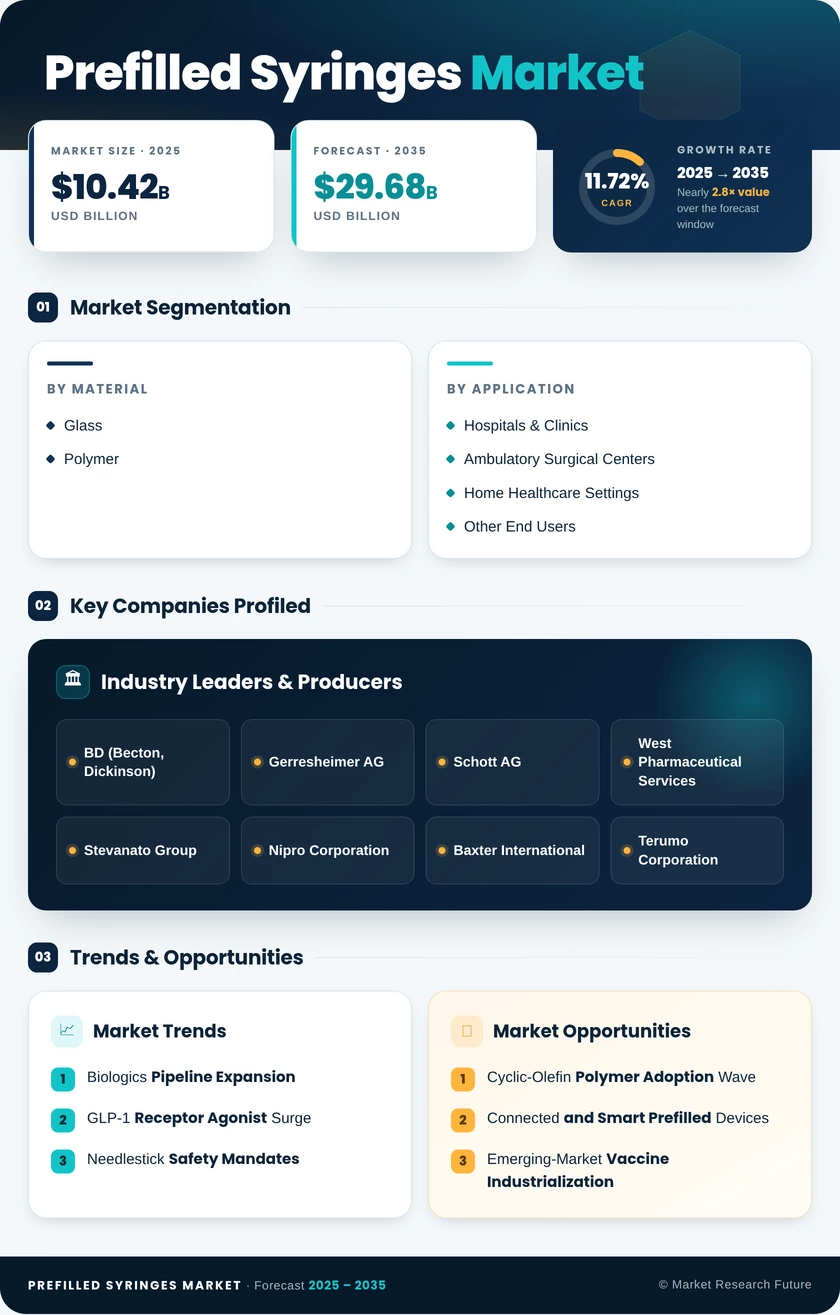
Prefilled Syringes Market

ID: MRFR/MED/4708-CR
157 Pages
Rahul Gotadki
Last Updated: June 05, 2026
Prefilled Syringes Market Research Report: Size, Share, Trend Analysis By Applications (Vaccination, Autoimmune Diseases, Diabetes Management, Hormonal Therapy, Oncology), By Material Type (Plastic, Glass, Metal), By Filling Type (Liquid, Lyophilized, Powder), By End Use (Hospitals, Home Healthcare, Pharmaceutical Companies, Research Laboratories) and By Regional (North America, Europe, South America, Asia Pacific, Middle East and Africa) - Growth Outlook & Industry Forecast 2025 To 2035
Download PDF ×

We do not share your information with anyone. However, we may send you emails based on your report interest from time to time. You may contact us at any time to opt-out.

  1. 1 Market Overview |
    1. 1.1 Study Assumptions & Market Definition |
    2. 1.2 Scope of the Study |
    3. 1.3 Research Methodology
  2. 2 Market Summary & Key Takeaways
  3. 3 Market Dynamics |
    1. 3.1 Market Drivers Analysis | |
      1. 3.1.1 Biologics Pipeline Expansion | |
      2. 3.1.2 GLP-1 Receptor Agonist Surge | |
      3. 3.1.3 Needlestick Safety Mandates | |
      4. 3.1.4 Home Healthcare Transition | |
      5. 3.1.5 Vaccine Preparedness Programs | |
      6. 3.1.6 Polymer Barrel Material Innovation | |
      7. 3.1.7 Connected-Device Telemetry Integration |
    2. 3.2 Market Restraints Analysis | |
      1. 3.2.1 Borosilicate Glass Supply Bottlenecks | |
      2. 3.2.2 Validation Cost Barriers | |
      3. 3.2.3 Cold-Chain Gaps in Emerging Economies | |
      4. 3.2.4 Silicone Oil Interaction Concerns | |
      5. 3.2.5 Biosimilar Price Erosion |
    3. 3.3 Market Opportunity Analysis | |
      1. 3.3.1 Cyclic-Olefin Polymer Adoption Wave | |
      2. 3.3.2 Connected and Smart Prefilled Devices | |
      3. 3.3.3 Emerging-Market Vaccine Industrialization | |
      4. 3.3.4 Dual-Chamber and Reconstitution Devices | |
      5. 3.3.5 Biosimilar Prefilled Packaging Expansion |
    4. 3.4 Industry Value Chain Analysis |
    5. 3.5 Porter's Five Forces Analysis
  4. 4 Global Prefilled Syringes Market Size & Forecast (2021–2035) |
    1. 4.1 Historical Market Size (2021–2025) |
    2. 4.2 Current & Forecast Market Size (2026–2035) |
    3. 4.3 Market Size by Revenue (USD Billion) |
    4. 4.4 Year-over-Year Growth Analysis
  5. 5 Segmentation Analysis |
    1. 5.1 By Material | |
      1. 5.1.1 Glass | |
      2. 5.1.2 Polymer |
    2. 5.2 By Application | |
      1. 5.2.1 Diabetes | |
      2. 5.2.2 Rheumatoid Arthritis | |
      3. 5.2.3 Vaccines | |
      4. 5.2.4 Anticoagulants | |
      5. 5.2.5 Other Applications |
    3. 5.3 By End User | |
      1. 5.3.1 Hospitals & Clinics | |
      2. 5.3.2 Ambulatory Surgical Centers | |
      3. 5.3.3 Home Healthcare Settings | |
      4. 5.3.4 Other End Users
  6. 6 Regional Analysis |
    1. 6.1 North America | |
      1. 6.1.1 United States | |
      2. 6.1.2 Canada | |
      3. 6.1.3 Mexico |
    2. 6.2 Europe | |
      1. 6.2.1 Germany | |
      2. 6.2.2 United Kingdom | |
      3. 6.2.3 France | |
      4. 6.2.4 Italy | |
      5. 6.2.5 Spain | |
      6. 6.2.6 Nordic Countries | |
      7. 6.2.7 Russia | |
      8. 6.2.8 Rest of Europe |
    3. 6.3 Asia-Pacific | |
      1. 6.3.1 China | |
      2. 6.3.2 India | |
      3. 6.3.3 Japan | |
      4. 6.3.4 South Korea | |
      5. 6.3.5 ASEAN | |
      6. 6.3.6 Rest of Asia-Pacific |
    4. 6.4 South America | |
      1. 6.4.1 Brazil | |
      2. 6.4.2 Argentina | |
      3. 6.4.3 Rest of South America |
    5. 6.5 Middle East & Africa | |
      1. 6.5.1 Saudi Arabia | |
      2. 6.5.2 UAE | |
      3. 6.5.3 South Africa | |
      4. 6.5.4 Egypt | |
      5. 6.5.5 Rest of MEA
  7. 7 Competitive Landscape |
    1. 7.1 Market Share Analysis (2025) |
    2. 7.2 Competitive Benchmarking Matrix |
    3. 7.3 Company Profiles | |
      1. 7.3.1 BD (Becton, Dickinson) | |
      2. 7.3.2 Gerresheimer AG | |
      3. 7.3.3 Schott AG | |
      4. 7.3.4 West Pharmaceutical Services | |
      5. 7.3.5 Stevanato Group | |
      6. 7.3.6 Nipro Corporation | |
      7. 7.3.7 Baxter International | |
      8. 7.3.8 Terumo Corporation | |
      9. 7.3.9 Catalent (Novo Holdings) | |
      10. 7.3.10 Vetter Pharma
  8. 8 Future Outlook & Strategic Recommendations (2026–2035) |
    1. 8.1 AI-Driven Quality Assurance in Fill-Finish Operations |
    2. 8.2 Platform Economics and Device Standardization |
    3. 8.3 Sustainability and ESG Reporting Pressures |
    4. 8.4 Subcutaneous Large-Volume Delivery and Wearable Injectors
  9. 9 Recent Developments & News
  10. 10 Frequently Asked Questions (FAQs)
  11. 11 Report Scope & Methodology |
    1. 11.1 Study Period & Base Year |
    2. 11.2 Data Sources & Citations |
    3. 11.3 Abbreviations
  12. 1 LIST OF TABLES
  13. 2 LIST OF FIGURES

Segmentation Quick Reference

DimensionSub-SegmentsDominant SegmentFastest Growing Segment
By MaterialGlass, PolymerGlassPolymer
By ApplicationDiabetes, Rheumatoid Arthritis, Vaccines, Anticoagulants, Other ApplicationsDiabetesVaccines
By End UserHospitals & Clinics, Ambulatory Surgical Centers, Home Healthcare Settings, Other End UsersHospitals & ClinicsHome Healthcare Settings
By GeographyNorth America, Europe, Asia-Pacific, South America, Middle East & AfricaNorth AmericaAsia-Pacific


Market Segmentation Overview

By Material

Sub-SegmentKey Trend
GlassContinued dominance driven by regulatory familiarity and established pharmacopeial standards for Type I borosilicate
PolymerAccelerating adoption for biologic drugs requiring silicone-oil-free, break-resistant primary packaging


Glass barrels remain the default choice for most injectable drug products due to their extensive regulatory track record. Polymer (COP/COC) is gaining rapid share as pharmaceutical companies prioritize biologics-compatible, lightweight, and break-resistant alternatives for sensitive formulations.

By Application

Sub-SegmentKey Trend
DiabetesLargest volume driver anchored by global insulin pen and GLP-1 autoinjector demand
Rheumatoid ArthritisSteady growth from TNF-inhibitor and JAK-inhibitor self-injection programs
VaccinesFastest growth driven by pandemic preparedness, WHO prequalification, and emerging-market immunization expansion
AnticoagulantsStable demand from low-molecular-weight heparin home-administration protocols
Other ApplicationsExpanding with oncology supportive care, fertility hormones, and migraine biologics


Diabetes and vaccines together account for over half of global prefilled syringe unit volumes. The GLP-1 agonist category is a major near-term catalyst, while vaccine preparedness investments ensure sustained long-term expansion.

By End User

Sub-SegmentKey Trend
Hospitals & ClinicsDominant channel driven by needlestick safety mandates and in-facility biologic administration
Ambulatory Surgical CentersGrowing with the outpatient procedure shift and same-day discharge protocols
Home Healthcare SettingsFastest-growing segment as payers incentivize self-injection to reduce healthcare facility costs
Other End UsersIncludes long-term care facilities, retail pharmacies, and specialty infusion centers


The site-of-care shift from hospitals to home settings is the defining structural trend in end-user dynamics. Autoinjector platforms designed for patient self-administration are the primary beneficiary of this transition.