×
Request Free Sample ×

Kindly complete the form below to receive a free sample of this Report

* Please use a valid business email

Leading companies partner with us for data-driven Insights

clients tt-cursor
Hero Background

Protective Fabrics Market

ID: MRFR/CnM/0374-HCR
140 Pages
Priya Nagrale
October 2025

Protective Fabrics Market Research Report Information By Material (Aramid, Polyolefin, Polyamide, Cotton, Polybenzimidazole (pbi), Polyesters and Others), Type (Ballistic & Mechanical Resistant, Thermal, Fire- and Heat-Resistant Fabrics, Chemical-Resistant Fabrics, UV-Resistant Fabrics and Others), End Use Industry (Building & construction, Oil & gas, Healthcare, Law enforcement & military and Others) and Region (North America, Europe, Asia-Pacific, Latin America and Middle East & Africa) Forecast Till 2035

Share:
Download PDF ×

We do not share your information with anyone. However, we may send you emails based on your report interest from time to time. You may contact us at any time to opt-out.

Protective Fabrics Market Infographic
Purchase Options

Protective Fabrics Market Summary

As per MRFR analysis, the Protective Fabrics Market was estimated at 2.49 USD Million in 2024. The Protective Fabrics industry is projected to grow from 2.7 in 2025 to 6.23 by 2035, exhibiting a compound annual growth rate (CAGR) of 8.7 during the forecast period 2025 - 2035.

Key Market Trends & Highlights

The Protective Fabrics Market is experiencing robust growth driven by technological advancements and increasing safety regulations.

  • North America remains the largest market for protective fabrics, driven by stringent safety regulations across various industries.
  • The Asia-Pacific region is emerging as the fastest-growing market, fueled by rapid industrialization and rising safety awareness.
  • Fire protection fabrics dominate the market, while chemical protection fabrics are witnessing the fastest growth due to heightened safety concerns.
  • Key market drivers include increasing safety regulations and the growth of the healthcare sector, which is propelling demand for specialized protective fabrics.

Market Size & Forecast

2024 Market Size 2.49 (USD Million)
2035 Market Size 6.23 (USD Million)
CAGR (2025 - 2035) 8.7%

Major Players

DuPont (US), 3M (US), Honeywell (US), Milliken & Company (US), Teijin Limited (JP), W. L. Gore & Associates (US), BASF SE (DE), SABIC (SA), TenCate Protective Fabrics (NL)

Protective Fabrics Market Trends

The Protective Fabrics Market is currently experiencing a notable evolution, driven by increasing awareness regarding safety standards across various industries. This market encompasses a wide range of materials designed to shield individuals from hazardous elements, including chemicals, flames, and electrical risks. As industries such as construction, manufacturing, and healthcare continue to prioritize worker safety, the demand for advanced protective textiles is likely to rise. Innovations in fabric technology, such as the integration of smart textiles and enhanced durability, appear to be shaping the future landscape of this market. Furthermore, the growing emphasis on sustainability may influence manufacturers to develop eco-friendly materials, potentially altering traditional production methods. In addition, the Protective Fabrics Market is witnessing a shift towards customization and personalization. Companies are increasingly seeking tailored solutions that meet specific safety requirements, which could lead to a more diverse product offering. This trend suggests that manufacturers may need to invest in research and development to create specialized fabrics that cater to unique industry needs. Overall, the Protective Fabrics Market seems poised for growth, with evolving consumer preferences and technological advancements driving innovation and expansion in this sector.

Sustainability Initiatives

The Protective Fabrics Market is increasingly influenced by sustainability initiatives. Manufacturers are exploring eco-friendly materials and production processes to reduce environmental impact. This trend reflects a broader societal shift towards responsible consumption and may lead to the development of biodegradable or recycled fabrics.

Technological Advancements

Technological advancements are playing a crucial role in the evolution of the Protective Fabrics Market. Innovations such as smart textiles, which incorporate sensors and responsive materials, are enhancing the functionality of protective gear. These developments may improve user safety and comfort, potentially transforming industry standards.

Customization and Personalization

Customization and personalization are emerging trends within the Protective Fabrics Market. As industries demand specific safety features, manufacturers are likely to offer tailored solutions. This shift could result in a more diverse range of products, catering to unique requirements across various sectors.

Protective Fabrics Market Drivers

Market Growth Projections

The Global Protective Fabrics Market Industry is poised for substantial growth, with projections indicating a market size of 4.86 USD Billion in 2024 and an anticipated increase to 11.8 USD Billion by 2035. This growth is driven by various factors, including technological advancements, regulatory changes, and increasing awareness of safety standards. The compound annual growth rate of 8.4% from 2025 to 2035 reflects the industry's robust potential. Such projections highlight the dynamic nature of the market and the various elements contributing to its expansion, indicating a promising future for the Global Protective Fabrics Market Industry.

Rising Demand for Safety Gear

The Global Protective Fabrics Market Industry experiences a notable surge in demand for safety gear across various sectors, including construction, manufacturing, and healthcare. As organizations prioritize worker safety, the need for protective clothing made from advanced fabrics is becoming increasingly critical. In 2024, the market is projected to reach 4.86 USD Billion, reflecting a growing awareness of occupational hazards and the importance of protective apparel. This trend is likely to continue, with the market expected to expand significantly as regulations surrounding workplace safety become more stringent. The emphasis on safety gear is thus a driving force in the Global Protective Fabrics Market Industry.

Expansion of End-Use Industries

The expansion of end-use industries such as oil and gas, construction, and healthcare is a crucial driver for the Global Protective Fabrics Market Industry. As these sectors grow, the demand for specialized protective clothing increases correspondingly. For instance, the oil and gas industry requires flame-resistant and chemical-resistant fabrics to safeguard workers in hazardous environments. This trend is expected to bolster the market, with projections indicating a potential market size of 11.8 USD Billion by 2035. The interplay between industry growth and the need for protective apparel underscores the importance of end-use sectors in shaping the Global Protective Fabrics Market Industry.

Increasing Regulatory Standards

The Global Protective Fabrics Market Industry is significantly influenced by the rise in regulatory standards aimed at ensuring worker safety. Governments worldwide are implementing stricter regulations regarding the use of protective clothing in hazardous environments. This regulatory landscape compels industries to adopt compliant protective apparel, thereby driving market growth. As organizations strive to meet these standards, the demand for high-quality protective fabrics is expected to increase. The anticipated compound annual growth rate of 8.4% from 2025 to 2035 underscores the importance of regulatory compliance in shaping the future of the Global Protective Fabrics Market Industry.

Growing Awareness of Workplace Safety

There is a marked increase in awareness regarding workplace safety, which is a significant driver of the Global Protective Fabrics Market Industry. Employers are recognizing the financial and ethical implications of workplace injuries, leading to a proactive approach in providing protective clothing. This heightened awareness is not limited to high-risk industries but extends to various sectors, including hospitality and retail. As a result, the demand for protective fabrics is expected to rise, contributing to the market's growth trajectory. The industry's expansion is indicative of a broader cultural shift towards prioritizing safety in the workplace, further solidifying its role in the Global Protective Fabrics Market Industry.

Technological Advancements in Fabric Production

Innovations in fabric technology play a pivotal role in shaping the Global Protective Fabrics Market Industry. The development of new materials, such as flame-resistant and chemical-resistant fabrics, enhances the protective capabilities of clothing. These advancements not only improve safety but also increase comfort and durability, making protective apparel more appealing to end-users. The integration of smart textiles, which can monitor environmental conditions, is also gaining traction. As manufacturers invest in research and development, the market is poised for growth, potentially reaching 11.8 USD Billion by 2035. This technological evolution is a key driver for the Global Protective Fabrics Market Industry.
Market Segment Insights

By Application: Fire Protection (Largest) vs. Chemical Protection (Fastest-Growing)

The Protective Fabrics Market displays a diverse range of applications, with Fire Protection leading in market share due to its critical role in safety across various industries like construction, manufacturing, and oil & gas. Chemical Protection follows closely, increasingly gaining attention as industrial chemicals become more hazardous, prompting a demand for reliable protective gear. Other applications like Electrical Protection, Thermal Protection, and Cut Resistance hold smaller but significant segments, each catering to niche markets where specialized safety measures are required.

Fire Protection (Dominant) vs. Chemical Protection (Emerging)

Fire Protection represents the dominant application within the Protective Fabrics Market, characterized by its stringent safety standards and widespread regulatory requirements across industries such as firefighting and utilities. These fabrics are often treated with flame-retardant chemicals and offer both thermal insulation and comfort. Meanwhile, Chemical Protection is emerging as a fast-growing segment due to rising concerns about chemical exposure in various sectors, including healthcare, construction, and manufacturing. This application emphasizes advanced material technology that provides superior barrier properties, durability, and comfort for users, making protective garments more effective in hazardous environments.

By End Use: Construction (Largest) vs. Healthcare (Fastest-Growing)

In the Protective Fabrics Market, the end use segment showcases a varied distribution across different sectors. Construction emerges as the largest segment due to the continuous demand for safety measures in construction sites. Protective fabrics used in this sector include durable and high-performance materials that safeguard workers against hazards. Conversely, the healthcare segment, while smaller in share, is rapidly catching up, driven by the increasing need for PPE and infection control materials in medical settings, reflecting the sector's adaptability and growth potential. The growth trends within the end use segment highlight significant drivers, particularly in healthcare, where the emphasis on safety and hygiene has surged post-pandemic. Innovations in protective gear, such as breathable, yet resistant fabrics are enhancing performance in both healthcare and construction sectors. The military and transportation sectors, while important, are growing at a moderate pace, driven by consistent procurement and upgrades in safety standards, reinforcing the overall robust expansion of the protective fabrics market across various end-use categories.

Construction: (Dominant) vs. Healthcare (Emerging)

The construction sector represents a dominant force in the Protective Fabrics Market, relying on advanced materials that meet specific safety regulations and performance criteria. These fabrics are designed to endure rough environmental conditions while protecting workers from potential injuries. Key characteristics of construction protective fabrics include their strength, durability, and resistance to abrasions. On the other hand, the healthcare segment is emerging with newfound vigor, reflecting heightened focus on personal protective equipment (PPE) and materials that offer both protection and comfort. Innovative developments, such as antimicrobial and fluid-resistant fabrics, are enhancing the market appeal in healthcare applications. The dual nature of these segments represents a dynamic market landscape, with construction sustaining demand and healthcare adapting to contemporary challenges.

By Material Type: Aramid Fiber (Largest) vs. Polyester (Fastest-Growing)

The Protective Fabrics Market showcases a competitive landscape in the 'Material Type' segment, with Aramid Fiber leading in market share due to its superior heat-resistance and durability properties. Polyester follows closely by gaining traction for its lightweight and versatile applications. Other materials like Cotton, Polyethylene, and Nylon hold smaller slices of the market, each contributing unique attributes like breathability in Cotton or chemical resistance in Polyethylene, but lag behind in overall share. In terms of growth dynamics, Polyester has emerged as the fastest-growing segment as manufacturers increasingly favor it for protective gear, driven by innovations in fabric technology enhancing performance and comfort. Meanwhile, Aramid Fiber retains its position due to ongoing demand in sectors such as aerospace and military applications. As industries evolve, the focus on performance-driven materials continues to shape the trajectory of this segment.

Aramid Fiber (Dominant) vs. Nylon (Emerging)

Aramid Fiber stands out as the dominant material in the Protective Fabrics Market, renowned for its exceptional strength and thermal resistance, making it the material of choice in high-risk applications like firefighting and military gear. Its ability to maintain integrity under extreme conditions reinforces its market leader status. Conversely, Nylon, recognized as an emerging choice, offers a blend of strength and flexibility at a more cost-effective price point. While still gaining traction, it is gaining popularity in various industrial applications. The lightweight and durable nature of Nylon fabrics provides a unique advantage in protective clothing, making it an appealing alternative as industries look for balanced solutions with safety and affordability.

Get more detailed insights about Protective Fabrics Market

Regional Insights

North America : Market Leader in Protective Fabrics

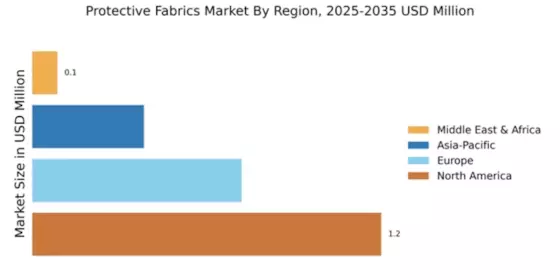
North America is poised to maintain its leadership in the Protective Fabrics Market, holding a significant market share of 1.25 billion in 2024. The region's growth is driven by stringent safety regulations across industries such as construction, healthcare, and manufacturing. Increasing awareness of workplace safety and the demand for high-performance fabrics are further propelling market expansion. Regulatory bodies are emphasizing the need for protective gear, which is expected to boost market growth in the coming years. The competitive landscape in North America is robust, featuring key players like DuPont, 3M, and Honeywell, who are at the forefront of innovation in protective materials. The presence of advanced manufacturing facilities and R&D centers enhances the region's capability to produce high-quality protective fabrics. Additionally, collaborations among industry leaders and investments in technology are expected to strengthen market dynamics, ensuring North America remains a pivotal player in the global protective fabrics sector.

Europe : Emerging Market with Growth Potential

Europe is witnessing a growing demand for protective fabrics, with a market size of 0.75 billion in 2024. The region's growth is fueled by increasing regulations regarding worker safety and environmental sustainability. Countries like Germany and France are leading the charge, implementing stringent safety standards that require the use of advanced protective materials. The European market is also influenced by the rising trend of eco-friendly fabrics, aligning with the EU's sustainability goals. The competitive landscape in Europe is characterized by the presence of established players such as BASF and TenCate Protective Fabrics. These companies are investing in innovative technologies to enhance fabric performance and sustainability. The market is also seeing a rise in local manufacturers who are focusing on niche segments, thereby increasing competition. The combination of regulatory support and a strong industrial base positions Europe as a significant player in the protective fabrics market.

Asia-Pacific : Rapidly Growing Protective Fabrics Sector

The Asia-Pacific region is emerging as a significant player in the Protective Fabrics Market, with a market size of 0.4 billion in 2024. The growth is driven by rapid industrialization, increasing safety regulations, and a rising awareness of workplace safety. Countries like China and India are witnessing a surge in demand for protective fabrics across various sectors, including construction, manufacturing, and healthcare. The region's expanding workforce and investments in infrastructure are further propelling market growth. The competitive landscape in Asia-Pacific is diverse, with both The Protective Fabrics share. Companies like Teijin Limited and W. L. Gore & Associates are leading the market, focusing on innovation and quality. The presence of a large manufacturing base and cost-effective production capabilities are attracting investments from international firms. As the region continues to develop, the demand for high-performance protective fabrics is expected to rise significantly, making Asia-Pacific a key market to watch.

Middle East and Africa : Emerging Market with Unique Challenges

The Middle East and Africa region is gradually developing its Protective Fabrics Market, currently valued at 0.09 billion in 2024. The growth is primarily driven by increasing industrial activities and a rising focus on worker safety. However, the market faces challenges such as economic instability and varying regulatory frameworks across countries. Despite these hurdles, the demand for protective fabrics is expected to grow as industries recognize the importance of safety gear in enhancing workforce protection. Leading countries in this region include South Africa and the UAE, where industrial growth is prompting investments in protective materials. The competitive landscape is still evolving, with a mix of local and international players. Companies are focusing on adapting their products to meet regional needs, which presents opportunities for growth. As awareness of safety standards increases, the Middle East and Africa are likely to see a gradual but steady rise in the protective fabrics market.

Key Players and Competitive Insights

The Protective Fabrics Market is currently characterized by a dynamic competitive landscape, driven by increasing demand for safety and protection across various industries, including healthcare, construction, and manufacturing. Key players such as DuPont (US), 3M (US), and Honeywell (US) are strategically positioned to leverage their extensive research and development capabilities, focusing on innovation and sustainability. These companies are not only enhancing their product offerings but are also exploring mergers and acquisitions to expand their market reach and technological capabilities, thereby shaping a competitive environment that emphasizes advanced protective solutions.

In terms of business tactics, companies are increasingly localizing manufacturing to reduce lead times and optimize supply chains. The market appears moderately fragmented, with a mix of established players and emerging companies. The collective influence of key players is significant, as they set industry standards and drive technological advancements that competitors must follow to remain relevant.

In November 2025, DuPont (US) announced the launch of a new line of bio-based protective fabrics aimed at reducing environmental impact while maintaining high-performance standards. This strategic move not only aligns with global sustainability trends but also positions DuPont as a leader in eco-friendly protective solutions, potentially attracting environmentally conscious consumers and businesses.

In October 2025, 3M (US) unveiled a partnership with a leading technology firm to integrate AI into their protective fabric manufacturing processes. This collaboration is expected to enhance production efficiency and product quality, indicating a shift towards smart manufacturing practices. The integration of AI could provide 3M with a competitive edge, allowing for rapid adaptation to market demands and improved customer satisfaction.

In September 2025, Honeywell (US) expanded its portfolio by acquiring a smaller firm specializing in advanced textile technologies. This acquisition is likely to bolster Honeywell's capabilities in developing innovative protective fabrics, thereby enhancing its market position. Such strategic actions reflect a broader trend of consolidation within the industry, as companies seek to enhance their technological prowess and product offerings.

As of December 2025, current competitive trends in the Protective Fabrics Market include a strong emphasis on digitalization, sustainability, and the integration of advanced technologies such as AI. Strategic alliances are increasingly shaping the landscape, enabling companies to pool resources and expertise. Looking ahead, competitive differentiation is expected to evolve, with a notable shift from price-based competition to a focus on innovation, technology, and supply chain reliability. This transition suggests that companies that prioritize research and development, alongside sustainable practices, will likely emerge as leaders in the market.

Key Companies in the Protective Fabrics Market market include

Future Outlook

Protective Fabrics Market Future Outlook

The Protective Fabrics Market is projected to grow at an 8.7% CAGR from 2024 to 2035, driven by increasing safety regulations and technological advancements.

New opportunities lie in:

  • Development of smart protective fabrics with integrated sensors
  • Expansion into emerging markets with tailored product lines
  • Partnerships with industries for customized protective solutions

By 2035, the Protective Fabrics Market is expected to achieve substantial growth and innovation.

Market Segmentation

Protective Fabrics Market End Use Outlook

  • Construction
  • Manufacturing
  • Healthcare
  • Military
  • Transportation

Protective Fabrics Market Application Outlook

  • Fire Protection
  • Chemical Protection
  • Electrical Protection
  • Thermal Protection
  • Cut Resistance

Protective Fabrics Market Material Type Outlook

  • Aramid Fiber
  • Polyester
  • Cotton
  • Polyethylene
  • Nylon

Report Scope

MARKET SIZE 20242.49(USD Million)
MARKET SIZE 20252.7(USD Million)
MARKET SIZE 20356.23(USD Million)
COMPOUND ANNUAL GROWTH RATE (CAGR)8.7% (2024 - 2035)
REPORT COVERAGERevenue Forecast, Competitive Landscape, Growth Factors, and Trends
BASE YEAR2024
Market Forecast Period2025 - 2035
Historical Data2019 - 2024
Market Forecast UnitsUSD Million
Key Companies ProfiledDuPont (US), 3M (US), Honeywell (US), Milliken & Company (US), Teijin Limited (JP), W. L. Gore & Associates (US), BASF SE (DE), SABIC (SA), TenCate Protective Fabrics (NL)
Segments CoveredApplication, End Use, Material Type
Key Market OpportunitiesIntegration of smart textiles enhances functionality in the Protective Fabrics Market.
Key Market DynamicsRising demand for advanced protective fabrics driven by stringent safety regulations and technological innovations in various industries.
Countries CoveredNorth America, Europe, APAC, South America, MEA

Market Highlights

Author
Priya Nagrale
Senior Research Analyst

With an experience of over five years in market research industry (Chemicals & Materials domain), I gather and analyze market data from diverse sources to produce results, which are then presented back to a client. Also, provide recommendations based on the findings. As a Senior Research Analyst, I perform quality checks (QC) for market estimations, QC for reports, and handle queries and work extensively on client customizations. Also, handle the responsibilities of client proposals, report planning, report finalization, and execution

Leave a Comment

FAQs

What growth rate global protective fabrics market would register in the future?

The global protective fabrics market would register a growth of 7.33 %.

Which industry will play a crucial role in taking the Protective Fabrics market ahead?

PCM industry, will play a crucial role in taking the Protective Fabrics market ahead.

What is the key restraining factor for the global protective fabrics market?

High costs associated with protective fabrics, is the key restraining factor for the global protective fabrics market.

Download Free Sample

Kindly complete the form below to receive a free sample of this Report

Compare Licence

×
Features License Type
Single User Multiuser License Enterprise User
Price $4,950 $5,950 $7,250
Maximum User Access Limit 1 User Upto 10 Users Unrestricted Access Throughout the Organization
Free Customization
Direct Access to Analyst
Deliverable Format
Platform Access
Discount on Next Purchase 10% 15% 15%
Printable Versions