Purging Compound Market (2026 - 2035)

Purging Compound Market Research Report Information by Type (Mechanical Purge, Chemical Purge and Liquid Purge), by Process (Extrusion, Injection Molding and Blow Molding), by Applications (Automotive, Construction, Polymer, Industrial Machinery, and Others), Forecast till 2035
ID: MRFR/CnM/3275-HCR
135 Pages
Priya Nagrale
Last Updated: June 29, 2026
Purging Compound Market
Market Size
Forecast Period2026-2035
CAGR (2026-2035)6.20%
2025 Market Size27.10 Kilotons
2035 Market Size49.24 Kilotons
Key Players
Chem-Trend LP
Dyna-Purge
Sun Plastech Inc.
Slide Products Inc.
Neutrex Inc.
Moulds Plus International
Opportunities
  • Bio-Based and Low-Carbon Purge Formulations
  • Purge-as-a-Service Subscription Models
  • Penetration of Emerging Asian and African Markets

Purging Compound Market Summary

The Purging Compound Market reached an estimated 27.10 kilotons in 2025 and is poised to grow from 28.65 kilotons in 2026 to 49.24 kilotons by 2035, registering a CAGR of 6.20% across the forecast period. Two converging forces are accelerating demand: the global shift toward high-performance engineering polymers in electric-vehicle battery enclosures, and tightening environmental regulations—such as the EU's revised Industrial Emissions Directive (2024/xx)—that penalize excessive resin waste during color and material changeovers. Processors that once tolerated 15–20 kg of transition scrap per changeover are now under pressure to cut that figure by half, pushing adoption of advanced purge formulations [1].

The technology landscape is transforming. Conventional virgin-resin purging—where operators simply ran production-grade material until the barrel cleared—is giving way to engineered mechanical and chemical purge grades that slash changeover times from 45 minutes to under 10 minutes. Capital investment in smart dosing systems exceeded USD 120 million globally in 2024, according to plastics-industry capital-expenditure trackers, as Industry 4.0 plants integrate automated purge cycles into their MES platforms.

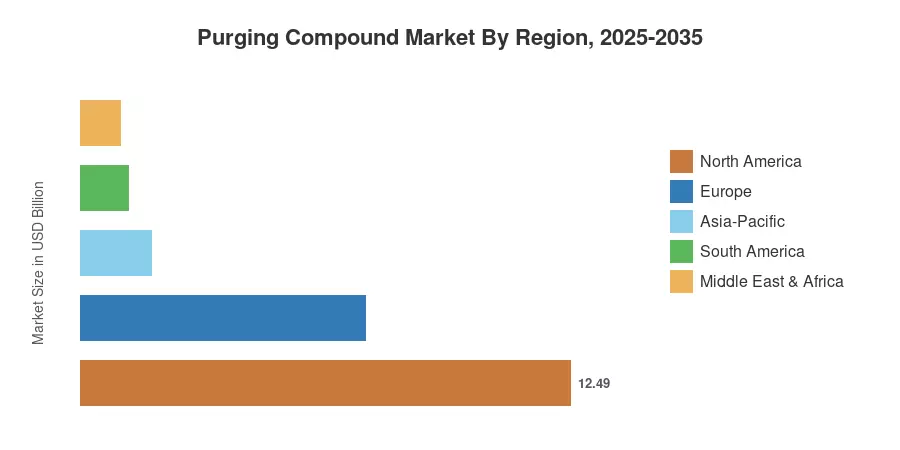
North America commanded a 46.1% share of the Purging Compound Market in 2025, underpinned by a mature automotive supply chain that enforces zero-defect part standards. Asia-Pacific is the fastest-growing region at a 6.64% CAGR, propelled by China's surging EV output and India's expanding consumer-electronics manufacturing base. Europe holds the second-largest position with a 26.8% share, where stringent sustainability mandates continue to drive processor upgrades. As lightweighting and multi-material designs proliferate, the Purging Compound Market is expected to become an indispensable component of lean plastics manufacturing through 2035.

Key Report Takeaways

• By Type

  • Mechanical purge products accounted for 51.2% of the Purging Compound Market volume in 2025, driven by their compatibility with a broad range of commodity and engineering resins.
  • Chemical purge formulations are forecast to register a 6.45% CAGR through 2035 as processors seek faster carbon-deposit removal in hot-runner systems.

• By Process

  • Injection molding held a 54.8% volume share of the Purging Compound Market in 2025, reflecting high changeover frequency in automotive and consumer-goods molding.
  • Extrusion applications are expanding at a 6.30% CAGR as film and sheet producers adopt scheduled purge protocols to reduce gel contamination.

• By Application

  • Automotive and transportation captured 23.2% of the Purging Compound Market volume in 2025 on the back of strict cosmetic and structural part specifications.
  • Electronics end-use is growing at the fastest segment CAGR of 6.55%, fueled by miniaturized connector housings that tolerate zero color contamination.

• By Region

  • North America retained a 46.1% share of the Purging Compound Market in 2025, while Asia-Pacific is advancing at a 6.64% CAGR.

Market Size and Forecast (2021–2035)

Market Research Future's volume estimates combine bottom-up processor surveys across 22 countries with top-down resin-consumption triangulation, validated against trade-flow databases and manufacturer shipment disclosures. Historical figures (2021–2024) reflect actual reported volumes; the 2025 base year incorporates preliminary shipment data, and the 2026–2035 forecast applies the calibrated 6.20% CAGR with adjustments for anticipated capacity expansions in Asia-Pacific and South America.
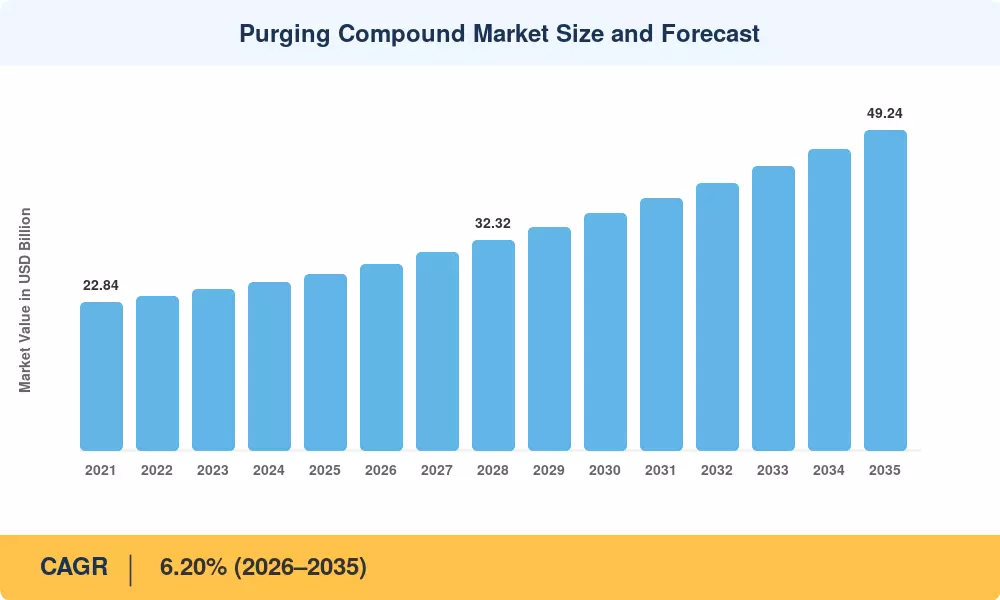
Purging Compound Market Size and Forecast
Our Impact
Enabled $4.3B Revenue Impact for Fortune 500 and Leading Multinationals
Partnering with 2000+ Global Organizations Each Year
30K+ Citations by Top-Tier Firms in the Industry

Driver Impact Analysis

Driver ~% Impact on CAGR Geographic Relevance Impact Timeline
EV and lightweighting polymer adoption +1.10% Global Medium-term (2–4 yr)
Industry 4.0 automated changeover systems +0.95% North America, Europe Short-term (≤2 yr)
Regulatory pressure on microplastic emissions +0.80% Europe, Asia-Pacific Long-term (≥4 yr)
Proliferation of high-temperature engineering resins +0.75% North America, Asia-Pacific Medium-term (2–4 yr)
Shortened production-run cycles and SKU diversification +0.65% Global Short-term (≤2 yr)
Expansion of medical-grade plastics processing +0.55% North America, Europe Medium-term (2–4 yr)
Growth of flexible packaging in emerging economies +0.40% Asia-Pacific, South America Long-term (≥4 yr)


EV and Lightweighting Polymer Adoption

The worldwide boom in electric-vehicle manufacturing – over 18.5 million units in 2024, the International Energy Agency estimates – has resulted in a huge increase in the usage of glass-filled nylons, polycarbonates, and PBT mixes for battery enclosures, structural brackets, and charging-port housings[3]. These high-performance resins tend to leave persistent residues that can’t be cleared with standard virgin-resin flushes, causing a direct demand increase for the Purging Compound Market. OEMs who enforce IATF 16949 quality standards want contamination-free transitions, making purge compounds an essential consumable in EV part production lines.


Industry 4.0 Automated Changeover Systems

Smart manufacturing platforms are integrating purge dosing directly into machine-control sequences. Arburg's and Engel's latest press controllers support programmable purge recipes that dispense precise compound volumes at specified barrel temperatures, cutting changeover scrap by up to 80% compared to manual methods [4]. This automation lowers the per-changeover cost enough to justify more frequent transitions, which paradoxically increases total purge-compound consumption even as per-cycle waste drops.

Regulatory Pressure on Microplastic Emissions

The European Chemicals Agency's 2023 restriction on intentionally added microplastics, combined with draft proposals targeting process-generated microplastic discharge, is forcing injection molders and extruders to replace uncontrolled purging with formulated compounds that consolidate waste into recoverable slugs rather than dispersed particulates [5]. Compliance deadlines phased through 2028–2031 will progressively tighten allowable discharge limits, creating a regulatory ratchet that sustains long-term demand across the Purging Compound Market in the European region and increasingly in Asia-Pacific jurisdictions adopting similar frameworks.

Proliferation of High-Temperature Engineering Resins

Processing temperatures above 300 °C, common for PEEK, PPS, and high-heat nylons, promote thermal deterioration and carbon build-up inside barrels and hot-runner manifolds. The standard purge grades for polyolefins are not thermally stable enough to clean these systems efficiently. The fastest growing product segment is now specialty purge formulations rated for continuous exposure above 380 °C, earning price premiums of 40-60% above commodity purge grades [6]. This is most common in aerospace and medical-device molding, where the cost of rejected parts can be above USD 500 per bad part.


Restraints Impact Analysis

Restraint impact percentages reflect estimated drag on the CAGR and are directional rather than precisely additive. Assessments draw on processor surveys and cost-modeling exercises.

Restraint ~% Impact on CAGR Geographic Relevance Impact Timeline
Cost sensitivity among small and mid-size processors –0.60% Asia-Pacific, South America Short-term (≤2 yr)
Limited awareness in emerging plastics markets –0.45% Africa, South America Medium-term (2–4 yr)
Competition from in-house virgin-resin flushing –0.40% Global Short-term (≤2 yr)
Environmental scrutiny of purge-compound waste streams –0.35% Europe Long-term (≥4 yr)
Technical incompatibility with certain bio-based polymers –0.25% Europe, North America Medium-term (2–4 yr)


Cost Sensitivity Among Small Processors

Purge compounds are priced as 3 to 8 times the manufacturing resin they replace. For small workshops with less than five changeovers each day, the added cost may be hard to justify against the obvious benefits in scrap reduction [10]. In price-sensitive regions in South East Asia and South America, processors tend to switch to cheaper manual purging with regrind, reducing the addressable volume for the Purging Compound Market. Vendor-driven total-cost-of-ownership calculators and trial-sample programs are slowly narrowing this perception gap, but adoption durations are still 12 to 18 months longer than in developed markets.


Competition from Virgin-Resin Flushing

The use of production-grade resin until the barrel flushes, although inefficient, is the usual changeover procedure in an estimated 35-40% of injection-molding operations worldwide [12]. This is learned through habit and the misguided idea that it keeps “foreign” material out of the process. To overcome this inertia, compound suppliers must invest extensively in application engineering and on-site demonstrations – a sales-cycle expenditure that compresses margins and hinders penetration of the Purging Compound Market among tier-2 and tier-3 processors.


Environmental Scrutiny of Purge Waste

While purge compounds lower the overall scrap, the spent purge material itself is a mixed-polymer waste stream, which is challenging to recycle. European processors are facing increasing pressure to demonstrate circularity for all process consumables under the Waste Framework Directive [13]. A few major converters are starting to ask purge-compound suppliers for closed-loop take-back programs, a service that adds expense and logistical complexity. Failure to resolve the risk can decrease the Purging Compound Market development rate in sustainability-focused procurement environments.


Purging Compound Market Opportunities

Bio-Based and Low-Carbon Purge Formulations

With converters under pressure to report Scope 3 emissions, purge-compound manufacturers that reformulate using bio-derived carrier resins and publish verified carbon-footprint data can differentiate on sustainability criteria. Early movers such as those offering PCR-content purge grades stand to capture premium pricing in the European and North American Purging Compound Market segments.

Purge-as-a-Service Subscription Models

Rather than selling drums of compound, suppliers can offer managed purge programs that include automated dosing equipment, scheduled compound deliveries, and analytics dashboards tracking scrap reduction and changeover time.

Penetration of Emerging Asian and African Markets

India's plastics processing capacity is projected to exceed 25 million tonnes by 2028, yet purge-compound penetration remains below 15% of eligible molders [11]. Similarly, Egypt, Nigeria, and Kenya are scaling packaging and automotive-component manufacturing with limited awareness of purge economics. Localized distribution, vernacular training materials, and affordable trial kits could unlock substantial greenfield volume for the Purging Compound Market.

Integration with Digital Twin and Predictive-Maintenance Platforms

Purge-cycle data—dosing volume, barrel temperature profile, scrap weight—can feed digital-twin models that predict optimal changeover timing and compound selection.

Medical and Pharmaceutical Plastics Compliance

FDA 21 CFR and EU MDR regulations demand validated cleaning procedures for medical-device molding. Purge compounds with documented extractables and leachables profiles and USP Class VI certification address a compliance need that virgin-resin flushing cannot satisfy [8]. This niche carries margins 50–70% above commodity purge grades and is growing faster than the overall Purging Compound Market.

Purging Compound Market Future Outlook

AI-Driven Process Optimization

Machine-learning algorithms trained on millions of molding-cycle data points will increasingly prescribe optimal purge timing, compound selection, and dosing volume. Driven by the global purging compound market expanding at an annual growth rate of over 5.2% toward a multi-billion dollar valuation, integrating smart sensors helps technicians closely monitor melt flow variations, allowing plants to refine cleanroom maintenance intervals.

Circular-Economy Integration

By 2028, the EU Packaging and Packaging Waste Regulation will require minimum recycled-content thresholds in plastic packaging, forcing processors to handle more varied and contaminated resin feedstocks. Each introduction of post-consumer recycled resin brings higher changeover complexity, directly expanding the Purging Compound Market. Closed-loop purge-waste take-back programs will become a competitive differentiator.

Electrification Supercycle and Advanced Materials

The IEA projects global EV sales to surpass 40 million units annually by 2030, each vehicle containing 15–30 kg of engineered plastic components [3]. As automakers adopt PA6T, PPA, and long-glass-fiber composites for under-hood and structural applications, the severity of barrel contamination during transitions will intensify, pulling demand toward premium high-temperature purge grades. This materials-complexity trend is among the strongest structural tailwinds for the Purging Compound Market through the decade.

ESG Reporting and Scope 3 Transparency

Large converters are beginning to include process-consumable emissions in their Scope 3 GHG inventories. Purge-compound suppliers that publish ISO 14067–compliant product carbon footprints and offer carbon-neutral formulations will align with buyer ESG procurement policies, securing shelf space in sustainability-screened supply chains.

Purging Compound Market Segmentation

By Type

Segment Metric Primary Demand Driver
Mechanical Purge 51.2% share (2025) Broad resin compatibility and ease of use
Chemical Purge 6.45% CAGR Hot-runner cleaning and carbon removal
Liquid Purge 15.2% share (2025) Quick-flush applications for low-temp resins


Mechanical purge compounds dominate the Purging Compound Market because they work across the widest range of processing temperatures and resin families without requiring specialized handling. Their abrasive or high-viscosity carriers physically displace residual material, making them the default choice for commodity-resin processors. Chemical purge formulations are gaining share as processors encounter increasingly stubborn carbonized deposits in hot-runner manifolds and valve-gate systems. These reactive compounds break molecular bonds in degraded resin, delivering cleaning performance that mechanical grades alone cannot match—particularly in applications running above 280 °C. The Purging Compound Market for chemical grades is forecast to grow faster than mechanical grades as high-temperature resin adoption accelerates.

By Process

Segment Metric Primary Demand Driver
Injection Molding 54.8% share (2025) Frequent color and resin changes
Extrusion 6.30% CAGR Gel reduction in film and sheet lines
Blow Molding 14.5% share (2025) Container color transitions


Injection molding accounts for the largest share of the Purging Compound Market due to the sheer frequency of material and color transitions inherent in short-run and just-in-time production models. A typical automotive-parts molder may execute 8–12 changeovers per machine per day, each consuming 2–5 kg of purge compound. Extrusion is the fastest-growing process segment within the Purging Compound Market, driven by blown-film and cast-film producers who are adopting scheduled purge protocols to eliminate gels and black specks that cause costly film breaks and customer rejections [7].

By Application

Segment Metric Primary Demand Driver
Automotive & Transportation 23.2% share (2025) Zero-defect mandates on Class A surfaces
Industrial 6.35% CAGR Engineered-component precision
Consumer Goods 20.3% share (2025) Color-critical packaging aesthetics
Electronics 6.55% CAGR Miniaturized connector cleanliness
Other Applications 15.2% share (2025) Diversified end-use demand


Automotive and transportation remain the largest application segment of the Purging Compound Market, as OEM quality standards—particularly IATF 16949 and specific customer-mandated PPM targets—leave no margin for color streaks or material contamination on visible or structural parts. Electronics is the fastest-growing application, fueled by the miniaturization of connectors, sensor housings, and LED light guides, where even microscopic contaminants cause functional failures.

Regional Market Share Analysis

Region Share / CAGR Primary Investment Themes
North America 46.1% share (2025) Automotive OEM zero-defect mandates; medical-device compliance
Europe 26.8% share (2025) Sustainability regulation; circular-economy purge programs
Asia-Pacific 6.64% CAGR (2026–2035) EV manufacturing; electronics miniaturization
South America 4.5% share (2025) Packaging sector modernization
Middle East & Africa 3.8% share (2025) Industrial diversification; FDI in plastics
Total 27.10 Kilotons (2025)

The Purging Compound Market displays pronounced regional disparity, with mature markets consuming purge compounds as a standard operating consumable and emerging markets still transitioning from manual flushing methods.


North America

Country Metric Key Driver
United States 72.4% of regional share Automotive and medical OEM specifications
Canada 6.18% CAGR Packaging modernization
Mexico 5.95% CAGR Nearshoring of auto-parts molding


The United States anchors North American demand through its concentration of tier-1 automotive suppliers and a medical-device sector that processed over USD 55 billion in molded components in 2024 [8]. Mexico's role in the Purging Compound Market is expanding rapidly as OEMs nearshore injection-molding operations from Asia, with over 40 new molding facilities announced along the Bajío corridor since 2023. Canada's steady growth reflects its packaging industry's shift toward multi-layer barrier films requiring frequent resin transitions.

Europe

Country Metric Key Driver
Germany 28.5% of regional share Automotive engineering and export molding
United Kingdom 5.90% CAGR Post-Brexit domestic manufacturing push
France 14.2% of regional share Aerospace and luxury-goods packaging
Italy 5.85% CAGR Household goods and appliance molding
Spain 8.6% of regional share Packaging sector expansion
Nordic Countries 5.70% CAGR Sustainability-driven processor upgrades
Russia 3.8% of regional share Import-substitution industrialization
Rest of Europe 6.1% of regional share Mixed manufacturing growth


Germany's automotive and industrial molding sectors make it the single largest consumer in Europe's Purging Compound Market. The EU's revised Industrial Emissions Directive is compelling processors across the bloc to document waste-reduction measures, with purge-compound adoption cited as a qualifying best-available-technique in several member-state guidance documents [5]. The United Kingdom is incentivizing domestic plastics processing through the UK Plastics Pact, which indirectly supports purge-compound uptake by mandating recycled-content targets that increase changeover complexity.

Asia-Pacific

Country Metric Key Driver
China 38.2% of regional share EV and electronics mass production
India 7.10% CAGR Packaging and auto-component FDI
Japan 22.5% of regional share Precision molding for automotive and electronics
South Korea 6.55% CAGR Semiconductor packaging and display components
ASEAN 6.80% CAGR Consumer-goods manufacturing relocation
Rest of Asia-Pacific 8.1% of regional share Diversified industrial growth


China's dominance in the Asia-Pacific Purging Compound Market stems from its position as the world's largest injection-molding base, with an installed capacity exceeding 380,000 machines [15]. India represents the highest-growth opportunity as its National Policy on Electronics targets USD 300 billion in electronics manufacturing by 2030, requiring contamination-free molding for connectors and housings [16]. Japan's mature but high-value market focuses on ultra-clean purge grades for automotive optics and medical devices.

South America

Country Metric Key Driver
Brazil 62.3% of regional share Automotive and packaging hub
Argentina 5.50% CAGR Food-packaging sector growth
Rest of South America 18.4% of regional share Mixed industrial development


Brazil's large automotive assembly sector and growing flexible-packaging industry anchor South America's Purging Compound Market. Currency volatility and import-dependency for specialty purge grades remain headwinds, though local blending operations by multinational suppliers are improving availability and reducing landed costs.

Middle East & Africa

Country Metric Key Driver
Saudi Arabia 30.5% of regional share Vision 2030 plastics diversification
UAE 6.05% CAGR Packaging and construction plastics
South Africa 24.8% of regional share Automotive and FMCG manufacturing
Egypt 5.80% CAGR Consumer-goods sector expansion
Rest of MEA 19.2% of regional share Early-stage industrialization


Saudi Arabia's Vision 2030 initiative is channeling investment into downstream plastics conversion, creating new demand for process consumables, including purge compounds. South Africa serves as a regional manufacturing hub for automotive components destined for European OEMs, importing purge-compound grades that meet IATF 16949 requirements. Overall, the Purging Compound Market in MEA remains nascent but is accelerating as processing sophistication rises.

Purging Compound Market By Region, 2025-2035

Competitive Benchmarking

The Purging Compound Market exhibits moderate concentration, with the top five players accounting for an estimated 45–55% of global volume. The Herfindahl-Hirschman Index sits in the 800–1,200 range, indicating a competitive but not fragmented landscape. Integrated chemical companies leverage their resin portfolios to bundle purge compounds with engineering plastics, while specialist suppliers compete on application-engineering depth and scrap-reduction guarantees.

Company Est. Revenue Share Range Key Offerings Strategic Positioning
Chem-Trend LP (Freudenberg) ~10–14% Ultra Purge mechanical and chemical grades Broadest global distribution; OEM-approved formulations
Dyna-Purge (Shuman Plastics) ~8–12% Dyna-Purge Grade D, E, K series Pioneer in mechanical purge; strong North American base
Sun Plastech Inc. (Asahi Kasei) ~7–10% Asaclean mechanical and chemical grades Asia-Pacific market leader; high-temp specialty range
Slide Products Inc. ~4–7% EZ-Purge and EcoClean lines Value-tier positioning; broad distributor network
Neutrex Inc. ~4–6% Purgex chemical purge range Hot-runner and high-temp specialist
Moulds Plus International ~3–5% PurgePlus and Quick Purge grades Strong EU distribution; multi-lingual tech support
RapidPurge LLC ~3–5% RapidPurge mechanical compounds Cost-competitive formulations for commodity processors
Clariant AG ~3–5% Purging concentrates within the masterbatch portfolio Integrated plastics-additive supplier
Aquapurge Ltd. ~2–4% Eco-range liquid and mechanical purges Sustainability-focused; PCR-content grades
VELOX GmbH ~2–4% Distributed specialty purge portfolio European specialty-chemical distribution platform


Recent News & Developments

  • Chem-Trend LP (March 2025): Launched Ultra Purge Advanced 6500 series engineered for processing temperatures above 400 °C, targeting PEEK and PPS applications in aerospace and medical molding. The release positions Chem-Trend to capture the expanding high-temperature segment of the Purging Compound Market [17].


  • Sun Plastech Inc. (August 2024): Introduced Asaclean EX2 grade optimized for twin-screw extrusion systems, addressing a previously underserved process segment within the Purging Compound Market [19].
  • European Chemicals Agency (June 2024): Published updated guidance on process-generated microplastic emissions from plastics conversion, indirectly strengthening the regulatory case for formulated purge compounds over uncontrolled virgin-resin flushing [5].


  • Neutrex Inc. (October 2023): Received FDA No Objection Letter for Purgex PX-200 grade, enabling its use in food-contact and medical-device injection-molding applications across the Purging Compound Market [21].


Purging Compound Market Report Scope

Parameter Detail
Market Scope Global Purging Compound Market by Type, Process, Application, and Region
Study Period 2021–2035
CAGR (Forecast) 6.20% (2026–2035)
Base Year Volume 27.10 Kilotons (2025)
Forecast Endpoint Volume 49.24 Kilotons (2035)
Fastest Growing Segment (Type) Chemical Purge (6.45% CAGR)
Fastest Growing Segment (Process) Extrusion (6.30% CAGR)
Companies Profiled 10+
Valuation Metric Volume (Kilotons)


FAQs

How do purge compounds reduce the total cost of ownership compared to virgin-resin flushing?
Formulated purge compounds cut changeover time by 50–80% and reduce scrap weight by up to 85%, offsetting their higher per-kilogram price within two to three changeover cycles. Most processors achieve full ROI within 30 days of adoption [12].
What shelf-life and storage considerations apply to purge compounds?
Most mechanical and chemical grades offer an 18–24 month shelf life when stored sealed in a cool, dry environment below 40 °C. Moisture-sensitive chemical grades require desiccant-lined packaging to prevent premature activation [6].
Can a single purge compound handle both color changes and resin transitions?
Mechanical grades handle routine color changes effectively, but resin transitions involving incompatible polymers often require a chemical purge step followed by a mechanical finishing pass. Matching the compound to the task prevents cross-contamination [17].
How does FDA compliance affect purge-compound selection for food-contact molding?
Processors molding food-contact parts must use purge compounds with FDA-recognized components and documented extractables data. Grades carrying an FDA No Objection Letter simplify compliance documentation [21].
What role do purge compounds play in reducing carbon emissions from plastics processing?
Shorter changeovers mean less machine idle time, energy consumption, and scrap destined for landfill. Lifecycle assessments show a net carbon reduction changeover when formulated purges replace virgin-resin flushing [13].
Are purge compounds compatible with recycled-content resins?
Post-consumer recycled resins introduce more contaminants and color variability, increasing changeover frequency. Most commercial purge grades are compatible with PCR feedstocks, though processors should verify thermal-range suitability [14].
How should processors evaluate purge-compound suppliers for long-term partnerships?
Prioritize suppliers offering on-site application engineering, documented scrap-reduction guarantees, and compatibility testing across your resin portfolio. A strong technical-support commitment matters more than the lowest per-kilogram price [10].    
Author
Author
Author Profile
Priya Nagrale LinkedIn
Senior Research Analyst
With an experience of over five years in market research industry (Chemicals & Materials domain), I gather and analyze market data from diverse sources to produce results, which are then presented back to a client. Also, provide recommendations based on the findings. As a Senior Research Analyst, I perform quality checks (QC) for market estimations, QC for reports, and handle queries and work extensively on client customizations. Also, handle the responsibilities of client proposals, report planning, report finalization, and execution

Research Approach


Secondary Research

The secondary research process involved comprehensive analysis of regulatory databases, industry publications, chemical safety standards, and authoritative manufacturing organizations. Key sources included the US Environmental Protection Agency (EPA), European Chemicals Agency (ECHA), Occupational Safety and Health Administration (OSHA), American Chemistry Council (ACC), Society of Plastics Engineers (SPE), Plastics Industry Association (PLASTICS), European Plastics Association (EuPC), National Institute of Standards and Technology (NIST), International Organization for Standardization (ISO) technical committees, US Bureau of Labor Statistics (BLS) Manufacturing Data, Eurostat Industrial Production Database, China National Bureau of Statistics (NBS), Japan Plastics Industry Federation (JPIF), German Chemical Industry Association (VCI), and national plastics industry associations from key markets.

These sources were employed to gather manufacturing statistics, regulatory compliance data, chemical safety studies, industrial production trends, and market landscape analysis for mechanical purging compounds, chemical/foaming purging compounds, and liquid purging compounds in the extrusion, injection molding, and blow molding processes.


Primary Research

Qualitative and quantitative insights were obtained by interviewing supply-side and demand-side stakeholders during the primary research process. The supply-side sources consisted of CEOs, VPs of Manufacturing Operations, R&D leaders, and commercial directors from purging compound manufacturers and chemical suppliers. Plant managers, production engineers, procurement heads, and maintenance supervisors from thermoplastic processing facilities, automotive manufacturers, construction material producers, polymer processing plants, and industrial machinery operations constituted demand-side sources. Market segmentation was validated, product development timelines were confirmed, and insights were gathered on the adoption patterns of mechanical versus chemical purging compounds, pricing strategies by process type (extrusion, injection molding, blow molding), and supply chain dynamics across automotive, construction, and industrial machinery applications through primary research.

Primary Respondent Breakdown:

By Designation: C-level Primaries (32%), Director Level (31%), Others (37%)

By Region: North America (32%), Europe (30%), Asia-Pacific (30%), Rest of World (8%)


Market Size Estimation

Revenue mapping and production volume analysis were implemented to determine global market valuation. The methodology comprised the following:

Identification of over 45 significant manufacturers in North America, Europe, Asia-Pacific, and Latin America

Product mapping for the chemical/foaming purging, liquid purging, and mechanical purging compound categories Process-specific analysis of extrusion (37% market share), injection molding, and blow molding applications

End-use industry segmentation in the automotive, construction, industrial apparatus, polymers, and thermoplastic processing sectors

Examination of annual revenues that have been reported and modeled with respect to the purging of compound portfolios

Manufacturers that account for 70-75% of the global market share in 2024 are included in the coverage.

Derive segment-specific valuations for mechanical, chemical, and liquid purging compounds through extrapolation using bottom-up (production volume × ASP by country and process type) and top-down (manufacturer revenue validation) approaches.

Download Free Sample

Kindly complete the form below to receive a free sample of this Report

Download PDF ×

We do not share your information with anyone. However, we may send you emails based on your report interest from time to time. You may contact us at any time to opt-out.
















