Request Free Sample ×

Kindly complete the form below to receive a free sample of this Report

* Please use a valid business email

Leading companies partner with us for data-driven Insights

clients tt-cursor
Hero Background

Compound Feed Market

ID: MRFR/Agri/3941-CR
118 Pages
Snehal Singh, Sakshi Gupta
Last Updated: May 28, 2026
Compound Feed Market Size, Share, Industry Trend & Analysis Research Report: Information By Animal Type (Poultry, Ruminants, Swine, Aquaculture, Equine, Others), By Ingredient (Cereals, Cakes and Meals, By-Products, Supplements), By Feed Form (Pellets, Mash, Crumbles, Extruded, Others), By Geography (North America, Europe, Asia-Pacific, South America, Middle East & Africa) – Forecast Till 2035
Download PDF ×

We do not share your information with anyone. However, we may send you emails based on your report interest from time to time. You may contact us at any time to opt-out.


Compound Feed Market Summary

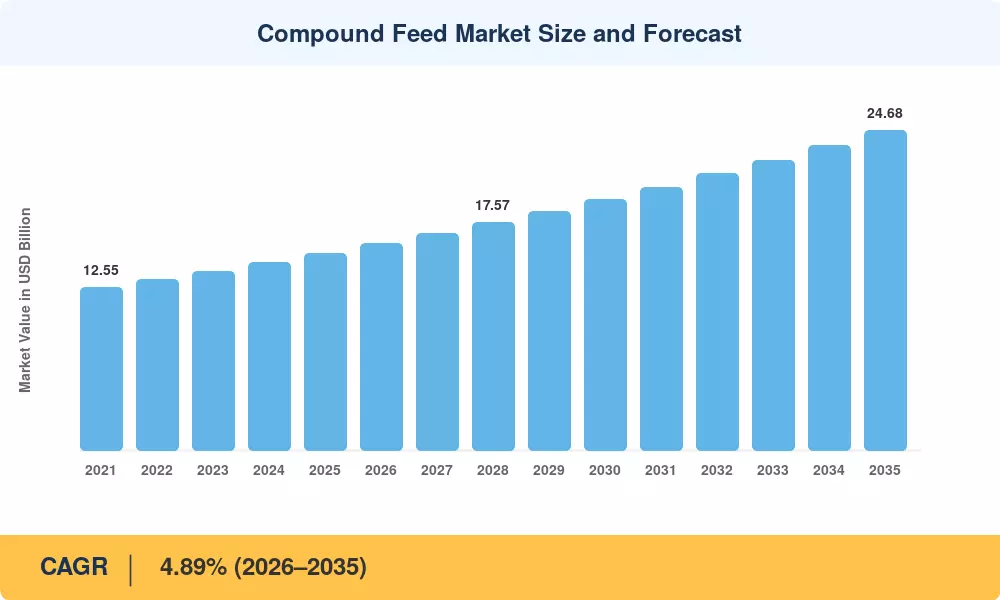
The Compound Feed Market reached a valuation of USD 15.19 Billion in 2025, with an estimated starting forecast value of USD 15.93 billion in 2026 and a projected endpoint of USD 24.68 billion by 2035, expanding at a CAGR of 4.89% across the forecast period. National food-security mandates — including the EU's Farm to Fork Strategy targeting a 50% reduction in antimicrobial use by 2030 and China's 14th Five-Year Plan earmarking over USD 12 billion for livestock modernization — continue to propel balanced livestock feed formulation investment globally [1]. The push toward self-sufficiency in animal protein production, particularly across South and Southeast Asia, is accelerating procurement volumes at an unprecedented pace.

A comprehensive technical revolution is reshaping the production of compound feed. Legacy hammer-mill and batch-mixing systems are being replaced with precision-dosing platforms, near-infrared (NIR) real-time quality analyzers and IoT-connected extrusion lines. Producers seeking better nutrient homogeneity and fewer waste drove an expected USD 1.7 billion in capital expenditures for the worldwide smart-feed-mill equipment industry in 2024 alone [2]. Regulatory pressure on antibiotic growth promoters is reshaping poultry compound feed ingredients and ruminant complete feed blend formulations towards enzyme-based and probiotic alternatives, with the EU’s complete ban effective January 2022 and similar phase-downs under India’s National Action Plan on AMR.


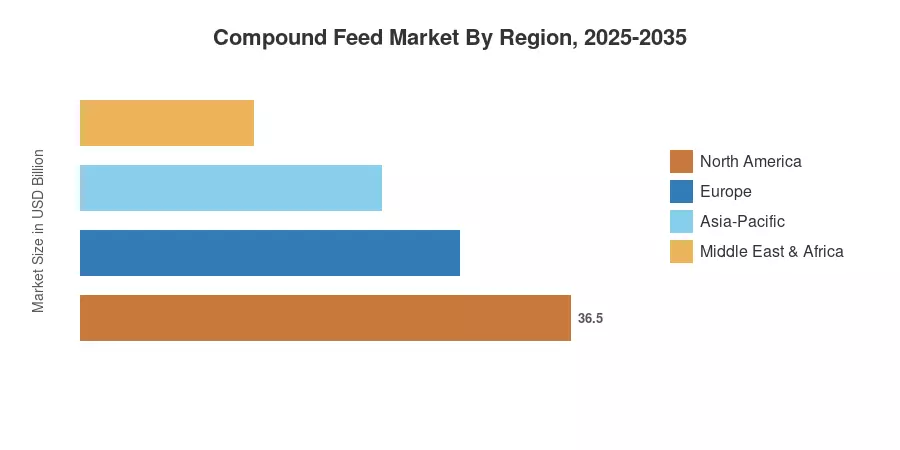
The revenue share of North America in the Compound Feed Market is at 29%, with vertical integration in the US Midwest and the growing poultry market in Mexico. The Asia-Pacific is the fastest-expanding region with a CAGR of 6.12% expected till 2035, driven by increasing per-capita meat consumption in China and India. Europe comes second with the highest market of around 26%, and here, stricter sustainability rules are driving innovation in aquafeed compound nutrition. In emerging economies, where protein demand curves are steepening, the Compound Feed Market will see sustained structural expansion over the next decade


Key Report Takeaways

• By Animal Type

  • Poultry dominated the Compound Feed Market with approximately 48% share in 2025, reflecting the birds' superior feed-conversion ratio and short production cycles
  • Aquaculture is projected to register the fastest CAGR of 9.34% through 2035, driven by government aquaculture expansion programs and rising aquafeed compound nutrition demand
  • Ruminant complete feed blend accounted for roughly USD 3.41 billion in 2025 as dairy intensification accelerated across South Asia and Latin America

• By Ingredient

  • Cereals represented 56% of the Compound Feed Market in 2025, with corn and wheat remaining the dominant energy substrates
  • Supplements are tracking a 10.18% CAGR through 2035 as producers shift toward precision micro-nutrient and enzyme dosing

• By Feed Form

  • Pellets held 63% revenue share in 2025, benefiting from superior storage stability and automated feeding-line compatibility in the Compound Feed Market
  • Extruded feeds are expanding at a 10.84% CAGR as aquafeed compound nutrition applications and high-fat poultry diets gain traction

• By Region

  • North America controlled roughly 29% of the Compound Feed Market in 2025; Asia-Pacific is set to register the highest regional CAGR of 6.12% to 2035
  • Europe's Compound Feed Market accounted for approximately 26% share, with sustainability mandates underpinning balanced livestock feed formulation upgrades


Compound Feed Market Size and Forecast (2021–2035)

MRFR’s market sizing is based on bottom-up production-volume analysis across 40+ countries and top-down revenue calibration based on trade databases (UN Comtrade, FAO), corporate financials, and exclusive primary surveys of 200+ feed-mill operators throughout the globe.
Compound Feed Market Size and Forecast
Our Impact
Enabled $4.3B Revenue Impact for Fortune 500 and Leading Multinationals
Partnering with 2000+ Global Organizations Each Year
30K+ Citations by Top-Tier Firms in the Industry
 

Driver Impact Analysis

Driver ~% Impact on CAGR Geographic Relevance Impact Timeline
Rising global protein consumption +1.3% Global Long-term (≥4 yr)
Antimicrobial ban-driven reformulation +0.8% EU, India, China Medium-term (2–4 yr)
Aquaculture expansion programs +0.7% Asia-Pacific, MEA Long-term (≥4 yr)
Precision nutrition & smart-mill adoption +0.5% North America, Europe Medium-term (2–4 yr)
Government food-security subsidies +0.6% South Asia, GCC, Africa Short-term (≤2 yr)
Vertical integration by agri-conglomerates +0.4% Global Medium-term (2–4 yr)
Pet-food grade compound feed premiumization +0.3% North America, Europe Long-term (≥4 yr)


Rising Global Protein Consumption

The FAO projects global meat demand will reach 374 million tonnes by 2030, a 14% increase over 2020 levels, with poultry and aquaculture absorbing most of that growth [5]. This structural shift directly expands the Compound Feed Market because intensive production systems require scientifically formulated rations. In China alone, structural livestock modernization has driven a steady shift toward industrial compound feed in the swine sector, steadily displacing traditional home-mixed rations and boosting demand for high-value poultry compound feed ingredients as well.


Aquaculture Expansion Programs

Global aquaculture output has expanded rapidly over the last decade, and long-term FAO outlooks project it will consistently outpace capture fisheries as the primary source of seafood for human consumption [6]. Governments across Southeast Asia, the GCC, and sub-Saharan Africa are channeling significant public and private investments into hatchery infrastructure and modern pond-based farming frameworks. This trajectory is accelerating the growth of the aquafeed compound nutrition segment, creating strong commercial demand for advanced extruded floating feeds that optimize feed-conversion ratios across high-value tilapia, shrimp, and salmon operations.


Precision Nutrition and Smart-Mill Adoption

Near-infrared (NIR) analyzers, automated micro-dosing systems, and AI-driven formulation platforms are transforming compound feed manufacturing economics by optimizing ingredient handling. Integrating real-time quality control solutions allows commercial mills to significantly lower raw-material waste, improve batch-to-batch nutrient consistency, and protect processing margins against raw commodity price volatility. While North American and European producers lead the initial adoption curve, Chinese state-owned enterprises are rapidly deploying similar smart-mill platforms as part of their comprehensive agricultural modernization plans.


Restraints Impact Analysis

Restraint ~% Impact on CAGR Geographic Relevance Impact Timeline
Volatile grain and oilseed import costs –0.6% Import-dependent markets Short-term (≤2 yr)
Stringent mycotoxin and contaminant regulations –0.3% EU, North America Medium-term (2–4 yr)
Fragmented smallholder resistance to compound feed –0.4% South Asia, Sub-Saharan Africa Long-term (≥4 yr)
Environmental pressure on soy-based ingredients –0.3% Global Medium-term (2–4 yr)
Energy-cost inflation in milling operations –0.2% Europe, GCC Short-term (≤2 yr)


Volatile Grain and Oilseed Import Costs

The 2022–2023 Ukraine conflict drove corn and wheat futures to decade highs, compressing margins for compound feed manufacturing operations globally [4]. Although prices partially normalized by late 2024, the World Bank's Commodity Outlook warns that El Niño-linked disruptions and Black Sea logistics bottlenecks could trigger another 15–20% price spike in 2026–2027. Import-dependent regions — the GCC, Japan, and Southeast Asia — face the sharpest exposure, with grain constituting 55–65% of total feed-mill input costs.

Fragmented Smallholder Resistance

More than 60% of livestock producers in South Asia and Sub-Saharan Africa are smallholders depending on crop wastes and locally mixed feeds [11]. However, conversion of these producers into economically balanced animal feed formulation is still a structural problem due to price sensitivity, restricted access to cold-chain, and cultural inertia. The Compound Feed Market will need targeted micro-packaging, mobile-distribution methods and government subsidy bridges to unlock this latent demand.


Environmental Pressure on Soy-Based Ingredients

The EU Deforestation Regulation (EUDR), entering full enforcement for major operators in December 2026, requires feed producers to demonstrate strict zero-deforestation sourcing and plot-level geolocation traceability for soy and palm kernel meal [12]. Upstream compliance and physical product segregation costs are expected to add 5–10% to European ingredient procurement budgets, creating severe headwinds for poultry compound feed ingredients that rely heavily on soybean meal as the primary protein source.


Compound Feed Market Opportunities

Insect-Protein and Alternative-Ingredient Integration

The European Commission's 2023 authorization of insect meal (Hermetia illucens) in poultry and swine diets opens a rapidly scalable protein alternative. Black soldier fly larvae deliver 40–45% crude protein and can be reared on organic waste streams, potentially reducing soy dependency and strengthening balanced livestock feed formulation sustainability credentials [14]

Digital Feed-Formulation Platforms

Cloud-based formulation software — integrating real-time commodity pricing, animal performance data, and nutritional-requirement algorithms — represents a significant opportunity for compound feed manufacturing efficiency gains. Platforms like Feedlogic and Adifo already serve over 4,000 mills globally, and the addressable market for precision-formulation SaaS is projected to exceed USD 800 Million by 2030 [2]

Emerging-Market Aquafeed Expansion

Sub-Saharan Africa's aquaculture output grew 12% annually between 2020 and 2024, yet compound feed penetration remains below 30% [6]. Nigeria, Ghana, and Kenya present substantial whitespace for aquafeed compound nutrition producers willing to invest in local extrusion capacity and distribution partnerships

Medicated and Functional Additive Premixes

As antimicrobial restrictions tighten, demand for pre-blended functional additive premixes — combining enzymes, probiotics, organic acids, and phytogenics — is accelerating. This high-margin segment allows compound feed manufacturing operators to differentiate on health outcomes and command 15–25% price premiums over standard rations

Data-Driven Feed-to-Farm Performance Monetization

Integrated agri-companies are building closed-loop ecosystems that link on-farm IoT sensors with feed-mill ERP systems, enabling performance-based pricing models where feed cost per kilogram of weight gain replaces cost per tonne. This data-monetization approach is gaining traction in the Compound Feed Market, particularly among vertically integrated poultry and swine integrators in Brazil and the United States


Compound Feed Market Future Outlook

AI-Driven Precision Feeding Systems

Artificial intelligence is reshaping compound feed manufacturing by enabling real-time diet optimization at the individual pen or cage level. Leading nutrition platforms utilize machine-learning-based formulation engines to dynamically adjust poultry compound feed ingredients. These systems evaluate environmental factors and flock health parameters to reduce feed-conversion ratios and cut nitrogen excretion. By optimizing processing efficiency, precision feeding lowers production costs and helps commercial operations scale up to meet strict environmental compliance mandates.


Circular-Economy Ingredient Sourcing

The Compound Feed Market is gravitating toward circular protein streams—such as insect meal, single-cell proteins, algae biomass, and food-processing co-products. Industry groups like EuropaBio highlight the growing role of these innovative materials in modern agriculture. These alternative-protein ingredients help displace conventional soy and fishmeal in balanced livestock feed formulation programs. Integrating upcycled inputs reduces direct deforestation pressure within the agricultural value chain and offers more predictable long-term pricing than volatile commodity grains.


ESG Reporting and Scope 3 Emissions Tracking

Scope 3 emissions from animal feed production represent 45–60% of total livestock carbon footprints [18]. As regulatory ESG disclosure mandates expand—such as the EU's Corporate Sustainability Reporting Directive—compound feed manufacturing operators face growing pressure to publish verified carbon-intensity metrics. Companies investing in low-carbon ruminant complete feed blend formulations and innovative methane-reducing additives will gain preferential supplier status among downstream meat and dairy processors looking to hit decarbonization goals.


Compound Feed Market Segmentation

By Animal Type

Segment Key Metric Primary Demand Driver
Poultry ~48% share (2025) Superior feed-conversion ratio; global broiler demand
Ruminants USD 3.41 Billion (2025) Dairy intensification in South Asia and Europe
Swine 4.56% CAGR Post-ASF herd recovery in China and Vietnam
Aquaculture 9.34% CAGR Government aquaculture expansion mandates
Equine ~2% share (2025) Sport and leisure horse nutrition
Others USD 0.18 Billion (2025) Pet-food-grade compound rations


Poultry remains the undisputed volume leader in the Compound Feed Market, driven by the bird's rapid growth cycle, high feed-conversion efficiency, and global dietary preference shifts toward white meat. Broiler operations in the US, Brazil, and China collectively consume over 180 million tonnes of poultry compound feed ingredients annually [5]. Aquaculture is the fastest-expanding frontier, with aquafeed compound nutrition demand surging as shrimp and salmon farming intensifies across ASEAN, Norway, and Chile.

Ruminant complete feed blend demand is expanding, particularly in India, where the National Dairy Development Board reported that organized dairy operations increased compound feed usage by 22% between 2021 and 2024 [11]. Total mixed rations (TMR) incorporating silage, concentrates, and mineral premixes are displacing traditional grazing-supplementation models.

By Ingredient

Segment Key Metric Primary Demand Driver
Cereals ~56% share (2025) Corn and wheat are primary energy substrates
Cakes and Meals USD 3.19 Billion (2025) Soy and rapeseed protein demand
By-Products 4.12% CAGR Circular-economy waste valorization
Supplements 10.18% CAGR Enzyme, probiotic, and vitamin premix growth


Cereals dominate ingredient procurement in the Compound Feed Market because corn and wheat deliver the highest metabolizable-energy density at the lowest cost per calorie. Supplements are the fastest-growing ingredient category, as antimicrobial bans drive investment in balanced livestock feed formulation alternatives, including phytase, xylanase, and direct-fed microbials [1].

By Feed Form

Segment Key Metric Primary Demand Driver
Pellets ~63% share (2025) Handling efficiency; automated feeding compatibility
Mash USD 1.82 Billion (2025) Low-cost option for smallholder poultry
Crumbles 4.78% CAGR Starter feeds for chicks and fingerlings
Extruded 10.84% CAGR High-fat aquafeed and specialty diets
Others ~2% share (2025) Liquid and block-form supplements


Pellets command the largest share in the Compound Feed Market because pelleting improves nutrient uniformity, reduces feed wastage by 5–8%, and integrates seamlessly with automated poultry and swine feeding lines [2]. Extruded feeds — produced through high-temperature, high-pressure cooking — are the fastest-growing form, particularly in aquafeed compound nutrition where buoyancy control and fat encapsulation are critical.


Regional Market Share Analysis

Region Key Metric Primary Investment Themes
North America ~29% share (2025) Vertical integration; precision nutrition platforms
Europe ~26% share (2025) Sustainability compliance; alternative proteins
Asia-Pacific 6.12% CAGR (2026–2035) Aquaculture expansion; poultry intensification
South America USD 2.13 Billion (2025) Soy-based formulation; export-oriented poultry
Middle East & Africa 5.87% CAGR (2026–2035) Food-security programs; aquafeed compound nutrition
Total USD 15.19 Billion (2025)

The Compound Feed Market exhibits distinct regional dynamics shaped by livestock density, grain self-sufficiency, regulatory maturity, and protein consumption trends. North America and Europe together account for over half of global revenue, while Asia-Pacific drives the steepest growth trajectory.


North America

Country Key Metric Key Driver
US ~72% of regional share Integrated poultry and swine operations
Canada 4.51% CAGR Canola-based ingredient innovation
Mexico USD 0.67 Billion (2025) Expanding broiler production capacity


The US Compound Feed Market benefits from massive grain surpluses and vertically integrated poultry compound feed ingredients supply chains anchored by Tyson, Cargill, and Perdue. Canada's feed sector is pivoting toward canola-meal and pulse-based protein formulations under the Canadian Grain Commission's sustainability framework. At the same time, Mexico's broiler output expanded 4.8% in 2024, driving compound feed manufacturing demand across the central highlands [15].

Europe

Country Key Metric Key Driver
Germany ~18% of regional share Ruminant complete feed blend for dairy
UK 4.72% CAGR Post-Brexit agricultural self-sufficiency push
France USD 0.58 Billion (2025) Poultry and swine ration modernization
Italy ~8% of regional share Mediterranean aquafeed production
Spain 5.04% CAGR Export-oriented pork sector
Nordic Countries USD 0.31 Billion (2025) Salmon aquafeed compound nutrition
Russia ~11% of regional share Grain self-sufficiency advantage
Rest of Europe 4.48% CAGR Diverse smallholder conversion


Europe's Compound Feed Market is shaped by the EU's Farm to Fork Strategy, which mandates organic farming targets of 25% by 2030 and strict limits on antibiotic use [1]. Germany leads in ruminant complete feed blend for its dairy herd of over 3.8 million cows, while Nordic countries are global leaders in salmon aquafeed innovation.

Asia-Pacific

Country Key Metric Key Driver
China ~38% of regional share Post-ASF swine herd rebuild; poultry scale-up
India 7.24% CAGR Dairy cooperative modernization
Japan USD 0.52 Billion (2025) Premium aquafeed for wagyu and seafood
South Korea ~6% of regional share Intensive poultry and swine operations
ASEAN 6.88% CAGR Shrimp and tilapia aquafeed compound nutrition
Rest of Asia-Pacific USD 0.29 Billion (2025) Emerging smallholder conversion


Asia-Pacific represents the fastest-growing frontier for the Compound Feed Market. China's Ministry of Agriculture reported that national compound feed output exceeded 260 million tonnes in 2024, with the poultry compound feed ingredients segment alone growing 7.3% year-on-year [5]. India's Operation Flood successor programs and AMUL's dairy cooperative network are driving ruminant complete feed blend adoption across Gujarat and Rajasthan.

South America

Country Key Metric Key Driver
Brazil ~68% of regional share World's largest poultry exporter
Argentina 4.63% CAGR Soy meal integration in cattle feed
Rest of South America USD 0.24 Billion (2025) Emerging aquaculture programs


Brazil's Compound Feed Market is inseparable from its position as the world's top poultry exporter, with JBS, BRF, and Seara operating integrated compound feed manufacturing complexes across Paraná and Santa Catarina. Argentina's feedlot sector consumed an estimated 8.2 million tonnes of balanced livestock feed formulation in 2024 [16].

Middle East & Africa

Country Key Metric Key Driver
Saudi Arabia ~34% of regional share Vision 2030 food-security investments
UAE 5.62% CAGR Subsidy-driven poultry self-sufficiency
South Africa USD 0.31 Billion (2025) Broiler and layer feed demand
Egypt ~14% of regional share Nile Delta aquaculture expansion
Rest of MEA 6.41% CAGR Sub-Saharan aquafeed compound nutrition growth


Saudi Arabia's National Transformation Program is channeling USD 3.5 billion into agricultural modernization through 2030, directly supporting the Compound Feed Market in the kingdom [7]. Egypt's tilapia industry — producing over 1.6 million tonnes annually — increasingly demands extruded aquafeed compound nutrition products.


Compound Feed Market By Region, 2025-2035
 

Competitive Benchmarking

The Compound Feed Market exhibits moderate concentration, with the top five players collectively holding an estimated 28–35% of global revenue. The Herfindahl-Hirschman Index (HHI) is estimated between 600 and 900, reflecting a landscape where large vertically integrated agri-conglomerates compete alongside regional specialists and technology-driven niche entrants focused on aquafeed compound nutrition and functional additives.

Company Est. Revenue Share Range Key Offerings Strategic Positioning
Cargill Inc. ~7–10% Full-spectrum poultry, swine, and aquafeed lines Global vertical integration; grain-origination advantage
ADM (Archer-Daniels-Midland) ~5–8% Oilseed meals, premixes, balanced livestock feed formulation Ingredient-supply dominance: soy and canola processing
Charoen Pokphand Foods ~5–7% Integrated poultry and shrimp feed Asia-Pacific market leadership; farm-to-fork model
New Hope Liuhe ~4–6% Swine and poultry compound feeds China's largest domestic producer, rural distribution
Nutreco (SHV Holdings) ~3–5% Skretting aquafeed; Trouw Nutrition premixes Aquafeed compound nutrition specialist; R&D leadership
De Heus Animal Nutrition ~2–4% Ruminant complete feed blend; poultry premixes Emerging-market expansion; 80+ countries
ARASCO ~2–3% GCC-focused poultry and ruminant feeds Regional scale; Saudi Arabia distribution leadership
Al Ghurair Foods ~1–3% Grain milling and compound feed manufacturing UAE integrated operations; flour-to-feed value chain
ForFarmers N.V. ~2–3% European dairy and swine compound feeds Western Europe specialization; sustainability focus
Alltech Inc. ~1–2% Specialty additives, enzymes and mycotoxin binders Technology-driven; precision nutrition platforms


Recent News & Developments


Compound Feed Market Report Scope

Parameter Detail
Market Scope Global Compound Feed Market — production, consumption, and trade of commercially manufactured animal feeds
Study Period 2021–2035
CAGR 4.89% (2026–2035)
Base Year Market Size USD 15.19 Billion (2025)
Forecast Endpoint USD 24.68 Billion (2035)
Fastest Growing Segments Aquaculture (by animal type); Supplements (by ingredient); Extruded (by feed form)
Companies Profiled 10 (Cargill, ADM, CP Foods, New Hope Liuhe, Nutreco, De Heus, ARASCO, Al Ghurair Foods, ForFarmers, Alltech)
Valuation Currency USD Billion


FAQs

How does the feed-conversion ratio influence compound feed purchasing decisions?

Feed-conversion ratio (FCR) is the single most scrutinized metric in procurement because it directly determines cost per kilogram of animal weight gain. Buyers increasingly demand third-party FCR trial data before committing to supplier contracts [21].

What role do mycotoxin binders play in the Compound Feed Market?

Mycotoxin binders — clay-based or yeast-derived — protect animal health and prevent costly mortality or growth depression. The EU's 2024 tightening of aflatoxin MRLs has made binder inclusion nearly standard in poultry compound feed ingredients across Europe [10].

How are blockchain traceability platforms reshaping compound feed manufacturing supply chains?

Blockchain enables end-to-end ingredient provenance tracking, which is critical for EUDR compliance and buyer trust. Early adopters report 15–20% faster audit cycles and reduced recall exposure [12].

What factors determine whether a feed mill should invest in extrusion versus pelleting equipment?

Extrusion suits high-fat aquafeed compound nutrition and specialty diets requiring gelatinization, while pelleting serves high-volume poultry and swine operations at lower capital cost. Product mix and target species drive the decision [2].

How does the Compound Feed Market address antibiotic-free labeling demand from downstream processors?

Producers reformulate with enzymes, probiotics, and organic acids to meet antibiotic-free specifications. Certification costs typically add 2–4% to production budgets but unlock premium pricing tiers [1].

What financing mechanisms support smallholder adoption of balanced livestock feed formulation?

Microfinance institutions and government subsidy programs in India and Sub-Saharan Africa offer input-credit schemes that bundle compound feed purchases with veterinary services. IFC-backed programs disbursed over USD 400 Million for this purpose in 2024 [17].

How do trade tariffs on soybean meal impact the Compound Feed Market in import-dependent regions?

Tariff fluctuations directly shift formulation economics, prompting millers in the GCC and ASEAN to substitute rapeseed or sunflower meal when soy premiums exceed 8–10% above alternatives. Ingredient flexibility is a key competitive differentiator [4].


Author
Author
Author Profile
Snehal Singh LinkedIn
Manager - Research
High acumen in analyzing complex macro & micro markets with more than 6 years of work experience in the field of market research. By implementing her analytical skills in forecasting and estimation into market research reports, she has expertise in Packaging, Construction, and Equipment domains. She handles a team size of 20-25 resources and ensures smooth running of the projects, associated marketing activities, and client servicing.
Co-Author
Co-Author Profile
Sakshi Gupta LinkedIn
Team Lead - Research
Currently a Team Lead in consumer goods, FMCG, and F&B, she translates rigorous research into decisive strategy. She develops GTM roadmaps, pricing architectures, and competitive benchmarks for companies across Europe, the US, and APAC. She synthesize insights, align cross-functional teams, and drive execution from brief to measurable outcomes. She leads end-to-end engagements with crisp analysis, compelling storytelling, and a strong command of Power BI, Tableau, SQL, and advanced research platforms.

Research Approach


Secondary Research

The secondary research process involved comprehensive analysis of regulatory databases, agricultural journals, industry publications, and authoritative food security organizations. Key sources included the US Food & Drug Administration (FDA) Center for Veterinary Medicine, US Department of Agriculture (USDA) Economic Research Service and National Agricultural Statistics Service (NASS), European Food Safety Authority (EFSA), European Commission Directorate-General for Agriculture and Rural Development (DG AGRI), Food and Agriculture Organization of the United Nations (FAO) FAOSTAT Database, World Organisation for Animal Health (WOAH), National Grain and Feed Association (NGFA), American Feed Industry Association (AFIA), International Feed Industry Federation (IFIF), EU Feed Manufacturers' Federation (FEFAC), China Feed Industry Association (CFIA), Animal Nutrition Association of Canada (ANAC), Brazilian Association of Animal Protein (ABPA), National Institutes of Health (NIH) PubMed veterinary science databases, and national agriculture ministry reports from key markets. These sources were used to collect feed production statistics, grain commodity pricing data, regulatory approval data for feed additives, livestock population trends, aquaculture production volumes, and market landscape analysis for cereals, oilseed meals, amino acids, enzymes, vitamins, and other supplement categories.


Primary Research

Qualitative and quantitative insights were obtained by interviewing supply-side and demand-side stakeholders during the primary research process. CEOs, VPs of Manufacturing, procurement leaders, regulatory affairs directors, and commercial managers from compound feed manufacturers, premix suppliers, and feed additive producers comprised the supply-side sources. Veterinary nutritionists, animal husbandry procurement leads, aquaculture facility directors, livestock farm proprietors, agricultural cooperative managers, and sustainability officers from large-scale poultry, swine, ruminant, and dairy operations comprised demand-side sources. Primary research has confirmed the product development timelines for alternative proteins and enzyme technologies, validated market segmentation across ingredient categories (cereals, oilseed meal, supplements), and gathered insights on feed conversion ratios, pricing strategies, commodity sourcing dynamics, and sustainability certification requirements.

Primary Respondent Breakdown:

By Designation: C-level Primaries (32%), Director Level (30%), Others (38%)

By Region: North America (32%), Europe (30%), Asia-Pacific (28%), Rest of World (10%)


Market Size Estimation

Global market valuation was derived through production volume mapping and ingredient pricing analysis. The methodology included:

Identification of over 45 significant compound feed manufacturers and premix suppliers in North America, Europe, Asia-Pacific, and Latin America

Product mapping across cereals (corn, wheat, barley), oilseed meals (soybean, rapeseed, sunflower), supplements (vitamins, amino acids, enzymes, acidifiers), and molasses categories

Analysis of reported and modeled annual revenues specific to feed portfolios and nutritional solution divisions

Coverage of manufacturers representing 70-75% of global market share in 2024

Extrapolation using bottom-up (livestock population × feed consumption rates per species by country/region) and top-down (manufacturer revenue validation) approaches to derive segment-specific valuations for ruminant, poultry, swine, and aquaculture feed applications

Download Free Sample

Kindly complete the form below to receive a free sample of this Report
















