Request Free Sample ×

Kindly complete the form below to receive a free sample of this Report

* Please use a valid business email

Leading companies partner with us for data-driven Insights

clients tt-cursor
Hero Background

Compound Feed Market

ID: MRFR/Agri/3941-CR
118 Pages
Snehal Singh
Last Updated: May 28, 2026
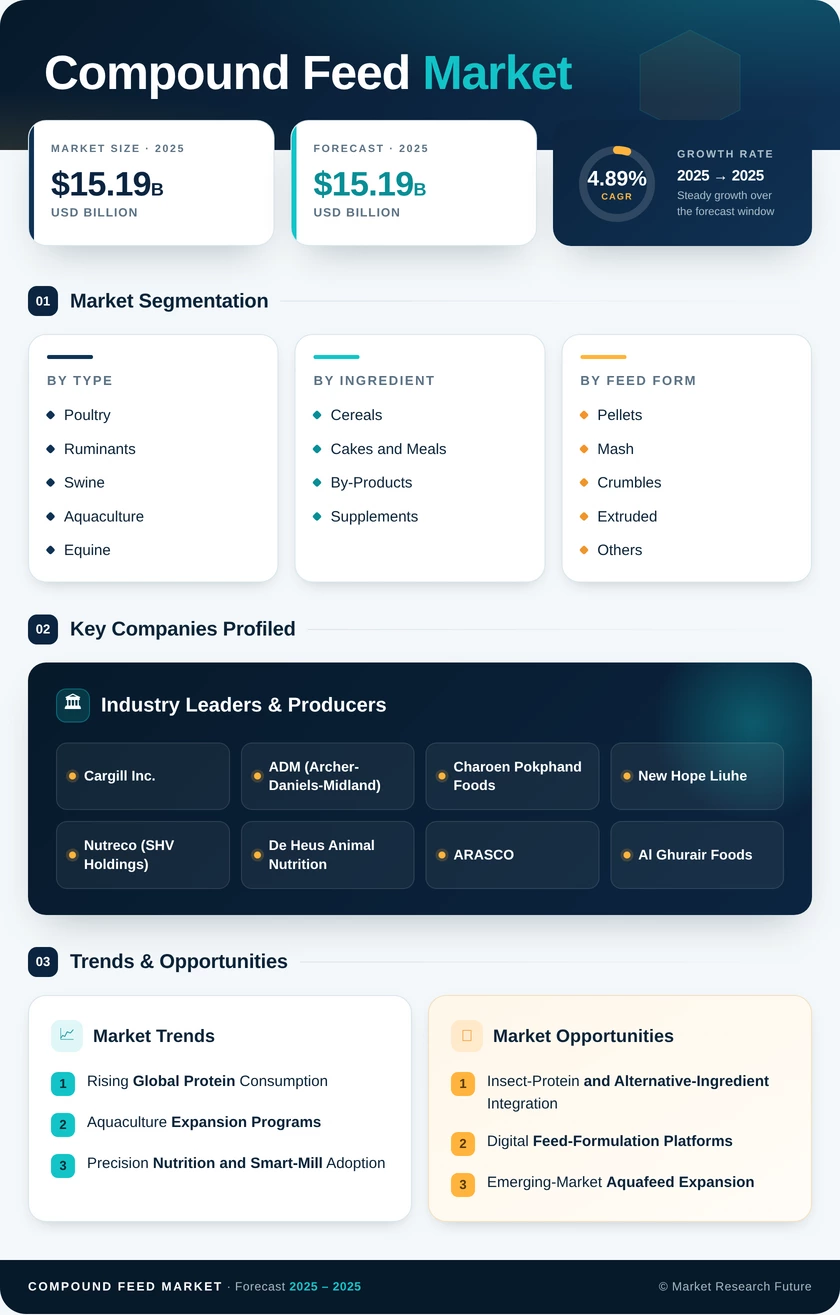
Compound Feed Market Size, Share, Industry Trend & Analysis Research Report: Information By Animal Type (Poultry, Ruminants, Swine, Aquaculture, Equine, Others), By Ingredient (Cereals, Cakes and Meals, By-Products, Supplements), By Feed Form (Pellets, Mash, Crumbles, Extruded, Others), By Geography (North America, Europe, Asia-Pacific, South America, Middle East & Africa) – Forecast Till 2035
Download PDF ×

We do not share your information with anyone. However, we may send you emails based on your report interest from time to time. You may contact us at any time to opt-out.

  1. 1 Market Overview |
    1. 1.1 Study Assumptions & Market Definition |
    2. 1.2 Scope of the Study |
    3. 1.3 Research Methodology
  2. 2 Market Summary & Key Takeaways
  3. 3 Market Dynamics |
    1. 3.1 Market Drivers Analysis | |
      1. 3.1.1 Rising Global Protein Consumption | |
      2. 3.1.2 Antimicrobial Ban-Driven Reformulation | |
      3. 3.1.3 Aquaculture Expansion Programs | |
      4. 3.1.4 Precision Nutrition & Smart-Mill Adoption | |
      5. 3.1.5 Government Food-Security Subsidies | |
      6. 3.1.6 Vertical Integration by Agri-Conglomerates | |
      7. 3.1.7 Pet-Food Grade Compound Feed Premiumization |
    2. 3.2 Market Restraints Analysis | |
      1. 3.2.1 Volatile Grain and Oilseed Import Costs | |
      2. 3.2.2 Stringent Mycotoxin and Contaminant Regulations | |
      3. 3.2.3 Fragmented Smallholder Resistance to Compound Feed | |
      4. 3.2.4 Environmental Pressure on Soy-Based Ingredients | |
      5. 3.2.5 Energy-Cost Inflation in Milling Operations |
    3. 3.3 Market Opportunity Analysis | |
      1. 3.3.1 Insect-Protein and Alternative-Ingredient Integration | |
      2. 3.3.2 Digital Feed-Formulation Platforms | |
      3. 3.3.3 Emerging-Market Aquafeed Expansion | |
      4. 3.3.4 Medicated and Functional Additive Premixes | |
      5. 3.3.5 Data-Driven Feed-to-Farm Performance Monetization |
    4. 3.4 Industry Value Chain Analysis |
    5. 3.5 Porter's Five Forces Analysis
  4. 4 Compound Feed Market Size & Forecast (2021–2035) |
    1. 4.1 Historical Market Size (2021–2025) |
    2. 4.2 Current & Forecast Market Size (2026–2035) |
    3. 4.3 Market Size by Revenue (USD Billion) |
    4. 4.4 Year-over-Year Growth Analysis
  5. 5 Segmentation Analysis |
    1. 5.1 By Animal Type | |
      1. 5.1.1 Poultry | |
      2. 5.1.2 Ruminants | |
      3. 5.1.3 Swine | |
      4. 5.1.4 Aquaculture | |
      5. 5.1.5 Equine | |
      6. 5.1.6 Others |
    2. 5.2 By Ingredient | |
      1. 5.2.1 Cereals | |
      2. 5.2.2 Cakes and Meals | |
      3. 5.2.3 By-Products | |
      4. 5.2.4 Supplements |
    3. 5.3 By Feed Form | |
      1. 5.3.1 Pellets | |
      2. 5.3.2 Mash | |
      3. 5.3.3 Crumbles | |
      4. 5.3.4 Extruded | |
      5. 5.3.5 Others
  6. 6 Regional Analysis |
    1. 6.1 North America | |
      1. 6.1.1 United States | |
      2. 6.1.2 Canada | |
      3. 6.1.3 Mexico |
    2. 6.2 Europe | |
      1. 6.2.1 Germany | |
      2. 6.2.2 United Kingdom | |
      3. 6.2.3 France | |
      4. 6.2.4 Italy | |
      5. 6.2.5 Spain | |
      6. 6.2.6 Nordic Countries | |
      7. 6.2.7 Russia | |
      8. 6.2.8 Rest of Europe |
    3. 6.3 Asia-Pacific | |
      1. 6.3.1 China | |
      2. 6.3.2 India | |
      3. 6.3.3 Japan | |
      4. 6.3.4 South Korea | |
      5. 6.3.5 ASEAN | |
      6. 6.3.6 Rest of Asia-Pacific |
    4. 6.4 South America | |
      1. 6.4.1 Brazil | |
      2. 6.4.2 Argentina | |
      3. 6.4.3 Rest of South America |
    5. 6.5 Middle East & Africa | |
      1. 6.5.1 Saudi Arabia | |
      2. 6.5.2 UAE | |
      3. 6.5.3 South Africa | |
      4. 6.5.4 Egypt | |
      5. 6.5.5 Rest of MEA
  7. 7 Competitive Landscape |
    1. 7.1 Market Share Analysis (2025) |
    2. 7.2 Competitive Benchmarking Matrix |
    3. 7.3 Company Profiles | |
      1. 7.3.1 Cargill Inc. | |
      2. 7.3.2 ADM (Archer-Daniels-Midland) | |
      3. 7.3.3 Charoen Pokphand Foods | |
      4. 7.3.4 New Hope Liuhe | |
      5. 7.3.5 Nutreco (SHV Holdings) | |
      6. 7.3.6 De Heus Animal Nutrition | |
      7. 7.3.7 ARASCO | |
      8. 7.3.8 Al Ghurair Foods | |
      9. 7.3.9 ForFarmers N.V. | |
      10. 7.3.10 Alltech Inc.
  8. 8 Future Outlook & Strategic Recommendations (2026–2035) |
    1. 8.1 AI-Driven Precision Feeding Systems |
    2. 8.2 Circular-Economy Ingredient Sourcing |
    3. 8.3 Climate-Resilient Supply Chains |
    4. 8.4 ESG Reporting and Scope 3 Emissions Tracking
  9. 9 Recent Developments & News
  10. 10 Frequently Asked Questions (FAQs)
  11. 11 Report Scope & Methodology |
    1. 11.1 Study Period & Base Year |
    2. 11.2 Data Sources & Citations |
    3. 11.3 Abbreviations
  12. 12 LIST OF TABLES |
  13. TABLE 1 Compound Feed Market Size & Forecast, by Revenue (USD Billion), 2021–2035 |
  14. TABLE 2 Compound Feed Market – Year-over-Year Growth Analysis, 2021–2035 |
  15. TABLE 3 Compound Feed Market – Driver Impact Analysis |
  16. TABLE 4 Compound Feed Market – Restraint Impact Analysis |
  17. TABLE 5 Compound Feed Market Size, by Animal Type, 2021–2035 |
  18. TABLE 6 Compound Feed Market Size, by Ingredient, 2021–2035 |
  19. TABLE 7 Compound Feed Market Size, by Feed Form, 2021–2035 |
  20. TABLE 8 Compound Feed Market Size, by Region, 2021–2035 (USD Billion) |
  21. TABLE 9 North America Compound Feed Market Size, by Country, 2021–2035 |
  22. TABLE 10 Europe Compound Feed Market Size, by Country, 2021–2035 |
  23. TABLE 11 Asia-Pacific Compound Feed Market Size, by Country, 2021–2035 |
  24. TABLE 12 South America Compound Feed Market Size, by Country, 2021–2035 |
  25. TABLE 13 Middle East & Africa Compound Feed Market Size, by Country, 2021–2035 |
  26. TABLE 14 Competitive Benchmarking Matrix – Compound Feed Market, 2025 |
  27. TABLE 15 Company Profiles – Key Players, Compound Feed Market |
  28. TABLE 16 Recent Developments & Strategic Announcements, 2023–2025 |
  29. TABLE 17 Report Scope & Methodology Summary |
  30. TABLE 18 Detailed Sources and Citations
  31. 13 LIST OF FIGURES |
  32. FIGURE 1 Compound Feed Market Dynamics — Drivers, Restraints, and Opportunities |
  33. FIGURE 2 Compound Feed Market Value Chain Analysis |
  34. FIGURE 3 Porter's Five Forces Analysis — Compound Feed Market |
  35. FIGURE 4 Compound Feed Market Size Trend (USD Billion), 2021–2035 |
  36. FIGURE 5 Compound Feed Market Share, by Animal Type (2025) |
  37. FIGURE 6 Compound Feed Market Share, by Ingredient (2025) |
  38. FIGURE 7 Compound Feed Market Share, by Feed Form (2025) |
  39. FIGURE 8 Compound Feed Market Share, by Region (2025) |
  40. FIGURE 9 North America Compound Feed Market Share, by Country (2025) |
  41. FIGURE 10 Europe Compound Feed Market Share, by Country (2025) |
  42. FIGURE 11 Asia-Pacific Compound Feed Market Share, by Country (2025) |
  43. FIGURE 12 South America Compound Feed Market Share, by Country (2025) |
  44. FIGURE 13 Middle East & Africa Compound Feed Market Share, by Country (2025) |
  45. FIGURE 14 Competitive Landscape — Market Share Distribution (2025)

Segmentation Quick Reference

DimensionSub-SegmentsDominant SegmentFastest Growing Segment
By Animal TypePoultry, Ruminants, Swine, Aquaculture, Equine, OthersPoultry (~48% share, 2025)Aquaculture (9.34% CAGR)
By IngredientCereals, Cakes and Meals, By-Products, SupplementsCereals (~56% share, 2025)Supplements (10.18% CAGR)
By Feed FormPellets, Mash, Crumbles, Extruded, OthersPellets (~63% share, 2025)Extruded (10.84% CAGR)
By GeographyNorth America, Europe, Asia-Pacific, South America, Middle East & AfricaNorth America (~29% share, 2025)Asia-Pacific (6.12% CAGR)


Market Segmentation Overview

By Animal Type

Sub-SegmentKey Trend
PoultrySustained global broiler demand; fastest feed-conversion economics
RuminantsDairy intensification driving TMR adoption in South Asia
SwinePost-ASF herd rebuild in China and Southeast Asia
AquacultureGovernment expansion mandates; shrimp and salmon feed innovation
EquineNiche premium nutrition for sport and leisure horses
OthersPet-food-grade compound rations and specialty animal feeds


Poultry dominates production volumes globally due to short grow-out cycles and favorable feed-conversion ratios. At the same time, aquaculture represents the structural growth story underpinning long-term compound feed demand expansion through 2035.

By Ingredient

Sub-SegmentKey Trend
CerealsCorn and wheat remain the backbone of energy-dense formulations
Cakes and MealsSoybean and rapeseed meal drive protein-source procurement
By-ProductsCircular-economy valorization of rice bran, DDGS, and molasses
SupplementsEnzyme, probiotic, and vitamin premix adoption accelerating post-antimicrobial bans


Cereals account for the majority of ingredient spend, but supplements represent the fastest-shifting category as regulatory changes compel feed manufacturers to invest in functional additive alternatives.

By Feed Form

Sub-SegmentKey Trend
PelletsIndustry standard for automated poultry and swine feeding systems
MashCost-effective option for smallholder and backyard operations
CrumblesPreferred starter-feed form for young poultry and fish fingerlings
ExtrudedHigh-temperature processing enabling fat encapsulation for aquafeed and specialty diets
OthersLiquid supplements, feed blocks, and lick-based mineral delivery


Pellets remain the dominant feed form due to handling efficiency, storage stability, and compatibility with modern feeding infrastructure, while extruded products are gaining rapid traction in aquafeed applications requiring precise buoyancy and nutrient-density control.