Quantum Sensors Market (2025 - 2035)

Quantum Sensors Market Size, Share and Research Report By Product Type (Atomic Clocks, Quantum Magnetometers, Quantum Gravimeters & Gradiometers, PAR Quantum Sensors, Others), By Sensing Mechanism (Cold-Atom Interferometry, Nitrogen-Vacancy (NV) Diamond, Superconducting, Others), By Deployment Platform (Ground-Based, Airborne, Spaceborne, Marine/Sub-Surface), By End-User (Defense & Security, Space & Satellite, Oil & Gas, Healthcare, Telecommunications, Others) and By Regional (North America, Europe, South America, Asia Pacific, Middle East and Africa) - Industry Forecast to 2035.
ID: MRFR/SEM/3835-CR
94 Pages
Nirmit Biswas, Aarti Dhapte
Last Updated: August 04, 2026
Quantum Sensors Market
Market Size
Forecast Period2025-2035
CAGR (2025-2035)11.9%
2025 Market SizeUSD 0.82 billion
2035 Market SizeUSD 2.56 billion
Key Players
Infleqtion
Microchip Technology
Teledyne e2v
Exail
AOSense
M Squared Lasers
Opportunities
  • Quantum-Enhanced Mineral Exploration
  • Autonomous Vehicle Inertial Navigation
  • Sensing-as-a-Service Business Models

Quantum Sensors Market Summary

The Quantum Sensors Market was valued at USD 0.82 billion in 2025 and is projected to grow from USD 0.93 billion in 2026 to USD 2.56 billion by 2035, registering a CAGR of 11.9% during the forecast period (2026–2035). Defense-funded positioning, navigation, and timing (PNT) modernization programs — particularly the U.S. Department of Defense's USD 1.2 billion quantum technology initiative [1] — have catalyzed early commercial adoption. Parallel venture investment in chip-scale atomic clocks and diamond-defect magnetometers is compressing unit costs by an estimated 18–22% annually, pulling price-sensitive telecom and autonomous navigation buyers into the addressable base [2].

The technology transition is decisive. Cold-atom interferometry platforms and nitrogen-vacancy (NV) diamond sensing architectures are replacing legacy crystal-oscillator timing references and mechanical gyroscopes that offer orders-of-magnitude increases in drift stability and sensitivity. The European Commission’s Quantum Flagship program has allocated more than EUR 1 billion in its second phase to field-ruggedized sensor prototypes for civil infrastructure and satellite geodesy [3].


North America was the leader in the Quantum Sensors Market with a 41.7% share of revenues in 2025, driven by classified defense procurement and a robust SBIR/STTR funding pipeline. The Asia-Pacific region is the fastest-expanding region with a projected CAGR of 12.6% through 2035, due to the National Laboratory for Quantum Information Sciences in China and Moonshot R&D Program in Japan [4]. The second largest is Europe at 24.8%, helped by coordinated EU quantum activities. The competitive environment remains moderately concentrated, with the top five suppliers accounting for around 38-42% of worldwide revenues.


Key Report Takeaways

• By Product Type

  • Atomic clocks commanded a 38.2% revenue share in 2025, driven by defense PNT upgrades and telecom synchronization mandates.
  • Quantum gravimeters and gradiometers are forecast to record the highest segment CAGR through 2035, propelled by subsurface mineral exploration and civil engineering monitoring.

• By Sensing Mechanism

  • Cold-atom interferometry held a 42.6% share of the Quantum Sensors Market in 2025.
  • NV-diamond sensors are expanding rapidly as wafer-scale fabrication drives unit cost reductions below USD 5,000 per module.

• By End-User

  • Defense and security captured a 45.3% share of the Quantum Sensors Market in 2025.
  • Space and satellite applications are projected to post a 12.8% CAGR through 2035 as LEO constellation operators integrate quantum timing payloads.

• By Geography

  • North America dominated at 41.7% revenue share, while Asia-Pacific leads growth at a 12.6% CAGR.


Market Size and Forecast (2021–2035)

Market Research Future (MRFR)’s size estimations are based on primary interviews with 85+ quantum technology stakeholders, cross-referenced against government procurement disclosures, patent filing trends, and quarterly earnings from publicly listed component suppliers.
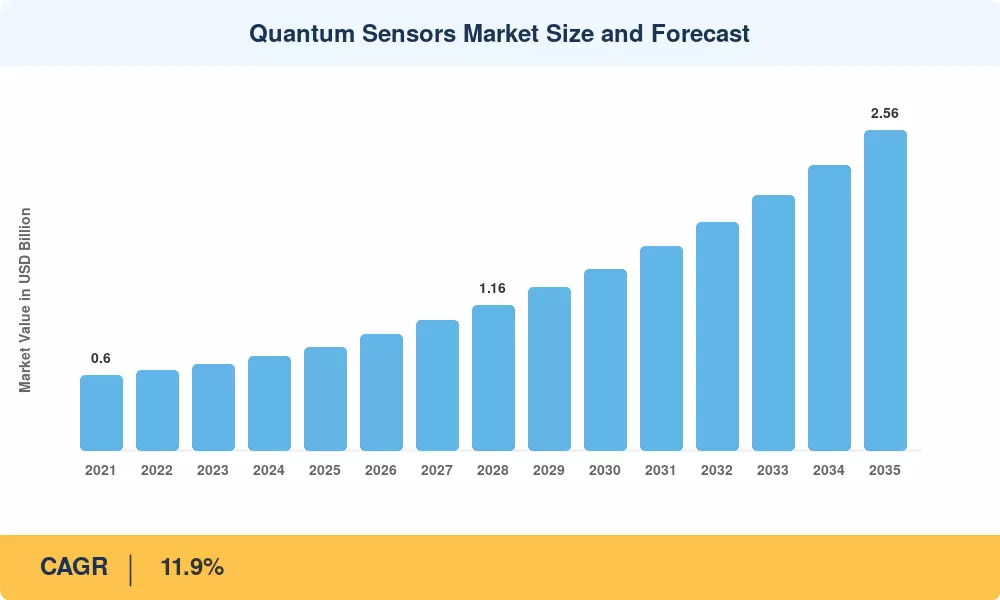
Quantum Sensors Market Size and Forecast
Our Impact
Enabled $4.3B Revenue Impact for Fortune 500 and Leading Multinationals
Partnering with 2000+ Global Organizations Each Year
30K+ Citations by Top-Tier Firms in the Industry

Driver Impact Analysis

Driver ~% Impact on CAGR Geographic Relevance Impact Timeline
Defense PNT modernization ~22% North America, Europe Short-term (≤2 yr)
Chip-scale atomic clock cost reduction ~18% Global Medium-term (2–4 yr)
LEO constellation timing payloads ~15% North America, Asia-Pacific Medium-term (2–4 yr)
Autonomous navigation demand ~14% Asia-Pacific, Europe Long-term (≥4 yr)
5G/6G network synchronization ~12% Global Medium-term (2–4 yr)
Civil infrastructure monitoring ~10% Europe, Asia-Pacific Long-term (≥4 yr)
Quantum computing adjacency investment ~9% North America Long-term (≥4 yr)


Defense PNT Modernization

The U.S. Department of Defense allocated approximately USD 1.2 billion toward quantum-assured PNT capabilities under its FY2024–2028 program objective memorandum, with field-portable atomic clocks and cold-atom inertial measurement units as priority deliverables [1]. These procurements provide volume orders that anchor supplier production lines and lower per-unit costs for downstream commercial buyers. NATO allies have followed with coordinated roadmaps — the UK's DASA Quantum Challenge awarded GBP 80 Million in contracts targeting GPS-denied navigation solutions for submarine and special operations forces [12].

Chip-Scale Fabrication Breakthroughs

MEMS-integrated atomic clock modules have shrunk from rack-mounted laboratory instruments to sub-17 cm³ packages weighing under 35 grams, unlocking integration into handheld devices and UAVs [6]. DARPA's Atomic Clocks with Enhanced Stability (ACES) program demonstrated timing drift below 1 × 10⁻¹² per day in operational prototypes, a threshold that makes quantum clocks commercially viable for telecom base station synchronization. This cost trajectory is reducing average selling prices by 18–22% per generation cycle.

LEO Constellation Integration

Satellite operators deploying mega-constellations — including programs with 4,000+ planned spacecraft — require onboard timing references immune to relativistic drift accumulated across orbital planes [7]. Quantum clocks and optical frequency standards provide picosecond-level stability that crystal oscillators cannot sustain over multi-year mission lifetimes. Industry contracts from constellation operators contributed an estimated USD 45 million in Quantum Sensors Market revenue during 2024 alone.


Restraints Impact Analysis

The restraint-impact percentages below represent directional assessments of each factor's drag on the Quantum Sensors Market growth rate.

Restraint ~% Negative Impact on CAGR Geographic Relevance Impact Timeline
Export control restrictions on quantum hardware ~−6% Global Short-term (≤2 yr)
Limited supply of ultracold laser components ~−5% North America, Europe Medium-term (2–4 yr)
Absence of unified calibration standards ~−4% Global Medium-term (2–4 yr)
High integration complexity for legacy platforms ~−3% Asia-Pacific Long-term (≥4 yr)
Skilled workforce scarcity in quantum engineering ~−3% Global Long-term (≥4 yr)


Export Control Restrictions

The U.S. Bureau of Industry and Security updated its Commerce Control List in 2024 to explicitly cover cold-atom accelerometers and gravimeters above specified sensitivity thresholds, adding licensing delays of 90–180 days for exports to non-allied nations [13]. The EU adopted parallel restrictions through its Dual-Use Regulation recast, while Japan's Ministry of Economy, Trade and Industry implemented end-use controls on NV-diamond substrates. These overlapping regimes create compliance overhead that raises transaction costs and slows cross-border sales cycles for sensor manufacturers.

Limited Laser Component Supply

High-performance quantum sensors depend on narrow-linewidth diode lasers and frequency-stabilized optical sources that fewer than 15 global suppliers can produce at the required specification [14]. Lead times for 780 nm and 852 nm laser modules extended to 26–32 weeks in 2024, constraining production ramp rates for cold-atom system integrators and delaying Quantum Sensors Market product deliveries by one to two quarters.


Quantum Sensors Market Opportunities

Quantum-Enhanced Mineral Exploration

Gravity gradient mapping powered by quantum gravimeters offers mining companies sub-surface resolution 5–10× sharper than conventional gravimeters, reducing exploratory drilling costs by an estimated 30% per prospect [10]. Rio Tinto and BHP have piloted airborne quantum gravity surveys in Western Australia, and the technology is transferable to groundwater mapping in water-stressed regions across Africa and South Asia.

Autonomous Vehicle Inertial Navigation

Self-driving vehicle programs require GPS-independent inertial sensing for tunnel, urban canyon, and adverse weather operations. Cold-atom gyroscopes achieve bias stability below 0.001°/hr — two orders of magnitude better than fiber-optic gyroscopes — positioning the Quantum Sensors Market for integration into L4/L5 autonomy stacks [8].

Sensing-as-a-Service Business Models

Rather than selling hardware outright, several startups are exploring subscription-based access to quantum sensor data streams for infrastructure monitoring, seismic early warning, and precision agriculture. This model lowers buyer capital expenditure thresholds and creates recurring revenue streams that improve supplier unit economics.

Emerging-Market Infrastructure Monitoring

Rapid urbanization across Southeast Asia, India, and sub-Saharan Africa is creating demand for structural health monitoring of bridges, dams, and high-rise buildings. Quantum tilt sensors and accelerometers can detect micro-deformation patterns months before visible distress, opening a greenfield Quantum Sensors Market opportunity worth an estimated USD 120 Million by 2032.

Medical and Biodefense Magnetometry

NV-diamond magnetometers operating at room temperature can image neural magnetic fields and detect trace biochemical signatures without cryogenic infrastructure, positioning them as alternatives to SQUID-based systems in clinical magnetoencephalography and biodefense screening.


Quantum Sensors Market Future Outlook

AI-Driven Sensor Fusion

Machine learning algorithms trained on quantum sensor output will enable real-time anomaly detection in structural health monitoring, autonomous navigation, and geophysical survey interpretation. By 2030, AI-quantum sensor fusion platforms could reduce false-positive rates in infrastructure inspection by 40–60%, creating a software-defined layer atop the Quantum Sensors Market hardware stack [8].

Quantum Inertial Navigation Standardization

Industry standards bodies — including IEEE and ISO — are drafting performance specifications for quantum inertial measurement units that will ease integration into certified aerospace platforms. Completion of these standards, expected by 2028–2029, should compress qualification timelines from 5+ years to 18–24 months, accelerating the Quantum Sensors Market transition from defense prototyping to commercial series production [15].

Space-Based Geodesy and Climate Science

ESA's Quantum Gravity Explorer and NASA's Cold Atom Laboratory extension missions will validate space-qualified quantum accelerometers for ice-sheet mass balance and ocean circulation monitoring. These missions, with combined budgets exceeding USD 650 Million through 2032, establish institutional demand for flight-heritage Quantum Sensors Market products [7].

Sustainability and ESG-Linked Demand

Regulators are tightening subsurface environmental monitoring requirements for carbon capture and storage (CCS) sites, landfills, and tailings dams. Quantum gravity gradient sensors can detect micro-density changes associated with subsurface fluid migration at centimeter-scale resolution, positioning them as compliance-grade instruments for ESG reporting frameworks mandated by the EU's Corporate Sustainability Reporting Directive [10].


Quantum Sensors Market Segmentation

By Product Type

Segment Key Metric Primary Demand Driver
Atomic Clocks 38.2% share (2025) Defense PNT and telecom sync
Quantum Magnetometers USD 0.17 billion (2025) Medical imaging, geophysical survey
Quantum Gravimeters & Gradiometers 12.8% CAGR (2026–2035) Mining exploration, geodesy
PAR Quantum Sensors USD 0.07 billion (2025) Environmental monitoring
Others 6.4% share (2025) Emerging R&D applications


Atomic clocks remain the revenue backbone of the Quantum Sensors Market, driven by defense GPS-denial resilience requirements and expanding 5G/6G network synchronization mandates. Chip-scale models from Microchip Technology and Vector Atomic now achieve timing accuracy of 1 × 10⁻¹¹ per day in packages small enough for UAV integration, pushing adoption beyond traditional defense customers into telecom and critical infrastructure sectors.

Quantum gravimeters and gradiometers represent the fastest-expanding product segment. Civil engineering firms deploying gravity gradient instruments for tunnel boring alignment and underground utility mapping have tripled their order backlogs since 2023, while mining companies report exploration cost savings of 25–35% versus conventional geophysical survey methods [10].

By Sensing Mechanism

Segment Key Metric Primary Demand Driver
Cold-Atom Interferometry 42.6% share (2025) Inertial navigation, gravimetry
Nitrogen-Vacancy (NV) Diamond 12.6% CAGR (2026–2035) Room-temperature magnetometry
Superconducting USD 0.09 billion (2025) Research, medical imaging
Others 8.2% share (2025) Photonic and trapped-ion platforms


Cold-atom interferometry anchors the Quantum Sensors Market sensing architecture through its proven performance in gravimetry, accelerometry, and gyroscopy. The technology's sensitivity — capable of detecting gravitational acceleration variations at the 10⁻⁹ g level — remains unmatched by competing platforms for defense and geoscience applications.

NV-diamond sensors are closing the gap rapidly. Their ability to operate at room temperature without cryogenic cooling eliminates a major cost and logistics barrier that has constrained superconducting alternatives. Wafer-scale diamond growth techniques now yield sensor-grade substrates at costs below USD 200 per unit, a threshold that enables volume production for biomedical and industrial inspection markets [6].

By Deployment Platform

Segment Key Metric Primary Demand Driver
Ground-Based 51.1% share (2025) Infrastructure monitoring, defense
Airborne USD 0.12 billion (2025) Geophysical survey, UAV integration
Spaceborne 12.4% CAGR (2026–2035) Satellite geodesy, LEO constellations
Marine/Sub-Surface 8.3% share (2025) Submarine navigation, offshore oil


By End-User

Segment Key Metric Primary Demand Driver
Defense & Security 45.3% share (2025) GPS-denied PNT, submarine nav
Space & Satellite 12.8% CAGR (2026–2035) LEO timing, climate missions
Oil & Gas USD 0.06 billion (2025) Reservoir characterization
Healthcare 9.7% share (2025) Magnetoencephalography
Telecommunications 8.4% share (2025) Network synchronization
Others 5.8% share (2025) Academic, environmental


Regional Market Share Analysis

Region Key Metric Primary Investment Themes
North America 41.7% revenue share (2025) Defense PNT, venture-funded startups
Europe 24.8% revenue share (2025) Quantum Flagship, civil geodesy
Asia-Pacific 12.6% CAGR (2026–2035) National labs, satellite programs
South America USD 0.04 billion (2025) Mining exploration, academic pilots
Middle East & Africa 5.8% revenue share (2025) Defense modernization, oil & gas
Total USD 0.82 billion (2025)


North America

Country Key Metric Key Driver
United States 78.4% of regional share DoD PNT contracts, DARPA programs
Canada 13.1% of regional share Arctic navigation, NRC quantum labs
Mexico 8.5% of regional share Telecom infrastructure upgrades


The United States dominates the North American Quantum Sensors Market through classified defense procurement, SBIR grants, and a concentrated cluster of quantum hardware startups in Colorado, Massachusetts, and California. Canada contributes through the National Research Council's Quantum Sensors Challenge Program, while Mexico's adoption centers on mobile telecom synchronization upgrades along the U.S.–Mexico border corridor [1] [4].

Europe

Country Key Metric Key Driver
Germany 11.2% CAGR (2026–2035) Fraunhofer quantum sensing institutes
United Kingdom USD 0.05 billion (2025) DASA quantum challenge contracts
France 10.8% CAGR (2026–2035) Exail/iXblue quantum inertial systems
Italy 4.1% of regional share Space agency gravimetry programs
Spain 3.2% of regional share Seismic monitoring networks
Nordic Countries 5.7% of regional share Arctic subsea navigation
Russia 3.8% of regional share Military inertial navigation
Rest of Europe 8.6% of regional share Academic and pilot deployments


Europe's Quantum Sensors Market strength derives from the EUR 1 billion+ Quantum Flagship program and defense modernization contracts across NATO members. Germany's Fraunhofer IOF and the UK's National Physical Laboratory anchor the research pipeline, while France's Exail has emerged as a leading supplier of maritime quantum inertial navigation systems deployed aboard French Navy submarines [3] [12].

Asia-Pacific

Country Key Metric Key Driver
China 38.6% of regional share National quantum lab infrastructure
Japan 12.4% CAGR (2026–2035) Moonshot R&D, satellite programs
India 11.8% CAGR (2026–2035) National Quantum Mission
South Korea 15.2% of regional share Defense modernization, KIST labs
ASEAN 7.3% of regional share Telecom timing upgrades
Rest of Asia-Pacific 5.9% of regional share Academic research


China's National Laboratory for Quantum Information Sciences in Hefei drives Asia-Pacific Quantum Sensors Market expansion with state-backed investment exceeding CNY 10 billion across cold-atom and photonic sensing platforms. Japan's Cabinet Office Moonshot Program targets autonomous underwater quantum navigation by 2030, and India's National Quantum Mission has earmarked INR 6,003 Crore (≈USD 730 Million) for quantum technology development through 2031 [4].

South America

Country Key Metric Key Driver
Brazil 52.3% of regional share Mining and oil exploration
Argentina 27.8% of regional share Lithium exploration, academic labs
Rest of South America 19.9% of regional share Pilot deployments


South America's adoption remains early-stage, centered on quantum gravimetry pilots for lithium and copper exploration in Chile and Argentina. Brazil's National Institute of Metrology has initiated atomic clock standardization programs to improve telecom network reliability across rural broadband expansion zones.

Middle East & Africa

Country Key Metric Key Driver
Saudi Arabia 31.4% of regional share Vision 2030 defense tech
UAE 28.7% of regional share Sovereign quantum investment fund
South Africa 16.2% of regional share Mining gravimetry pilots
Egypt 11.5% of regional share Telecom modernization
Rest of MEA 12.2% of regional share Infrastructure monitoring


Saudi Arabia and the UAE are leveraging sovereign wealth funds to fast-track quantum technology procurement under national technology sovereignty agendas. South Africa's mining sector has initiated quantum gravity gradient surveys for platinum and gold exploration at depths exceeding 3 km.


Quantum Sensors Market By Region, 2025-2035

Competitive Benchmarking

The Quantum Sensors Market is moderately consolidated in nature, with the Herfindahl-Hirschman Index (HHI) estimated at about 1,100-1,300. The top five vendors jointly represent 38-42% of sales, suggesting a rather competitive space with defense-funded incumbents competing with venture-backed companies following commercial miniaturization tactics. High barriers to entry based on specialized laser and vacuum system skills remain, but are increasingly dropping with the advent of chip-scale platforms.

Company Est. Revenue Share Range Key Offerings Strategic Positioning
Infleqtion (fmr. ColdQuanta) ~8–11% Cold-atom quantum sensors, RF sensing Full-stack cold-atom platform supplier
Microchip Technology ~7–10% Chip-scale atomic clocks (CSAC) High-volume MEMS-integrated timing
Teledyne e2v ~6–9% Space-qualified atomic clocks Satellite and defense timing heritage
Exail (fmr. iXblue) ~5–8% Quantum inertial navigation, gravimeters Maritime and defense navigation specialist
AOSense ~4–7% Cold-atom accelerometers, gyroscopes DARPA-funded precision navigation
M Squared Lasers ~3–6% Laser systems for quantum sensors Enabling technology and laser subsystems
Vector Atomic ~3–5% Portable atomic clocks, inertial sensors Miniaturized GPS-denied PNT solutions
Q.ANT ~2–4% Photonic quantum sensors Industrial metrology and particle sensing
SBQuantum ~1–3% NV-diamond magnetometers Mining exploration magnetometry
Nomad Atomics ~1–3% Compact quantum gravimeters Field-portable geophysical instruments


Recent News & Developments

  • Infleqtion (February 2026): Secured a USD 100 Million Series C funding round led by strategic defense investors, earmarked for scaling production of its Tiqker portable atomic clock platform for military and telecom customers [18].
  • SBQuantum (October 2023): Partnered with a major Canadian mining conglomerate to deploy NV-diamond magnetometers for passive subsurface exploration across three mineral lease blocks in Ontario [21].

Quantum Sensors Market Report Scope

Parameter Detail
Market Scope Global Quantum Sensors Market spanning hardware, software, and integration services
Study Period 2021–2035
Base Year 2025
Forecast Period 2026–2035
CAGR (2026–2035) 11.9%
Market Size (2025) USD 0.82 billion
Market Size (2035) USD 2.56 billion
Fastest Growing Segment Spaceborne deployment platform (12.4% CAGR)
Companies Profiled 10 (Infleqtion, Microchip Technology, Teledyne e2v, Exail, AOSense, M Squared Lasers, Vector Atomic, Q.ANT, SBQuantum, Nomad Atomics)
Valuation Currency USD billion


FAQs

How do quantum sensor procurement cycles differ from conventional sensor purchases?
Quantum sensor procurement typically involves 12–18 months' lead times due to laser component sourcing and export license processing. Buyers should engage suppliers during the requirements-definition phase rather than after specifications are locked [13].
What total cost of ownership considerations apply to cold-atom sensor systems?
Vacuum system maintenance, laser recalibration every 2,000–4,000 operating hours, and specialist technician labor account for roughly 30–40% of five-year ownership costs beyond the initial hardware price [14].
Can NV-diamond magnetometers replace SQUID sensors in clinical settings?
NV-diamond devices eliminate cryogenic helium requirements, cutting facility costs substantially. Clinical sensitivity remains approximately 10× lower than SQUIDs, limiting current use to screening rather than diagnostic-grade imaging [11].
How do export controls affect cross-border quantum sensor deployments?
Sensors exceeding specified sensitivity thresholds require individual validated licenses under U.S., EU, and Japanese dual-use frameworks. Processing timelines range from 90 to 180 days, depending on the destination country [13].
What role do quantum sensors play in GPS-denied underwater navigation?
Cold-atom accelerometers maintain positional accuracy below 1 nautical mile over 30-day submerged missions without external reference signals, outperforming ring-laser gyroscopes by an order of magnitude [20].
Are there emerging financing models that reduce upfront capital requirements for buyers?
Several vendors now offer sensor-as-a-service subscriptions, bundling hardware, calibration, and data analytics for monthly fees that reduce initial outlay by 60–70% compared to outright purchase [5].
How is quantum sensor data integrated into existing enterprise IT architectures?
Most vendors provide API-based middleware that translates raw quantum measurement streams into standard industrial protocols such as OPC UA or MQTT for seamless integration with SCADA and IoT platforms [15].    
Author
Author
Author Profile
Nirmit Biswas LinkedIn
Senior Research Analyst
With 5+ years of expertise in Market Intelligence and Strategic Research, Nirmit Biswas specializes in ICT, Semiconductors, and BFSI. Backed by an MBA in Financial Services and a Computer Science foundation, Nirmit blends technical depth with business acumen. He has successfully led 100+ projects for global enterprises and startups, including Amazon, Cisco, L&T and Huawei, delivering market estimations, competitive benchmarking, and GTM strategies. His focus lies in transforming complex data into clear, actionable insights that drive growth, innovation, and investment decisions. Recognized for bridging engineering innovation with executive strategy, Nirmit helps businesses navigate dynamic markets with confidence.
Co-Author
Co-Author Profile
Aarti Dhapte LinkedIn
AVP - Research
A consulting professional focused on helping businesses navigate complex markets through structured research and strategic insights. I partner with clients to solve high-impact business problems across market entry strategy, competitive intelligence, and opportunity assessment. Over the course of my experience, I have led and contributed to 100+ market research and consulting engagements, delivering insights across multiple industries and geographies, and supporting strategic decisions linked to $500M+ market opportunities. My core expertise lies in building robust market sizing, forecasting, and commercial models (top-down and bottom-up), alongside deep-dive competitive and industry analysis. I have played a key role in shaping go-to-market strategies, investment cases, and growth roadmaps, enabling clients to make confident, data-backed decisions in dynamic markets.

Research Approach


Secondary Research

The secondary research process involved comprehensive analysis of quantum technology databases, peer-reviewed physics and engineering journals, government quantum initiatives, and authoritative technology organizations. Key sources included the National Institute of Standards and Technology (NIST), European Quantum Flagship Programme, National Quantum Initiative (NQI) - U.S. Department of Energy, Defense Advanced Research Projects Agency (DARPA), Institute of Electrical and Electronics Engineers (IEEE) Quantum Initiative, American Physical Society (APS), European Physical Society (EPS), Quantum Economic Development Consortium (QED-C), National Science Foundation (NSF) Quantum Leap Challenge Institutes, U.S. Geological Survey (USGS) for gravimetric applications, National Oceanic and Atmospheric Administration (NOAA) for timing and navigation standards, Bureau International des Poids et Mesures (BIPM), Organisation for Economic Co-operation and Development (OECD) Science and Technology Policy Database, EU Eurostat Research & Development Statistics, and national quantum program reports from key markets (UK National Quantum Programme, China Quantum Research Initiative, Japan Quantum Technology Strategy). These sources were used to collect quantum technology investment statistics, regulatory frameworks for quantum technologies, academic research publications on atomic interferometry and quantum entanglement applications, patent landscapes for quantum sensing technologies, deployment data across military & defense, oil & gas exploration, healthcare diagnostics, and precision agriculture verticals, and market landscape analysis for atomic clocks, gravity sensors, magnetic sensors, and emerging quantum sensor modalities.


Primary Research

Qualitative and quantitative insights were obtained by interviewing supply-side and demand-side stakeholders during the primary research process. Supply-side sources comprised CEOs, CTOs, VPs of Quantum Research, leaders of quantum engineering divisions, and commercial directors from quantum sensor manufacturers, quantum computing companies that were diversifying into sensing applications, and precision instrumentation OEMs. The demand-side sources included chief geophysicists, defense technology procurement officers, medical imaging directors, precision agriculture technology managers, and R&D heads from oil & gas exploration companies, defense contractors and military research laboratories, healthcare systems and medical device manufacturers, automotive OEMs developing autonomous navigation systems, and environmental monitoring agencies.

Primary research validated market segmentation across atomic clocks, gravity sensors, magnetic sensors, PAR sensors, and quantum gyroscopes; confirmed product development timelines and commercialization roadmaps; gathered insights on technology adoption barriers including cryogenic cooling requirements and laser stability needs; assessed pricing strategies across research-grade versus commercial-grade quantum sensors; and evaluated procurement dynamics in government defense contracts versus commercial industrial applications.

Primary Respondent Breakdown:

By Designation: C-level Primaries (28%), Director Level (35%), Others (37%)

By Region: North America (40%), Europe (25%), Asia-Pacific (28%), Rest of World (7%)


Market Size Estimation

Global market valuation was derived through revenue mapping and deployment volume analysis across quantum sensing modalities. The methodology included:

Identification of 35+ key manufacturers and research institutions across North America, Europe, Asia-Pacific, and emerging quantum markets including dedicated quantum sensor companies, diversified industrial conglomerates with quantum divisions, and academic spin-offs commercializing laboratory quantum technologies

Product mapping across atomic clocks (chip-scale, optical lattice, and fountain architectures), gravity sensors (absolute and relative gravimeters), magnetic sensors (optically pumped magnetometers, SQUIDs, and NV-diamond sensors), photosynthetically active radiation quantum sensors, and emerging quantum gyroscopes/inertial sensors

Analysis of reported and modeled annual revenues specific to quantum sensor portfolios, distinguishing between component sales, integrated systems, and quantum sensing-as-a-service offerings

Coverage of manufacturers and research commercialization entities representing 75-80% of global market share in 2024

Extrapolation using bottom-up (deployment volume × ASP by application vertical and sensor type) and top-down (manufacturer revenue validation, quantum research grant allocations, and defense procurement budget analysis) approaches to derive segment-specific valuations across oil & gas exploration, military & defense navigation systems, healthcare diagnostics, automotive positioning, and precision agriculture monitoring applications

Download Free Sample

Kindly complete the form below to receive a free sample of this Report

Download PDF ×

We do not share your information with anyone. However, we may send you emails based on your report interest from time to time. You may contact us at any time to opt-out.