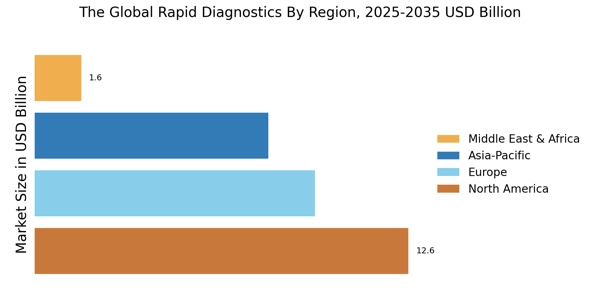
By region, the report provides market insights into Europe, North America, Asia-Pacific, and the Rest of the World. The North American rapid diagnostics market will likely exhibit a significant CAGR growth in the study period. The North American region is the largest market for rapid diagnostics due to well-established healthcare infrastructure, the increasing prevalence of infectious diseases, and the rising demand for point-of-care testing.
The United States dominates the market in this region due to the high demand for early diagnosis and treatment. In the United States, chronic diseases are the primary cause of death and disability. As per the Centers for Disease Control & Prevention (CDC), 6 in 10 Americans have at least one chronic illness as of February 2021. These and other chronic diseases are the leading causes of death and disability in the United States and the major cause of healthcare costs. Also, the major countries studied in the market report are the U.S., German, Canada, France, the U.K., Italy, Spain, China, Japan, India, Australia, South Korea, and Brazil.
The European rapid diagnostics market accounts for the second-largest global market share. Europe is a key market for rapid diagnostics owing to the rising incidence of chronic diseases, the expanding need for personalized medication, and the growing understanding of the value of early diagnosis. The Germany rapid diagnostics market holds the largest share within Europe, while the U.K. market is emerging as the fastest-growing.
The region also sees the introduction of novel technologies such as lab-on-a-chip and microfluidics, boosting market growth. Further, the German market of rapid diagnostics held the largest market share, and the U.K. market of rapid diagnostics was the fastest-growing market in the European region.
The Asia Pacific rapid diagnostics market is expected to grow at the fastest CAGR from 2023 to 2032 due to the increasing burden of infectious diseases, rising healthcare expenditure, and growing demand for affordable and accessible diagnostic testing. Emerging economies such as China and India are key contributors, with the China rapid diagnostics market leading in terms of market share, while the India rapid diagnostics market is witnessing the fastest growth due to expanding healthcare access and infrastructure. The region also offers significant opportunities for market players owing to a large untapped market. Moreover, the China market of rapid diagnostics held the largest market share, and the Indian market of rapid diagnostics was the fastest-growing market in the Asia-Pacific region.
Additionally, regions such as the Middle East are gaining momentum, with the GCC rapid diagnostics market showing steady growth supported by improving healthcare systems, rising awareness of early disease detection, and increasing government investments in healthcare infrastructure.