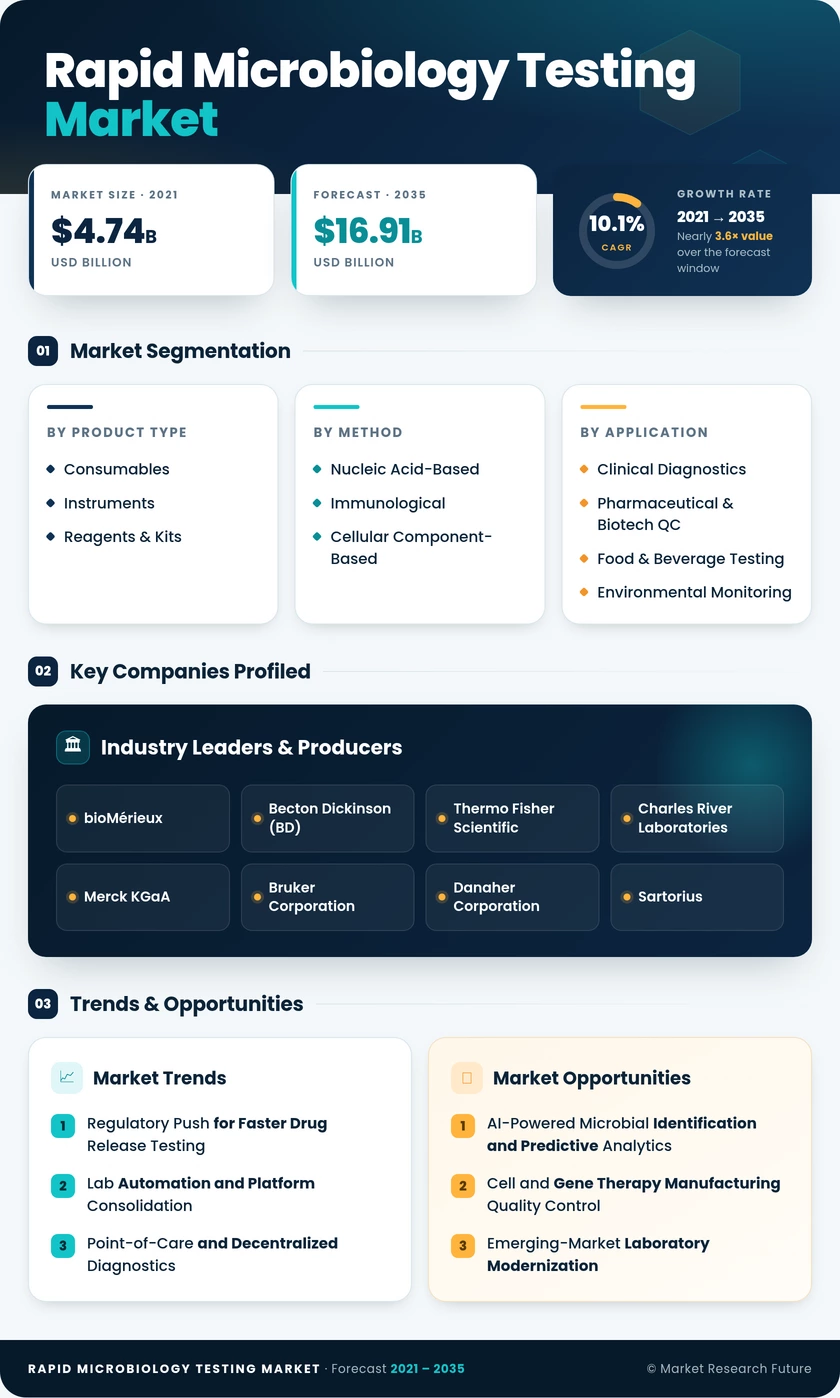
Rapid Microbiology Testing Market

ID: MRFR/LS/23092-HCR
100 Pages
Satyendra Maurya
Last Updated: June 22, 2026
Rapid Microbiology Testing Market Research Report: Size, Share, Trend Analysis By Sample Type (Blood Culture, Urine Culture, Wound Culture, Respiratory Culture, Stool Culture), By Technology (Molecular Diagnostics, Culture-Based Methods, Immunoassays, Flow Cytometry), By Target Pathogen (Bacteria, Fungi, Viruses, Parasites, Mycobacteria), By Applications (Sepsis Diagnosis, Antimicrobial Susceptibility Testing, Hospital-Acquired Infections (HAIs) Monitoring, Infectious Disease Outbreak Investigations, Public Health Surveillance), By Automation Level (Manual, Semi-Automated, Fully Automated) and By Regional (North America, Europe, South America, Asia Pacific, Middle East and Africa) - Growth Outlook & Industry Forecast Till 2035
Download PDF ×

We do not share your information with anyone. However, we may send you emails based on your report interest from time to time. You may contact us at any time to opt-out.

  1. 1 Market Overview |
    1. 1.1 Study Assumptions & Market Definition |
    2. 1.2 Scope of the Study |
    3. 1.3 Research Methodology
  2. 2 Market Summary & Key Takeaways
  3. 3 Market Dynamics |
    1. 3.1 Market Drivers Analysis | |
      1. 3.1.1 Regulatory Push for Faster Drug Release Testing | |
      2. 3.1.2 Lab Automation and Platform Consolidation | |
      3. 3.1.3 Point-of-Care and Decentralized Diagnostics | |
      4. 3.1.4 Food-Safety Modernization Mandates | |
      5. 3.1.5 Cell and Gene Therapy QC Requirements | |
      6. 3.1.6 AI and Machine-Learning Integration in Microbiology | |
      7. 3.1.7 Antimicrobial Resistance Surveillance Programs |
    2. 3.2 Market Restraints Analysis | |
      1. 3.2.1 High Upfront Instrument Costs | |
      2. 3.2.2 Regulatory Validation Complexity | |
      3. 3.2.3 Skilled-Workforce Shortages in Microbiology | |
      4. 3.2.4 Legacy Lab Infrastructure Inertia | |
      5. 3.2.5 Reimbursement Uncertainty for Rapid Tests |
    3. 3.3 Market Opportunity Analysis | |
      1. 3.3.1 AI-Powered Microbial Identification and Predictive Analytics | |
      2. 3.3.2 Cell and Gene Therapy Manufacturing Quality Control | |
      3. 3.3.3 Emerging-Market Laboratory Modernization | |
      4. 3.3.4 Data Monetization and Laboratory Information Platforms | |
      5. 3.3.5 Environmental and Water-Quality Testing Expansion |
    4. 3.4 Industry Value Chain Analysis |
    5. 3.5 Porter's Five Forces Analysis
  4. 4 Global Rapid Microbiology Testing Market Size & Forecast (2021–2035) |
    1. 4.1 Historical Market Size (2021–2025) |
    2. 4.2 Current & Forecast Market Size (2026–2035) |
    3. 4.3 Market Size by Revenue (USD Billion) |
    4. 4.4 Year-over-Year Growth Analysis
  5. 5 Segmentation Analysis |
    1. 5.1 By Product Type | |
      1. 5.1.1 Consumables | |
      2. 5.1.2 Instruments | |
      3. 5.1.3 Reagents & Kits |
    2. 5.2 By Method | |
      1. 5.2.1 Nucleic Acid-Based | |
      2. 5.2.2 Immunological | |
      3. 5.2.3 Cellular Component-Based |
    3. 5.3 By Application | |
      1. 5.3.1 Clinical Diagnostics | |
      2. 5.3.2 Pharmaceutical & Biotech Quality Control | |
      3. 5.3.3 Food & Beverage Testing | |
      4. 5.3.4 Environmental Monitoring |
    4. 5.4 By End User | |
      1. 5.4.1 Clinical Laboratories | |
      2. 5.4.2 Pharmaceutical & Biotech Companies | |
      3. 5.4.3 Food & Beverage Processors | |
      4. 5.4.4 Academic & Research Institutions
  6. 6 Regional Analysis |
    1. 6.1 North America | |
      1. 6.1.1 United States | |
      2. 6.1.2 Canada | |
      3. 6.1.3 Mexico |
    2. 6.2 Europe | |
      1. 6.2.1 Germany | |
      2. 6.2.2 United Kingdom | |
      3. 6.2.3 France | |
      4. 6.2.4 Italy | |
      5. 6.2.5 Spain | |
      6. 6.2.6 Nordic Countries | |
      7. 6.2.7 Russia | |
      8. 6.2.8 Rest of Europe |
    3. 6.3 Asia-Pacific | |
      1. 6.3.1 China | |
      2. 6.3.2 India | |
      3. 6.3.3 Japan | |
      4. 6.3.4 South Korea | |
      5. 6.3.5 ASEAN | |
      6. 6.3.6 Rest of Asia-Pacific |
    4. 6.4 South America | |
      1. 6.4.1 Brazil | |
      2. 6.4.2 Argentina | |
      3. 6.4.3 Rest of South America |
    5. 6.5 Middle East & Africa | |
      1. 6.5.1 Saudi Arabia | |
      2. 6.5.2 UAE | |
      3. 6.5.3 South Africa | |
      4. 6.5.4 Egypt | |
      5. 6.5.5 Rest of MEA
  7. 7 Competitive Landscape |
    1. 7.1 Market Share Analysis (2025) |
    2. 7.2 Competitive Benchmarking Matrix |
    3. 7.3 Company Profiles | |
      1. 7.3.1 bioMérieux | |
      2. 7.3.2 Becton Dickinson (BD) | |
      3. 7.3.3 Thermo Fisher Scientific | |
      4. 7.3.4 Charles River Laboratories | |
      5. 7.3.5 Merck KGaA | |
      6. 7.3.6 Bruker Corporation | |
      7. 7.3.7 Danaher Corporation | |
      8. 7.3.8 Sartorius | |
      9. 7.3.9 Rapid Micro Biosystems | |
      10. 7.3.10 Roper Technologies
  8. 8 Future Outlook & Strategic Recommendations (2026–2035) |
    1. 8.1 Near-Term Outlook (2026–2028) |
    2. 8.2 Medium-Term Outlook (2029–2031) |
    3. 8.3 Long-Term Outlook (2032–2035)
  9. 9 Recent Developments & News
  10. 10 Frequently Asked Questions (FAQs)
  11. 11 Report Scope & Methodology |
    1. 11.1 Study Period & Base Year |
    2. 11.2 Data Sources & Citations |
    3. 11.3 Abbreviations
  12. 12 LIST OF TABLES |
  13. TABLE 1 Global Rapid Microbiology Testing Market Size & Forecast, by Revenue (USD Billion), 2021–2035 |
  14. TABLE 2 Global Rapid Microbiology Testing Market — Year-over-Year Growth Analysis, 2021–2035 |
  15. TABLE 3 Global Rapid Microbiology Testing Market — Driver Impact Analysis |
  16. TABLE 4 Global Rapid Microbiology Testing Market — Restraint Impact Analysis |
  17. TABLE 5 Global Rapid Microbiology Testing Market Size, by Product Type, 2021–2035 (USD Billion) |
  18. TABLE 6 Global Rapid Microbiology Testing Market Size, by Method, 2021–2035 (USD Billion) |
  19. TABLE 7 Global Rapid Microbiology Testing Market Size, by Application, 2021–2035 (USD Billion) |
  20. TABLE 8 Global Rapid Microbiology Testing Market Size, by End User, 2021–2035 (USD Billion) |
  21. TABLE 9 Global Rapid Microbiology Testing Market Size, by Region, 2021–2035 (USD Billion) |
  22. TABLE 10 North America Rapid Microbiology Testing Market Size, by Country, 2021–2035 (USD Billion) |
  23. TABLE 11 Europe Rapid Microbiology Testing Market Size, by Country, 2021–2035 (USD Billion) |
  24. TABLE 12 Asia-Pacific Rapid Microbiology Testing Market Size, by Country, 2021–2035 (USD Billion) |
  25. TABLE 13 South America Rapid Microbiology Testing Market Size, by Country, 2021–2035 (USD Billion) |
  26. TABLE 14 Middle East & Africa Rapid Microbiology Testing Market Size, by Country, 2021–2035 (USD Billion) |
  27. TABLE 15 Competitive Benchmarking Matrix — Global Rapid Microbiology Testing Market, 2025 |
  28. TABLE 16 Company Profiles — Key Players, Global Rapid Microbiology Testing Market |
  29. TABLE 17 Recent Developments & Strategic Announcements, 2023–2025 |
  30. TABLE 18 North America Rapid Microbiology Testing Market Size, by Product Type, 2021–2035 (USD Billion) |
  31. TABLE 19 North America Rapid Microbiology Testing Market Size, by Method, 2021–2035 (USD Billion) |
  32. TABLE 20 North America Rapid Microbiology Testing Market Size, by Application, 2021–2035 (USD Billion) |
  33. TABLE 21 North America Rapid Microbiology Testing Market Size, by End User, 2021–2035 (USD Billion) |
  34. TABLE 22 Europe Rapid Microbiology Testing Market Size, by Product Type, 2021–2035 (USD Billion) |
  35. TABLE 23 Europe Rapid Microbiology Testing Market Size, by Method, 2021–2035 (USD Billion) |
  36. TABLE 24 Europe Rapid Microbiology Testing Market Size, by Application, 2021–2035 (USD Billion) |
  37. TABLE 25 Europe Rapid Microbiology Testing Market Size, by End User, 2021–2035 (USD Billion) |
  38. TABLE 26 Asia-Pacific Rapid Microbiology Testing Market Size, by Product Type, 2021–2035 (USD Billion) |
  39. TABLE 27 Asia-Pacific Rapid Microbiology Testing Market Size, by Method, 2021–2035 (USD Billion) |
  40. TABLE 28 Asia-Pacific Rapid Microbiology Testing Market Size, by Application, 2021–2035 (USD Billion) |
  41. TABLE 29 Asia-Pacific Rapid Microbiology Testing Market Size, by End User, 2021–2035 (USD Billion) |
  42. TABLE 30 South America Rapid Microbiology Testing Market Size, by Product Type, 2021–2035 (USD Billion) |
  43. TABLE 31 South America Rapid Microbiology Testing Market Size, by Method, 2021–2035 (USD Billion) |
  44. TABLE 32 South America Rapid Microbiology Testing Market Size, by Application, 2021–2035 (USD Billion) |
  45. TABLE 33 South America Rapid Microbiology Testing Market Size, by End User, 2021–2035 (USD Billion) |
  46. TABLE 34 Middle East & Africa Rapid Microbiology Testing Market Size, by Product Type, 2021–2035 (USD Billion) |
  47. TABLE 35 Middle East & Africa Rapid Microbiology Testing Market Size, by Method, 2021–2035 (USD Billion) |
  48. TABLE 36 Middle East & Africa Rapid Microbiology Testing Market Size, by Application, 2021–2035 (USD Billion) |
  49. TABLE 37 Middle East & Africa Rapid Microbiology Testing Market Size, by End User, 2021–2035 (USD Billion) |
  50. TABLE 38 Report Scope & Methodology Summary |
  51. TABLE 39 Detailed Sources and Citations
  52. 13 LIST OF FIGURES |
  53. FIGURE 1 Rapid Microbiology Testing Market Dynamics — Drivers, Restraints & Opportunities |
  54. FIGURE 2 Industry Value Chain Analysis — Rapid Microbiology Testing Market |
  55. FIGURE 3 Porter's Five Forces Analysis — Rapid Microbiology Testing Market |
  56. FIGURE 4 Global Rapid Microbiology Testing Market Size Trend, 2021–2035 (USD Billion) |
  57. FIGURE 5 Rapid Microbiology Testing Market Share, by Product Type, 2025 (%) |
  58. FIGURE 6 Rapid Microbiology Testing Market Share, by Method, 2025 (%) |
  59. FIGURE 7 Rapid Microbiology Testing Market Share, by Application, 2025 (%) |
  60. FIGURE 8 Rapid Microbiology Testing Market Share, by End User, 2025 (%) |
  61. FIGURE 9 Rapid Microbiology Testing Market Share, by Region, 2025 (%) |
  62. FIGURE 10 North America Rapid Microbiology Testing Market Share, by Country, 2025 (%) |
  63. FIGURE 11 Europe Rapid Microbiology Testing Market Share, by Country, 2025 (%) |
  64. FIGURE 12 Asia-Pacific Rapid Microbiology Testing Market Share, by Country, 2025 (%) |
  65. FIGURE 13 South America Rapid Microbiology Testing Market Share, by Country, 2025 (%) |
  66. FIGURE 14 Middle East & Africa Rapid Microbiology Testing Market Share, by Country, 2025 (%) |
  67. FIGURE 15 Competitive Landscape — Market Concentration & Positioning Chart

Segmentation Quick Reference

DimensionSub-SegmentsDominant SegmentFastest Growing Segment
Product TypeConsumables, Instruments, Reagents & KitsConsumables (49.1% share, 2025)Instruments (11.6% CAGR)
MethodNucleic Acid-Based, Immunological, Cellular Component-BasedNucleic Acid-Based (57.8% share, 2025)Immunological (11.4% CAGR)
ApplicationClinical Diagnostics, Pharmaceutical & Biotech QC, Food & Beverage Testing, Environmental MonitoringClinical Diagnostics (49.2% share, 2025)Pharmaceutical & Biotech QC (12.9% CAGR)
End UserClinical Laboratories, Pharmaceutical & Biotech Companies, Food & Beverage Processors, Academic & Research InstitutionsClinical Laboratories (52.5% share, 2025)Pharmaceutical & Biotech Companies (12.8% CAGR)
GeographyNorth America, Europe, Asia-Pacific, South America, Middle East & AfricaNorth America (42.0% share, 2025)Asia-Pacific (10.8% CAGR)


Market Segmentation Overview

By Product Type

Sub-SegmentKey Trend
ConsumablesClosed-ecosystem reagent models drive recurring revenue and vendor retention.
InstrumentsAutomation capex cycle fueled by greenfield APAC labs and legacy replacements.
Reagents & KitsMolecular assay proliferation expands kit volumes across clinical and industrial settings.


Consumables remain the revenue foundation of the market due to the razor-and-blade model embedded in automated microbiology platforms. Instruments are gaining share as automation becomes a strategic priority for high-volume laboratories seeking to offset staffing shortages and improve turnaround times.

By Method

Sub-SegmentKey Trend
Nucleic Acid-BasedPCR panel consolidation and falling sequencing costs expand addressable use cases
ImmunologicalLateral-flow and ELISA formats enable decentralized, low-infrastructure deployment.
Cellular Component-BasedATP bioluminescence and flow cytometry serve niche environmental and pharma applications


Nucleic acid-based technologies lead because molecular diagnostics are the clinical standard for high-sensitivity pathogen identification. Immunological methods are closing the gap in settings where speed, portability, and cost-per-test matter more than multi-pathogen capability.

By Application

Sub-SegmentKey Trend
Clinical DiagnosticsBlood-culture and respiratory-panel volumes anchor the largest application pool.
Pharmaceutical & Biotech QCAnnex 1 and USP <71> enforcement accelerates migration from compendial methods
Food & Beverage TestingFSMA and international export standards mandate sub-2-hour pathogen detection
Environmental MonitoringDrinking-water directives and cleanroom compliance expand regulatory scope.


Clinical diagnostics generates the highest absolute revenue due to sheer test volume. At the same time, pharmaceutical QC is the fastest-growing application as manufacturers convert from legacy sterility methods to validated rapid alternatives.

By End User

Sub-SegmentKey Trend
Clinical LaboratoriesCentralized reference labs and hospital networks consolidate testing volume.
Pharmaceutical & Biotech CompaniesIn-house QC lab buildout reduces outsourcing dependency.
Food & Beverage ProcessorsSupply-chain liability drives investment in on-site rapid screening.
Academic & Research InstitutionsMicrobiome and AMR research grants fund instrument procurement


Clinical laboratories dominate end-user spending because they aggregate demand across multiple clinical specialties. Pharmaceutical companies are the fastest-growing end-user segment as regulatory and competitive pressures incentivize in-house rapid-testing capabilities.