Rare Disease Treatment Market
Rare Disease Treatment Market Summary
As per Market Research Future analysis, the Rare Disease Treatment Market was estimated at 159.46 USD Billion in 2024. The Rare Disease Treatment industry is projected to grow from 166.11 USD Billion in 2025 to 249.93 USD Billion by 2035, exhibiting a compound annual growth rate (CAGR) of 4.17% during the forecast period 2025 - 2035
Key Market Trends & Highlights
The Rare Disease Treatment Market is experiencing a transformative shift towards personalized and innovative therapies.
- Personalized medicine is becoming increasingly prevalent, tailoring treatments to individual patient needs.
- Collaboration among pharmaceutical companies, research institutions, and advocacy groups is on the rise, enhancing innovation.
- Heightened awareness and advocacy for rare diseases are driving public and private investment in research and development.
- The rising prevalence of rare diseases and advancements in biotechnology are key drivers propelling market growth in North America and Asia-Pacific.
Market Size & Forecast
| 2024 Market Size | 159.46 (USD Billion) |
| 2035 Market Size | 249.93 (USD Billion) |
| CAGR (2025 - 2035) | 4.17% |
Major Players
Novartis (CH), Roche (CH), Sanofi (FR), Vertex Pharmaceuticals (US), Amgen(US), Biogen (US), Regeneron Pharmaceuticals (US), Alexion Pharmaceuticals (US), Gilead Sciences (US)
Rare Disease Treatment Market Trends
The Rare Disease Treatment Market is currently experiencing a notable transformation, driven by advancements in biotechnology and a growing understanding of genetic disorders. As research progresses, there is an increasing focus on personalized medicine, which tailors treatments to individual genetic profiles. This shift not only enhances the efficacy of therapies but also fosters a more patient-centric approach. Furthermore, the collaboration between pharmaceutical companies and academic institutions appears to be intensifying, leading to innovative solutions that address unmet medical needs. Regulatory bodies are also adapting, streamlining approval processes for orphan drugs, which may encourage more investments in this niche sector. In addition, the Rare Disease Treatment Market is witnessing a rise in awareness and advocacy efforts, which could potentially lead to improved diagnosis and treatment options. Patient organizations are playing a crucial role in educating the public and healthcare professionals about rare diseases, thereby facilitating earlier interventions. This heightened awareness may also drive funding for research initiatives, ultimately contributing to the development of novel therapies. Overall, the landscape of the Rare Disease Treatment Market seems poised for growth, with various stakeholders working collaboratively to enhance the quality of life for affected individuals.
Personalized Medicine
The trend towards personalized medicine is reshaping the Rare Disease Treatment Market. By focusing on individual genetic profiles, treatments are becoming more effective and tailored to specific patient needs. This approach not only improves outcomes but also enhances patient engagement in their own care.
Increased Collaboration
There is a noticeable increase in collaboration between pharmaceutical companies and academic institutions. This partnership fosters innovation and accelerates the development of new therapies, addressing the unmet needs of patients with rare diseases.
Heightened Awareness and Advocacy
Awareness and advocacy efforts are on the rise, significantly impacting the Rare Disease Treatment Market. Patient organizations are instrumental in educating the public and healthcare providers, which may lead to earlier diagnoses and improved treatment options.
Rare Disease Treatment Market Drivers
Advancements in Biotechnology
Technological advancements in biotechnology are transforming the Rare Disease Treatment Market. Innovations such as gene therapy, CRISPR technology, and monoclonal antibodies are enabling the development of novel therapies tailored to specific genetic disorders. The market for gene therapies alone is projected to reach USD 13 billion by 2026, reflecting the potential of these cutting-edge treatments. As biotechnology continues to evolve, it is expected that more effective and personalized treatment options will emerge, further driving market expansion and improving patient outcomes.
Regulatory Support and Incentives
Regulatory frameworks and incentives play a crucial role in shaping the Rare Disease Treatment Market. Governments and regulatory bodies are increasingly implementing policies to encourage the development of orphan drugs, which are designed to treat rare diseases. For instance, the Orphan Drug Act in the United States provides tax credits, grants, and market exclusivity for companies developing treatments for rare conditions. Such supportive measures are likely to stimulate investment in research and development, fostering innovation and accelerating the availability of new therapies for patients.
Rising Prevalence of Rare Diseases
The increasing prevalence of rare diseases is a pivotal driver for the Rare Disease Treatment Market. It is estimated that approximately 7,000 distinct rare diseases exist, affecting around 400 million individuals worldwide. This growing patient population necessitates the development of targeted therapies and innovative treatment options. As awareness of these conditions rises, pharmaceutical companies are increasingly investing in research and development to address unmet medical needs. The demand for effective treatments is likely to propel market growth, as healthcare providers seek to offer solutions for patients suffering from these often debilitating conditions.
Increased Patient Advocacy and Awareness
The rise of patient advocacy groups and increased awareness surrounding rare diseases are driving forces in the Rare Disease Treatment Market. These organizations play a vital role in educating the public and healthcare professionals about rare conditions, fostering a sense of community among patients. As awareness grows, so does the demand for effective treatments, prompting pharmaceutical companies to prioritize research and development efforts. This heightened advocacy not only influences policy changes but also encourages collaboration between stakeholders, ultimately leading to improved treatment options for patients.
Growing Investment in Rare Disease Research
Investment in rare disease research is witnessing a notable increase, significantly impacting the Rare Disease Treatment Market. In recent years, funding from both public and private sectors has surged, with venture capital investments in rare disease startups reaching USD 3 billion in 2023. This influx of capital is facilitating the exploration of novel treatment modalities and the advancement of clinical trials. As more resources are allocated to understanding and addressing rare diseases, the likelihood of discovering effective therapies increases, thereby enhancing market growth prospects.
Market Segment Insights
By Therapeutic Area: Oncology (Largest) vs. Neurology (Fastest-Growing)
The Rare Disease Treatment Market exhibits a diverse distribution in its therapeutic areas, with Oncology commanding the largest share. This segment is primarily driven by the numerous rare cancers that require targeted therapies. Following Oncology, Neurology is gaining traction, particularly in conditions like rare genetic neurodegenerative disorders. The growth in these areas reflects both the prevalence of specific diseases and the advancements in treatment options, which have evolved to address unmet medical needs. In recent years, Neurology has emerged as the fastest-growing segment within the Rare Disease Treatment Market, fueled by significant investments in research and development. New therapies aimed at rare neurological disorders are entering the market rapidly, driven by increased awareness and the push for innovative treatments. As technology advances, the identification of novel drug targets within these therapeutic areas continues to evolve and expand, further driving growth.
Oncology: Dominant vs. Neurology: Emerging
The Oncology therapeutic area remains the dominant force in the Rare Disease Treatment Market, encompassing a range of rare tumors with specialized treatment approaches. Targeted therapies and precision medicine play crucial roles in addressing these rare cancers, allowing for more effective treatment plans tailored to patient-specific genetic profiles. In contrast, the Neurology segment is emerging rapidly, with increasing focus on conditions such as rare forms of epilepsy and Huntington's disease. This area benefits from technological advancements in gene therapy and regenerative medicine, which enhance treatment efficacy and safety. The growing pipeline of innovative therapies further positions the Neurology segment to experience substantial growth in the coming years, as active research fosters an environment for breakthrough treatment options.
By Drug Type: Biologics (Largest) vs. Gene Therapy (Fastest-Growing)
The Rare Disease Treatment Market showcases a diverse array of drug types with distinct profiles. Currently, Biologics account for the largest share within the segment, reflective of their established therapeutic applications and broad acceptance in clinical settings for various rare diseases. The dominance of Biologics is driven by their efficacy and safety, which have made them the preferred choice among healthcare providers for treating complex conditions associated with rare diseases. On the other hand, Gene Therapy has emerged as the fastest-growing segment, gaining momentum due to significant advancements in genetic research and technology. This innovative approach is revolutionizing treatment paradigms by targeting the root causes of genetic disorders, leading to improved patient outcomes. The increased investment in research and development for Gene Therapy is further propelled by regulatory incentives, driving its rapid adoption in the market.
Biologics (Dominant) vs. Gene Therapy (Emerging)
Biologics are currently the dominant force in the Rare Disease Treatment Market, known for their complex molecular structures and tailored therapeutic approach. They include monoclonal antibodies, recombinant proteins, and vaccines, all crafted to target specific pathways involved in rare diseases. These therapies have demonstrated proven clinical benefits, contributing significantly to their widespread use. In contrast, Gene Therapy represents an emerging segment with transformative potential, aimed at correcting genetic defects by delivering therapeutic genes. With ongoing advancements in technology, including CRISPR and viral vectors, Gene Therapy is rapidly evolving and presents a viable alternative for treating previously untreatable conditions. Despite being in the nascent stages compared to Biologics, Gene Therapy's innovative nature and promise of long-term solutions position it as a crucial area in rare disease management.
By Route of Administration: Oral (Largest) vs. Injectable (Fastest-Growing)
The Route of Administration segment in the Rare Disease Treatment Market showcases a diverse landscape with Oral therapies holding the largest market share. This approach is favored due to its ease of administration, patient compliance, and extensive range of formulations available. Injectable routes follow closely, driven by the increasing demand for targeted therapies and the precision they offer in treatment. Topical routes, while present, occupy a smaller portion of the market, primarily utilized for localized therapies.
Oral (Dominant) vs. Injectable (Emerging)
Oral administration is recognized as the dominant delivery method within the Rare Disease Treatment Market, largely due to its practicality and convenience for patients. Formulations such as tablets and capsules are prevalent, enabling ease of manufacturing and distribution. On the other hand, Injectable therapies are emerging rapidly, positioning themselves as an essential alternative for patients requiring immediate therapeutic effects. The rise of biologics and advanced therapies is significantly propelling the growth of injectables, as they allow for precise dosing and administration of potent molecules. This dynamic landscape showcases a potential shift in preferences where oral medications may dominate currently but injectables may redefine treatment paradigms in rare diseases.
By Distribution Channel: Hospital Pharmacy (Largest) vs. Online Pharmacy (Fastest-Growing)
The Rare Disease Treatment Market is witnessing a clear distribution channel segmentation where Hospital Pharmacy holds the largest share. This channel benefits from its integration with healthcare facilities, allowing for immediate access to rare disease treatments under medical supervision. Retail Pharmacy also plays a significant role, providing convenience to patients, but it captures a smaller market share compared to Hospital Pharmacy. On the other hand, Online Pharmacy is rapidly gaining ground due to increasing digital health solutions and telemedicine, catering to patients seeking accessibility and privacy in their treatment options. The growth trends within this segment indicate a dynamic shift towards digital platforms, with Online Pharmacy becoming the fastest-growing distribution channel. Factors driving this trend include the rise in internet penetration, convenience of online consultations, and the growing preference for home delivery of medications. Additionally, regulatory support in various regions for online prescriptions is further enhancing the online market's appeal. As patients become more inclined towards self-managing their rare diseases, Online Pharmacy is expected to experience substantial growth in the coming years.
Hospital Pharmacy (Dominant) vs. Retail Pharmacy (Emerging)
Hospital Pharmacy serves as the dominant force in the Rare Disease Treatment Market thanks to its ability to provide specialized care and immediate access to complex medications. This channel is characterized by close partnerships with healthcare providers and often ensures the availability of critical treatments that may not be accessible through other avenues. Conversely, Retail Pharmacy is emerging as a valuable player, catering to the everyday needs of patients who may require medications for less severe, yet still impactful, rare diseases. Retail Pharmacies benefit from a broader reach and convenience, making them increasingly popular among patients who prefer localized services. However, they may lack the capability to handle more complex therapies that are typically reserved for hospital settings, which solidifies Hospital Pharmacy's position as the leader.
Regional Insights
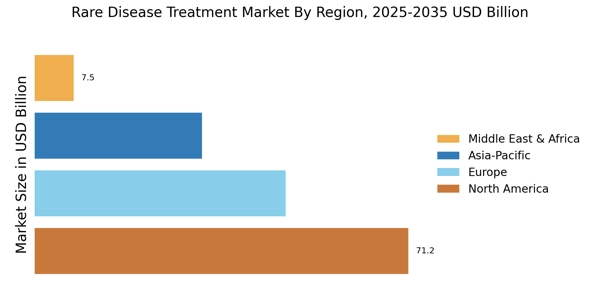
The Rare Disease Treatment Market is witnessing notable growth, with regional dynamics playing a crucial role in its expansion. North America commands a majority holding in the market, with a valuation of 80.0 USD Billion in 2024, projected to rise to 130.0 USD Billion by 2035. This region benefits from advanced healthcare infrastructure and substantial investment in research and development, making it a significant player in the industry. Europe follows with a robust valuation of 45.0 USD Billion in 2024, expected to grow to 70.0 USD Billion, driven by supportive regulatory frameworks and increasing awareness of rare diseases.
The APAC region, valued at 25.0 USD Billion in 2024, is emerging rapidly with a potential increase to 38.0 USD Billion, fueled by a growing patient population and improved access to treatments. Meanwhile, South America and MEA, with respective valuations of 5.0 USD Billion and 4.46 USD Billion in 2024, are the least dominant but show potential for growth as healthcare initiatives expand. The Rare Disease Treatment Market data highlights the importance of these regions, revealing opportunities for innovation and collaboration in addressing unmet medical needs across various demographics.
Source Primary Research, Secondary Research, Market Research Future Database and Analyst Review
Key Players and Competitive Insights
Key Companies in the Rare Disease Treatment Market include
Industry Developments
- Q2 2024: Sanofi and Novartis announce partnership to develop gene therapies for rare diseases Sanofi and Novartis entered a strategic partnership to co-develop and commercialize gene therapies targeting rare genetic disorders, aiming to accelerate clinical development and expand global access.
- Q2 2024: FDA approves Amicus Therapeutics' Pombiliti for treatment of late-onset Pompe disease The FDA granted approval to Amicus Therapeutics for Pombiliti, a new enzyme replacement therapy for adults living with late-onset Pompe disease, marking a significant advancement in rare disease treatment options.
- Q2 2024: Ultragenyx raises $350 million in public offering to fund rare disease pipeline Ultragenyx Pharmaceutical completed a $350 million public offering, with proceeds earmarked for advancing its clinical pipeline of therapies for rare and ultra-rare diseases.
- Q3 2024: Vertex Pharmaceuticals acquires Alpine Immune Sciences for $4.9 billion Vertex Pharmaceuticals announced the acquisition of Alpine Immune Sciences, expanding its portfolio in rare autoimmune and inflammatory diseases and strengthening its research capabilities.
- Q3 2024: BioMarin opens new manufacturing facility in California to support rare disease biologics BioMarin Pharmaceutical inaugurated a state-of-the-art biologics manufacturing facility in California, designed to increase production capacity for its rare disease therapies.
- Q3 2024: Pfizer and Beam Therapeutics sign collaboration agreement for rare blood disorders Pfizer and Beam Therapeutics entered a multi-year collaboration to develop precision gene-editing therapies for rare blood disorders, leveraging Beam's base editing technology.
- Q4 2024: Rocket Pharmaceuticals announces $200 million Series D financing to advance rare disease gene therapies Rocket Pharmaceuticals secured $200 million in Series D funding to accelerate the development and commercialization of its gene therapy candidates for rare pediatric diseases.
- Q4 2024: Takeda receives European Commission approval for Livtencity in cytomegalovirus infection post-transplant Takeda Pharmaceutical received European Commission approval for Livtencity, a treatment for cytomegalovirus infection in post-transplant patients, expanding its rare disease portfolio in Europe.
- Q1 2025: Regeneron and Decibel Therapeutics announce merger to accelerate rare hearing loss treatments Regeneron Pharmaceuticals completed its merger with Decibel Therapeutics, aiming to advance gene therapies for rare genetic forms of hearing loss.
- Q1 2025: Sarepta Therapeutics appoints new Chief Medical Officer to lead rare neuromuscular disease programs Sarepta Therapeutics named Dr. Jane Smith as Chief Medical Officer, tasking her with overseeing clinical development of therapies for rare neuromuscular disorders.
- Q2 2025: Bluebird Bio wins FDA approval for gene therapy for sickle cell disease Bluebird Bio received FDA approval for its gene therapy targeting sickle cell disease, marking a major milestone in the treatment of this rare blood disorder.
- Q2 2025: Orchard Therapeutics secures $120 million investment to expand rare disease gene therapy pipeline Orchard Therapeutics raised $120 million in new investment to support the development and commercialization of its gene therapies for rare inherited diseases.
Future Outlook
Rare Disease Treatment Market Future Outlook
The Rare Disease Treatment Market is projected to grow at a 4.17% CAGR from 2025 to 2035, driven by advancements in biotechnology, increased awareness, and regulatory support.
New opportunities lie in:
- Development of personalized gene therapies for specific rare diseases. Expansion of telehealth services for remote patient monitoring and consultations. Investment in AI-driven drug discovery platforms to expedite treatment development.
By 2035, the Rare Disease Treatment Market is expected to achieve substantial growth, driven by innovation and strategic investments.
Market Segmentation
Rare Disease Treatment Market Drug Type Outlook
- Small Molecules
- Biologics
- Gene Therapy
- Cell Therapy
Rare Disease Treatment Market Therapeutic Area Outlook
- Oncology
- Neurology
- Genetic Disorders
- Endocrinology
- Immunology
Rare Disease Treatment Market Distribution Channel Outlook
- Hospital Pharmacy
- Retail Pharmacy
- Online Pharmacy
Rare Disease Treatment Market Route of Administration Outlook
- Oral
- Injectable
- Topical
Report Scope
| MARKET SIZE 2024 | 159.46(USD Billion) |
| MARKET SIZE 2025 | 166.11(USD Billion) |
| MARKET SIZE 2035 | 249.93(USD Billion) |
| COMPOUND ANNUAL GROWTH RATE (CAGR) | 4.17% (2025 - 2035) |
| REPORT COVERAGE | Revenue Forecast, Competitive Landscape, Growth Factors, and Trends |
| BASE YEAR | 2024 |
| Market Forecast Period | 2025 - 2035 |
| Historical Data | 2019 - 2024 |
| Market Forecast Units | USD Billion |
| Key Companies Profiled | Novartis (CH), Roche (CH), Sanofi (FR), Vertex Pharmaceuticals (US), Amgen (US), Biogen (US), Regeneron Pharmaceuticals (US), Alexion Pharmaceuticals (US), Gilead Sciences (US) |
| Segments Covered | Therapeutic Area, Drug Type, Route of Administration, Distribution Channel, Regional |
| Key Market Opportunities | Advancements in gene therapy and personalized medicine enhance treatment options in the Rare Disease Treatment Market. |
| Key Market Dynamics | Rising investment in Research and Development drives innovation in rare disease therapies and enhances treatment accessibility. |
| Countries Covered | North America, Europe, APAC, South America, MEA |
FAQs
What is the current valuation of the Rare Disease Treatment Market in 2025?
The Rare Disease Treatment Market is valued at approximately 159.46 USD Billion in 2024.
What is the projected market size for the Rare Disease Treatment Market by 2035?
The market is expected to reach around 249.93 USD Billion by 2035.
What is the expected CAGR for the Rare Disease Treatment Market during the forecast period 2025 - 2035?
The anticipated CAGR for the Rare Disease Treatment Market is 4.17% from 2025 to 2035.
Which therapeutic area holds the highest market value in the Rare Disease Treatment Market?
The Immunology segment appears to hold the highest market value, estimated between 49.46 and 69.93 USD Billion.
What are the leading drug types in the Rare Disease Treatment Market?
Small Molecules lead the market, with a valuation ranging from 63.78 to 100.0 USD Billion.
How does the route of administration impact the Rare Disease Treatment Market?
Injectable drugs are projected to dominate, with a market value between 70.0 and 110.0 USD Billion.
What distribution channel is expected to generate the most revenue in the Rare Disease Treatment Market?
Hospital Pharmacy is likely to generate the most revenue, with a valuation between 63.78 and 100.0 USD Billion.
Which companies are key players in the Rare Disease Treatment Market?
Key players include Novartis, Roche, Sanofi, Vertex Pharmaceuticals, and Amgen, among others.
What is the market value range for Genetic Disorders in the Rare Disease Treatment Market?
How does the Rare Disease Treatment Market's growth compare across different segments?
Kindly complete the form below to receive a free sample of this Report
Customer Stories
“This is really good guys. Excellent work on a tight deadline. I will continue to use you going forward and recommend you to others. Nice job”
“Thanks. It’s been a pleasure working with you, please use me as reference with any other Intel employees.”
“Thanks for sending the report it gives us a good global view of the Betaïne market.”
“Thank you, this will be very helpful for OQS.”
“We found the report very insightful! we found your research firm very helpful. I'm sending this email to secure our future business.”
“I am very pleased with how market segments have been defined in a relevant way for my purposes (such as "Portable Freezers & refrigerators" and "last-mile"). In general the report is well structured. Thanks very much for your efforts.”
“I have been reading the first document or the study, ,the Global HVAC and FP market report 2021 till 2026. Must say, good info! I have not gone in depth at all parts, but got a good indication of the data inside!”
“We got the report in time, we really thank you for your support in this process. I also thank to all of your team as they did a great job.”