×
Request Free Sample ×

Kindly complete the form below to receive a free sample of this Report

* Please use a valid business email

Leading companies partner with us for data-driven Insights

clients tt-cursor
Hero Background

Reed Sensor Market

ID: MRFR/SEM/5244-HCR
100 Pages
Aarti Dhapte
October 2025

Reed Sensor Market Research Report Information By Mount Type (Panel Mount, Screw Mount, Surface Mount & Thread Mount), By Type (High-Temperature Reed Sensor, High Voltage Reed Sensor, Metal Detection Reed Sensor, Ultra-Miniature, Dry-Reed Sensor & Mercury-Wetted Reed Sensor), By Verticals (Automotive & Transportation, Healthcare, Consumer Electronics, Telecommunications, Safety & Security, Construction, Robotics & Automation & Others) And Region (North America, Europe, Asia-Pacific & Rest Of The World) –Industry F... read more

Share:
Download PDF ×

We do not share your information with anyone. However, we may send you emails based on your report interest from time to time. You may contact us at any time to opt-out.

Reed Sensor Market Infographic
Purchase Options

Reed Sensor Market Summary

As per MRFR analysis, the Reed Sensor Market Size was estimated at 1.72 USD Billion in 2024. The Reed Sensor industry is projected to grow from 1.831 USD Billion in 2025 to 3.418 USD Billion by 2035, exhibiting a compound annual growth rate (CAGR) of 6.44 during the forecast period 2025 - 2035.

Key Market Trends & Highlights

The Reed Sensor Market is poised for substantial growth driven by technological advancements and increasing demand across various sectors.

  • Technological advancements are enhancing the performance and applications of reed sensors, particularly in the automotive and consumer electronics sectors.
  • The Asia-Pacific region is emerging as the fastest-growing market, driven by rapid industrialization and increasing automation.
  • High-temperature reed sensors dominate the market, while ultra-miniature sensors are witnessing the fastest growth due to their compact size and versatility.
  • Key market drivers include the rising demand in the automotive sector and the expansion of industrial automation, which are propelling the adoption of reed sensors.

Market Size & Forecast

2024 Market Size 1.72 (USD Billion)
2035 Market Size 3.418 (USD Billion)
CAGR (2025 - 2035) 6.44%

Major Players

Honeywell (US), TE Connectivity (US), Omron (JP), Schneider Electric (FR), STMicroelectronics (CH), Microchip Technology (US), Bourns (US), Coto Technology (US), Mouser Electronics (US)

Reed Sensor Market Trends

The Reed Sensor Market is currently experiencing a notable evolution, driven by advancements in technology and increasing demand across various sectors. These sensors, known for their reliability and efficiency, are finding applications in automotive, consumer electronics, and industrial automation. The growing emphasis on automation and smart technologies appears to be propelling the adoption of reed sensors, as they offer precise control and monitoring capabilities. Furthermore, the trend towards miniaturization in electronic devices is likely to enhance the market's growth, as smaller sensors can be integrated into compact systems without compromising performance. In addition, environmental considerations are becoming increasingly relevant in the Reed Sensor Market. Manufacturers are exploring eco-friendly materials and production processes, which may lead to sustainable product offerings. This shift not only aligns with global sustainability goals but also caters to a consumer base that is progressively more conscious of environmental impacts. As the market continues to evolve, it seems poised for further innovation, with potential developments in sensor technology that could enhance functionality and broaden application areas. Overall, the Reed Sensor Market is on a trajectory of growth, influenced by technological advancements and changing consumer preferences.

Technological Advancements

Recent innovations in sensor technology are enhancing the capabilities of reed sensors, making them more efficient and versatile. These advancements may lead to improved performance in various applications, including automation and smart devices.

Sustainability Initiatives

There is a growing focus on sustainability within the Reed Sensor Market, with manufacturers increasingly adopting eco-friendly materials and processes. This trend reflects a broader commitment to environmental responsibility and may attract environmentally conscious consumers.

Miniaturization Trends

The ongoing trend towards miniaturization in electronics is likely to drive demand for smaller, more compact reed sensors. This development could facilitate their integration into a wider range of devices, enhancing functionality without sacrificing performance.

Reed Sensor Market Drivers

Growth in Consumer Electronics

The Reed Sensor Market is witnessing significant growth due to the rising demand for consumer electronics. Devices such as smartphones, tablets, and smart home appliances increasingly incorporate reed sensors for functionalities like magnetic switches and proximity detection. The proliferation of Internet of Things (IoT) devices further amplifies this trend, as manufacturers seek efficient and compact sensing solutions. Market data indicates that the consumer electronics segment is expected to grow at a robust rate, reflecting the broader trend of digitization and smart technology integration. This growth is likely to enhance the overall landscape of the Reed Sensor Market, as manufacturers innovate to meet consumer expectations.

Rising Focus on Energy Efficiency

The Reed Sensor Market is benefiting from a rising focus on energy efficiency across various sectors. As organizations and consumers alike prioritize sustainability, the demand for energy-efficient solutions is on the rise. Reed sensors, known for their low power consumption and reliability, are increasingly being adopted in applications that require energy management and monitoring. This trend is particularly evident in sectors such as renewable energy, where reed sensors are utilized in wind turbines and solar panels for performance monitoring. Market data indicates that the emphasis on energy efficiency will likely continue to shape the Reed Sensor Market, driving innovation and adoption of these sensing technologies.

Advancements in Medical Technology

The Reed Sensor Market is poised for growth due to advancements in medical technology. Reed sensors are increasingly utilized in medical devices for applications such as patient monitoring, diagnostic equipment, and wearable health devices. The demand for precise and reliable sensing solutions in healthcare is escalating, driven by the need for improved patient outcomes and the integration of technology in medical practices. Industry expert's suggest that the healthcare sector will continue to expand, thereby creating new opportunities for the Reed Sensor Market. As medical technology evolves, the role of reed sensors in enhancing device functionality and reliability is likely to become more pronounced.

Expansion of Industrial Automation

The Reed Sensor Market is significantly influenced by the ongoing expansion of industrial automation. As industries strive for enhanced efficiency and productivity, the integration of advanced sensing technologies becomes paramount. Reed sensors are widely employed in automation systems for applications such as position detection, limit switches, and safety interlocks. The increasing adoption of Industry 4.0 practices, characterized by smart factories and interconnected systems, is expected to drive the demand for reed sensors. Market analysis suggests that the industrial automation sector will continue to grow, thereby positively impacting the Reed Sensor Market and fostering innovation in sensor technologies.

Increasing Demand in Automotive Sector

The Reed Sensor Market is experiencing a notable surge in demand from the automotive sector. As vehicles become increasingly equipped with advanced electronic systems, the need for reliable sensing solutions has escalated. Reed sensors are utilized in various applications, including position sensing, speed detection, and safety systems. According to recent data, the automotive segment is projected to account for a substantial share of the overall market, driven by the growing trend of electric vehicles and autonomous driving technologies. This shift towards automation and enhanced safety features is likely to propel the adoption of reed sensors, thereby contributing to the expansion of the Reed Sensor Market.

Market Segment Insights

By Type: High-Temperature Reed Sensor (Largest) vs. Ultra-Miniature (Fastest-Growing)

The Reed Sensor Market comprises various types, each catering to specific applications and industries. The High-Temperature Reed Sensor holds the largest market share, largely due to its widespread use in demanding environments. In contrast, options like the Ultra-Miniature Reed Sensor have gained traction, especially in consumer electronics and compact devices, signaling a shift in market preferences. Other types, including High Voltage, Metal Detection, Dry-Reed, and Mercury-Wetted Reed Sensors, occupy niche segments, contributing to the overall diversity of the market.

High-Temperature Reed Sensor (Dominant) vs. Ultra-Miniature Reed Sensor (Emerging)

High-Temperature Reed Sensors are essential for applications that involve extreme conditions, making them a dominant force in the market. They are commonly utilized in industrial and automotive applications, providing reliability and durability. On the other hand, Ultra-Miniature Reed Sensors, designed for compact and miniaturized applications, are emerging rapidly, driven by the demand for smaller devices in technology and consumer goods. These sensors are lightweight and offer flexibility in design, making them ideal for wearable technology and smart devices. As industries evolve, the interplay between these sensors exemplifies the market's adaptability to changing consumer demands and technological advancements.

By Mount Type: Panel Mount (Largest) vs. Surface Mount (Fastest-Growing)

The Reed Sensor Market exhibits a diverse mount type distribution, with Panel Mount capturing the largest market share. This mount type is widely used across various applications due to its versatility and ease of integration. In contrast, while Screw and Thread Mount types also hold significant positions, Surface Mount is emerging as the fastest-growing segment thanks to increasing demand for compact and space-efficient designs in modern electronics, thereby propelling its market share upwards.

Surface Mount (Dominant) vs. Thread Mount (Emerging)

In the Reed Sensor Market, Surface Mount is currently the dominant segment due to its compatibility with modern, miniaturized electronic devices, making it a preferred choice among manufacturers. The efficiency of Surface Mount technology in producing slimmer profiles is increasingly attracting OEMs seeking to optimize space within their products. On the other hand, Thread Mount is recognized as an emerging segment characterized by its robust anchoring capabilities. Though it has a smaller market share, its unique advantages make it attractive for industrial applications where secure and adjustable installations are crucial. As industries evolve, Thread Mount has the potential to experience significant growth.

By Verticals: Automotive & Transportation (Largest) vs. Healthcare (Fastest-Growing)

The Reed Sensor Market exhibits a diverse distribution across various verticals, with Automotive & Transportation being the largest segment, driven by the rapid growth of automotive electronics. Healthcare follows closely, showcasing a significant increase in demand for advanced sensor technologies for patient monitoring and diagnostic applications. Other important segments include Consumer Electronics & Appliances and Telecommunications, which contribute to a competitive landscape, yet Automotive & Transportation dominates with its extensive applications in modern vehicles and safety systems. Growth trends in the Reed Sensor Market reveal that the Healthcare segment is emerging as the fastest-growing vertical, fueled by technological advancements and the integration of IoT in medical devices. The push for smart healthcare solutions, telemedicine, and remote patient monitoring has accelerated the adoption of reed sensors in medical applications. Simultaneously, the Automotive sector continues to innovate with the implementation of electric vehicles and advanced driver-assistance systems, driving consistent growth within this segment.

Healthcare: Wearable Devices (Dominant) vs. Smart Home Solutions (Emerging)

In the Reed Sensor Market, the Healthcare segment's dominant value lies in wearable devices, which have become essential for health monitoring and diagnostics. These devices employ reed sensors for accurate physiological tracking, supporting proactive health management. The growing awareness of personal health and wellness, coupled with technological advancements, has positioned wearable devices at the forefront of healthcare innovation. Conversely, smart home solutions are an emerging value within this segment, focusing on automation and energy efficiency. As consumers embrace internet-connected devices for home monitoring, reed sensors are increasingly integrated into smart home systems, enhancing security and comfort. This growth is indicative of a shift towards interconnected health and home management systems, where reed sensors play a pivotal role.

Get more detailed insights about Reed Sensor Market

Regional Insights

North America : Innovation and Technology Hub

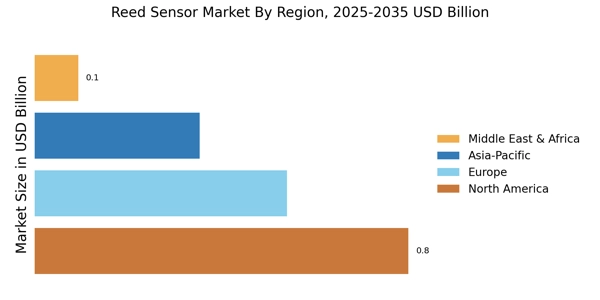
North America is the largest market for reed sensors, accounting for approximately 45% of the global share. The region's growth is driven by advancements in automation, increasing demand for smart home devices, and stringent regulatory standards promoting energy efficiency. The presence of major players like Honeywell and TE Connectivity further fuels market expansion, supported by government initiatives aimed at enhancing technological innovation. The United States dominates the North American market, followed by Canada, which contributes significantly to the sector. The competitive landscape is characterized by a mix of established companies and emerging startups, focusing on innovative solutions for various applications, including automotive and industrial sectors. The ongoing investments in R&D by key players ensure a robust pipeline of new products, enhancing market competitiveness.

Europe : Regulatory-Driven Market Growth

Europe is the second-largest market for reed sensors, holding around 30% of the global market share. The region's growth is propelled by increasing automation in manufacturing, the rise of electric vehicles, and stringent environmental regulations that promote the use of energy-efficient technologies. Countries like Germany and France are at the forefront, driving demand through innovative applications and regulatory support for sustainable practices. Germany leads the European market, followed closely by France and the UK. The competitive landscape is marked by the presence of key players such as Schneider Electric and STMicroelectronics, who are investing in advanced technologies to meet the growing demand. The European market is also witnessing collaborations between companies and research institutions to foster innovation in reed sensor applications, ensuring a dynamic and competitive environment.

Asia-Pacific : Emerging Market with High Potential

Asia-Pacific is witnessing rapid growth in the reed sensor market, accounting for approximately 20% of the global share. The region's expansion is driven by increasing industrial automation, rising consumer electronics demand, and government initiatives promoting smart city projects. Countries like China and Japan are leading the market, supported by favorable regulations and investments in technology development to enhance manufacturing capabilities. China is the largest market in the Asia-Pacific region, followed by Japan and South Korea. The competitive landscape is characterized by a mix of local and international players, including Omron and Microchip Technology, who are focusing on product innovation and cost-effective solutions. The region's growing emphasis on research and development is expected to further boost the market, making it a key area for future investments in reed sensor technology.

Middle East and Africa : Resource-Rich Market Opportunities

The Middle East and Africa region is gradually emerging in the reed sensor market, holding about 5% of the global share. The growth is primarily driven by increasing investments in infrastructure development, smart city initiatives, and the rising demand for automation in various sectors. Countries like the UAE and South Africa are leading the market, supported by government policies aimed at enhancing technological adoption and sustainability practices. The competitive landscape in this region is still developing, with a mix of local and international players exploring opportunities in the reed sensor market. Key players are beginning to establish a presence, focusing on innovative solutions tailored to regional needs. The ongoing economic diversification efforts in the Middle East are expected to create new avenues for growth in the reed sensor sector, making it an attractive market for future investments.

Reed Sensor Market Regional Image

Key Players and Competitive Insights

Leading market participants are financing heavily in research and development to develop their product lines, which will assist the reed sensor market to grow even more. Market participants are also undertaking numerous strategic activities to expand their global footprint with advanced market developments, including contractual agreements, new product launches, mergers and acquisitions, collaboration with other organizations, and higher investments. To enhance and survive in a more competitive and rising market climate, the reed sensor industry must offer cost-effective items.

Manufacturing locally to decrease operational costs is one of the major business tactics manufacturers use in the global reed sensor industry to benefit clients and increase the market sector. Major players in the Reed Sensor Market, including Littelfuse Inc. (US), HSI Sensing (US), RMCIP (Russia), Standex Electronics, Inc. (US), PIC GmbH (Germany), and others, are trying to increase market demand by investing in research and development operations.

Google LLC, an Alphabet Inc. subsidiary, provides search and advertising services online. The company's business areas include advertising, search, platforms and operating systems, and enterprise and hardware products. Its portfolio of products and services includes Google Search, Google Chrome, Google Docs, Google Calendar, Google Photos, Google Meet, Google Drive, Google Finance, Google Play Books, Google News, Google Earth, Google Ad Manager, Google Play, AdMob, Google Maps, AdSense, Gmail, Google Groups, and YouTube. In October 2022, Google launched a 2nd-generation wired nest doorbell with sensors and always-on recording with built-in storage.

The device supports 960p video recording, intelligent alerts, activity zones, and two-way audio.

Littelfuse Inc is a manufacturer of electrical products. The company's portfolio includes circuit protection products and solutions such as fuses and protectors, positive temperature coefficient (PTC) resettable fuses, polymer electrostatic discharge and varistors. It also offers suppressors, discrete transient voltage suppression (TVS) diodes, TVS diode arrays, protection thyristors; gas discharge tubes; fuse holders, blocks and related accessories. Littelfuse's services include testing services and customized circuit protection solutions. The company serves automotive, EV charging, food and beverages, consumer electronics and other industries.

In February 2021, Littelfuse, Inc. launched a reed relay product range that supports AC & DC loads up to 300 Vdc, extends voltage capabilities to encompass AC ratings, and offers input/output isolation voltage of 2500 VRMS.

Key Companies in the Reed Sensor Market market include

Industry Developments

In May 2024, Standex Electronics unveiled the MK33 SMD Reed Switch Serie: a series that is engineered in a way that its size is small but capable of withstanding and switching high power.

In April 2024, Honeywell and Lilium went ahead to deepen their earlier alliance. This time around, Honeywell is supposed to supply the Lilium Jet with lightweight sensor technology, the electric vertical take-off and landing (VTOL) aircraft. With the new sensor technology, the performance and efficiency of the jet are improved by the provision of information which is critical for flight operation and safety.

In February 2024, Littelfuse, Inc., launched the 59177 series ultra miniature overmolded reed transducer. This switch offers designers a limitless range of alternatives for applications with space restrictions. Designed with low power usage characteristics and being compact, the 59177 series reed switch presents a good option for high-speed switching activities.

In August 2023, Littelfuse came up with smallest subminiature flange mount reed sensors aimed at several uses. The sensors design allows miniaturization, contactless activation and customization making them ideal for tight spacing uses in a variety of industries.

In February 2023, Littelfuse, Inc. launched the 59177 series ultra-miniature over-molded reed switch. Such switches grant the user freedom in design when space is at a premium. Furthermore, given its size and low power consumption, the 59177 series reed switch is adequate for several applications requiring a high number of switching actions within short timescales.

In September 2021, HSI Sensing, the dominant company in the research of tailor-made reed switch and sensor technology as well as engineering and manufacturing, proudly commemorated the inauguration of its new production site and warehouse for one of its subsidiaries, Genisco Filter Corp. The defunct Genisco Filter Corp. is located in Madison, Wisconsin, and former employees described the company as a leader in designing and manufacturing EMI/RFI filters.

Future Outlook

Reed Sensor Market Future Outlook

The Reed Sensor Market is projected to grow at a 6.44% CAGR from 2024 to 2035, driven by advancements in automation, IoT integration, and increasing demand for energy-efficient solutions.

New opportunities lie in:

  • Development of smart home automation systems utilizing reed sensors.
  • Expansion into automotive applications for enhanced safety features.
  • Integration of reed sensors in industrial IoT for predictive maintenance.

By 2035, the Reed Sensor Market is expected to achieve substantial growth, reflecting evolving technological demands.

Market Segmentation

Reed Sensor Market Type Outlook

  • High-Temperature Reed Sensor
  • High Voltage Reed Sensor
  • Metal Detection Reed Sensor
  • Ultra-Miniature
  • Dry-Reed Sensor
  • Mercury-Wetted Reed Sensor

Reed Sensor Market Verticals Outlook

  • Automotive & Transportation
  • Healthcare
  • Consumer Electronics & Appliances
  • Telecommunications
  • Safety & Security
  • Construction
  • Robotics & Automation
  • Others

Reed Sensor Market Mount Type Outlook

  • Panel Mount
  • Screw Mount
  • Surface Mount
  • Thread Mount

Report Scope

MARKET SIZE 2024 1.72(USD Billion)
MARKET SIZE 2025 1.831(USD Billion)
MARKET SIZE 2035 3.418(USD Billion)
COMPOUND ANNUAL GROWTH RATE (CAGR) 6.44% (2024 - 2035)
REPORT COVERAGE Revenue Forecast, Competitive Landscape, Growth Factors, and Trends
BASE YEAR 2024
Market Forecast Period 2025 - 2035
Historical Data 2019 - 2024
Market Forecast Units USD Billion
Key Companies Profiled Market analysis in progress
Segments Covered Market segmentation analysis in progress
Key Market Opportunities Integration of Reed Sensors in smart home automation systems enhances energy efficiency and user convenience.
Key Market Dynamics Rising demand for automation drives innovation and competition in the Reed Sensor market across various industries.
Countries Covered North America, Europe, APAC, South America, MEA

Market Highlights

Author
Aarti Dhapte
Team Lead - Research

She holds an experience of about 6+ years in Market Research and Business Consulting, working under the spectrum of Information Communication Technology, Telecommunications and Semiconductor domains. Aarti conceptualizes and implements a scalable business strategy and provides strategic leadership to the clients. Her expertise lies in market estimation, competitive intelligence, pipeline analysis, customer assessment, etc.

Leave a Comment

FAQs

What is the projected market valuation of the Reed Sensor Market by 2035?

The Reed Sensor Market is projected to reach a valuation of 3.418 USD Billion by 2035.

What was the market valuation of the Reed Sensor Market in 2024?

In 2024, the Reed Sensor Market was valued at 1.72 USD Billion.

What is the expected CAGR for the Reed Sensor Market during the forecast period 2025 - 2035?

The expected CAGR for the Reed Sensor Market during the forecast period 2025 - 2035 is 6.44%.

Which companies are considered key players in the Reed Sensor Market?

Key players in the Reed Sensor Market include Honeywell, TE Connectivity, Omron, Schneider Electric, and STMicroelectronics.

What are the main types of Reed Sensors and their market valuations?

The main types of Reed Sensors include High-Temperature Reed Sensors valued at 0.34 to 0.68 USD Billion and High Voltage Reed Sensors valued at 0.3 to 0.6 USD Billion.

How do the market valuations of different mount types for Reed Sensors compare?

Market valuations for mount types include Panel Mount at 0.5 to 0.95 USD Billion and Surface Mount at 0.52 to 1.05 USD Billion.

What verticals are driving growth in the Reed Sensor Market?

Key verticals driving growth include Consumer Electronics & Appliances valued at 0.5 to 1.0 USD Billion and Automotive & Transportation valued at 0.4 to 0.8 USD Billion.

Download Free Sample

Kindly complete the form below to receive a free sample of this Report

Compare Licence

×
Features License Type
Single User Multiuser License Enterprise User
Price $4,950 $5,950 $7,250
Maximum User Access Limit 1 User Upto 10 Users Unrestricted Access Throughout the Organization
Free Customization
Direct Access to Analyst
Deliverable Format
Platform Access
Discount on Next Purchase 10% 15% 15%
Printable Versions