×
Request Free Sample ×

Kindly complete the form below to receive a free sample of this Report

* Please use a valid business email

Leading companies partner with us for data-driven Insights

clients tt-cursor
Hero Background

Residential Ducted Heat Pump Market

ID: MRFR/Equip/28684-HCR
128 Pages
Snehal Singh
October 2025

Residential Ducted Heat Pump Market Research Report By Heat Source (Air Source, Water Source, Geothermal Source), By Capacity (Less than 5 Tons, 5 to 10 Tons, 10 to 15 Tons, 15 to 20 Tons, 20 Tons or more), By Control Type (Remote Control, Zoned Control, Smart Control), By Efficiency (Low Efficiency (SEER less than 15), Moderate Efficiency (SEER 15-18), High Efficiency (SEER 18-21), Ultra-High Efficiency (SEER 21 or greater)), By Distribution System (Ductwork, Plenum, Ceiling-Mounted) and By Regional (North America, Europe, South America, As... read more

Share:
Download PDF ×

We do not share your information with anyone. However, we may send you emails based on your report interest from time to time. You may contact us at any time to opt-out.

Residential Ducted Heat Pump Market Infographic
Purchase Options

Residential Ducted Heat Pump Market Summary

As per MRFR analysis, the Residential Ducted Heat Pump Market Size was estimated at 9.62 USD Billion in 2024. The Residential Ducted Heat Pump industry is projected to grow from 10.19 USD Billion in 2025 to 18.15 USD Billion by 2035, exhibiting a compound annual growth rate (CAGR) of 5.94 during the forecast period 2025 - 2035.

Key Market Trends & Highlights

The Residential Ducted Heat Pump Market is experiencing a transformative shift towards energy efficiency and smart technology integration.

  • Technological advancements are driving innovation in the Residential Ducted Heat Pump Market, enhancing performance and user experience.
  • A growing focus on sustainability is influencing consumer preferences, leading to increased demand for eco-friendly heating solutions.
  • North America remains the largest market, while the Asia-Pacific region is emerging as the fastest-growing area for ducted heat pumps.
  • Energy efficiency regulations and rising energy costs are significant drivers propelling the adoption of air source systems, particularly in the 5 to 10 tons segment.

Market Size & Forecast

2024 Market Size 9.62 (USD Billion)
2035 Market Size 18.15 (USD Billion)
CAGR (2025 - 2035) 5.94%

Major Players

Daikin (JP), Mitsubishi Electric (JP), Carrier (US), Trane (US), Lennox (US), Fujitsu (JP), Bosch (DE), Rheem (US), Panasonic (JP), Hitachi (JP)

Residential Ducted Heat Pump Market Trends

The Residential Ducted Heat Pump Market is currently experiencing a notable transformation, driven by increasing consumer awareness regarding energy efficiency and sustainability. As homeowners seek to reduce their carbon footprints, the demand for advanced heating solutions that offer both comfort and environmental benefits is on the rise. This market appears to be influenced by technological advancements, which enhance the performance and efficiency of ducted heat pumps. Furthermore, government incentives and regulations promoting renewable energy sources are likely to bolster market growth, encouraging more households to adopt these systems. In addition, the trend towards smart home integration is becoming increasingly relevant within the Residential Ducted Heat Pump Market. Consumers are showing a preference for systems that can be controlled remotely and integrated with other smart devices. This shift not only enhances user convenience but also optimizes energy consumption, aligning with the broader movement towards intelligent home solutions. As the market evolves, it seems poised for further expansion, with innovations and consumer preferences shaping its trajectory in the coming years.

Technological Advancements

The Residential Ducted Heat Pump Market is witnessing rapid technological innovations that enhance system efficiency and performance. Newer models are being developed with improved compressors and heat exchangers, which may lead to better energy utilization and lower operational costs.

Sustainability Focus

There is a growing emphasis on sustainability within the Residential Ducted Heat Pump Market. Consumers are increasingly prioritizing eco-friendly solutions, prompting manufacturers to design systems that minimize environmental impact while maximizing energy efficiency.

Smart Home Integration

The integration of smart technology into heating systems is becoming a prominent trend in the Residential Ducted Heat Pump Market. Homeowners are favoring systems that offer remote control capabilities and compatibility with smart home ecosystems, enhancing convenience and energy management.

Residential Ducted Heat Pump Market Drivers

Rising Energy Costs

Rising energy costs are significantly influencing the Residential Ducted Heat Pump Market. As energy prices continue to escalate, homeowners are increasingly seeking cost-effective heating solutions. Ducted heat pumps offer a viable alternative, providing efficient heating and cooling at lower operational costs compared to traditional systems. This shift is evident in market trends, where the demand for energy-efficient appliances is on the rise. According to recent data, the adoption of ducted heat pumps has been linked to a reduction in energy expenses, making them an attractive option for budget-conscious consumers. Consequently, the market is likely to experience growth as more individuals prioritize energy efficiency in their purchasing decisions.

Technological Innovations

Technological innovations play a crucial role in shaping the Residential Ducted Heat Pump Market. Advances in heat pump technology, such as variable speed compressors and smart thermostats, enhance the efficiency and performance of these systems. These innovations not only improve energy efficiency but also provide homeowners with greater control over their heating and cooling needs. The integration of smart technology allows for remote monitoring and management, appealing to the tech-savvy consumer. Market analysis suggests that as these technologies become more prevalent, they will likely drive further adoption of ducted heat pumps. The continuous evolution of technology in this sector may lead to increased competition among manufacturers, fostering a dynamic market environment.

Increased Consumer Awareness

Increased consumer awareness regarding environmental impacts and energy efficiency is driving the Residential Ducted Heat Pump Market. As individuals become more informed about the benefits of sustainable heating solutions, there is a noticeable shift towards adopting ducted heat pumps. These systems are recognized for their lower carbon footprint compared to conventional heating methods. Market data indicates that consumers are actively seeking products that align with their values, particularly those that contribute to energy conservation. This trend is likely to encourage manufacturers to enhance their marketing strategies, focusing on the eco-friendly attributes of ducted heat pumps. As awareness continues to grow, the market may see a corresponding increase in demand.

Energy Efficiency Regulations

The increasing implementation of energy efficiency regulations is a pivotal driver for the Residential Ducted Heat Pump Market. Governments are enacting stringent standards aimed at reducing energy consumption in residential buildings. For instance, regulations may mandate the use of high-efficiency heating systems, which can lead to a surge in demand for ducted heat pumps. These systems are designed to provide optimal heating and cooling while minimizing energy use, aligning with regulatory goals. As a result, manufacturers are innovating to meet these standards, potentially increasing market competition and driving technological advancements. The market is projected to grow as consumers seek compliant solutions that not only meet legal requirements but also reduce their energy bills.

Government Incentives and Rebates

Government incentives and rebates are emerging as a significant driver for the Residential Ducted Heat Pump Market. Many governments are offering financial incentives to encourage the adoption of energy-efficient heating systems. These programs can significantly reduce the upfront costs associated with purchasing and installing ducted heat pumps, making them more accessible to a broader range of consumers. Market data indicates that regions with robust incentive programs experience higher rates of heat pump installations. As these initiatives continue to expand, they are likely to stimulate market growth by motivating homeowners to invest in energy-efficient solutions. The potential for financial savings, combined with environmental benefits, positions ducted heat pumps as an attractive option for consumers.
Market Segment Insights

By Heat Source: Air Source (Largest) vs. Geothermal Source (Fastest-Growing)

In the Residential Ducted Heat Pump Market, the heat source segment is notably varied, with Air Source units commanding a substantial market share. This segment benefits from its widespread adoption due to ease of installation and cost-effectiveness. Conversely, Geothermal Source heat pumps, despite their smaller market presence, are gaining traction due to increasing consumer awareness and government incentives promoting energy-efficient solutions. The Water Source segment, while significant, lags in growth compared to its counterparts.

Air Source (Dominant) vs. Geothermal Source (Emerging)

Air Source heat pumps are recognized for their efficiency and versatility, often serving as the go-to choice for homeowners seeking reliable heating solutions. Their ability to function in various climates makes them dominant in the market, meeting diverse consumer needs. On the other hand, Geothermal Source heat pumps are emerging rapidly, capturing market interest due to their sustainability and long-term cost benefits. Although installation costs are higher, their lower operational expenses and reduced environmental impact appeal to eco-conscious consumers, positioning them as a valuable alternative in the evolving landscape of residential heating.

By Capacity: 5 to 10 Tons (Largest) vs. 10 to 15 Tons (Fastest-Growing)

In the Residential Ducted Heat Pump Market, the capacity segment showcases a diverse distribution of market share. The '5 to 10 Tons' category stands out as the largest segment, appealing to a wide range of residential consumers looking for efficiency and effective heating solutions. Meanwhile, the '10 to 15 Tons' segment is emerging with rapid growth, driven by increased demand for larger systems suitable for spacious homes or commercial applications. This competitive landscape highlights varied preferences among homeowners and the importance of scalability in heat pump systems. The growth trends within this segment are significantly influenced by shifts in consumer preferences towards energy-efficient solutions. As homeowners become more aware of the benefits of ducted heat pumps, especially those in the '10 to 15 Tons' category, they are increasingly opting for higher capacity solutions that promise better energy performance. Additionally, technological advancements and incentives from energy programs foster adoption in these segments, fueling the overall market's evolution within residential heating solutions.

5 to 10 Tons (Dominant) vs. 15 to 20 Tons (Emerging)

The '5 to 10 Tons' capacity segment remains the dominant choice for residential ducted heat pumps, known for its balance between efficiency and performance. This segment effectively caters to medium-sized homes, providing adequate heating without excessive energy consumption. Its extensive adoption is reinforced by consumer trust and established brands, making it a safe bet for homeowners. On the other hand, the '15 to 20 Tons' segment is emerging as a viable option for larger properties, appealing to consumers concerned with heating expansive spaces. Although it currently holds a smaller share in the market, the increasing trend towards larger installations suggests an upward trajectory driven by growing housing sizes and heightened energy demands.

By Control Type: Zoned Control (Largest) vs. Smart Control (Fastest-Growing)

In the Residential Ducted Heat Pump Market, the control type segment has witnessed a diverse distribution of preferences among consumers. Zoned control has established itself as the largest category, primarily due to its ability to provide tailored heating solutions across various spaces in a home. This functionality ensures energy efficiency and comfort, making it a preferred choice for many homeowners looking for specific climate control in different areas of their residences. Meanwhile, remote control features are quite popular but are being increasingly overshadowed by the innovative smart control solutions that are gaining traction. Growing trends in the Residential Ducted Heat Pump Market indicate that smart control technologies are the fastest-growing segment due to their integration with home automation systems. As technology evolves, homeowners seek more convenience and flexibility in managing their heating systems remotely. The increasing adoption of IoT devices is driving this shift, highlighting the demand for energy-efficient and user-friendly operating solutions. Additionally, the trend towards sustainability and smart living is attracting more consumers towards smart control options, suggesting a promising outlook for this segment in the coming years.

Control Type: Zoned Control (Dominant) vs. Smart Control (Emerging)

Zoned control represents the dominant segment within the Residential Ducted Heat Pump Market, characterized by its ability to efficiently regulate temperatures in different areas of a home. This control type allows homeowners to customize their heating needs, resulting in significant energy savings and enhanced comfort. On the other hand, smart control is emerging quickly, leveraging advanced technologies such as AI and machine learning to offer users even greater flexibility and automation in their heating systems. Smart controls can connect to smartphones, enabling users to monitor and adjust settings remotely. As consumers increasingly prioritize smart home solutions, the demand for smart control options is expected to rise, positioning it as a significant player in the market.

By Efficiency: High Efficiency (Largest) vs. Ultra-High Efficiency (Fastest-Growing)

The Residential Ducted Heat Pump Market is segmented into four distinct efficiency categories: Low, Moderate, High, and Ultra-High Efficiency models. Currently, High Efficiency models (SEER 18-21) dominate the market, capturing a significant share due to their optimal balance of performance and energy savings. Moderate Efficiency models (SEER 15-18) follow closely, appealing to budget-conscious consumers while still offering a viable energy-efficient solution. Low Efficiency models hold the smallest share, reflecting a shift in consumer preferences towards greener options. As the market increasingly prioritizes energy conservation, growth trends favor Ultra-High Efficiency models (SEER 21 or greater), which are emerging as consumer favorites driven by governmental incentives and heightened awareness of energy efficiency. Technological advancements and a greater focus on sustainability are propelling the popularity of these models, making them a key component of future residential HVAC systems. The transition away from traditional heating methods supports this trend toward higher efficiency ratings, highlighting a substantial shift in market dynamics.

High Efficiency (Dominant) vs. Ultra-High Efficiency (Emerging)

High Efficiency models in the Residential Ducted Heat Pump Market represent a robust choice for homeowners seeking to optimize energy consumption without a premium price tag. With SEER ratings ranging from 18 to 21, these systems offer a compelling middle ground, balancing performance, cost, and energy savings, appealing to a broad customer base. On the other hand, Ultra-High Efficiency models are rapidly gaining traction as an emerging category, boasting SEER ratings of 21 or greater. Their increasing popularity is fueled by advancements in technology and strong environmental incentives. Homeowners are gravitating toward these models not only for their superior energy efficiency but also for the long-term savings and reduced environmental impact they promise. Together, these segments underscore a significant transition in consumer preferences toward energy-efficient heating solutions.

By Distribution System: Ductwork (Largest) vs. Ceiling-Mounted (Fastest-Growing)

In the Residential Ducted Heat Pump Market, the distribution system segment is primarily dominated by Ductwork, which remains the largest component due to its established presence in HVAC installations. Ductwork systems are preferred for their ability to efficiently distribute heated or cooled air throughout a home. Meanwhile, the Ceiling-Mounted option, although smaller in current market share, is gaining traction as residential preferences shift towards more discreet and space-saving solutions.

Ductwork (Dominant) vs. Ceiling-Mounted (Emerging)

Ductwork is the traditional choice for residential ducted heat pumps, providing effective air distribution and being easily compatible with various home designs. Its longevity and reliability have solidified its position as the dominant player in the market. Conversely, the Ceiling-Mounted systems are emerging rapidly, especially in homes where aesthetics and space utilization are prioritized. These systems tend to be less invasive and provide a more modern solution, appealing to a growing segment of homeowners looking for innovative heating and cooling options.

Get more detailed insights about Residential Ducted Heat Pump Market

Regional Insights

North America : Market Leader in Innovation

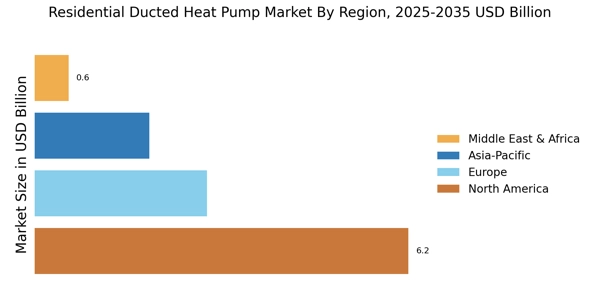
North America is witnessing significant growth in the residential ducted heat pump market, driven by increasing energy efficiency regulations and a shift towards sustainable heating solutions. The U.S. holds the largest market share at approximately 65%, followed by Canada at around 20%. The demand is further fueled by government incentives promoting energy-efficient technologies and rising consumer awareness regarding climate change. The competitive landscape is dominated by key players such as Carrier, Trane, and Lennox, which are investing heavily in R&D to enhance product efficiency and performance. The presence of established brands like Daikin and Mitsubishi Electric also contributes to a robust market environment. As the region continues to prioritize energy efficiency, the adoption of ducted heat pumps is expected to rise, solidifying North America's position as a market leader.

Europe : Sustainable Heating Solutions

Europe is emerging as a significant player in the residential ducted heat pump market, driven by stringent environmental regulations and a strong push for renewable energy sources. The largest markets are Germany and France, holding approximately 30% and 25% of the market share, respectively. The European Union's Green Deal and various national policies are catalyzing the transition to low-carbon heating solutions, enhancing market demand. Leading countries in this region are Germany, France, and the UK, with a competitive landscape featuring major players like Bosch and Fujitsu. The market is characterized by innovation and a focus on energy efficiency, with companies investing in advanced technologies to meet regulatory standards. The presence of strong government support and incentives further boosts the adoption of ducted heat pumps across Europe.

Asia-Pacific : Emerging Market Potential

Asia-Pacific is rapidly becoming a key market for residential ducted heat pumps, driven by urbanization, rising disposable incomes, and increasing awareness of energy efficiency. Countries like China and Japan are leading the market, with China holding approximately 40% of the share, followed by Japan at around 25%. Government initiatives promoting energy-efficient appliances are further propelling market growth in the region. The competitive landscape features major players such as Daikin and Mitsubishi Electric, which are expanding their presence through strategic partnerships and local manufacturing. The region's focus on sustainable development and energy conservation is encouraging the adoption of ducted heat pumps, making it a promising market for future investments and innovations.

Middle East and Africa : Untapped Market Opportunities

The Middle East and Africa region presents untapped opportunities in the residential ducted heat pump market, driven by rapid urbanization and increasing energy demands. Countries like South Africa and the UAE are leading the market, with South Africa holding approximately 30% of the share. The region's growing population and rising living standards are contributing to an increased demand for efficient heating solutions, supported by government initiatives promoting energy efficiency. The competitive landscape is still developing, with key players like Bosch and Carrier beginning to establish a foothold. As awareness of energy-efficient technologies grows, the market is expected to expand significantly. The region's unique climatic conditions also present opportunities for tailored solutions, making it an attractive market for future investments in ducted heat pumps.

Residential Ducted Heat Pump Market Regional Image

Key Players and Competitive Insights

Major players in the Residential Ducted Heat Pump Market industry are continuously striving to enhance their product portfolio and geographical presence. Strategic partnerships, collaborations, and mergers & acquisitions are key strategies adopted by leading Residential Ducted Heat Pump Market players to gain a competitive edge. Additionally, companies are focusing on developing innovative technologies and solutions to meet the evolving needs of customers. The Residential Ducted Heat Pump Market Competitive Landscape is characterized by the presence of both global and regional players.

Key players are investing heavily in research and development to stay ahead of the competition and offer advanced products to customers.Daikin Industries, Ltd. is a leading player in the Residential Ducted Heat Pump Market, offering a comprehensive range of high-efficiency and innovative products. The company has a strong global presence and a reputation for delivering quality products and services. Daikin is focused on developing sustainable and environmentally friendly solutions that meet the growing demand for energy-efficient heating and cooling systems.Mitsubishi Electric Corporation is another prominent player in the Residential Ducted Heat Pump Market.

The company offers a wide range of products that are designed to provide efficient heating and cooling solutions for homes of all sizes. Mitsubishi Electric is known for its advanced technology and commitment to customer satisfaction. The company has a strong distribution network and provides excellent technical support to its customers.

Key Companies in the Residential Ducted Heat Pump Market market include

Industry Developments

The Global Residential Ducted Heat Pump Market is projected to reach USD 17.13 billion by 2034, exhibiting a CAGR of 5.94% during the forecast period. The market growth is attributed to the increasing demand for energy-efficient heating and cooling solutions, government regulations promoting sustainable practices, and rising concerns about environmental impact. Recent news developments include the launch of new products with advanced features, such as variable-speed compressors and smart controls, by leading players like Carrier and Lennox.

Furthermore, the growing adoption of smart home technologies and the integration of heat pumps with renewable energy sources are expected to drive market expansion.

Future Outlook

Residential Ducted Heat Pump Market Future Outlook

The Residential Ducted Heat Pump Market is projected to grow at a 5.94% CAGR from 2024 to 2035, driven by energy efficiency demands, technological advancements, and increasing consumer awareness.

New opportunities lie in:

  • Expansion into smart home integration solutions
  • Development of energy-efficient models targeting urban markets
  • Partnerships with renewable energy providers for bundled offerings

By 2035, the market is expected to achieve robust growth, positioning itself as a leader in sustainable heating solutions.

Market Segmentation

Residential Ducted Heat Pump Market Capacity Outlook

  • Less than 5 Tons
  • 5 to 10 Tons
  • 10 to 15 Tons
  • 15 to 20 Tons
  • 20 Tons or more

Residential Ducted Heat Pump Market Efficiency Outlook

  • Low Efficiency (SEER less than 15)
  • Moderate Efficiency (SEER 15-18)
  • High Efficiency (SEER 18-21)
  • Ultra-High Efficiency (SEER 21 or greater)

Residential Ducted Heat Pump Market Heat Source Outlook

  • Air Source
  • Water Source
  • Geothermal Source

Residential Ducted Heat Pump Market Control Type Outlook

  • Remote Control
  • Zoned Control
  • Smart Control

Residential Ducted Heat Pump Market Distribution System Outlook

  • Ductwork
  • Plenum
  • Ceiling-Mounted

Report Scope

MARKET SIZE 20249.62(USD Billion)
MARKET SIZE 202510.19(USD Billion)
MARKET SIZE 203518.15(USD Billion)
COMPOUND ANNUAL GROWTH RATE (CAGR)5.94% (2024 - 2035)
REPORT COVERAGERevenue Forecast, Competitive Landscape, Growth Factors, and Trends
BASE YEAR2024
Market Forecast Period2025 - 2035
Historical Data2019 - 2024
Market Forecast UnitsUSD Billion
Key Companies ProfiledMarket analysis in progress
Segments CoveredMarket segmentation analysis in progress
Key Market OpportunitiesGrowing demand for energy-efficient heating solutions drives innovation in the Residential Ducted Heat Pump Market.
Key Market DynamicsRising consumer demand for energy-efficient solutions drives innovation and competition in the Residential Ducted Heat Pump Market.
Countries CoveredNorth America, Europe, APAC, South America, MEA

Leave a Comment

FAQs

What is the projected market valuation for the Residential Ducted Heat Pump Market in 2035?

The projected market valuation for the Residential Ducted Heat Pump Market in 2035 is 18.15 USD Billion.

What was the market valuation for the Residential Ducted Heat Pump Market in 2024?

The market valuation for the Residential Ducted Heat Pump Market in 2024 was 9.62 USD Billion.

What is the expected CAGR for the Residential Ducted Heat Pump Market from 2025 to 2035?

The expected CAGR for the Residential Ducted Heat Pump Market during the forecast period 2025 - 2035 is 5.94%.

Which companies are considered key players in the Residential Ducted Heat Pump Market?

Key players in the Residential Ducted Heat Pump Market include Daikin, Mitsubishi Electric, Carrier, Trane, Lennox, Fujitsu, Bosch, Rheem, Panasonic, and Hitachi.

What are the projected values for Air Source heat pumps by 2035?

The projected values for Air Source heat pumps are expected to reach 9.0 USD Billion by 2035.

How does the market for Zoned Control systems compare to Remote Control systems in 2035?

By 2035, the market for Zoned Control systems is projected to be 7.02 USD Billion, compared to 5.34 USD Billion for Remote Control systems.

What is the expected market size for High Efficiency heat pumps by 2035?

The expected market size for High Efficiency heat pumps is projected to be 5.18 USD Billion by 2035.

What are the projected values for the distribution system segment in 2035?

The projected values for the distribution system segment in 2035 include 7.02 USD Billion for Ductwork and 5.25 USD Billion for Plenum.

What is the anticipated growth for the Water Source heat pump segment by 2035?

The anticipated growth for the Water Source heat pump segment is expected to reach 4.0 USD Billion by 2035.

How does the market for Ultra-High Efficiency heat pumps compare to Low Efficiency heat pumps in 2035?

In 2035, the market for Ultra-High Efficiency heat pumps is projected to be 4.34 USD Billion, while Low Efficiency heat pumps are expected to reach 3.45 USD Billion.

Download Free Sample

Kindly complete the form below to receive a free sample of this Report

Compare Licence

×
Features License Type
Single User Multiuser License Enterprise User
Price $4,950 $5,950 $7,250
Maximum User Access Limit 1 User Upto 10 Users Unrestricted Access Throughout the Organization
Free Customization
Direct Access to Analyst
Deliverable Format
Platform Access
Discount on Next Purchase 10% 15% 15%
Printable Versions