Ride Sharing Market

ID: MRFR/AT/5975-HCR
135 Pages
Shubham Munde
Last Updated: June 16, 2026
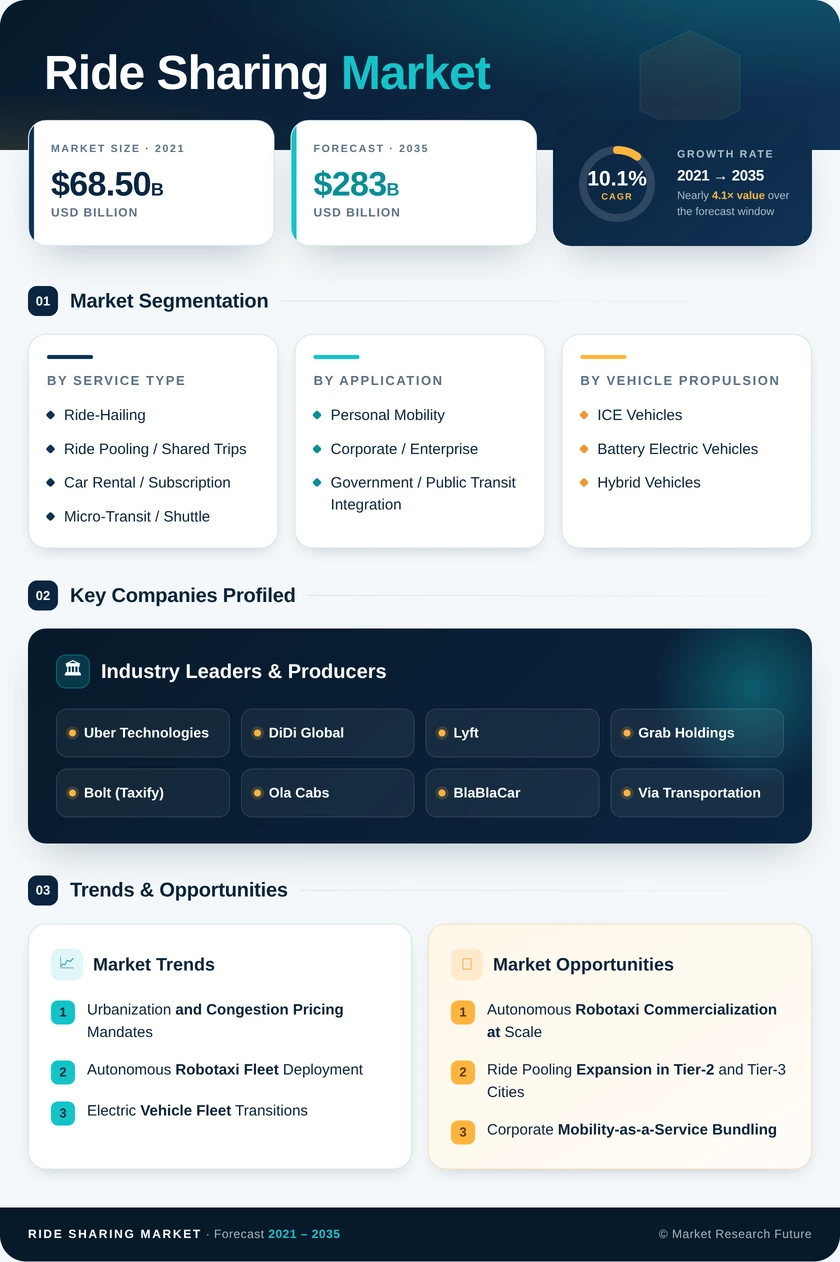
Ride Sharing Market Size, Share & Growth Analysis Report By Service Type (Ride-Hailing, Ride Pooling / Shared Trips, Car Rental / Subscription, Micro-Transit / Shuttle), By Application (Personal Mobility, Corporate / Enterprise, Government / Public Transit Integration), By Vehicle Propulsion (ICE Vehicles, Battery Electric Vehicles, Hybrid Vehicles) and By Regional (North America, Europe, South America, Asia Pacific, Middle East and Africa) - Growth & Industry Forecast to 2035
Download PDF ×

We do not share your information with anyone. However, we may send you emails based on your report interest from time to time. You may contact us at any time to opt-out.

  1. 1 Market Overview |
    1. 1.1 Study Assumptions & Market Definition |
    2. 1.2 Scope of the Study |
    3. 1.3 Research Methodology
  2. 2 Market Summary & Key Takeaways
  3. 3 Market Dynamics |
    1. 3.1 Market Drivers Analysis | |
      1. 3.1.1 Urbanization & Congestion Pricing Mandates | |
      2. 3.1.2 Autonomous Robotaxi Fleet Deployment | |
      3. 3.1.3 Electric Vehicle Fleet Transitions | |
      4. 3.1.4 Corporate Commute Program Expansion | |
      5. 3.1.5 Super-App Integration & Platform Economics | |
      6. 3.1.6 Ride Pooling Algorithm Optimization | |
      7. 3.1.7 Regulatory Standardization Momentum |
    2. 3.2 Market Restraints Analysis | |
      1. 3.2.1 Driver Classification & Labor Regulation | |
      2. 3.2.2 Regulatory Fragmentation Across Jurisdictions | |
      3. 3.2.3 Data Privacy Constraints | |
      4. 3.2.4 Infrastructure Gaps in Emerging Markets | |
      5. 3.2.5 Autonomous Vehicle Liability Ambiguity |
    3. 3.3 Market Opportunity Analysis | |
      1. 3.3.1 Autonomous Robotaxi Commercialization at Scale | |
      2. 3.3.2 Ride Pooling Expansion in Tier-2 and Tier-3 Cities | |
      3. 3.3.3 Corporate Mobility-as-a-Service Bundling | |
      4. 3.3.4 Data Monetization & Urban Planning Partnerships | |
      5. 3.3.5 Emerging Market Leapfrogging in Africa & Southeast Asia |
    4. 3.4 Industry Value Chain Analysis |
    5. 3.5 Porter's Five Forces Analysis
  4. 4 Global Ride Sharing Market Size & Forecast (2021–2035) |
    1. 4.1 Historical Market Size (2021–2025) |
    2. 4.2 Current & Forecast Market Size (2026–2035) |
    3. 4.3 Market Size by Revenue (USD Billion) |
    4. 4.4 Year-over-Year Growth Analysis
  5. 5 Segmentation Analysis |
    1. 5.1 By Service Type | |
      1. 5.1.1 Ride-Hailing | |
      2. 5.1.2 Ride Pooling / Shared Trips | |
      3. 5.1.3 Car Rental / Subscription | |
      4. 5.1.4 Micro-Transit / Shuttle |
    2. 5.2 By Application | |
      1. 5.2.1 Personal Mobility | |
      2. 5.2.2 Corporate / Enterprise | |
      3. 5.2.3 Government / Public Transit Integration |
    3. 5.3 By Vehicle Propulsion | |
      1. 5.3.1 ICE Vehicles | |
      2. 5.3.2 Battery Electric Vehicles | |
      3. 5.3.3 Hybrid Vehicles
  6. 6 Regional Analysis |
    1. 6.1 North America | |
      1. 6.1.1 United States | |
      2. 6.1.2 Canada | |
      3. 6.1.3 Mexico |
    2. 6.2 Europe | |
      1. 6.2.1 United Kingdom | |
      2. 6.2.2 Germany | |
      3. 6.2.3 France | |
      4. 6.2.4 Rest of Europe |
    3. 6.3 Asia-Pacific | |
      1. 6.3.1 China | |
      2. 6.3.2 India | |
      3. 6.3.3 Southeast Asia (Grab/Gojek Markets) | |
      4. 6.3.4 Japan | |
      5. 6.3.5 Rest of Asia-Pacific |
    4. 6.4 South America | |
      1. 6.4.1 Brazil | |
      2. 6.4.2 Argentina | |
      3. 6.4.3 Rest of South America |
    5. 6.5 Middle East & Africa | |
      1. 6.5.1 UAE | |
      2. 6.5.2 Saudi Arabia | |
      3. 6.5.3 Nigeria | |
      4. 6.5.4 Rest of Middle East & Africa
  7. 7 Competitive Landscape |
    1. 7.1 Market Share Analysis (2025) |
    2. 7.2 Competitive Benchmarking Matrix |
    3. 7.3 Company Profiles | |
      1. 7.3.1 Uber Technologies | |
      2. 7.3.2 DiDi Global | |
      3. 7.3.3 Lyft | |
      4. 7.3.4 Grab Holdings | |
      5. 7.3.5 Bolt (Taxify) | |
      6. 7.3.6 Ola Cabs | |
      7. 7.3.7 BlaBlaCar | |
      8. 7.3.8 Via Transportation | |
      9. 7.3.9 Waymo (Alphabet) | |
      10. 7.3.10 Careem (Uber)
  8. 8 Future Outlook & Strategic Recommendations (2026–2035) |
    1. 8.1 Autonomous Operations & AI-Driven Fleet Management |
    2. 8.2 Platform Economics & Consolidation |
    3. 8.3 Electrification & Grid Integration |
    4. 8.4 ESG Reporting & Sustainability Mandates
  9. 9 Recent Developments & News
  10. 10 Frequently Asked Questions (FAQs)
  11. 11 Report Scope & Methodology |
    1. 11.1 Study Period & Base Year |
    2. 11.2 Data Sources & Citations |
    3. 11.3 Abbreviations
  12. 12 LIST OF TABLES |
  13. TABLE 1 Global Ride Sharing Market Size & Forecast, by Revenue (USD Billion), 2021–2035 |
  14. TABLE 2 Global Ride Sharing Market — Year-over-Year Growth Analysis, 2021–2035 |
  15. TABLE 3 Global Ride Sharing Market — Driver Impact Analysis |
  16. TABLE 4 Global Ride Sharing Market — Restraint Impact Analysis |
  17. TABLE 5 Global Ride Sharing Market Size, by Service Type, 2021–2035 (USD Billion) |
  18. TABLE 6 Global Ride Sharing Market Size, by Application, 2021–2035 (USD Billion) |
  19. TABLE 7 Global Ride Sharing Market Size, by Vehicle Propulsion, 2021–2035 (USD Billion) |
  20. TABLE 8 Global Ride Sharing Market Size, by Region, 2021–2035 (USD Billion) |
  21. TABLE 9 North America Ride Sharing Market Size, by Country, 2021–2035 (USD Billion) |
  22. TABLE 10 Europe Ride Sharing Market Size, by Country, 2021–2035 (USD Billion) |
  23. TABLE 11 Asia-Pacific Ride Sharing Market Size, by Country, 2021–2035 (USD Billion) |
  24. TABLE 12 South America Ride Sharing Market Size, by Country, 2021–2035 (USD Billion) |
  25. TABLE 13 Middle East & Africa Ride Sharing Market Size, by Country, 2021–2035 (USD Billion) |
  26. TABLE 14 North America Ride Sharing Market Size, by Service Type, 2021–2035 (USD Billion) |
  27. TABLE 15 North America Ride Sharing Market Size, by Application, 2021–2035 (USD Billion) |
  28. TABLE 16 North America Ride Sharing Market Size, by Vehicle Propulsion, 2021–2035 (USD Billion) |
  29. TABLE 17 Europe Ride Sharing Market Size, by Service Type, 2021–2035 (USD Billion) |
  30. TABLE 18 Europe Ride Sharing Market Size, by Application, 2021–2035 (USD Billion) |
  31. TABLE 19 Europe Ride Sharing Market Size, by Vehicle Propulsion, 2021–2035 (USD Billion) |
  32. TABLE 20 Asia-Pacific Ride Sharing Market Size, by Service Type, 2021–2035 (USD Billion) |
  33. TABLE 21 Asia-Pacific Ride Sharing Market Size, by Application, 2021–2035 (USD Billion) |
  34. TABLE 22 Asia-Pacific Ride Sharing Market Size, by Vehicle Propulsion, 2021–2035 (USD Billion) |
  35. TABLE 23 South America Ride Sharing Market Size, by Service Type, 2021–2035 (USD Billion) |
  36. TABLE 24 South America Ride Sharing Market Size, by Application, 2021–2035 (USD Billion) |
  37. TABLE 25 South America Ride Sharing Market Size, by Vehicle Propulsion, 2021–2035 (USD Billion) |
  38. TABLE 26 Middle East & Africa Ride Sharing Market Size, by Service Type, 2021–2035 (USD Billion) |
  39. TABLE 27 Middle East & Africa Ride Sharing Market Size, by Application, 2021–2035 (USD Billion) |
  40. TABLE 28 Middle East & Africa Ride Sharing Market Size, by Vehicle Propulsion, 2021–2035 (USD Billion) |
  41. TABLE 29 Competitive Benchmarking Matrix — Global Ride Sharing Market, 2025 |
  42. TABLE 30 Company Profiles — Key Players, Global Ride Sharing Market |
  43. TABLE 31 Recent Developments & Strategic Announcements, 2023–2025 |
  44. TABLE 32 Report Scope & Methodology Summary |
  45. TABLE 33 Detailed Sources & Citations
  46. 13 LIST OF FIGURES |
  47. FIGURE 1 Global Ride Sharing Market Dynamics — Drivers, Restraints, Opportunities |
  48. FIGURE 2 Ride Sharing Market Value Chain Analysis |
  49. FIGURE 3 Porter's Five Forces Analysis — Global Ride Sharing Market |
  50. FIGURE 4 Global Ride Sharing Market Size Trend (USD Billion), 2021–2035 |
  51. FIGURE 5 Global Ride Sharing Market Share, by Service Type (%), 2025 |
  52. FIGURE 6 Global Ride Sharing Market Share, by Application (%), 2025 |
  53. FIGURE 7 Global Ride Sharing Market Share, by Vehicle Propulsion (%), 2025 |
  54. FIGURE 8 Global Ride Sharing Market Share, by Region (%), 2025 |
  55. FIGURE 9 North America Ride Sharing Market Size Trend, 2021–2035 |
  56. FIGURE 10 Europe Ride Sharing Market Size Trend, 2021–2035 |
  57. FIGURE 11 Asia-Pacific Ride Sharing Market Size Trend, 2021–2035 |
  58. FIGURE 12 South America Ride Sharing Market Size Trend, 2021–2035 |
  59. FIGURE 13 Middle East & Africa Ride Sharing Market Size Trend, 2021–2035 |
  60. FIGURE 14 Competitive Landscape — Market Share Distribution, 2025 |
  61. FIGURE 15 Competitive Positioning Matrix — Key Players, Global Ride Sharing Market

Segmentation Quick Reference

DimensionSub-SegmentsDominant SegmentFastest Growing Segment
By Service TypeRide-Hailing; Ride Pooling / Shared Trips; Car Rental / Subscription; Micro-Transit / ShuttleRide-Hailing (62% share)Ride Pooling / Shared Trips (CAGR 13.4%)
By ApplicationPersonal Mobility; Corporate / Enterprise; Government / Public Transit IntegrationPersonal Mobility (74% share)Corporate / Enterprise (CAGR 14.1%)
By Vehicle PropulsionICE Vehicles; Battery Electric Vehicles; Hybrid VehiclesICE Vehicles (61% share)Battery Electric Vehicles (CAGR 18.2%)


Market Segmentation Overview

By Service Type

Sub-SegmentKey Trend
Ride-HailingContinued dominance driven by ride-hailing platform Uber Lyft network effects, and global brand recognition
Ride Pooling / Shared TripsAI-powered ride pooling shared trip matching optimization driving 85%+ match rates in dense corridors
Car Rental / SubscriptionFlexible ownership models are attracting younger urban demographics, avoiding vehicle purchase
Micro-Transit / ShuttleCorporate ride sharing employee commute programs and municipal first/last-mile contracts are expanding rapidly


The ride-hailing segment generates the highest absolute revenue within the Ride Sharing Market, benefiting from established driver networks and consumer habit formation. Ride pooling services are gaining momentum as algorithmic improvements reduce detour times and pricing advantages widen relative to solo trips.

By Application

Sub-SegmentKey Trend
Personal MobilityDaily commute, airport transfers, and leisure travel driving sustained volume growth
Corporate / EnterpriseEmployer-subsidized corporate ride sharing employee commute programs replacing parking stipends
Government / Public Transit IntegrationPublic-private micro-transit partnerships are filling service gaps in suburban and rural zones


Personal mobility remains the Ride Sharing Market's core demand driver, though corporate and government segments are growing faster as organizations formalize shared mobility into employee benefit and transit planning frameworks.

By Vehicle Propulsion

Sub-SegmentKey Trend
ICE VehiclesDeclining share as electric vehicle ride sharing fleet mandates take effect in key markets
Battery Electric VehiclesFastest-growing propulsion type, supported by 35–45% lower per-mile operating costs
Hybrid VehiclesServing as a transition bridge in markets where charging infrastructure remains limited


The shift toward electric vehicle ride sharing fleet deployment is the single most transformative operational trend in the Ride Sharing Market. Regulatory mandates in California, the EU, and China are accelerating fleet turnover timelines beyond what market economics alone would dictate.