Ride Sharing Market

Key Players: Uber Technologies, DiDi Global, Lyft, Grab Holdings, Bolt (Taxify), Ola Cabs, BlaBlaCar, Via Transportation

Ride Sharing Market

Marktgröße, Marktanteil und Wachstumsanalysebericht für Mitfahrgelegenheiten nach Servicetyp (Ride-Hailing, Ride-Pooling/gemeinsame Fahrten, Autovermietung/Abonnement, Mikro-Transit/Shuttle), nach Anwendung (persönliche Mobilität, Unternehmen/Unternehmen, Integration von Regierung/Öffentlichem Nahverkehr), nach Fahrzeugantrieb (Fahrzeuge mit Verbrennungsmotor, batteriebetriebene Elektrofahrzeuge, Hybridfahrzeuge) und nach Region (Nordamerika, Europa, Südamerika, Asien-Pazifik, Naher Osten und Afrika) – Wachstums- und Branchenprognose bis 2035
ID: MRFR/AT/5975-HCR
135 Pages
Shubham Munde, Swapnil Palwe
Last Updated: June 16, 2026

Ride Sharing Market Zusammenfassung

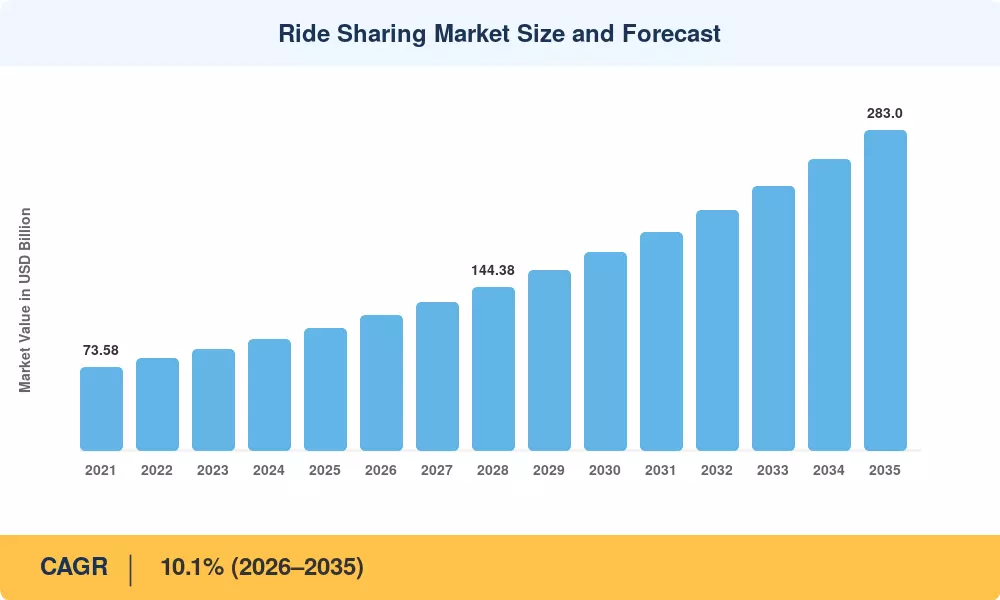
Laut MRFR-Analyse wurde die Größe des Ride-Sharing-Marktes im Jahr 2024 auf 96,04 Milliarden US-Dollar geschätzt. Die Ride-Sharing-Branche wird voraussichtlich von 114,48 Milliarden US-Dollar im Jahr 2025 auf 663,06 Milliarden US-Dollar im Jahr 2035 wachsen und im Prognosezeitraum 2025–2035 eine durchschnittliche jährliche Wachstumsrate (CAGR) von 19,2 % aufweisen.

Wichtige Markttrends & Highlights

Der Ride-Sharing-Markt erlebt einen transformativen Wandel hin zu Nachhaltigkeit und technologischer Integration.

  • Nachhaltigkeitsinitiativen rücken zunehmend in den Mittelpunkt der operativen Strategien von Mitfahrunternehmen in Nordamerika.
  • Die technologische Integration, insbesondere bei mobilen Anwendungen und Zahlungssystemen, verbessert das Benutzererlebnis und die betriebliche Effizienz im gesamten asiatisch-pazifischen Raum.
  • Das Ride-Hailing-Segment bleibt das größte Segment, während sich Fahrgemeinschaften als das am schnellsten wachsende Segment herausstellen, was die veränderten Verbraucherpräferenzen widerspiegelt.
  • Urbanisierungstendenzen und Umweltbedenken treiben die Nachfrage nach Elektrofahrzeugen voran, die auf dem Markt zunehmend an Bedeutung gewinnen.

Marktgröße & Prognose

Marktgröße 2024 96.04 (USD Billion)
Marktgröße 2035 663.06 (USD Billion)
CAGR (2025 - 2035) 19.2%
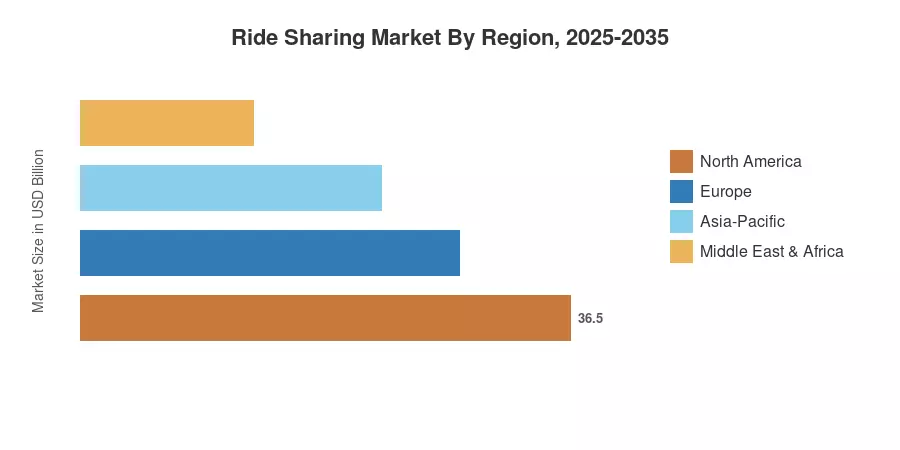
Größter regionaler Marktanteil im Jahr 2024 Nordamerika

Hauptakteure

Uber (USA),Lyft (USA), Didi Chuxing (CN), Ola (IN), Grab (SG), Bolt (EE), Gett (IL), Careem (AE), Yandex.Taxi (RU)

Our Impact
Enabled $4.3B Revenue Impact for Fortune 500 and Leading Multinationals
Partnering with 2000+ Global Organizations Each Year
30K+ Citations by Top-Tier Firms in the Industry

Zu den wichtigsten Unternehmen im Ride Sharing Market-Markt gehören

Berichtsumfang

MARKET SIZE 2024 96.04(USD Billion)
MARKET SIZE 2025 114.48(USD Billion)
MARKET SIZE 2035 663.06(USD Billion)
COMPOUND ANNUAL GROWTH RATE (CAGR) 19.2% (2025 - 2035)
REPORT COVERAGE Revenue Forecast, Competitive Landscape, Growth Factors, and Trends
BASE YEAR 2024
Market Forecast Period 2025 - 2035
Historical Data 2019 - 2024
Market Forecast Units USD Billion
Key Companies Profiled Uber (US), Lyft (US), Didi Chuxing (CN), Ola (IN), Grab (SG), Bolt (EE), Gett (IL), Careem (AE), Yandex.Taxi (RU)
Segments Covered Service Type, Vehicle Type, User Demographics, Payment Model, Technology Integration
Key Market Opportunities Integration of electric vehicles and autonomous technology enhances sustainability in the Ride Sharing Market.
Key Market Dynamics Technological advancements and regulatory changes are reshaping competitive dynamics in the ride sharing market.
Countries Covered North America, Europe, APAC, South America, MEA

FAQs

What is the current valuation of the Ride Sharing Market in 2025?

The Ride Sharing Market is valued at approximately 96.04 USD Billion in 2024.

What is the projected market size for the Ride Sharing Market by 2035?

The market is projected to reach around 663.06 USD Billion by 2035.

What is the expected CAGR for the Ride Sharing Market from 2025 to 2035?

The expected CAGR for the Ride Sharing Market during the forecast period 2025 - 2035 is 19.2%.

Which service type generates the highest revenue in the Ride Sharing Market?

Ride Hailing generates the highest revenue, with a valuation of 267.0 USD Billion.

How does the revenue from carpooling compare to ridesharing in 2025?

Carpooling generates 135.0 USD Billion, while ridesharing generates 105.0 USD Billion.

What vehicle type is projected to have the highest revenue in the Ride Sharing Market?

Sedans are projected to generate the highest revenue, estimated at 210.0 USD Billion.

Which user demographic is expected to contribute the most to the Ride Sharing Market?

Families are expected to contribute the most, with a projected revenue of 180.0 USD Billion.

What payment model is anticipated to dominate the Ride Sharing Market?

The Pay Per Ride model is anticipated to dominate, generating 274.0 USD Billion.

What technology integration is crucial for the Ride Sharing Market's growth?

Mobile Applications are crucial, with a projected revenue of 210.0 USD Billion.

Who are the key players in the Ride Sharing Market?

Key players include Uber Technologies Inc, Lyft Inc, Didi Global Inc, and others.

Autor
Author
Author Profile
Shubham Munde LinkedIn
Team Lead - Research
Shubham brings over 7 years of expertise in Market Intelligence and Strategic Consulting, with a strong focus on the Automotive, Aerospace, and Defense sectors. Backed by a solid foundation in semiconductors, electronics, and software, he has successfully delivered high-impact syndicated and custom research on a global scale. His core strengths include market sizing, forecasting, competitive intelligence, consumer insights, and supply chain mapping. Widely recognized for developing scalable growth strategies, Shubham empowers clients to navigate complex markets and achieve a lasting competitive edge. Trusted by start-ups and Fortune 500 companies alike, he consistently converts challenges into strategic opportunities that drive sustainable growth.
Co-Author
Co-Author Profile
Swapnil Palwe LinkedIn
Team Lead - Research
With a technical background as Bachelor's in Mechanical Engineering, with MBA in Operations Management , Swapnil has 6+ years of experience in market research, consulting and analytics with the tasks of data mining, analysis, and project execution. He is the POC for our clients, for their consulting projects running under the Automotive/A&D domain. Swapnil has worked on major projects in verticals such as Aerospace & Defense, Automotive and many other domain projects. He has worked on projects for fortune 500 companies' syndicate and consulting projects along with several government projects.
Einen Kommentar hinterlassen

Research Approach


Secondary Research

The secondary research process involved comprehensive analysis of regulatory databases, transportation authority publications, peer-reviewed journals, and authoritative mobility organizations. Key sources included the US Department of Transportation (DOT), Federal Transit Administration (FTA), European Commission Directorate-General for Mobility and Transport (DG MOVE), International Transport Forum (ITF/OECD), International Association of Public Transport (UITP), National Highway Traffic Safety Administration (NHTSA), Bureau of Transportation Statistics (BTS), US Census Bureau American Community Survey, Eurostat Transport Database, World Bank Open Data - Transport Sector, International Energy Agency (IEA) Global EV Outlook, Society of Automotive Engineers (SAE International), American Public Transportation Association (APTA), European Automobile Manufacturers' Association (ACEA), China Ministry of Transport Statistical Data, India Ministry of Road Transport and Highways, and national transport ministry reports from key markets. These sources were used to collect mobility statistics, regulatory compliance data, vehicle fleet data, urbanization trends, carbon emission studies, and market landscape analysis for peer-to-peer platforms, business-to-consumer services, business-to-business fleet solutions, electric vehicle integration, and autonomous mobility technologies.


Primary Research

To gather both qualitative and quantitative information, the primary research process involved interviewing players from both the supply and demand sides. CEOs, CTOs, VPs of mobility services, heads of regulatory compliance, directors of fleet operations, and strategy directors from ride-sharing platforms, MaaS providers, and vehicle original equipment manufacturers (OEMs) made up the supply side. End-users from enterprise accounts, government agencies, and educational institutions made up the demand-side sources, along with urban transportation planners, municipal mobility officers, corporate fleet managers, and travel procurement leaders. Market segmentation across P2P, B2C, and B2B service models was established through primary research. Likewise, deployment timescales for autonomous vehicles were confirmed, and insights on platform adoption trends, dynamic pricing algorithms, driver incentive structures, and regulatory compliance frameworks were acquired.

Primary Respondent Breakdown:

By Designation: C-level Primaries (32%), Director Level (31%), Others (37%)

By Region: North America (32%), Europe (30%), Asia-Pacific (28%), Rest of World (10%)


Market Size Estimation

Global market valuation was derived through revenue mapping and trip volume analysis. The methodology included:

Identification of 50+ key platform providers across North America, Europe, Asia-Pacific, Latin America, and Middle East & Africa

Service mapping across peer-to-peer (P2P), business-to-consumer (B2C), and business-to-business (B2B) models

Vehicle type segmentation across sedans, SUVs, minivans, luxury vehicles, and electric vehicles

Analysis of reported and modeled annual revenues specific to ride-sharing and mobility service portfolios

Coverage of platform providers representing 75-80% of global market share in 2024

Extrapolation using bottom-up (trip volume × average fare by country/region) and top-down (platform revenue validation) approaches to derive segment-specific valuations across service models, vehicle types, ride types (pooling, private, luxury), and payment structures (pay-as-you-go, subscription-based, on-demand)

Kostenloses Muster herunterladen

Bitte füllen Sie das folgende Formular aus, um ein kostenloses Muster dieses Berichts zu erhalten

Download PDF ×

We do not share your information with anyone. However, we may send you emails based on your report interest from time to time. You may contact us at any time to opt-out.