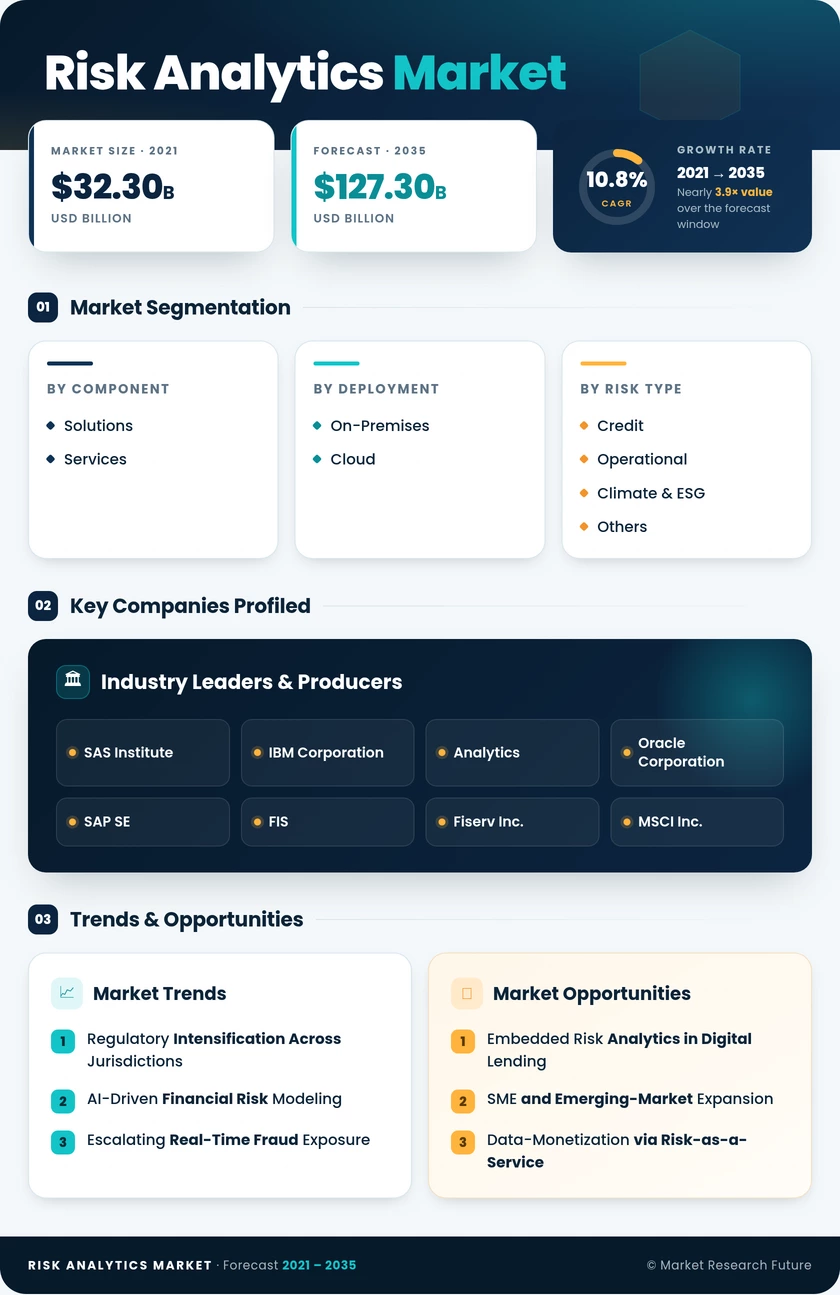
Risk Analytics Market

ID: MRFR/ICT/2285-HCR
100 Pages
Ankit Gupta
Last Updated: June 17, 2026
Risk Analytics Market Size, Share and Research Report By Component (Solutions, Services), By Deployment (On-Premises, Cloud), By Risk Type (Credit Risk, Operational Risk, Climate & ESG Risk, Other Risk Types (Market Risk, Liquidity Risk, Model Risk)), By Application (Fraud Detection & AML, Stress Testing & Scenario Analysis, Cyber-Risk Analytics, Other Applications (Insurance Underwriting, Supply-Chain Risk)), By End-User Industry (BFSI, Healthcare & Life Sciences, Retail & E-Commerce, Other Industries (Energy, Telecom, Government)), By Organization Size (Large Enterprises, Small and Medium Enterprises (SMEs)) and By Regional (North America, Europe, South America, Asia Pacific, Middle East and Africa) - Industry Forecast to 2035.
Download PDF ×

We do not share your information with anyone. However, we may send you emails based on your report interest from time to time. You may contact us at any time to opt-out.

  1. 1 Market Overview |
    1. 1.1 Study Assumptions & Market Definition |
    2. 1.2 Scope of the Study |
    3. 1.3 Research Methodology
  2. 2 Market Summary & Key Takeaways
  3. 3 Market Dynamics |
    1. 3.1 Market Drivers Analysis | |
      1. 3.1.1 Regulatory Intensification Across Jurisdictions | |
      2. 3.1.2 AI-Driven Financial Risk Modeling Adoption | |
      3. 3.1.3 Escalating Real-Time Fraud Exposure | |
      4. 3.1.4 Climate and ESG Risk Quantification Mandates | |
      5. 3.1.5 Cloud-Native Platform Migration | |
      6. 3.1.6 Cyber-Risk Escalation and Compliance Mandates | |
      7. 3.1.7 SME Digital-Risk Democratization |
    2. 3.2 Market Restraints Analysis | |
      1. 3.2.1 Data Privacy and Cross-Border Transfer Restrictions | |
      2. 3.2.2 Talent Shortage in Quantitative Risk Analytics | |
      3. 3.2.3 Model-Governance and Explainability Barriers | |
      4. 3.2.4 Legacy System Integration Complexity | |
      5. 3.2.5 High Total Cost of Ownership for On-Premises Deployments |
    3. 3.3 Market Opportunity Analysis | |
      1. 3.3.1 Embedded Risk Analytics in Digital Lending | |
      2. 3.3.2 SME and Emerging-Market Expansion | |
      3. 3.3.3 Data-Monetization via Risk-as-a-Service | |
      4. 3.3.4 Quantum-Computing Readiness | |
      5. 3.3.5 Unified Cyber-Physical Risk Platforms |
    4. 3.4 Industry Value Chain Analysis |
    5. 3.5 Porter's Five Forces Analysis
  4. 4 Global Risk Analytics Market Size & Forecast (2021–2035) |
    1. 4.1 Historical Market Size (2021–2025) |
    2. 4.2 Current & Forecast Market Size (2026–2035) |
    3. 4.3 Market Size by Revenue (USD Billion) |
    4. 4.4 Year-over-Year Growth Analysis
  5. 5 Segmentation Analysis |
    1. 5.1 By Component | |
      1. 5.1.1 Solutions | |
      2. 5.1.2 Services |
    2. 5.2 By Deployment | |
      1. 5.2.1 On-Premises | |
      2. 5.2.2 Cloud |
    3. 5.3 By Risk Type | |
      1. 5.3.1 Credit Risk | |
      2. 5.3.2 Operational Risk | |
      3. 5.3.3 Climate & ESG Risk | |
      4. 5.3.4 Other Risk Types (Market Risk, Liquidity Risk, Model Risk) |
    4. 5.4 By Application | |
      1. 5.4.1 Fraud Detection & AML | |
      2. 5.4.2 Stress Testing & Scenario Analysis | |
      3. 5.4.3 Cyber-Risk Analytics | |
      4. 5.4.4 Other Applications (Insurance Underwriting, Supply-Chain Risk) |
    5. 5.5 By End-User Industry | |
      1. 5.5.1 BFSI | |
      2. 5.5.2 Healthcare & Life Sciences | |
      3. 5.5.3 Retail & E-Commerce | |
      4. 5.5.4 Other Industries (Energy, Telecom, Government) |
    6. 5.6 By Organization Size | |
      1. 5.6.1 Large Enterprises | |
      2. 5.6.2 Small and Medium Enterprises (SMEs)
  6. 6 Regional Analysis |
    1. 6.1 North America | |
      1. 6.1.1 United States | |
      2. 6.1.2 Canada | |
      3. 6.1.3 Mexico |
    2. 6.2 Europe | |
      1. 6.2.1 Germany | |
      2. 6.2.2 United Kingdom | |
      3. 6.2.3 France | |
      4. 6.2.4 Italy | |
      5. 6.2.5 Spain | |
      6. 6.2.6 Nordic Countries | |
      7. 6.2.7 Russia | |
      8. 6.2.8 Rest of Europe |
    3. 6.3 Asia-Pacific | |
      1. 6.3.1 China | |
      2. 6.3.2 India | |
      3. 6.3.3 Japan | |
      4. 6.3.4 South Korea | |
      5. 6.3.5 ASEAN | |
      6. 6.3.6 Rest of Asia-Pacific |
    4. 6.4 South America | |
      1. 6.4.1 Brazil | |
      2. 6.4.2 Argentina | |
      3. 6.4.3 Rest of South America |
    5. 6.5 Middle East & Africa | |
      1. 6.5.1 Saudi Arabia | |
      2. 6.5.2 UAE | |
      3. 6.5.3 South Africa | |
      4. 6.5.4 Egypt | |
      5. 6.5.5 Rest of MEA
  7. 7 Competitive Landscape |
    1. 7.1 Market Share Analysis (2025) |
    2. 7.2 Competitive Benchmarking Matrix |
    3. 7.3 Company Profiles | |
      1. 7.3.1 SAS Institute | |
      2. 7.3.2 IBM Corporation | |
      3. 7.3.3 Analytics | |
      4. 7.3.4 Oracle Corporation | |
      5. 7.3.5 SAP SE | |
      6. 7.3.6 FIS | |
      7. 7.3.7 Fiserv Inc. | |
      8. 7.3.8 MSCI Inc. | |
      9. 7.3.9 Verisk Analytics | |
      10. 7.3.10 Palantir Technologies
  8. 8 Future Outlook & Strategic Recommendations (2026–2035) |
    1. 8.1 Autonomous Risk Decisioning |
    2. 8.2 Platform Economics and Consolidation |
    3. 8.3 Real-Time Regulatory Reporting |
    4. 8.4 Climate-Scenario and ESG Integration
  9. 9 Recent Developments & News
  10. 10 Frequently Asked Questions (FAQs)
  11. 11 Report Scope & Methodology |
    1. 11.1 Study Period & Base Year |
    2. 11.2 Data Sources & Citations |
    3. 11.3 Abbreviations
  12. 12 LIST OF TABLES |
  13. TABLE 1 Global Risk Analytics Market Size & Forecast, by Revenue (USD Billion), 2021–2035 |
  14. TABLE 2 Global Risk Analytics Market — Year-over-Year Growth Analysis, 2021–2035 |
  15. TABLE 3 Market Driver Impact Analysis, 2026–2035 |
  16. TABLE 4 Market Restraint Impact Analysis, 2026–2035 |
  17. TABLE 5 Global Risk Analytics Market Size, by Component, 2021–2035 (USD Billion) |
  18. TABLE 6 Global Risk Analytics Market Size, by Deployment, 2021–2035 (USD Billion) |
  19. TABLE 7 Global Risk Analytics Market Size, by Risk Type, 2021–2035 (USD Billion) |
  20. TABLE 8 Global Risk Analytics Market Size, by Application, 2021–2035 (USD Billion) |
  21. TABLE 9 Global Risk Analytics Market Size, by End-User Industry, 2021–2035 (USD Billion) |
  22. TABLE 10 Global Risk Analytics Market Size, by Organization Size, 2021–2035 (USD Billion) |
  23. TABLE 11 Global Risk Analytics Market Size, by Region, 2021–2035 (USD Billion) |
  24. TABLE 12 North America Risk Analytics Market Size, by Country, 2021–2035 (USD Billion) |
  25. TABLE 13 Europe Risk Analytics Market Size, by Country, 2021–2035 (USD Billion) |
  26. TABLE 14 Asia-Pacific Risk Analytics Market Size, by Country, 2021–2035 (USD Billion) |
  27. TABLE 15 South America Risk Analytics Market Size, by Country, 2021–2035 (USD Billion) |
  28. TABLE 16 Middle East & Africa Risk Analytics Market Size, by Country, 2021–2035 (USD Billion) |
  29. TABLE 17 Competitive Benchmarking Matrix — Global Risk Analytics Market, 2025 |
  30. TABLE 18 Company Profiles — Key Players, Global Risk Analytics Market |
  31. TABLE 19 Recent Developments & Strategic Announcements, 2023–2025 |
  32. TABLE 20 Report Scope & Methodology Summary |
  33. TABLE 21 Detailed Sources and Citations
  34. 13 LIST OF FIGURES |
  35. FIGURE 1 Risk Analytics Market Dynamics — Drivers, Restraints, and Opportunities |
  36. FIGURE 2 Industry Value Chain Analysis — Risk Analytics Market |
  37. FIGURE 3 Porter's Five Forces Analysis — Risk Analytics Market |
  38. FIGURE 4 Global Risk Analytics Market Size Trend (USD Billion), 2021–2035 |
  39. FIGURE 5 Risk Analytics Market Share, by Component, 2025 |
  40. FIGURE 6 Risk Analytics Market Share, by Deployment, 2025 |
  41. FIGURE 7 Risk Analytics Market Share, by Risk Type, 2025 |
  42. FIGURE 8 Risk Analytics Market Share, by Application, 2025 |
  43. FIGURE 9 Risk Analytics Market Share, by End-User Industry, 2025 |
  44. FIGURE 10 Risk Analytics Market Share, by Organization Size, 2025 |
  45. FIGURE 11 Risk Analytics Market Share, by Region, 2025 |
  46. FIGURE 12 North America Risk Analytics Market Size (USD Billion), 2021–2035 |
  47. FIGURE 13 Europe Risk Analytics Market Size (USD Billion), 2021–2035 |
  48. FIGURE 14 Asia-Pacific Risk Analytics Market Size (USD Billion), 2021–2035 |
  49. FIGURE 15 South America Risk Analytics Market Size (USD Billion), 2021–2035 |
  50. FIGURE 16 Middle East & Africa Risk Analytics Market Size (USD Billion), 2021–2035 |
  51. FIGURE 17 Competitive Landscape — Market Share Distribution, 2025

Segmentation Quick Reference

DimensionSub-SegmentsDominant SegmentFastest Growing Segment
ComponentSolutions, ServicesSolutions (59.5% share, 2025)Services (12.4% CAGR)
DeploymentOn-Premises, CloudOn-Premises (61.5% share, 2025)Cloud (12.9% CAGR)
Risk TypeCredit, Operational, Climate & ESG, OthersCredit Risk (37.1% share, 2025)Climate & ESG Risk (11.9% CAGR)
ApplicationFraud Detection & AML, Stress Testing & Scenario Analysis, Cyber-Risk Analytics, OthersFraud Detection & AML (37.8% share, 2025)Cyber-Risk Analytics (11.6% CAGR)
End-User IndustryBFSI, Healthcare & Life Sciences, Retail & E-Commerce, OthersBFSI (39.0% share, 2025)Retail & E-Commerce (11.2% CAGR)
Organisation SizeLarge Enterprises, SMEsLarge Enterprises (63.9% share, 2025)SMEs (12.9% CAGR)
GeographyNorth America, Europe, Asia-Pacific, South America, Middle East & AfricaNorth America (35.5% share, 2025)Asia-Pacific (12.1% CAGR)


Market Segmentation Overview

By Component

Sub-SegmentKey Trend
SolutionsPlatform consolidation toward unified risk-intelligence suites embedding AI-native decisioning
ServicesRapid growth in managed-risk operations and model-validation consulting engagements


Solutions remain the primary revenue contributor as institutions seek integrated platforms that combine credit, operational, and climate modules under a single governance framework. Services are expanding faster as banks increasingly outsource specialized functions such as model validation, regulatory-reporting integration, and managed analytics to domain-expert consultancies.

By Deployment

Sub-SegmentKey Trend
On-PremisesSustained demand among systemically important banks with strict data-residency mandates
CloudAccelerating migration driven by elastic compute, lower TCO, and hyperscaler compliance certifications


On-premises deployment continues to serve institutions with stringent data-sovereignty obligations, while cloud adoption is gaining critical mass as confidential-computing and zero-trust architectures satisfy regulatory security thresholds.

By Risk Type

Sub-SegmentKey Trend
Credit RiskBasel IV implementation driving model recalibration and advanced scorecard development
Operational RiskDORA and ICT-resilience mandates expanding operational-risk analytics scope
Climate & ESG RiskMandatory disclosure standards (ISSB, SEC) are accelerating scenario-modeling tool adoption.
Other Risk TypesMarket risk and liquidity risk analytics modernization amid rising rate-volatility regimes


Credit risk analytics anchor the market because regulatory capital calculations are non-discretionary for all licensed banks. Climate and ESG risk analytics are the fastest-growing sub-segment as disclosure mandates shift from voluntary to compulsory across major jurisdictions.

By Application

Sub-SegmentKey Trend
Fraud Detection & AMLReal-time transaction monitoring on instant-payment rails, replacing batch-screening engines
Stress Testing & Scenario AnalysisCentral-bank supervisory exercises are expanding in frequency and granularity.
Cyber-Risk AnalyticsRising ransomware and supply-chain-attack exposure is driving dedicated cyber-risk quantification tools.
Other ApplicationsInsurance underwriting analytics and supply-chain risk visibility are gaining traction.


Fraud detection and AML capture the largest application share, propelled by the rapid growth of instant-payment networks globally. Cyber-risk analytics registers the fastest growth as breach costs escalate and regulatory frameworks such as NIST CSF 2.0 require continuous risk quantification.

By End-User Industry

Sub-SegmentKey Trend
BFSIDeepening regulatory stack (Basel IV, DORA, SEC climate), sustaining the highest absolute spending
Healthcare & Life SciencesHIPAA, clinical-trial risk monitoring, and supply-chain integrity are driving analytics adoption
Retail & E-CommerceSoaring digital-transaction volumes are increasing fraud-prevention and customer-risk analytics demand.
Other IndustriesEnergy, telecom, and government are expanding risk analytics procurement for critical infrastructure protection.


BFSI remains the dominant vertical by a wide margin, given the regulatory density and systemic importance of financial institutions. Retail and e-commerce represent the fastest-growing vertical as online transaction volumes create an expanding attack surface for fraud.

By Organization Size

Sub-SegmentKey Trend
Large EnterprisesComplex multi-jurisdictional compliance driving demand for enterprise-grade platforms
Small and Medium Enterprises (SMEs)Cloud-native, consumption-based pricing models are lowering adoption barriers for mid-market firms.


Large enterprises command the majority of market demand due to the breadth of regulatory obligations and risk-portfolio complexity. SMEs are the fastest-growing segment, enabled by cloud deployment models that eliminate the need for large upfront capital expenditure.