Download Free Sample
Kindly complete the form below to receive a free sample of this Report
Roadside Assistance Services Market Research Report: Size, Share, Trend Analysis By Service Type Outlook (Towing Service, Battery Jump Start, Flat Tire Change, Fuel Delivery, Lockout Service) By Vehicle Type Outlook (Passenger Vehicle, Commercial Vehicle, Motorcycle, Recreational Vehicle, Electric Vehicle) By Customer Type Outlook (Individual Consumers, Fleet Operators, Insurance Companies, Automobile Manufacturers, Roadside Assistance Providers) By Region (North America, Europe, APAC, South America, MEA) – Growth Outlook & Industry Forecast To 2035
As per MRFR analysis, the Roadside Assistance Services Market Size was estimated at 30.0 USD Billion in 2024. The Roadside Assistance Services industry is projected to grow from 31.43 USD Billion in 2025 to 50.0 USD Billion by 2035, exhibiting a compound annual growth rate (CAGR) of 4.75% during the forecast period 2025 - 2035.
The Roadside Assistance Services market is evolving towards greater technological integration and expanded service offerings, driven by rising consumer expectations and increased vehicle ownership.
| 2024 Market Size | 30.0 (USD Billion) |
| 2035 Market Size | 50.0 (USD Billion) |
| CAGR (2025 - 2035) | 4.75% |
AAA (US), Allstate (US), Nationwide (US), Geico (US), Agero (US), Roadside Protect (US), RAC (GB), Green Flag (GB), BCAA (CA), CAA (CA)
Our Impact
Enabled $4.3B Revenue Impact for Fortune 500 and Leading Multinationals
Partnering with 2000+ Global Organizations Each Year
30K+ Citations by Top-Tier Firms in the Industry
The landscape of Roadside Assistance Services is evolving, driven by advancements in technology and changing consumer expectations. As vehicles become increasingly sophisticated, the demand for comprehensive support services is rising. Customers now seek not only traditional towing and battery jump-starts but also a range of services that include tire changes, fuel delivery, and even locksmith assistance. This shift indicates a broader understanding of what roadside assistance entails, as consumers prioritize convenience and reliability in their service providers. Furthermore, the integration of mobile applications and GPS technology enhances the efficiency of service delivery, allowing for quicker response times and improved customer satisfaction. In addition to technological advancements, the competitive nature of the market is prompting service providers to innovate continuously. Companies are exploring partnerships with automotive manufacturers and insurance firms to offer bundled services, which may enhance customer loyalty and retention. The emphasis on sustainability is also becoming more pronounced, with some providers exploring eco-friendly options for their operations. As the Roadside Assistance Services market continues to adapt to these trends, it appears poised for growth, with an increasing focus on customer-centric solutions and technological integration.
The incorporation of advanced technologies, such as mobile applications and GPS tracking, is transforming the Roadside Assistance Services sector. These innovations facilitate faster response times and enhance the overall customer experience.
There is a noticeable trend towards broadening the range of services provided. Beyond traditional towing, companies are now offering tire changes, fuel delivery, and locksmith services, reflecting changing consumer needs.
A growing emphasis on eco-friendly practices is emerging within the industry. Service providers are exploring sustainable options, which may include electric vehicles for towing and environmentally conscious operational practices.
Technological advancements are reshaping the Roadside Assistance Services. in profound ways. The integration of mobile applications and GPS technology facilitates quicker response times and enhances customer experience. Data indicates that a significant percentage of consumers now prefer to access services via mobile platforms, which has prompted many providers to invest in app development. Additionally, the use of telematics in vehicles allows for real-time monitoring, enabling proactive assistance before a breakdown occurs. This shift towards technology-driven solutions not only improves operational efficiency but also aligns with consumer expectations for instant access to services, thereby driving growth in the industry.
The rise in vehicle ownership across various demographics appears to be a primary driver for the Roadside Assistance Services.. As more individuals acquire vehicles, the demand for support services in case of breakdowns or emergencies escalates. Recent data indicates that vehicle ownership rates have surged, particularly in urban areas, where convenience and mobility are paramount. This trend suggests that the Roadside Assistance Services Industry must adapt to cater to a growing customer base, potentially leading to increased service offerings and competitive pricing strategies. Furthermore, the proliferation of personal vehicles may correlate with a heightened awareness of the importance of safety and reliability, thereby reinforcing the necessity for roadside assistance.
Rising consumer expectations are significantly influencing the Roadside Assistance Services.. Today's consumers demand not only prompt service but also a range of options tailored to their specific needs. This trend is evident in the increasing popularity of premium services, such as concierge assistance and vehicle recovery. Market data suggests that consumers are willing to pay more for enhanced services that provide peace of mind. As a result, companies within the Roadside Assistance Services Industry are compelled to innovate and diversify their offerings to meet these evolving expectations. This dynamic creates a competitive landscape where service quality and customer satisfaction become critical differentiators.
An increased focus on safety and security is becoming a crucial driver for the Roadside Assistance Services.. As consumers become more aware of the risks associated with vehicle breakdowns, there is a growing demand for reliable assistance services. Recent surveys indicate that safety features and support services are among the top considerations for vehicle buyers. This heightened awareness is prompting service providers to enhance their offerings, ensuring that they not only respond to emergencies but also provide preventive measures. Consequently, the Roadside Assistance Services Industry is likely to see a shift towards more comprehensive safety solutions, which could include educational resources and enhanced communication during emergencies.
Partnerships between roadside assistance providers and automotive manufacturers are emerging as a pivotal driver for the Roadside Assistance Services.. These collaborations often result in bundled services offered at the point of sale, enhancing the value proposition for consumers. Data indicates that a growing number of new vehicles come equipped with complimentary roadside assistance packages, which not only boosts initial sales but also fosters brand loyalty. Such partnerships enable service providers to tap into a broader customer base while manufacturers benefit from enhanced customer satisfaction and retention. This symbiotic relationship is likely to shape the future landscape of the industry.
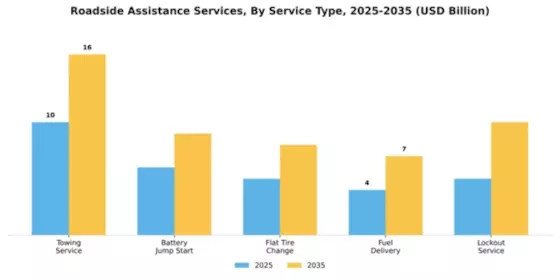
In the Roadside Assistance Services market, the major service types include Towing Service, Battery Jump Start, Flat Tire Change, Fuel Delivery, and Lockout Service. Towing Service holds the largest market share due to the high frequency of vehicles requiring towing following breakdowns. Battery Jump Start and other services are also significant but contribute less compared to towing. As a result, Towing Service remains a crucial offering for companies in this sector, providing essential support to stranded motorists.
Towing Service (Dominant) vs. Battery Jump Start (Emerging)
Towing Service is the dominant segment in Roadside Assistance Services, characterized by its critical response to vehicle breakdowns and accidents. It thrives on a robust network of tow truck operators and partnerships with automotive repair services. Conversely, Battery Jump Start is an emerging segment, gaining traction thanks to technological advancements and increased consumer awareness of battery maintenance. The rise in electric vehicles also contributes to the growth of battery-related services. Together, these segments highlight the diverse needs of motorists and the evolving landscape of roadside assistance.
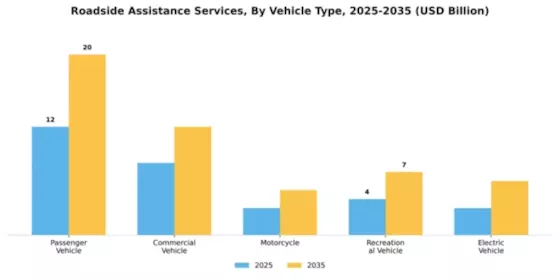
In the Roadside Assistance Services market, the distribution among vehicle types reveals that Passenger Vehicles hold the largest share, driven by the increasing number of personal cars on the road. This segment benefits from the widespread adoption of services like towing, flat tire changes, and battery jump-starts, which cater to the everyday needs of commuters and families alike. In contrast, while currently smaller, the Motorcycle segment represents the fastest-growing area, fueled by rising interest in two-wheeler travel and the popularity of motorcycle tourism. The growth of the Roadside Assistance Services market is mainly driven by the surge in vehicle ownership and urbanization, leading to an increased demand for reliable assistance frameworks. The Motorcycle segment, in particular, is capitalizing on the growth of the electric motorcycle niche, along with the expanding outdoor recreation trend, prompting new service offerings tailored specifically for this category. Furthermore, the emphasis on eco-friendliness contributes to emerging market demands for support services related to sustainable transport options, enhancing the prospects of electric vehicles in roadside assistance.
Passenger Vehicle (Dominant) vs. Electric Vehicle (Emerging)
Within the Roadside Assistance Services market, Passenger Vehicles are regarded as the dominant segment, characterized by their prevalence in urban and suburban areas. They benefit from well-established service networks that provide comprehensive support, including emergency response and maintenance services. In contrast, Electric Vehicles represent an emerging segment, gaining traction due to growing environmental concerns and technological advancements. While they require specialized knowledge for service delivery, the expansion of charging infrastructure and government incentives plays a vital role in enhancing their appeal. Both segments reflect a shift in consumer preferences towards convenience and sustainability, suggesting a need for roadside assistance providers to adapt their offerings accordingly, fostering innovation and responsiveness to evolving market demands.
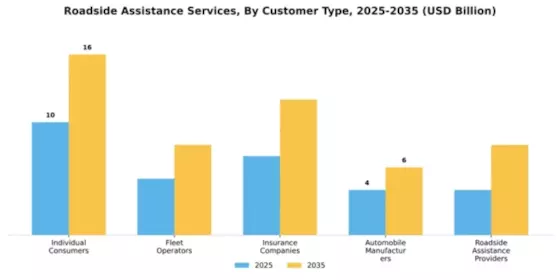
The roadside assistance services market is predominantly driven by individual consumers, who account for a significant share of the overall market. This segment is characterized by a stable demand, mainly due to the increasing number of vehicles on the road and the necessity for safety and convenience. In contrast, fleet operators, while smaller in market share compared to individual consumers, are emerging rapidly. The growth in e-commerce and logistics sectors is propelling fleet operators to seek comprehensive roadside assistance services, leading to increased investments in this area.
Individual Consumers (Dominant) vs. Fleet Operators (Emerging)
Individual consumers represent the dominant segment in roadside assistance services, driven by the need for quick support in emergencies and a straightforward access model via apps and service providers. Their established demand allows service providers to cater specifically to personal vehicle users, ensuring tailored solutions that enhance user experience. On the other hand, fleet operators are becoming an emerging force in the market, motivated by the demand for efficiency and reduced operational downtime. They require robust assistance services that can cater to diverse vehicle types and provide seamless integration with their logistics operations, thus presenting significant growth potential for service providers targeting this segment.
Get more detailed insights about Roadside Assistance Services Market Request Free Sample
North America is poised to maintain its leadership in the roadside assistance market, holding a significant market share of 15.0 in 2024. The growth is driven by increasing vehicle ownership, rising consumer expectations for service quality, and advancements in technology that enhance service delivery. Regulatory support for safety and service standards further catalyzes market expansion, ensuring a robust framework for service providers to thrive. The competitive landscape is characterized by major players such as AAA, Allstate, and Geico, which dominate the market with comprehensive service offerings. The presence of these key players fosters innovation and competition, leading to improved service quality and customer satisfaction. Additionally, the integration of mobile technology and real-time tracking systems is reshaping service delivery, making roadside assistance more efficient and accessible.
Europe's roadside assistance market is experiencing notable growth, with a market size of 8.0 in 2025. Factors such as increasing vehicle usage, heightened consumer awareness regarding safety, and the rise of electric vehicles are driving demand. Regulatory frameworks across various countries are also evolving to enhance service standards, ensuring that consumers receive timely and efficient assistance when needed. Leading countries in this region include the UK, Germany, and France, where companies like RAC and Green Flag are prominent. The competitive landscape is marked by a mix of established players and new entrants, all striving to innovate and improve service offerings. The emphasis on sustainability and eco-friendly practices is also shaping the market, as companies adapt to changing consumer preferences and regulatory requirements.
The Asia-Pacific region is witnessing a gradual rise in the roadside assistance market, currently valued at 5.0. This growth is fueled by increasing urbanization, rising disposable incomes, and a growing number of vehicles on the road. Additionally, the region's regulatory bodies are beginning to implement standards that promote safety and service quality, which are essential for market development. Countries like China, India, and Australia are leading the charge, with local and international players entering the market to capitalize on the growing demand. The competitive landscape is diverse, with both established companies and startups offering innovative solutions. The integration of technology, such as mobile apps for service requests, is becoming increasingly common, enhancing customer experience and operational efficiency.
The Middle East and Africa region presents significant opportunities for growth in roadside assistance services, with a market size of 2.0. Factors such as increasing vehicle ownership, urbanization, and a growing middle class are driving demand for these services. Regulatory initiatives aimed at improving road safety and service standards are also emerging, which will further support market growth in the coming years. Leading countries in this region include South Africa and the UAE, where local companies are beginning to establish a foothold in the market. The competitive landscape is still developing, with opportunities for both local and international players to enter. As consumer awareness of roadside assistance services increases, companies are focusing on enhancing their service offerings to meet evolving customer expectations.
The Roadside Assistance Services market is characterized by a competitive landscape that is increasingly shaped by technological advancements and evolving consumer expectations. Key players such as AAA (US), Allstate (US), and RAC (GB) are strategically positioning themselves through digital transformation and enhanced service offerings. AAA (US) has focused on expanding its mobile app capabilities, allowing for real-time tracking and service requests, which appears to enhance customer satisfaction and operational efficiency. Meanwhile, Allstate (US) has been investing in partnerships with tech firms to integrate AI-driven solutions into their service delivery, potentially streamlining operations and improving response times. These strategies collectively indicate a shift towards a more customer-centric approach, where innovation plays a pivotal role in maintaining competitive advantage.The business tactics employed within this market reflect a moderately fragmented structure, with numerous players vying for market share. Companies are increasingly localizing their service offerings to cater to regional demands, which may optimize their supply chains and enhance service delivery. This localized approach, combined with strategic partnerships, allows companies to leverage regional expertise while maintaining operational efficiency. The collective influence of these key players suggests a dynamic environment where adaptability and responsiveness are crucial for success.In November RAC (GB) announced a significant partnership with a leading telematics provider to enhance its roadside assistance capabilities. This collaboration is expected to integrate real-time vehicle data into their service model, allowing for predictive maintenance and quicker response times. Such a move not only positions RAC (GB) as a forward-thinking player in the market but also underscores the importance of data-driven decision-making in enhancing service efficiency.In October Allstate (US) launched a new initiative aimed at expanding its electric vehicle (EV) roadside assistance services. This initiative is particularly noteworthy as it aligns with the growing trend towards sustainability and the increasing number of EVs on the road. By catering to this emerging market segment, Allstate (US) demonstrates its commitment to innovation and responsiveness to changing consumer needs, potentially capturing a significant share of the EV market.In September AAA (US) introduced a subscription-based model for its roadside assistance services, allowing customers to choose from various tiers of service. This strategic move appears to cater to a diverse customer base, providing flexibility and choice, which may enhance customer loyalty. The introduction of subscription services reflects a broader trend in the industry towards personalized offerings, which could redefine customer engagement strategies.As of December the competitive trends within the Roadside Assistance Services market are increasingly defined by digitalization, sustainability, and the integration of AI technologies. Strategic alliances are becoming more prevalent, as companies recognize the need to collaborate to enhance service delivery and operational efficiency. Looking ahead, it is likely that competitive differentiation will evolve from traditional price-based competition to a focus on innovation, technology integration, and supply chain reliability. This shift may ultimately redefine the landscape of roadside assistance, emphasizing the importance of adaptability and forward-thinking strategies.





The Roadside Assistance Services market is projected to grow at a 4.75% CAGR from 2025 to 2035, driven by increasing vehicle ownership, technological advancements, and consumer demand for convenience.
New opportunities lie in:
By 2035, the market is expected to be robust, reflecting evolving consumer needs and technological integration.
| MARKET SIZE 2024 | 30.0(USD Billion) |
| MARKET SIZE 2025 | 31.43(USD Billion) |
| MARKET SIZE 2035 | 50.0(USD Billion) |
| COMPOUND ANNUAL GROWTH RATE (CAGR) | 4.75% (2025 - 2035) |
| REPORT COVERAGE | Revenue Forecast, Competitive Landscape, Growth Factors, and Trends |
| BASE YEAR | 2024 |
| Market Forecast Period | 2025 - 2035 |
| Historical Data | 2019 - 2024 |
| Market Forecast Units | USD Billion |
| Key Companies Profiled | AAA (US), Allstate (US), Nationwide (US), Geico (US), Agero (US), Roadside Protect (US), RAC (GB), Green Flag (GB), BCAA (CA), CAA (CA) |
| Segments Covered | Service Type, Vehicle Type, Customer Type |
| Key Market Opportunities | Integration of telematics and mobile applications enhances customer experience in Roadside Assistance Services. |
| Key Market Dynamics | Rising consumer demand for on-demand services drives innovation and competition in roadside assistance offerings. |
| Countries Covered | North America, Europe, APAC, South America, MEA |
The market valuation of Roadside Assistance Services was 30.0 USD Billion in 2024.
The projected market size for Roadside Assistance Services is expected to reach 50.0 USD Billion by 2035.
The expected CAGR for Roadside Assistance Services during the forecast period 2025 - 2035 is 4.75%.
Towing Service appears to generate the highest revenue, with a valuation range from 10.0 to 16.0 USD Billion.
Revenue from Battery Jump Start services ranges from 6.0 to 9.0 USD Billion, while Flat Tire Change services range from 5.0 to 8.0 USD Billion.
Key customer segments include Individual Consumers, Fleet Operators, Insurance Companies, Automobile Manufacturers, and Roadside Assistance Providers.
Passenger Vehicles are projected to have the highest revenue, with a valuation range from 12.0 to 20.0 USD Billion.
Major companies such as AAA and Allstate are key players, contributing significantly to the overall market dynamics and service offerings.
The revenue range for Electric Vehicle roadside assistance services is projected to be between 3.0 and 6.0 USD Billion.
Lockout Services generate revenue ranging from 5.0 to 10.0 USD Billion, whereas Fuel Delivery services range from 4.0 to 7.0 USD Billion.


Kindly complete the form below to receive a free sample of this Report

“This is really good guys. Excellent work on a tight deadline. I will continue to use you going forward and recommend you to others. Nice job”


“Thanks. It’s been a pleasure working with you, please use me as reference with any other Intel employees.”


“Thanks for sending the report it gives us a good global view of the Betaïne market.”


“Thank you, this will be very helpful for OQS.”


“We found the report very insightful! we found your research firm very helpful. I'm sending this email to secure our future business.”


“I am very pleased with how market segments have been defined in a relevant way for my purposes (such as "Portable Freezers & refrigerators" and "last-mile"). In general the report is well structured. Thanks very much for your efforts.”


“I have been reading the first document or the study, ,the Global HVAC and FP market report 2021 till 2026. Must say, good info! I have not gone in depth at all parts, but got a good indication of the data inside!”


“We got the report in time, we really thank you for your support in this process. I also thank to all of your team as they did a great job.”


“The Automotive 48V ECU Components Procurement Intelligence Study” was a complex project, but the Market Research Future (MRFR) team handled it with quality, agility, and customer-centricity. They delivered all requested data on time and within the agreed scope. The team, including Shubhendra Anand and Rahul Gotadki, was always readily available to clarify questions and swiftly implement necessary adjustments, driving the project to a successful conclusion within a very demanding timeframe.
I would also like to specifically commend Akshay Agarwal for his responsiveness and support at every stage—from our initial inquiry on May 6th through to final delivery on June 18th. His dedication made the entire process seamless.”



