×
Request Free Sample ×

Kindly complete the form below to receive a free sample of this Report

* Please use a valid business email

Leading companies partner with us for data-driven Insights

clients tt-cursor
Hero Background

Robotic Welding Cell Market

ID: MRFR/PCM/38141-HCR
128 Pages
Tejas Chaudhary
October 2025

Robotic Welding Cell Market Research Report By Application (Automotive, Aerospace, Electronics, Construction, Heavy Machinery), By Type (Articulated Robots, SCARA Robots, Collaborative Robots, Cartesian Robots), By Welding Technology (Arc Welding, Resistance Welding, Laser Welding, Spot Welding), By End Use (Manufacturing, Repair and Maintenance, Research and Development) and By Regional (North America, Europe, South America, Asia Pacific, Middle East and Africa) - Forecast to 2035.

Share:
Download PDF ×

We do not share your information with anyone. However, we may send you emails based on your report interest from time to time. You may contact us at any time to opt-out.

Robotic Welding Cell Market Infographic
Purchase Options

Robotic Welding Cell Market Summary

As per MRFR analysis, the Robotic Welding Cell Market Size was estimated at 5.16 USD Billion in 2024. The Robotic Welding Cell industry is projected to grow from 5.5 in 2025 to 10.5 by 2035, exhibiting a compound annual growth rate (CAGR) of 6.67 during the forecast period 2025 - 2035.

Key Market Trends & Highlights

The Robotic Welding Cell Market is experiencing robust growth driven by automation and technological advancements.

  • The market is witnessing increased automation adoption, particularly in North America, which remains the largest market.
  • Customization and flexibility in robotic welding solutions are becoming essential to meet diverse manufacturing needs, especially in the automotive sector.
  • The integration of AI and machine learning technologies is enhancing operational efficiency and precision in welding processes, particularly in the aerospace segment.
  • Rising demand for precision manufacturing and labor shortages are key drivers propelling market growth in both the manufacturing and assembly sectors.

Market Size & Forecast

2024 Market Size 5.16 (USD Billion)
2035 Market Size 10.5 (USD Billion)
CAGR (2025 - 2035) 6.67%

Major Players

KUKA (DE), FANUC (JP), ABB (CH), Yaskawa (JP), Mitsubishi Electric (JP), Lincoln Electric (US), Esab (SE), Universal Robots (DK), OTC Daihen (JP)

Robotic Welding Cell Market Trends

The Robotic Welding Cell Market is currently experiencing a transformative phase, driven by advancements in automation technology and increasing demand for precision in manufacturing processes. As industries strive for enhanced efficiency and reduced operational costs, the integration of robotic welding cells has become a strategic priority. These systems not only improve productivity but also ensure consistent quality in welding applications across various sectors, including automotive, aerospace, and construction. Furthermore, the growing emphasis on workplace safety and the need to minimize human error in hazardous environments are propelling the adoption of robotic solutions. In addition to technological advancements, the Robotic Welding Cell Market is influenced by the rising trend of customization in manufacturing. Companies are increasingly seeking flexible solutions that can adapt to diverse production requirements. This shift towards tailored automation solutions indicates a potential for growth in the market, as manufacturers look to optimize their operations. Moreover, the ongoing development of artificial intelligence and machine learning capabilities within robotic systems suggests that future iterations of welding cells may offer even greater efficiency and adaptability, further solidifying their role in modern manufacturing.

Increased Automation Adoption

The trend towards automation in manufacturing processes is gaining momentum, as companies seek to enhance productivity and reduce labor costs. Robotic welding cells are becoming integral to this shift, providing efficient and reliable solutions for various welding applications.

Customization and Flexibility

Manufacturers are increasingly demanding customized solutions that can adapt to specific production needs. This trend highlights the importance of flexibility in robotic welding cells, allowing for quick adjustments to accommodate different welding tasks.

Integration of AI and Machine Learning

The incorporation of artificial intelligence and machine learning into robotic welding systems is emerging as a key trend. These technologies enable smarter decision-making and improved operational efficiency, potentially revolutionizing the capabilities of welding cells.

Robotic Welding Cell Market Drivers

Market Growth Projections

The Global Robotic Welding Cell Market Industry is poised for substantial growth, with projections indicating a market value of 5.16 USD Billion in 2024 and an anticipated increase to 10.5 USD Billion by 2035. This growth trajectory suggests a compound annual growth rate (CAGR) of 6.67% from 2025 to 2035. Such figures reflect the increasing adoption of robotic welding solutions across various sectors, driven by factors such as automation, quality demands, and technological advancements. The market's expansion is indicative of a broader trend towards automation in manufacturing, positioning robotic welding cells as a critical component of future industrial operations.

Labor Shortages and Skills Gap

The Global Robotic Welding Cell Market Industry is significantly influenced by labor shortages and the skills gap in manufacturing. As the workforce ages and fewer skilled workers enter the field, companies are turning to robotic welding solutions to mitigate these challenges. By automating welding processes, manufacturers can maintain production levels without relying heavily on skilled labor. This shift not only addresses labor shortages but also enhances operational efficiency. The market's growth is further supported by a projected CAGR of 6.67% from 2025 to 2035, highlighting the increasing reliance on robotic solutions in the face of workforce challenges.

Rising Demand for High-Quality Welds

Quality assurance is paramount in manufacturing, particularly in sectors such as aerospace and automotive. The Global Robotic Welding Cell Market Industry is driven by the rising demand for high-quality welds that robotic systems can provide. These systems minimize human error and ensure consistent weld quality, which is crucial for safety and durability. As industries increasingly prioritize quality, the adoption of robotic welding cells is likely to rise. This trend is projected to contribute to the market's growth, with estimates suggesting a value of 10.5 USD Billion by 2035, indicating a robust trajectory for the industry.

Growing Focus on Safety and Compliance

Safety and compliance are critical considerations in the manufacturing sector, driving the Global Robotic Welding Cell Market Industry. Robotic welding cells enhance workplace safety by reducing the risk of accidents associated with manual welding processes. As regulations become more stringent, companies are compelled to adopt safer practices, including the use of robotic systems. This focus on safety not only protects workers but also ensures compliance with industry standards. The increasing emphasis on safety is expected to propel market growth, as organizations prioritize investments in technologies that enhance both safety and operational efficiency.

Increasing Automation in Manufacturing

The Global Robotic Welding Cell Market Industry is experiencing a surge in demand due to the increasing automation in manufacturing processes. Industries are increasingly adopting robotic welding cells to enhance productivity and reduce labor costs. For instance, automotive manufacturers are integrating these systems to streamline assembly lines, resulting in improved efficiency and precision. As of 2024, the market is valued at approximately 5.16 USD Billion, reflecting the industry's shift towards automation. This trend is expected to continue, as companies seek to optimize operations and maintain competitiveness in a rapidly evolving market.

Technological Advancements in Robotics

Technological advancements play a pivotal role in shaping the Global Robotic Welding Cell Market Industry. Innovations such as artificial intelligence, machine learning, and enhanced sensor technologies are making robotic welding systems more efficient and adaptable. These advancements allow for real-time monitoring and adjustments, improving the overall welding process. As manufacturers seek to leverage these technologies, the demand for advanced robotic welding cells is likely to increase. This trend is indicative of a broader movement towards smart manufacturing, where connectivity and automation are paramount for operational success.

Market Segment Insights

By Application: Automotive (Largest) vs. Aerospace (Fastest-Growing)

In the Robotic Welding Cell Market, the application landscape is primarily dominated by the automotive sector, which holds a significant share due to the widespread adoption of automation for enhancing production efficiency and precision in welding processes. The aerospace, construction, electronics, and shipbuilding sectors also contribute to the overall market, but to a lesser extent. Each segment is evolving with unique manufacturing demands, yet automotive remains the key player in this domain.

Automotive: Dominant vs. Aerospace: Emerging

The automotive application in the Robotic Welding Cell Market is characterized by a high demand for precision and efficiency in production lines, where robotic welding cells are extensively used for tasks like body assembly and frame welding. This segment’s dominance is attributed to the industry's need for cost-effective and high-quality production processes. Conversely, the aerospace sector represents an emerging opportunity, with increasing investments in automation to meet the stringent quality and safety standards. As aircraft manufacturing evolves, the reliance on robotic welding systems is anticipated to escalate, driven by innovations in materials and design, leading to enhanced production capabilities.

By End Use: Manufacturing (Largest) vs. Assembly (Fastest-Growing)

The robotic welding cell market has various end-use segments, notably including Manufacturing, Maintenance, Repair, Assembly, and Fabrication. Among these, Manufacturing holds the largest market share due to its extensive application in automating production processes. This sector benefits from increased operational efficiency and meets high-demand production volumes. Conversely, Assembly is emerging as the fastest-growing segment, driven by the increasing adoption of automation technologies and the need for precision in assembling complex components across various industries.

Assembly (Emerging) vs. Manufacturing (Dominant)

In the robotic welding cell market, Manufacturing is currently the dominant segment, leveraging advanced automation to enhance productivity and ensure consistent quality in large-scale production. It caters to a wide range of industries, from automotive to heavy machinery, where accurate and rapid welding is critical. On the other hand, Assembly represents an emerging value, gaining traction due to advancements in automation technology. Companies increasingly seek precision in assembly tasks, which robotic welding cells provide, particularly in sectors like electronics and consumer goods. This shift highlights not only the flexibility of robotic systems but also their ability to adapt to a growing array of tasks across sectors.

By Type: Arc Welding (Largest) vs. Laser Welding (Fastest-Growing)

In the Robotic Welding Cell Market, the 'Type' segment showcases a diverse range of technologies, with Arc Welding being the most dominant. This traditional yet versatile method holds a significant share of the market, making it a preferred choice for various applications across industries. In contrast, Laser Welding, while currently smaller in share, is identified as the fastest-growing segment as manufacturers increasingly adopt this technology for its precision and efficiency. Growth trends in the 'Type' segment are propelled by technological advancements and the demand for automation in manufacturing processes. Businesses are seeking faster and more precise welding solutions, driving the shift towards Laser Welding, while Arc Welding remains essential for heavy-duty applications. This dynamic landscape suggests a balanced coexistence, with each type meeting specific market needs and preferences.

Welding Technology: Arc Welding (Dominant) vs. Laser Welding (Emerging)

Arc Welding, recognized for its robustness and versatility, holds a dominant position in the Robotic Welding Cell Market. It is widely employed in heavy industrial applications, capable of handling complex geometries and thicker materials. However, the landscape is evolving with the emergence of Laser Welding, which offers high-speed, high-precision welding capabilities. Laser Welding is showing promise, particularly in the automotive and electronics sectors, where precision and speed are paramount. As manufacturers invest in advanced technologies that enhance production efficiency and quality, the significance of Laser Welding is expected to rise, fostering innovative applications and redefining competitive advantages in the market.

By Technology: Automated Welding (Largest) vs. Collaborative Robotics (Fastest-Growing)

The Robotic Welding Cell Market is characterized by a diverse range of technologies, with Automated Welding currently holding the largest market share. This segment benefits from high efficiency, precision, and the ability to handle complex tasks, making it the go-to choice for many industries. In contrast, Collaborative Robotics is rapidly gaining traction, catering to manufacturers seeking flexibility and ease of integration into existing workflows. This shift towards collaboration highlights the need for adaptable solutions in a fast-paced market, thus driving growth in this segment. The growth trends in the Robotic Welding Cell Market are fueled by advancements in technology and increasing demand for automation across various sectors. Collaboration between humans and robots is becoming paramount, as businesses look to enhance productivity while ensuring safety. Additionally, emerging technologies like Artificial Intelligence and Machine Learning are playing a significant role in optimizing robotic operations, bolstering the overall market growth. As manufacturers invest in these technologies, the market is poised for progressive transformation and expansion.

Technology: Automated Welding (Dominant) vs. Collaborative Robotics (Emerging)

Automated Welding is a dominant force within the Robotic Welding Cell Market, known for its speed, consistency, and capability to perform repetitive tasks with minimal human intervention. This technology is particularly favored in industries like automotive and aerospace, where precision and repeatability are paramount. On the other hand, Collaborative Robotics represents an emerging trend characterized by its ability to work alongside human operators, improving the efficiency of manufacturing processes. These robots are designed to be intuitive and safe, enabling companies to adopt automation without extensive restructuring. Together, these technologies illustrate the market's dual focus on high productivity and enhanced human-robot interaction.

By Component: Robotic Arm (Largest) vs. Welding Power Supply (Fastest-Growing)

The Robotic Welding Cell Market showcases a diverse range of components, including the Robotic Arm, Welding Power Supply, Control System, End Effector, and Safety Equipment. Among these, the Robotic Arm holds the largest share, reflecting its fundamental role in the execution of welding tasks. The Welding Power Supply, however, is emerging as the fastest-growing segment, attributed to the increasing demand for more efficient and versatile power solutions that can cater to advanced welding processes.

Robotic Arm (Dominant) vs. Welding Power Supply (Emerging)

The Robotic Arm serves as the backbone of robotic welding cells, known for its precision, speed, and ability to handle various welding techniques. Its dominance is accentuated by innovations in design and functionality that enhance operational efficiency across various applications. Conversely, the Welding Power Supply segment is witnessing rapid growth driven by advancements in inverter technology and the rising need for power sources that support complex welding tasks. This trend is reshaping the market dynamics, as suppliers focus on developing compact, energy-efficient, and smart power solutions to meet evolving manufacturing demands.

Get more detailed insights about Robotic Welding Cell Market

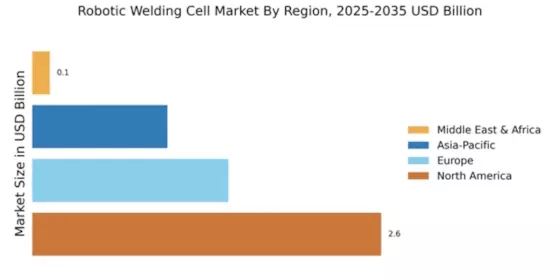
Regional Insights

North America : Leading Market Innovators

North America is poised to maintain its leadership in the robotic welding cell market, holding a significant market share of 2.58 billion. The growth is driven by increasing automation in manufacturing, stringent safety regulations, and a push for higher productivity. The automotive and aerospace sectors are particularly influential, as they adopt advanced welding technologies to enhance efficiency and reduce costs. The competitive landscape is robust, with key players like KUKA, FANUC, and Lincoln Electric leading the charge. The U.S. is the primary market, supported by a strong presence of technology firms and a skilled workforce. The region's focus on innovation and R&D further solidifies its position, making it a hub for robotic welding advancements.

Europe : Emerging Technological Hub

Europe's robotic welding cell market is valued at €1.5 billion, driven by a strong emphasis on automation and Industry 4.0 initiatives. The region benefits from supportive government policies aimed at enhancing manufacturing efficiency and sustainability. Countries like Germany and France are at the forefront, with significant investments in robotics and automation technologies, fostering a conducive environment for market growth. The competitive landscape features major players such as ABB and Yaskawa, who are innovating to meet the rising demand for automated solutions. The European market is characterized by a diverse range of applications across industries, including automotive, electronics, and metal fabrication, ensuring a steady demand for robotic welding cells. "The European Union aims to increase the adoption of robotics in manufacturing by 30% by 2025," European Commission, Directorate-General for Internal Market, Industry, Entrepreneurship and SMEs.

Asia-Pacific : Rapidly Growing Market

The Asia-Pacific region is witnessing rapid growth in the robotic welding cell market, currently valued at $0.9 billion. This growth is fueled by increasing industrial automation, particularly in countries like China, Japan, and South Korea. The demand for high-quality manufacturing processes and the need to reduce labor costs are significant drivers. Additionally, government initiatives promoting smart manufacturing are catalyzing market expansion. China stands out as a leading country in adopting robotic technologies, with substantial investments in automation across various sectors. The competitive landscape includes key players like Mitsubishi Electric and FANUC, who are actively enhancing their product offerings to cater to the growing demand. The region's focus on innovation and technology integration is expected to further boost market growth.

Middle East and Africa : Emerging Market Potential

The Middle East and Africa (MEA) region's robotic welding cell market is valued at $0.18 billion, reflecting emerging opportunities in automation. The growth is driven by increasing industrialization and a shift towards advanced manufacturing processes. Countries like the UAE and South Africa are investing in automation technologies to enhance productivity and competitiveness. Government initiatives aimed at diversifying economies are also contributing to market growth. The competitive landscape is still developing, with local and international players vying for market share. Companies are focusing on establishing partnerships and collaborations to enhance their technological capabilities. As industries in the MEA region continue to evolve, the demand for robotic welding cells is expected to rise significantly, paving the way for future growth.

Key Players and Competitive Insights

The Robotic Welding Cell Market is currently characterized by a dynamic competitive landscape, driven by technological advancements and increasing demand for automation across various industries. Key players such as KUKA (DE), FANUC (JP), and ABB (CH) are at the forefront, each adopting distinct strategies to enhance their market positioning. KUKA (DE) focuses on innovation through the development of advanced robotic solutions that integrate AI and machine learning, thereby improving operational efficiency. Meanwhile, FANUC (JP) emphasizes regional expansion, particularly in emerging markets, to capitalize on the growing need for automated welding solutions. ABB (CH) is strategically investing in digital transformation initiatives, enhancing its product offerings with smart technologies that cater to the evolving needs of manufacturers.

The business tactics employed by these companies reflect a concerted effort to optimize supply chains and localize manufacturing processes. The market structure appears moderately fragmented, with several players vying for market share while also collaborating through strategic partnerships. This collective influence of key players fosters a competitive environment that encourages innovation and responsiveness to market demands.

In November 2025, KUKA (DE) announced the launch of its latest robotic welding cell, which incorporates advanced AI capabilities to enhance precision and reduce cycle times. This strategic move is likely to solidify KUKA's position as a leader in the market, as it addresses the increasing demand for high-quality welding solutions that minimize human error. Similarly, in October 2025, FANUC (JP) unveiled a new line of collaborative robots designed specifically for welding applications, which are expected to enhance safety and efficiency in manufacturing environments. This initiative not only showcases FANUC's commitment to innovation but also positions the company to capture a larger share of the growing collaborative robotics segment.

In September 2025, ABB (CH) entered into a strategic partnership with a leading automotive manufacturer to develop customized robotic welding solutions tailored to the automotive sector. This collaboration is indicative of ABB's focus on leveraging partnerships to enhance its technological capabilities and expand its market reach. Furthermore, in August 2025, Yaskawa (JP) launched a new series of welding robots that utilize advanced sensors for real-time monitoring and adjustment, thereby improving weld quality and reducing material waste. This development underscores Yaskawa's commitment to sustainability and operational excellence in the welding domain.

As of December 2025, the competitive trends within the Robotic Welding Cell Market are increasingly defined by digitalization, sustainability, and the integration of AI technologies. Strategic alliances among key players are shaping the landscape, fostering innovation and enhancing product offerings. The shift from price-based competition to a focus on technological advancement and supply chain reliability is becoming more pronounced. Looking ahead, it appears that competitive differentiation will increasingly hinge on the ability to innovate and adapt to the rapidly changing demands of the market, with a strong emphasis on sustainable practices and advanced technological solutions.

Key Companies in the Robotic Welding Cell Market market include

Industry Developments

  • Q2 2024: EVS Metal Expands Robotic Welding Capabilities with New Automated Cell at New Jersey Facility EVS Metal announced the installation of a new robotic welding cell at its New Jersey facility, aimed at increasing production efficiency and supporting growth in precision sheet metal fabrication.

Future Outlook

Robotic Welding Cell Market Future Outlook

The Robotic Welding Cell Market is projected to grow at a 6.67% CAGR from 2024 to 2035, driven by automation advancements, labor shortages, and increased demand for precision manufacturing.

New opportunities lie in:

  • Integration of AI-driven quality control systems
  • Expansion into emerging markets with tailored solutions
  • Development of modular robotic systems for diverse applications

By 2035, the market is expected to be robust, reflecting substantial growth and innovation.

Market Segmentation

Robotic Welding Cell Market Type Outlook

  • Arc Welding
  • Spot Welding
  • Laser Welding
  • TIG Welding
  • MIG Welding

Robotic Welding Cell Market End Use Outlook

  • Manufacturing
  • Maintenance
  • Repair
  • Assembly
  • Fabrication

Robotic Welding Cell Market Component Outlook

  • Robotic Arm
  • Welding Power Supply
  • Control System
  • End Effector
  • Safety Equipment

Robotic Welding Cell Market Technology Outlook

  • Automated Welding
  • Collaborative Robotics
  • Artificial Intelligence
  • Machine Learning
  • Vision Systems

Robotic Welding Cell Market Application Outlook

  • Automotive
  • Aerospace
  • Construction
  • Electronics
  • Shipbuilding

Report Scope

MARKET SIZE 20245.16(USD Billion)
MARKET SIZE 20255.5(USD Billion)
MARKET SIZE 203510.5(USD Billion)
COMPOUND ANNUAL GROWTH RATE (CAGR)6.67% (2024 - 2035)
REPORT COVERAGERevenue Forecast, Competitive Landscape, Growth Factors, and Trends
BASE YEAR2024
Market Forecast Period2025 - 2035
Historical Data2019 - 2024
Market Forecast UnitsUSD Billion
Key Companies ProfiledKUKA (DE), FANUC (JP), ABB (CH), Yaskawa (JP), Mitsubishi Electric (JP), Lincoln Electric (US), Esab (SE), Universal Robots (DK), OTC Daihen (JP)
Segments CoveredApplication, End Use, Type, Technology, Component
Key Market OpportunitiesIntegration of artificial intelligence enhances efficiency and precision in the Robotic Welding Cell Market.
Key Market DynamicsRising automation in manufacturing drives demand for advanced robotic welding cells, enhancing production efficiency and precision.
Countries CoveredNorth America, Europe, APAC, South America, MEA

Leave a Comment

FAQs

What is the projected compound annual growth rate (CAGR) for the Robotic Welding Cell Market during the forecast period?

Robotic Welding Cell Market is projected to register a CAGR of 6.67% from 2025-2035

Which region is expected to hold the largest market share in the Robotic Welding Cell Market by 2034?

North America is expected to hold the largest market share in the Robotic Welding Cell Market, valued at 2.8 USD Billion by 2034.

What will the market value of the Automotive application segment be by 2034?

The Automotive application segment of the Robotic Welding Cell Market is projected to be valued at 3.2 USD Billion by 2034.

Who are the key players in the Robotic Welding Cell Market?

Major players in the Robotic Welding Cell Market include Panasonic, KUKA, FANUC, and Lincoln Electric, among others.

What is the expected market value for the Aerospace application segment by 2034?

The Aerospace application segment of the Robotic Welding Cell Market is expected to reach 1.5 USD Billion by 2034.

What is the anticipated market size for the Heavy Machinery application segment by 2034?

By 2034, the Heavy Machinery application segment is projected to be valued at 1.2 USD Billion.

How does the market size of Europe compare to other regions by 2034?

Europe is expected to have a market size of 2.1 USD Billion in the Robotic Welding Cell Market by 2034.

What is the projected market size for the Electronics application segment by 2034?

The Electronics application segment is expected to be valued at 1.0 USD Billion by 2034.

What is the expected market size for the Construction application segment by 2034?

The Construction application segment is projected to reach a market value of 1.2 USD Billion by 2034.

Download Free Sample

Kindly complete the form below to receive a free sample of this Report

Compare Licence

×
Features License Type
Single User Multiuser License Enterprise User
Price $4,950 $5,950 $7,250
Maximum User Access Limit 1 User Upto 10 Users Unrestricted Access Throughout the Organization
Free Customization
Direct Access to Analyst
Deliverable Format
Platform Access
Discount on Next Purchase 10% 15% 15%
Printable Versions