Scandinavia Construction Market Summary
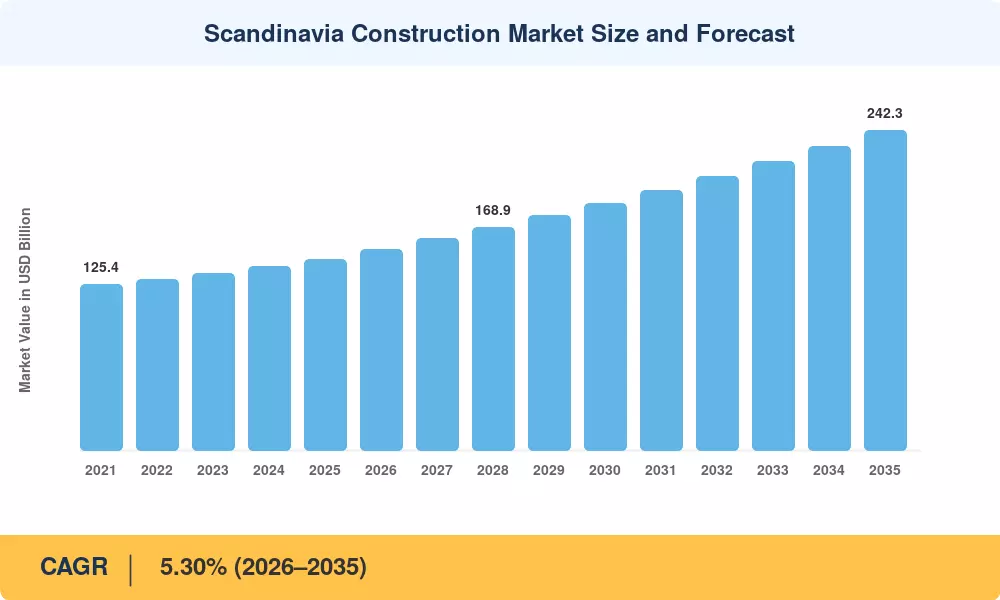
The Scandinavia Construction Market reached a valuation of USD 144.60 Billion in 2025 and is projected to grow from USD 152.30 Billion in 2026 to USD 242.30 Billion by 2035, registering a CAGR of 5.30% across the forecast window. That trajectory rests on two structural pillars: multi-year national infrastructure plans — particularly Norway's National Transport Plan and Sweden's railway expansion packages — and the EU-aligned energy-performance mandates that require deep retrofits of aging building stock across Denmark and Sweden [1][2]. Public-sector balance sheets remain healthy by global standards, giving procurement agencies the fiscal headroom to front-load spending on defense facilities, renewable-energy hubs, and data-center campuses.
A technology shift is reshaping how projects are delivered in the Scandinavia Construction Market. Conventional stick-built methods still dominate, yet factory-fabricated volumetric modules, mass-timber structural systems, and BIM-integrated design-for-manufacture workflows are displacing traditional approaches at a faster clip than anywhere else in Europe. Sweden's government allocated SEK 6.5 billion toward industrialized housing pilots through 2030, while Denmark's 2025 Climate Act amendments tie building-permit approvals to whole-life carbon assessments [3][4]. These policy levers reward contractors who can demonstrate verified embodied-carbon reductions.
Sweden commands the largest share of the Scandinavia Construction Market, contributing roughly 41% of regional revenue in 2025 on the back of large-scale rail, defense, and data-center investments. Norway is on track to be the fastest-growing country at a 6.50% CAGR through 2035, fueled by offshore-wind-related onshore construction and accelerated road-tunnel programs. Denmark accounts for the remaining share, anchored by Copenhagen metro extensions and industrial decarbonization retrofits. As green-bond financing scales and cross-border labor mobility deepens, the region's construction pipeline looks well-supported into the next decade [5][6].
Key Report Takeaways
• By Sector
- Infrastructure commanded a 48% share of the Scandinavia Construction Market in 2025, driven by transport corridors and energy-transition facilities.
- Residential is projected to register the quickest sectoral growth at a 6.30% CAGR through 2035, supported by acute housing shortages in Stockholm, Oslo, and Copenhagen.
• By Construction Type
- New construction held a 55% share of the Scandinavia Construction Market in 2025 as greenfield transport and data-center projects dominated order books.
- Renovation is forecast to advance at a 5.40% CAGR to 2035, driven by mandatory energy-performance upgrades under revised EU building directives.
• By Construction Method
- Conventional on-site techniques retained a 74% share in 2025, though that figure is declining as prefabrication scales.
- Modern methods of construction are expanding at a 7.50% CAGR through 2035.
• By Region
- Sweden led the Scandinavia Construction Market with a 41% revenue share in 2025.
- Norway is on track for the quickest country-level growth at a 6.50% CAGR over 2026–2035.
Market Size and Forecast (2021–2035)
Market Research Future's proprietary estimation framework combines national statistical bureau output data (SCB Sweden, SSB Norway, DST Denmark) with contractor-reported order backlogs, public-procurement pipeline databases, and triangulated primary interviews across 120+ industry stakeholders. Historical values reflect actual construction output at current prices; forecast values apply a calibrated compound growth rate validated against macroeconomic indicators and announced project pipelines.




















.webp?v=1787579730)
