×
Request Free Sample ×

Kindly complete the form below to receive a free sample of this Report

Leading companies partner with us for data-driven Insights

clients tt-cursor
Hero Background

Serviced Office Market

ID: MRFR/ICT/39103-HCR
128 Pages
Rahul Gotadki
October 2025

Serviced Office Market Research Report By Product Type (Managed Office Space, Coworking Space, Virtual Office), By Size (Small Offices (Less than 500 sq ft), Medium Offices (500-2,000 sq ft), Large Offices (2,000 sq ft or more)), By Location (Central Business Districts, Suburbs, Other), By Customer Type (Startups and Small Businesses, Corporations, Freelancers and Solopreneurs), By Amenities (High-Speed Internet, Conference Rooms, Reception Services, 24/7 Access, Flexible Lease Terms) and By Regional (North America, Europe, South America, A... read more

Share:
Download PDF ×

We do not share your information with anyone. However, we may send you emails based on your report interest from time to time. You may contact us at any time to opt-out.

Serviced Office Market Infographic
Purchase Options

Serviced Office Market Summary

As per MRFR analysis, the Serviced Office Market Size was estimated at 23.77 USD Billion in 2024. The Serviced Office industry is projected to grow from 25.32 USD Billion in 2025 to 47.58 USD Billion by 2035, exhibiting a compound annual growth rate (CAGR) of 6.51 during the forecast period 2025 - 2035.

Key Market Trends & Highlights

The Serviced Office Market is experiencing a dynamic shift towards flexibility and technology integration.

  • The demand for flexibility in workspace solutions continues to rise, particularly in North America, which remains the largest market.
  • Technology integration is becoming increasingly essential, with businesses seeking advanced solutions to enhance productivity and collaboration.
  • Sustainability and wellness are gaining traction, influencing design and operational practices across serviced office spaces.
  • The rise of remote work culture and urbanization are key drivers propelling growth in managed office spaces and small offices, especially in the Asia-Pacific region.

Market Size & Forecast

2024 Market Size 23.77 (USD Billion)
2035 Market Size 47.58 (USD Billion)
CAGR (2025 - 2035) 6.51%

Major Players

Regus (GB), WeWork (US), Spaces (NL), Servcorp (AU), Impact Hub (AT), Knotel (US), The Office Group (GB), Mindspace (IL), Industrious (US)

Serviced Office Market Trends

The Serviced Office Market is currently experiencing a dynamic evolution, driven by various factors that influence workspace preferences. As businesses increasingly seek flexibility and cost-effectiveness, the demand for serviced offices appears to be on the rise. This trend is particularly evident among startups and small enterprises that prioritize agility in their operations. Moreover, the integration of technology into these workspaces enhances productivity and collaboration, making them attractive options for modern businesses. The market seems to be adapting to the changing needs of organizations, with a focus on providing tailored solutions that cater to diverse requirements. In addition, the Serviced Office Market is witnessing a shift towards sustainability and wellness-oriented designs. Companies are becoming more conscious of their environmental impact, prompting serviced office providers to incorporate eco-friendly practices and amenities. This focus on sustainability not only appeals to environmentally aware clients but also fosters a healthier work environment. As the market continues to evolve, it is likely that these trends will shape the future of workspaces, creating opportunities for innovation and growth within the sector.

Increased Demand for Flexibility

The Serviced Office Market is seeing a notable rise in demand for flexible workspace solutions. Organizations are increasingly favoring short-term leases and adaptable office layouts that can accommodate changing team sizes and project needs. This trend reflects a broader shift towards agile business practices, allowing companies to respond swiftly to market fluctuations.

Emphasis on Technology Integration

There is a growing emphasis on technology integration within serviced offices. Providers are incorporating advanced tools and platforms that facilitate seamless communication and collaboration among teams. This trend not only enhances operational efficiency but also attracts tech-savvy businesses looking for modern work environments.

Focus on Sustainability and Wellness

The Serviced Office Market is increasingly prioritizing sustainability and wellness in workspace design. Providers are adopting eco-friendly materials and promoting health-conscious amenities, such as natural lighting and green spaces. This focus aligns with the values of contemporary organizations that seek to create a positive impact on both employees and the environment.

Serviced Office Market Drivers

Technological Advancements

Technological advancements are significantly influencing the Serviced Office Market. The integration of cutting-edge technology into serviced office spaces enhances operational efficiency and user experience. Features such as high-speed internet, smart office solutions, and advanced communication tools are becoming standard offerings. Data indicates that serviced offices equipped with modern technology can command higher rental rates, as businesses prioritize tech-enabled environments. Moreover, the Serviced Office Market is witnessing a shift towards hybrid work models, where technology plays a crucial role in facilitating collaboration among remote and in-office employees. This trend suggests that serviced office providers must continuously innovate to meet the evolving needs of their clients.

Rise of Remote Work Culture

The rise of remote work culture appears to be a pivotal driver for the Serviced Office Market. As organizations increasingly adopt flexible work arrangements, the demand for serviced offices has surged. This trend is evidenced by a reported increase in the number of companies seeking flexible workspace solutions, with estimates suggesting that the serviced office sector could grow by approximately 20% annually. The ability to provide fully equipped workspaces without the long-term commitment of traditional leases makes serviced offices an attractive option for businesses looking to adapt to changing workforce dynamics. Furthermore, the Serviced Office Market is likely to benefit from the growing number of freelancers and startups, who often prefer short-term leases and flexible terms.

Changing Workforce Demographics

Changing workforce demographics are reshaping the Serviced Office Market. The influx of millennials and Generation Z into the workforce is influencing workplace preferences, with younger employees favoring flexibility and collaboration. This demographic shift is prompting companies to seek serviced office solutions that cater to the needs of a diverse workforce. Market Research Future indicates that businesses are increasingly prioritizing work environments that foster creativity and innovation, which serviced offices are well-equipped to provide. As the workforce continues to evolve, the Serviced Office Market is likely to adapt by offering more collaborative spaces and amenities that resonate with the values of younger professionals.

Increased Focus on Sustainability

An increased focus on sustainability is emerging as a key driver in the Serviced Office Market. Companies are becoming more environmentally conscious, leading to a demand for office spaces that align with sustainable practices. Serviced offices that implement energy-efficient systems, utilize sustainable materials, and promote green initiatives are likely to attract environmentally aware businesses. Market data indicates that serviced office providers adopting sustainable practices can enhance their brand image and appeal to a broader clientele. This trend not only reflects a growing awareness of environmental issues but also suggests that the Serviced Office Market may see a shift towards eco-friendly certifications and practices as standard expectations.

Urbanization and Population Growth

Urbanization and population growth are driving factors for the Serviced Office Market. As more individuals migrate to urban centers in search of employment opportunities, the demand for flexible office spaces is likely to increase. The concentration of businesses in metropolitan areas creates a competitive landscape, where serviced offices can provide a viable solution for companies seeking to establish a presence without the burden of long-term leases. Current estimates suggest that urban areas are expected to grow by 1.5 billion people by 2030, further intensifying the need for adaptable workspaces. Consequently, the Serviced Office Market is positioned to capitalize on this trend by offering strategically located office solutions.
Market Segment Insights

By Product Type: Managed Office Space (Largest) vs. Coworking Space (Fastest-Growing)

In the serviced office market, the product type segmentation reveals that Managed Office Space holds a significant share, catering to businesses seeking flexible yet private office solutions. This segment appeals particularly to larger corporations and established enterprises that require a consistent workspace with comprehensive services. On the other hand, Coworking Spaces are gaining traction, particularly among startups and freelancers, contributing to a notable rise in market demands. Its appeal lies in the ability to foster community engagement and collaboration, which is increasingly valued by the new generation of entrepreneurs and professionals.

Managed Office Space (Dominant) vs. Coworking Space (Emerging)

Managed Office Space is characterized by fully equipped offices offering extensive amenities, tailored for larger businesses or those looking for stability and professionalism in their workspace. This segment generally provides longer lease terms and personalized services, appealing to enterprises prioritizing operational efficiency and productivity. In contrast, Coworking Spaces emerge as a vibrant hub for freelancers and small businesses, promoting flexibility and an interactive environment. This segment thrives on the concept of shared community resources and networking opportunities, making it particularly attractive to the startup culture. Both segments redefine workspace dynamics, catering to distinct business needs and growth trajectories.

By Size: Medium Offices (Largest) vs. Small Offices (Fastest-Growing)

The Serviced Office Market exhibits a diverse distribution of office sizes, with medium offices (500-2,000 sq ft) dominating the market share. This segment reflects a balanced demand from various businesses seeking flexibility and adaptability in workspace solutions. Meanwhile, small offices (less than 500 sq ft) have emerged as the fastest-growing segment, primarily driven by startups and freelancers who prioritize smaller, more manageable spaces that offer essential amenities without the overhead costs associated with larger offices. As organizations continue to adapt to dynamic work environments, the trend toward medium and small office spaces is significant. Factors such as remote work evolution and a growing gig economy are propelling small office demand, while medium offices are favored for their scalability. Companies are increasingly looking for hybrid solutions that offer a combination of collaboration space, privacy, and cost-effectiveness, contributing to a robust growth trajectory for these segments in the serviced office landscape.

Medium Offices (Dominant) vs. Small Offices (Emerging)

Medium offices (500-2,000 sq ft) hold a substantial market position within the serviced office sector due to their versatility and capacity to accommodate diverse business needs. This segment is characterized by its ability to provide a balance between collaborative workspaces and private offices, appealing to SMEs and established companies alike. Moreover, they often feature modern amenities and flexible lease terms, attracting businesses aiming for scalability without committing to long-term locations. In contrast, small offices (less than 500 sq ft) have become increasingly popular among freelancers and startups, positioning themselves as flexible solutions for those looking to minimize expenses while maintaining a professional setting. As the demand for personalized workspace solutions grows, small offices are becoming an essential part of the serviced office market, representing a shift towards more personalized and efficient workspace utilization.

By Customer Type: Startups and Small Businesses (Largest) vs. Corporations (Fastest-Growing)

In the Serviced Office Market, the customer type segment is primarily dominated by Startups and Small Businesses, which account for a significant portion of the demand for flexible office spaces. This demographic is increasingly drawn to serviced offices due to the lower overhead costs and the flexibility they offer in terms of lease agreements. Corporations, while smaller in total market share, exhibit rapid growth as they seek flexible solutions to accommodate their dynamic workforce, especially in today's ever-evolving business landscape. The growth trends indicate that Startups and Small Businesses will continue to thrive as they capitalize on cost-effective office solutions. Conversely, Corporations are expected to expand their footprint in the serviced office market, driven by the need for adaptable workspaces that foster collaboration and innovation. Factors such as the rise of remote work, the increasing importance of employee well-being, and advancements in technology are further propelling this growth trend.

Startups and Small Businesses (Dominant) vs. Corporations (Emerging)

Startups and Small Businesses represent the dominant force in the Serviced Office Market, characterized by their high adaptability and lower operational costs. These entities are often lean, focusing on innovation and growth without the burden of long-term leases. On the other hand, Corporations are emerging as significant players in this sector, leveraging serviced offices to enhance workforce flexibility and operational efficiency. The appeal of serviced offices lies in their ability to provide a professional environment equipped with necessary amenities, which is essential for both customer types. As Corporations increasingly adopt hybrid working models, their interest in serviced office solutions will likely drive further enhancements in service offerings, making this segment a focal point for future developments.

By Amenities: High-Speed Internet (Largest) vs. Conference Rooms (Fastest-Growing)

The serviced office market has seen significant segmentation with amenities playing a vital role in attracting clients. High-Speed Internet stands out as the largest segment, catering to the growing demand for connectivity in modern workplaces. Conference Rooms also hold substantial market presence but are recognized as the fastest-growing segment due to businesses increasingly valuing face-to-face interactions and the need for collaboration spaces that enhance productivity and creativity. In recent trends, serviced office providers are increasingly focusing on providing high-quality amenities that not only meet basic requirements but also enhance overall workplace experience. The demand for Conference Rooms, in particular, is being driven by the rise in remote work, as companies seek flexible solutions to accommodate their teams in a hybrid working environment. As businesses adapt, the emphasis on technologies and amenities that support communication and collaboration will continue to propel growth in these segments.

High-Speed Internet (Dominant) vs. Reception Services (Emerging)

High-Speed Internet is a dominant force in the serviced office market, essential for businesses that thrive on connectivity and digital communication. Clients expect reliable and fast internet access as a non-negotiable amenity, and providers are focusing on upgrading their infrastructure to meet this demand. In contrast, Reception Services are emerging steadily as businesses begin to recognize the importance of professional front-desk services that enhance their corporate image. This amenity is gaining traction, particularly among startups and small businesses that may not have the resources to maintain a full-time receptionist. The growing focus on customer service and first impressions in business interactions makes Reception Services an increasingly valuable offering in serviced offices.

Get more detailed insights about Serviced Office Market

Regional Insights

North America : Flexible Workspace Leader

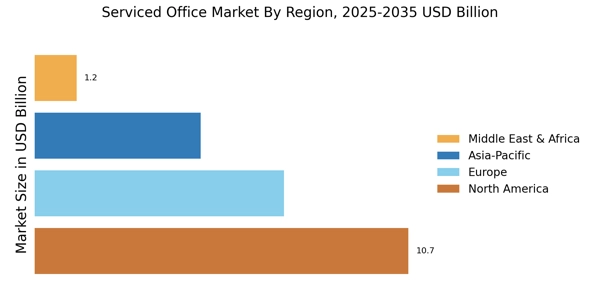
North America is the largest market for serviced offices, holding approximately 45% of the global share. The growth is driven by the increasing demand for flexible workspaces, particularly in urban areas. Regulatory support for remote work and the gig economy has further catalyzed this trend. The second largest market is Europe, accounting for around 30% of the market share, reflecting a strong demand for adaptable office solutions. The United States leads the North American market, with major cities like New York and San Francisco being hotspots for serviced offices. Key players such as WeWork, Regus, and Knotel dominate the landscape, offering diverse workspace solutions. The competitive environment is characterized by innovation and a focus on customer experience, with companies continuously adapting to meet the evolving needs of businesses and freelancers.

Europe : Emerging Market Dynamics

Europe is witnessing a significant rise in the serviced office market, currently holding about 30% of the global share. The demand is fueled by a shift towards remote work and the need for flexible office solutions. Countries like the UK and Germany are leading this trend, with regulatory frameworks increasingly supporting co-working spaces and flexible leases. The market is expected to grow as businesses seek cost-effective solutions in response to economic pressures. The UK is the largest market in Europe, with London being a central hub for serviced offices. Germany follows closely, with cities like Berlin and Munich gaining traction. Key players such as Spaces and The Office Group are prominent in this region, contributing to a competitive landscape that emphasizes innovation and sustainability. The presence of diverse offerings caters to startups and established firms alike, enhancing the appeal of serviced offices.

Asia-Pacific : Rapid Growth Potential

Asia-Pacific is rapidly emerging as a significant player in the serviced office market, currently holding about 20% of the global share. The region's growth is driven by urbanization, a burgeoning startup culture, and increasing foreign investments. Countries like China and India are at the forefront, with supportive government policies promoting entrepreneurship and flexible work environments. The market is expected to expand as more businesses adopt agile working practices. China is the largest market in the region, with cities like Beijing and Shanghai leading the way. India follows closely, with cities such as Bangalore and Mumbai experiencing a surge in demand for serviced offices. Key players like Servcorp and Impact Hub are establishing a strong presence, contributing to a competitive landscape that is increasingly focused on technology integration and customer-centric services.

Middle East and Africa : Emerging Market Opportunities

The Middle East and Africa region is gradually developing its serviced office market, currently holding about 5% of the global share. The growth is driven by increasing urbanization, a rise in entrepreneurship, and government initiatives aimed at diversifying economies. Countries like the UAE and South Africa are leading this trend, with a growing number of co-working spaces catering to startups and freelancers. The market is expected to grow as businesses seek flexible solutions in response to economic changes. The UAE, particularly Dubai, is the largest market in the region, with a vibrant startup ecosystem and a strong demand for flexible office solutions. South Africa is also emerging as a key player, with cities like Johannesburg and Cape Town gaining traction. Key players such as Mindspace and Industrious are establishing a foothold, contributing to a competitive landscape that emphasizes innovation and adaptability.

Serviced Office Market Regional Image

Key Players and Competitive Insights

 Major players in the Serviced Office Market industry are increasingly focusing on expanding their  footprint through strategic partnerships, acquisitions, and joint ventures. Leading Serviced Office Market players are investing heavily in technology and innovation to enhance their offerings and cater to the evolving needs of their clients. The Serviced Office Market industry is characterized by a highly competitive landscape, with numerous established and emerging players vying for market share.

Key players are adopting various strategies, such as product differentiation, strategic alliances, and geographical expansion, to gain a competitive edge.IWG, a leading  provider of flexible workspace solutions, has a strong presence in the Serviced Office Market industry. The company operates a network of over 3,300 locations in more than 120 countries. IWG offers a range of flexible workspace solutions, including private offices, coworking spaces, and virtual offices.

The company's focus on innovation and customer service has contributed to its strong position in the market.Another major player in the Serviced Office Market industry is Regus, which is part of the IWG group. Regus offers a range of flexible workspace solutions, including private offices, coworking spaces, and meeting rooms. The company has a  network of over 3,000 locations in more than 120 countries. Regus's focus on providing high-quality workspace solutions and its commitment to customer satisfaction has made it a leading player in the industry.

Key Companies in the Serviced Office Market market include

Industry Developments

The Serviced Office Market is projected to reach a valuation of USD 39.35 billion by 2032, exhibiting a CAGR of 6.51% from 2024 to 2032. The growing demand for flexible and cost-effective workspace solutions, coupled with the rise of remote work and the adoption of hybrid work models, is driving market growth. Key players in the market include IWG, Regus, and WeWork, who are expanding their presence ly and offering a range of services to cater to the evolving needs of businesses.

Technological advancements, such as the integration of smart building technologies and virtual reality, are also shaping the market landscape, enhancing the user experience and efficiency of serviced offices.

Future Outlook

Serviced Office Market Future Outlook

The Serviced Office Market is projected to grow at a 6.51% CAGR from 2024 to 2035, driven by increasing demand for flexible workspaces and technological advancements.

New opportunities lie in:

  • Integration of AI-driven workspace management systems.
  • Expansion of hybrid office solutions tailored for remote teams.
  • Development of eco-friendly office spaces with sustainable materials.

By 2035, the market is expected to solidify its position as a leader in flexible workspace solutions.

Market Segmentation

Serviced Office Market Size Outlook

  • Small Offices (less than 500 sq ft)
  • Medium Offices (500-2,000 sq ft)
  • Large Offices (2,000 sq ft or more)

Serviced Office Market Amenities Outlook

  • High-Speed Internet
  • Conference Rooms
  • Reception Services
  • 24/7 Access
  • Flexible Lease Terms

Serviced Office Market Product Type Outlook

  • Managed Office Space
  • Coworking Space
  • Virtual Office

Serviced Office Market Customer Type Outlook

  • Startups and Small Businesses
  • Corporations
  • Freelancers and Solopreneurs

Report Scope

MARKET SIZE 202423.77(USD Billion)
MARKET SIZE 202525.32(USD Billion)
MARKET SIZE 203547.58(USD Billion)
COMPOUND ANNUAL GROWTH RATE (CAGR)6.51% (2024 - 2035)
REPORT COVERAGERevenue Forecast, Competitive Landscape, Growth Factors, and Trends
BASE YEAR2024
Market Forecast Period2025 - 2035
Historical Data2019 - 2024
Market Forecast UnitsUSD Billion
Key Companies ProfiledMarket analysis in progress
Segments CoveredMarket segmentation analysis in progress
Key Market OpportunitiesIntegration of advanced technology solutions enhances flexibility and efficiency in the Serviced Office Market.
Key Market DynamicsRising demand for flexible workspaces drives competition and innovation in the serviced office market.
Countries CoveredNorth America, Europe, APAC, South America, MEA

Leave a Comment

FAQs

What is the current valuation of the Serviced Office Market?

As of 2024, the Serviced Office Market was valued at 23.77 USD Billion.

What is the projected market size for the Serviced Office Market in 2035?

The market is projected to reach 47.58 USD Billion by 2035.

What is the expected CAGR for the Serviced Office Market from 2025 to 2035?

The expected CAGR for the Serviced Office Market during the forecast period 2025 - 2035 is 6.51%.

Which companies are considered key players in the Serviced Office Market?

Key players in the market include Regus, WeWork, Spaces, Servcorp, Impact Hub, Knotel, The Office Group, Mindspace, and Industrious.

What are the main product types in the Serviced Office Market?

The main product types include Managed Office Space, Coworking Space, and Virtual Office, with valuations ranging from 5.77 to 20.0 USD Billion.

How does the market segment by office size?

The market segments by office size into Small Offices, Medium Offices, and Large Offices, with valuations from 4.75 to 18.13 USD Billion.

What customer types are driving the Serviced Office Market?

Customer types include Startups and Small Businesses, Corporations, and Freelancers, with valuations between 5.0 and 20.0 USD Billion.

What amenities are commonly offered in serviced offices?

Common amenities include High-Speed Internet, Conference Rooms, Reception Services, 24/7 Access, and Flexible Lease Terms, with valuations from 2.5 to 17.08 USD Billion.

How has the demand for coworking spaces evolved in recent years?

Demand for coworking spaces has shown substantial growth, with valuations increasing from 10.0 to 20.0 USD Billion.

What trends are influencing the future of the Serviced Office Market?

Trends such as flexible lease terms and enhanced amenities are likely to shape the market's growth trajectory through 2035.

Download Free Sample

Kindly complete the form below to receive a free sample of this Report

Compare Licence

×
Features License Type
Single User Multiuser License Enterprise User
Price $4,950 $5,950 $7,250
Maximum User Access Limit 1 User Upto 10 Users Unrestricted Access Throughout the Organization
Free Customization
Direct Access to Analyst
Deliverable Format
Platform Access
Discount on Next Purchase 10% 15% 15%
Printable Versions