Shapewear Market (2025 - 2035)

Shapewear Market Size, Share, Industry Trend & Analysis Research Report Information, By Type (Full-Body Shapers, High-Waist Shapers, Shapewear Panties, Others), By Distribution Channel (Supermarket/Hypermarket, Specialty Stores, Online Retail Stores, Other Distribution Channels), By Geography (North America, Europe, Asia-Pacific, South America, Middle East & Africa) – Forecast Till 2035
ID: MRFR/CG/5806-HCR
128 Pages
Snehal Singh
Last Updated: July 02, 2026
Shapewear Market
Market Size
Forecast Period2025-2035
CAGR (2025-2035)5.3%
2025 Market SizeUSD 2.64 Billion
2035 Market SizeUSD 4.42 Billion
Key Players
Spanx
Hanesbrands Inc.
Wacoal Holdings Corp.
SKIMS
Jockey International
Triumph International
Opportunities
  • Smart Textiles and Wearable Integration
  • Subscription and Replenishment Commerce
  • Emerging Market Penetration via Localized Pricing

Shapewear Market Summary

The Shapewear Market was valued at USD 2.64 Billion in 2025 and is projected to grow from USD 2.78 Billion in 2026 to USD 4.42 Billion by 2035, registering a CAGR of 5.3% during the forecast period (2026–2035). A combination of shifting consumer attitudes toward body confidence and rising disposable incomes across developing economies has accelerated demand. The global body positivity movement has reframed shapewear from a corrective undergarment into a confidence-boosting wardrobe essential, attracting both legacy intimate-wear brands and digitally native startups into the category [1].

Technological innovation is rewriting the product playbook for the Shapewear Market. Traditional rigid-panel construction is giving way to seamless knitting technologies, 3D body-mapping, and breathable micro-fiber composites that deliver targeted compression without sacrificing comfort. Brands invested an estimated USD 180 Million in fabric R&D between 2022 and 2024, and that pace of spending is expected to accelerate as smart textiles with moisture-wicking and thermoregulation properties enter pilot production [2]. Inclusive sizing initiatives — now covering up to 6XL at several leading brands — have opened addressable consumer pools that were historically underserved.

North America commands roughly 36% of global revenue, anchored by a mature e-commerce infrastructure and high brand awareness. Asia-Pacific is the fastest-growing region with a projected CAGR of 6.8%, propelled by urbanization and expanding middle-class spending in China, India, and ASEAN nations. Europe holds the second-largest share at approximately 27%, driven by premiumization trends and sustainability-conscious purchasing behavior. The Shapewear Market is poised to broaden its consumer base considerably as men's shapewear and athleisure-hybrid categories gain traction through 2035.


Key Report Takeaways

• By Type

  • Full-Body Shapers account for the largest share of the Shapewear Market at roughly 33%, driven by demand for all-over silhouette control during formal and bridal occasions.
  • High-Waist Shapers are forecast to grow at a CAGR of 5.9% through 2035 as everyday wear adoption increases.
  • Shapewear Panties represent an estimated USD 0.66 Billion in 2025 value, benefiting from accessible price points and impulse purchasing patterns in the Shapewear Market.

• By Distribution Channel

  • Online Retail Stores capture approximately 38% of the global Shapewear Market sales, fueled by influencer marketing and virtual try-on technology.
  • Specialty Stores maintain a CAGR of 4.2% as personalized fitting experiences sustain brick-and-mortar relevance.

• By Region

  • North America holds a 36% share of the Shapewear Market, with the United States contributing the majority of regional revenue.
  • Asia-Pacific is expected to register a CAGR of 6.8%, making it the fastest-growing region in the Shapewear Market.
  • Europe accounts for roughly 27% of global value, with Germany and the United Kingdom leading consumption.


Shapewear Market Size and Forecast (2021–2035)

Market Research Future's sizing model combines top-down revenue analysis from brand financial disclosures with bottom-up demand modeling using retail panel data, import-export statistics, and primary surveys across 22 countries. Historical figures (2021–2024) rely on audited company filings and trade databases; forecast figures (2026–2035) apply a calibrated constant-CAGR growth trajectory validated against macroeconomic indicators and consumer spending projections.
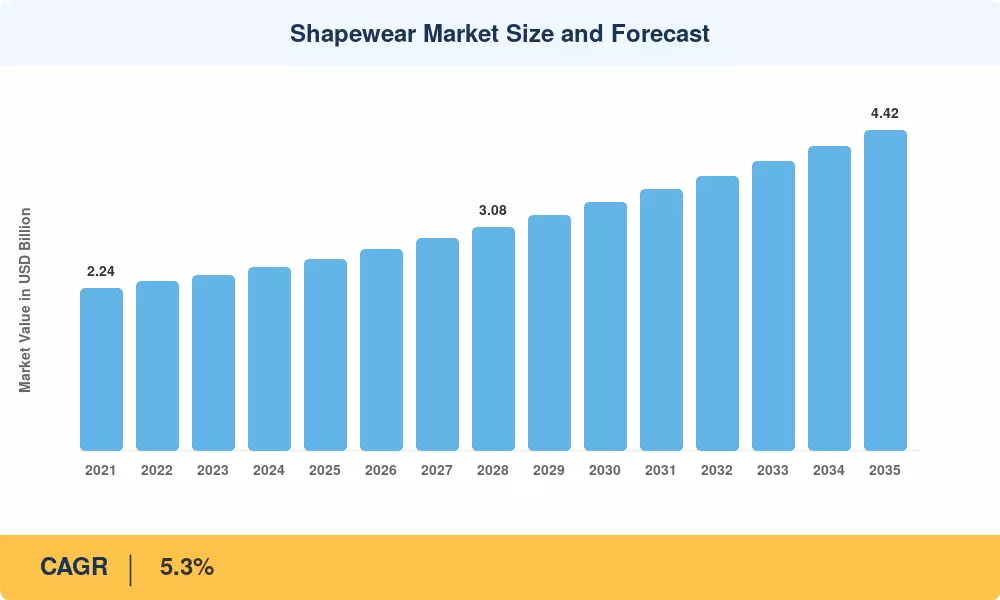
Shapewear Market Size and Forecast
Our Impact
Enabled $4.3B Revenue Impact for Fortune 500 and Leading Multinationals
Partnering with 2000+ Global Organizations Each Year
30K+ Citations by Top-Tier Firms in the Industry

Driver Impact Analysis

Driver ~% Impact on CAGR Geographic Relevance Impact Timeline
Body positivity and confidence culture 18–22% Global Long-term (≥4 yr)
Rising global obesity prevalence 15–18% Global Long-term (≥4 yr)
E-commerce and social commerce penetration 14–17% North America, Asia-Pacific Short-term (≤2 yr)
Inclusive sizing and gender expansion 10–13% North America, Europe Medium-term (2–4 yr)
Fabric technology advancement 8–11% Global Medium-term (2–4 yr)
Celebrity and influencer brand launches 7–10% North America, Europe Short-term (≤2 yr)
Postpartum and medical recovery demand 6–8% Global Long-term (≥4 yr)


Body Positivity and Confidence Culture

Cultural perceptions around shapewear have undergone a fundamental shift. Rather than being positioned as a corrective product, leading brands now frame shapewear as a self-expression tool. The global Shapewear Market has benefited directly from this narrative pivot: consumer surveys by Euromonitor in 2024 indicated that 62% of shapewear buyers cited "feeling confident" rather than "hiding imperfections" as their primary motivation [1]. Social media amplification of diverse body representation has turned shapewear into a visible, aspirational category.

Rising Global Obesity Prevalence

The World Obesity Federation reported in 2023 that over 2.2 billion adults were classified as overweight or obese, a figure expected to reach 3.3 billion by 2035 [13]. This demographic expansion has a direct commercial implication for the Shapewear Market: larger consumer pools seeking comfortable compression garments for everyday wear. Brands that have extended size ranges to 5XL and 6XL report 25–30% faster sell-through in extended-size SKUs compared to standard lines, according to NPD Group retail tracking data [6].

E-Commerce and Social Commerce Penetration

Online channels accounted for roughly 38% of Shapewear Market sales in 2025, and that share is climbing. Virtual try-on tools powered by augmented reality have reduced return rates by an estimated 18% at early adopters like SKIMS and Shapellx [5]. TikTok Shop and Instagram Checkout have created impulse-purchase pathways that bypass traditional retail entirely, with social commerce estimated to contribute USD 0.35 Billion to shapewear revenue globally in 2025 [11].

Inclusive Sizing and Gender Expansion

Men's shapewear remains nascent — roughly 8% of global Shapewear Market revenue in 2025 — but it is growing at nearly double the overall category rate. Brands including Spanx, Leonisa, and Under Armour have expanded men's compression lines targeting both fitness enthusiasts and professional-wear consumers. Grandview's 2024 consumer segmentation study estimated the men's shapewear addressable market at USD 0.55 Billion by 2030.


Restraints Impact Analysis

The restraint estimates below are directional and represent headwinds that partially offset the growth drivers described in Section 4. They do not subtract directly from the CAGR figure.

Restraint ~% Drag on CAGR Geographic Relevance Impact Timeline
Price sensitivity in emerging markets –3 to –5% Asia-Pacific, South America Long-term (≥4 yr)
Comfort and wearability concerns –2 to –4% Global Medium-term (2–4 yr)
Sustainability and waste criticism –2 to –3% Europe, North America Medium-term (2–4 yr)
Counterfeit and unregulated products –1 to –3% Asia-Pacific, MEA Short-term (≤2 yr)
Seasonal demand fluctuation –1 to –2% Global Short-term (≤2 yr)


Price Sensitivity in Emerging Markets

Premium shapewear from global brands retails between USD 40 and USD 120 per unit, a price band that exceeds discretionary budgets for many consumers in South Asia, Southeast Asia, and sub-Saharan Africa. Local unbranded alternatives selling at USD 5–15 dominate volume in these regions, limiting revenue capture for established Shapewear Market players. Until mid-tier product lines at the USD 15–30 price point achieve sufficient scale, price remains a structural barrier to penetration in lower-income demographics [8].

Comfort and Wearability Concerns

Despite fabric innovation, a persistent segment of consumers associates shapewear with discomfort, restricted breathing, and skin irritation. A 2024 survey by Cotton Incorporated found that 29% of lapsed shapewear buyers cited physical discomfort as the reason for discontinuation [15]. The Shapewear Market must continue investing in medical-grade compression calibration and hypoallergenic materials to overcome this perception gap.

Sustainability and Waste Criticism

Shapewear products rely heavily on nylon and elastane blends — synthetic materials with limited recyclability. European regulatory frameworks, including the EU Strategy for Sustainable and Circular Textiles adopted in 2022, increasingly require extended producer responsibility for synthetic garments. Compliance costs are projected to add 4–6% to production expenses for Shapewear Market manufacturers selling into Europe by 2028 [10].


Shapewear Market Opportunities

Smart Textiles and Wearable Integration

Embedding bio-sensing fibers into shapewear garments opens up a hybrid wellness-fashion niche. Early prototypes out of textile research laboratories can monitor posture, core temperature and muscular involvement in real-time. If development timetables hold, commercially viable smart shapewear could be on store shelves by 2029, generating a premium tier for the Shapewear Market that is projected to be worth USD 0.20 Billion annually by 2032 [2].


Subscription and Replenishment Commerce

Shapewear garments have a finite compression lifespan, usually 6 to 12 months, making them perfect candidates for subscription replenishment models. Brands that utilize auto-ship programs can increase customer lifetime value by 30–40% and add more stability to the demand forecasts for the Shapewear Market [11].


Emerging Market Penetration via Localized Pricing

India, Brazil and Nigeria combined account for approximately 1.8 billion consumers with expanding discretionary spend but limited exposure to branded shapewear. Unit costs can come down to below USD 10 through localized manufacturing partnerships, allowing the Shapewear Market to cater to price-sensitive consumers. India’s domestic textile incentive scheme (PLI for Textiles, 2021) provides an extra cost break for local manufacturing [8].


Medical and Postpartum Recovery Segment

Postpartum recovery shapewear is a hybrid between a medical device and a fashion item. In the U.S. and Western Europe, hospital partnerships and OB-GYN referral programs have been proven to have a 22% greater conversion rate than direct-to-consumer advertising for recovery garments. The Shapewear Market can increase incremental income through the adoption of medical-channel distribution and clinical endorsement [14].


Data-Driven Personalization and Custom Fit

3D body-scanning kiosks and at-home scanning apps generate precise measurement data that enables mass customization. Brands like Shapellx have piloted AI-driven size recommendation engines that reduce return rates by up to 25%. The monetization potential extends beyond fit accuracy: aggregated anonymized body-data analytics can inform product development cycles across the Shapewear Market, reducing time-to-market for new styles [2].


Shapewear Market Future Outlook

AI-Powered Personalization and Virtual Fitting

Artificial intelligence will reshape how consumers interact with shapewear. By 2028, an estimated 40% of online Shapewear Market purchases will involve some form of AI-driven size or style recommendation. Computer-vision algorithms trained on millions of body scans can now predict optimal compression zones with 92% accuracy, drastically reducing fit-related returns and boosting consumer satisfaction [2].

Athleisure Convergence and Category Blurring

The boundary between shapewear and activewear is dissolving. Performance-compression leggings that double as everyday shapewear represent a USD 0.45 Billion sub-category growing at roughly 7% annually. The Shapewear Market stands to benefit as fitness-conscious consumers demand garments that transition seamlessly from gym to office to social settings, a trend that athletic brands like Under Armour and Nike are already capitalizing on.

Circular Economy and Material Innovation

Sustainability mandates will move from competitive differentiator to market-entry requirement by the early 2030s. Biodegradable elastane alternatives — including bio-based spandex derived from castor oil — are currently in advanced pilot stages, with commercial scalability expected by 2029. The Shapewear Market's reliance on synthetic fibers makes it particularly exposed to extended producer responsibility regulations, but early adopters of circular design principles can capture margin premiums of 10–15% [10].

Male and Gender-Neutral Expansion

Men's shapewear is projected to reach roughly 12% of the total Shapewear Market by 2035, up from 8% in 2025. Gender-neutral branding strategies — exemplified by SKIMS' expansion beyond women's lines — are normalizing shapewear usage across demographics. Medical endorsement for posture-corrective garments among desk-bound professionals provides an additional demand lever that transcends traditional fashion-driven purchasing.


Shapewear Market Segmentation

By Type

Segment Key Metric Primary Demand Driver
Full-Body Shapers 33% share (2025) Bridal, formal occasion, and postpartum demand
High-Waist Shapers CAGR of 5.9% Everyday wear adoption and athleisure crossover
Shapewear Panties USD 0.66 Billion (2025) Accessible pricing and entry-level purchase behavior
Others 12% share (2025) Specialty products including arm shapers and thigh bands


Full-Body Shapers lead the Shapewear Market by type, commanding a third of global revenue. These products serve high-involvement purchase occasions — weddings, galas, and postpartum recovery — where consumers are willing to pay premiums ranging from USD 60 to USD 150 per unit. High-Waist Shapers are the fastest-growing segment, driven by the convergence of casualwear and light compression. As work-from-home culture permanently altered wardrobe priorities, consumers shifted toward comfort-first garments that still offer silhouette enhancement.

Shapewear Panties represent the highest-volume, lowest-unit-price segment in the Shapewear Market, functioning as a gateway product that introduces new consumers to the category. Specialty items in the "Others" category — including targeted arm compression sleeves and thigh-shaping bands — cater to niche use cases and are gaining traction through social media marketing.

By Distribution Channel

Segment Key Metric Primary Demand Driver
Online Retail Stores 38% share (2025) Social commerce, virtual try-on technology
Specialty Stores CAGR of 4.2% Personalized fitting expertise
Supermarket/Hypermarket USD 0.45 Billion (2025) Convenience-driven impulse purchasing
Other Distribution Channels 8% share (2025) Department stores and catalog retail


Online Retail Stores dominate the Shapewear Market distribution landscape, fueled by influencer-led product discovery and direct-to-consumer brand models. Specialty stores — including lingerie boutiques and brand-owned retail locations — maintain relevance through tactile product experience and expert fitting consultations that reduce buyer uncertainty, particularly for premium full-body products.


Regional Market Share Analysis

Region Key Metric Primary Investment Themes
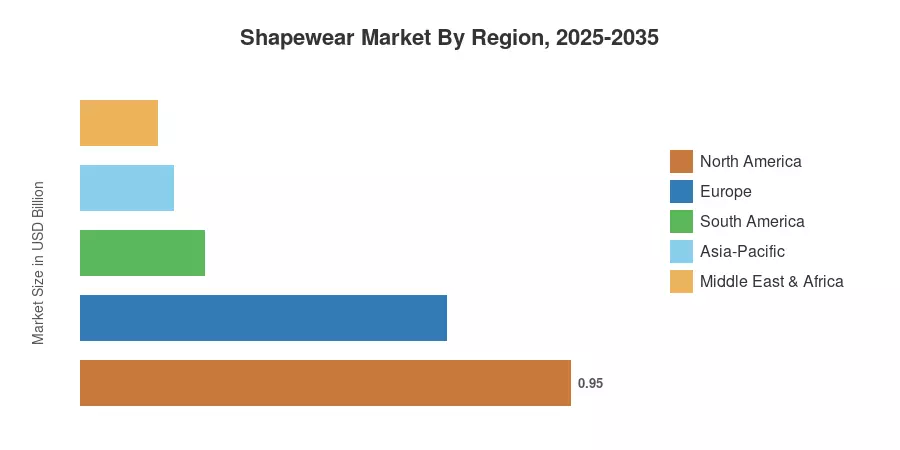
North America 36% share (2025) DTC brand proliferation, inclusive sizing
Europe USD 0.71 Billion (2025) Sustainability compliance, premium positioning
Asia-Pacific 6.8% CAGR (2026–2035) Urbanization, e-commerce infrastructure
South America 9% share (2025) Localized manufacturing, price accessibility
Middle East & Africa USD 0.15 Billion (2025) Modest fashion integration, retail modernization
Total USD 2.64 Billion (2025)

The Shapewear Market exhibits distinct regional dynamics shaped by consumer purchasing power, cultural attitudes toward body aesthetics, retail infrastructure maturity, and regulatory environments. North America leads in total value, while Asia-Pacific presents the highest trajectory of growth through 2035.


North America

Country Key Metric Key Driver
United States 78% of regional share Celebrity brand ecosystems and social commerce
Canada CAGR of 4.9% Health-conscious consumer culture
Mexico USD 0.06 Billion (2025) Growing middle-class retail spending


The United States anchors North America's Shapewear Market dominance through a mature DTC ecosystem and high per-capita discretionary spending. Celebrity-backed brands — including SKIMS, which achieved a USD 4 Billion valuation in 2023 — have elevated category visibility beyond traditional intimate-wear aisles [7]. Canada's growth is supported by cross-border e-commerce access and rising health-and-wellness spending, while Mexico's expanding urban middle class offers a nascent but accelerating opportunity for the Shapewear Market.

Europe

Country Key Metric Key Driver
Germany 22% of the regional share Premium product preference
United Kingdom CAGR of 5.2% Strong online retail culture
France USD 0.09 Billion (2025) Luxury intimate-wear tradition
Italy 11% of regional share Fashion industry influence
Spain CAGR of 4.8% Tourism-driven seasonal demand
Nordic Countries USD 0.05 Billion (2025) Sustainability-driven purchasing
Russia 6% of regional share Import substitution dynamics
Rest of Europe CAGR of 4.5% Varied emerging demand


Europe's Shapewear Market leans heavily toward premium and sustainability-certified products. The EU's Circular Textiles Strategy is pushing manufacturers toward recyclable fiber blends, and early movers are commanding 15–20% price premiums for eco-labeled shapewear. Germany and the United Kingdom together account for over 40% of regional consumption, while France maintains a niche positioning rooted in its luxury lingerie heritage [10].

Asia-Pacific

Country Key Metric Key Driver
China 35% of regional share Domestic brand growth and social commerce
India CAGR of 7.6% Rising disposable incomes and urbanization
Japan USD 0.07 Billion (2025) An aging population and posture-support demand
South Korea CAGR of 6.9% K-beauty influenced body aesthetics
ASEAN 14% of regional share E-commerce expansion across Southeast Asia
Rest of Asia-Pacific USD 0.03 Billion (2025) Early-stage market development


Asia-Pacific represents the highest-growth frontier for the Shapewear Market. China's domestic brands — including Ubras, Bananain, and local Taobao-native labels — are challenging Western incumbents through aggressive pricing and livestream commerce. India's shapewear penetration remains below 5% of the intimate-wear category, but rising per-capita income and growing fashion consciousness among urban women position the country as a high-potential market through 2035 [8].

South America

Country Key Metric Key Driver
Brazil 58% of regional share Cultural emphasis on body aesthetics
Argentina CAGR of 5.1% Growing online retail adoption
Rest of South America USD 0.04 Billion (2025) Fragmented early-stage markets


Brazil's deep-rooted cultural focus on body aesthetics makes it the undisputed anchor of South America's Shapewear Market. Domestic brands like Leonisa and Lupo compete effectively against global entrants through localized sizing and distribution networks. Argentina's inflationary environment creates pricing volatility, but digital retail channels are mitigating some distribution friction.

Middle East & Africa

Country Key Metric Key Driver
Saudi Arabia 28% of the regional share Rising female workforce participation
UAE CAGR of 5.8% Premium retail and tourism-driven demand
South Africa USD 0.02 Billion (2025) Expanding urban middle class
Egypt 12% of regional share Growing youth population
Rest of MEA CAGR of 4.3% Infrastructure-dependent development


The Middle East & Africa region remains the smallest contributor to the Shapewear Market but carries meaningful upside. Saudi Arabia's Vision 2030 reforms, which have increased female labor force participation from 17% to over 33% between 2017 and 2024, are directly correlated with rising demand for professional and occasion-wear shapewear. The UAE benefits from high-spending expatriate and tourist populations that gravitate toward premium product tiers [17].


Shapewear Market By Region, 2025-2035

Competitive Benchmarking

The Shapewear Market exhibits medium concentration with the top five players collectively holding an estimated 35–42% of global revenue. The competitive environment blends established intimate-wear conglomerates with fast-scaling DTC challengers. Market fragmentation is higher in Asia-Pacific and South America, where local brands dominate through pricing advantages and cultural alignment. Brand equity, product innovation speed, and social media engagement serve as the primary differentiators.

Company Est. Revenue Share Range Key Offerings for Shapewear Market Strategic Positioning
Spanx 8–11% Bodysuits, high-waist briefs, leggings Pioneer brand with premium DTC focus
Hanesbrands Inc. 7–10% Maidenform shapewear, everyday compression Mass-market scale across retail channels
Wacoal Holdings Corp. 5–8% Premium full-body shapers, wireless bras Specialty intimate-wear expertise in Asia and North America
SKIMS 5–7% Inclusive-size bodysuits, sculpting shorts Celebrity-driven DTC with rapid size expansion
Jockey International 4–6% Shaping slips, control briefs Heritage brand leveraging trusted retail relationships
Triumph International 3–5% Full-body and waist shapers European and Asian market penetration
Leonisa 3–5% Postpartum recovery, high-waist panties Latin America specialist with localized sizing
Dermawear 2–4% Men's and women's shapewear India-focused brand with medical positioning
Shapellx 2–3% INNER ARMOR series, sculpting bodysuits Innovation-led DTC with sustainability positioning
Under Armour 1–3% Compression base layers, performance shapewear Athletic crossover appealing to fitness-oriented buyers


Recent News & Developments

  • Shapellx (April 2024): Unveiled the INNER ARMOR shapewear series featuring advanced compression engineering, reinforcing its position as an innovation-driven DTC challenger in the Shapewear Market [7].
  • SKIMS (July 2023) Closed a USD 270 Million funding round at a USD 4 Billion valuation, accelerating international distribution plans across Europe and Asia [7].


  • EU Commission (March 2024): Published the final implementing rules for the Strategy for Sustainable and Circular Textiles, requiring extended producer responsibility for synthetic garments sold in EU member states starting 2027 [10].


Shapewear Market Report Scope

Parameter Detail
Market Scope Global Shapewear Market covering type, distribution channel, and regional segmentation
Study Period 2021–2035
CAGR (2026–2035) 5.3%
Market Size (2025) USD 2.64 Billion
Market Size (2035) USD 4.42 Billion
Fastest Growing Region Asia-Pacific (CAGR 6.8%)
Fastest Growing Segment High-Waist Shapers (CAGR 5.9%)
Companies Profiled 10 (Spanx, Hanesbrands Inc., Wacoal Holdings Corp., SKIMS, Jockey International, Triumph International, Leonisa, Dermawear, Shapellx, Under Armour)
Valuation Currency USD Billion


FAQs

How should institutional investors evaluate shapewear brand acquisition targets?
Prioritize brands with over 60% DTC revenue mix, verified inclusive sizing above 4XL, and repeat-purchase rates exceeding 30%. These metrics signal defensible customer loyalty and margin resilience [20].
What minimum order quantities do private-label shapewear manufacturers typically require?
Most contract manufacturers in China and Vietnam set MOQs between 500 and 2,000 units per SKU. Smaller runs are available from Turkish and Colombian factories at a 15–20% cost premium [21].
How does compression-level grading affect product liability for Shapewear Market sellers?
Medical-grade compression (above 20 mmHg) may trigger device-classification requirements in the EU and United States. Sellers should verify regulatory thresholds before marketing recovery-grade products [14].
What return-rate benchmarks should DTC Shapewear Market brands target?
Industry-leading DTC brands achieve return rates of 15–18%, compared to the 25–30% category average. Virtual try-on tools and AI size guides are the primary drivers of lower returns [5].
Which fabric certifications carry the most weight with European Shapewear Market buyers?
OEKO-TEX Standard 100 and Global Recycled Standard are the two most recognized certifications. Products carrying both achieve 12–18% higher conversion rates in Germany and Scandinavia [10].
How are tariff structures affecting cross-border shapewear pricing in 2025?
US Section 301 tariffs add 7.5–25% to China-origin intimate apparel imports. Brands are mitigating exposure by diversifying sourcing to Vietnam, Bangladesh, and Sri Lanka [16].
What warehouse and fulfillment considerations are unique to the Shapewear Market?
Shapewear requires climate-controlled storage to preserve elastane integrity. Excessive heat degrades compression fibers, making cold-chain-adjacent warehousing essential for inventory beyond 90 days [22].    
Author
Author
Author Profile
Snehal Singh LinkedIn
Manager - Research
High acumen in analyzing complex macro & micro markets with more than 6 years of work experience in the field of market research. By implementing her analytical skills in forecasting and estimation into market research reports, she has expertise in Packaging, Construction, and Equipment domains. She handles a team size of 20-25 resources and ensures smooth running of the projects, associated marketing activities, and client servicing.

Research Approach

Secondary Research

The secondary research process involved comprehensive analysis of regulatory databases, trade publications, textile industry journals, and authoritative economic organizations. Key sources included the US Consumer Product Safety Commission (CPSC), Federal Trade Commission (FTC) Textile Labeling Rules, Environmental Protection Agency (EPA) textile sustainability guidelines, Occupational Safety and Health Administration (OSHA) apparel manufacturing standards, European Chemicals Agency (ECHA) REACH regulations for textiles, American Apparel & Footwear Association (AAFA), National Retail Federation (NRF), World Trade Organization (WTO) textile trade statistics, International Trade Centre (ITC), US Census Bureau Annual Survey of Manufactures, Bureau of Labor Statistics Consumer Expenditure Surveys, UN Comtrade Database, World Bank Textile and Apparel Value Chain data, International Labour Organization (ILO) garment sector reports, Textile Exchange Industry Reports, Council of Fashion Designers of America (CFDA) market data, and national statistics offices from key manufacturing hubs including China National Bureau of Statistics, Eurostat Textile Production data, and India Ministry of Textiles annual reports. These sources were utilized to collect production volume data, import/export trade flows, fiber consumption statistics, consumer spending patterns, regulatory compliance requirements, and sustainability certification frameworks for compression garments, seamless shapewear, corsetry, and body shaping apparel across nylon, spandex, cotton, and latex material segments.


Primary Research

During the primary research process, both supply-side and demand-side stakeholders were interviewed to gather qualitative and quantitative views. Supply-side sources were CEOs, Chief Product Officers, heads of sustainability, and commercial directors from shapewear companies, intimate clothing manufacturers, textile mills, and OEM suppliers. Fashion buyers from department shops and specialty stores, e-commerce merchandising directors, boutique owners, fashion stylists, and procurement leads from multi-brand lingerie chains were all part of the demand side. Primary research confirmed market segmentation by product type (bodysuits vs. shaping briefs), confirmed material innovation pipelines (sustainable spandex alternatives, recycled nylon adoption), and gathered insights on sizing inclusivity trends, direct-to-consumer pricing strategies, and omnichannel distribution dynamics.

Primary Respondent Breakdown:

• By Designation: C-level Primaries (42%), Director Level (25%), Others (33%)

• By Region: North America (32%), Europe (30%), Asia-Pacific (28%), Rest of World (10%)


Market Size Estimation

Global market valuation was derived through revenue mapping and volume analysis across compression wear categories. The methodology included:

• Identification of 60+ key manufacturers and private label suppliers across North America, Europe, Asia-Pacific, and Latin America, spanning established shapewear specialists, intimate apparel conglomerates, and athletic compression wear companies

• Product mapping across body briefs, seamless shapewear, control camisoles, long legs, corsets, bodysuits, and plus-size categories, segmented by material composition (nylon, spandex/elastane, cotton, latex, polyester blends)

• Analysis of reported and modeled annual revenues specific to shapewear and body contouring apparel portfolios, corporate filings, and segment disclosures for publicly traded parent companies (Van de Velde, Wacoal Holdings, Golden Lady Company)

• Coverage of manufacturers and retail brands representing 75-80% of global market share in 2024, including direct brand sales, wholesale to retailers, and private label manufacturing

• Extrapolation using bottom-up (unit shipment volume × average selling price by country/region, adjusted for channel mix between store-based and non-store-based) and top-down (manufacturer revenue validation and retail point-of-sale data triangulation) approaches to derive segment-specific valuations by gender (women's vs. men's shapewear), size category (medium, plus-size, petite), and compression level (light, medium, firm)

Download Free Sample

Kindly complete the form below to receive a free sample of this Report

Download PDF ×

We do not share your information with anyone. However, we may send you emails based on your report interest from time to time. You may contact us at any time to opt-out.














