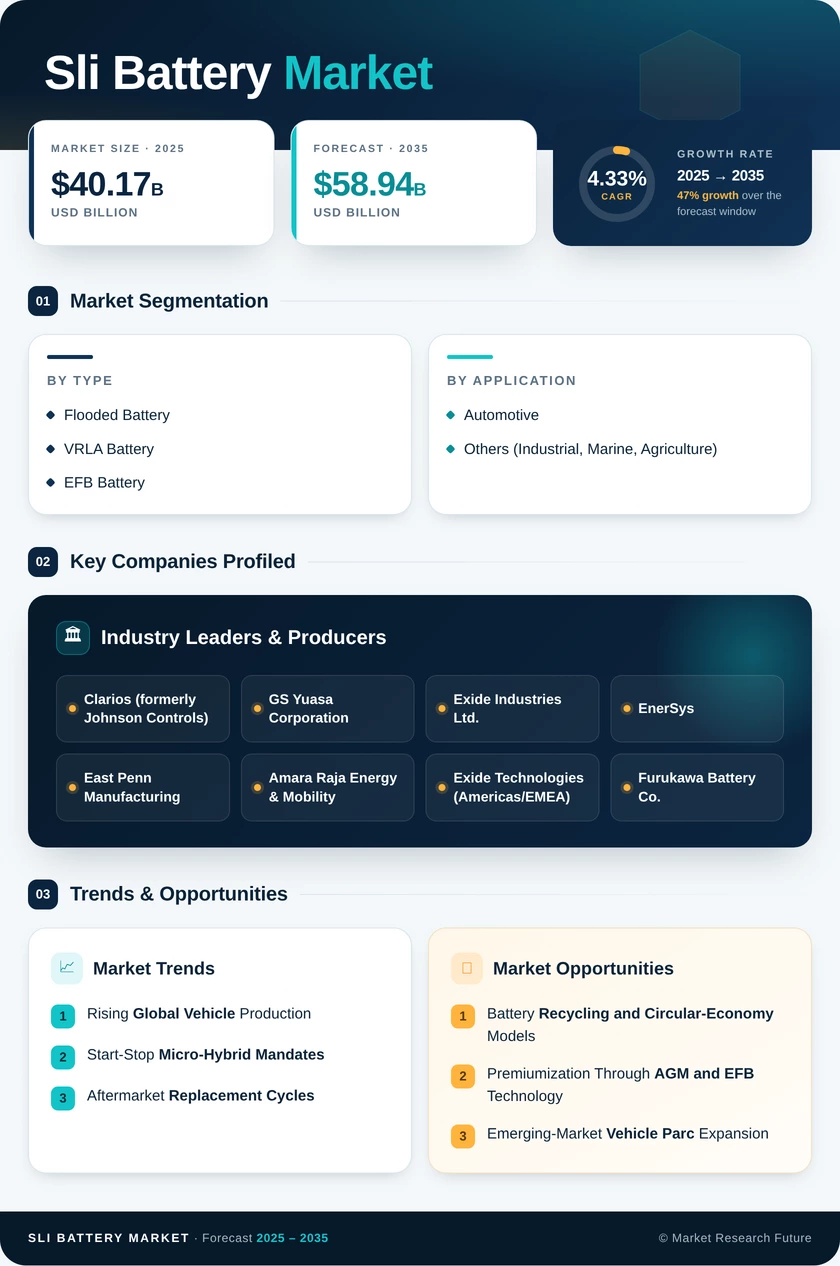
SLI Battery Market

ID: MRFR/EnP/27452-HCR
100 Pages
Chitranshi Jaiswal
Last Updated: June 04, 2026
Sli Battery Market Research Report By Type (Lithium-ion batteries, Lead-acid batteries, Nickel-cadmium batteries, Polymer batteries), By Application (Power tools, Electric vehicles, Consumer electronics, Energy storage systems, Uninterruptible power supplies), By Voltage (12V, 24V, 48V, 60V, 120V, 240V), By Capacity (Under 20 Ah, 20-50 Ah, 50-100 Ah, Over 100 Ah), By Shape (Cylindrical, Prismatic, Pouch) and By Regional (North America, Europe, South America, Asia Pacific, Middle East and Africa) - Forecast to 2035
Download PDF ×

We do not share your information with anyone. However, we may send you emails based on your report interest from time to time. You may contact us at any time to opt-out.

  1. 1 Market Overview |
    1. 1.1 Study Assumptions & Market Definition |
    2. 1.2 Scope of the Study |
    3. 1.3 Research Methodology
  2. 2 Market Summary & Key Takeaways
  3. 3 Market Dynamics |
    1. 3.1 Market Drivers Analysis | |
      1. 3.1.1 Rising Global Vehicle Production | |
      2. 3.1.2 Start-Stop Micro-Hybrid Mandates | |
      3. 3.1.3 Aftermarket Replacement Cycles | |
      4. 3.1.4 Agricultural and Industrial SLI Demand | |
      5. 3.1.5 OEM Cold Cranking Amps Upgrades | |
      6. 3.1.6 Expansion of Organized Distribution | |
      7. 3.1.7 Two-Wheeler Electrification Lag |
    2. 3.2 Market Restraints Analysis | |
      1. 3.2.1 Li-Ion / LFP Adoption in BEVs | |
      2. 3.2.2 Lead-Emission and Environmental Regulations | |
      3. 3.2.3 Raw-Material Cost Volatility | |
      4. 3.2.4 BEV Fleet Penetration Reducing ICE Parc | |
      5. 3.2.5 Counterfeit / Substandard Battery Imports |
    3. 3.3 Market Opportunity Analysis | |
      1. 3.3.1 Battery Recycling and Circular-Economy Models | |
      2. 3.3.2 Premiumization Through AGM and EFB Technology | |
      3. 3.3.3 Emerging-Market Vehicle Parc Expansion | |
      4. 3.3.4 Smart Battery Monitoring and IoT Integration | |
      5. 3.3.5 Dual-Battery Architectures in 48 V Mild Hybrids |
    4. 3.4 Industry Value Chain Analysis |
    5. 3.5 Porter's Five Forces Analysis
  4. 4 Global SLI Battery Market Size & Forecast (2021–2035) |
    1. 4.1 Historical Market Size (2021–2025) |
    2. 4.2 Current & Forecast Market Size (2026–2035) |
    3. 4.3 Market Size by Revenue (USD Billion) |
    4. 4.4 Year-over-Year Growth Analysis
  5. 5 Segmentation Analysis |
    1. 5.1 By Type | |
      1. 5.1.1 Flooded Battery | |
      2. 5.1.2 VRLA Battery | |
      3. 5.1.3 EFB Battery |
    2. 5.2 By End-User | |
      1. 5.2.1 Automotive | |
      2. 5.2.2 Others (Industrial, Marine, Agriculture)
  6. 6 Regional Analysis |
    1. 6.1 North America | |
      1. 6.1.1 United States | |
      2. 6.1.2 Canada | |
      3. 6.1.3 Mexico |
    2. 6.2 Europe | |
      1. 6.2.1 Germany | |
      2. 6.2.2 United Kingdom | |
      3. 6.2.3 France | |
      4. 6.2.4 Italy | |
      5. 6.2.5 Spain | |
      6. 6.2.6 Nordic Countries | |
      7. 6.2.7 Russia | |
      8. 6.2.8 Rest of Europe |
    3. 6.3 Asia-Pacific | |
      1. 6.3.1 China | |
      2. 6.3.2 India | |
      3. 6.3.3 Japan | |
      4. 6.3.4 South Korea | |
      5. 6.3.5 ASEAN | |
      6. 6.3.6 Rest of Asia-Pacific |
    4. 6.4 South America | |
      1. 6.4.1 Brazil | |
      2. 6.4.2 Argentina | |
      3. 6.4.3 Rest of South America |
    5. 6.5 Middle East & Africa | |
      1. 6.5.1 Saudi Arabia | |
      2. 6.5.2 UAE | |
      3. 6.5.3 South Africa | |
      4. 6.5.4 Egypt | |
      5. 6.5.5 Rest of MEA
  7. 7 Competitive Landscape |
    1. 7.1 Market Share Analysis (2025) |
    2. 7.2 Competitive Benchmarking Matrix |
    3. 7.3 Company Profiles | |
      1. 7.3.1 Clarios | |
      2. 7.3.2 GS Yuasa Corporation | |
      3. 7.3.3 Exide Industries Ltd. | |
      4. 7.3.4 EnerSys | |
      5. 7.3.5 East Penn Manufacturing | |
      6. 7.3.6 Amara Raja Energy & Mobility | |
      7. 7.3.7 Exide Technologies (Americas/EMEA) | |
      8. 7.3.8 Furukawa Battery Co. | |
      9. 7.3.9 Camel Group Co. | |
      10. 7.3.10 Hankook AtlasBX
  8. 8 Future Outlook & Strategic Recommendations (2026–2035) |
    1. 8.1 48 V Mild-Hybrid Architecture and Dual-Battery Demand |
    2. 8.2 Circular Economy and Closed-Loop Lead Recycling |
    3. 8.3 Digitalization of Aftermarket Distribution |
    4. 8.4 Climate Adaptation and Performance Engineering
  9. 9 Recent Developments & News
  10. 10 Frequently Asked Questions (FAQs)
  11. 11 Report Scope & Methodology |
    1. 11.1 Study Period & Base Year |
    2. 11.2 Data Sources & Citations |
    3. 11.3 Abbreviations
  12. 1 LIST OF TABLES
  13. 2 LIST OF FIGURES

Segmentation Quick Reference

DimensionSub-SegmentsDominant SegmentFastest Growing Segment
By TypeFlooded Battery, VRLA Battery, EFB BatteryFlooded BatteryVRLA Battery
By End-UserAutomotive, Others (Industrial, Marine, Agriculture)AutomotiveOthers
By RegionNorth America, Europe, Asia-Pacific, South America, Middle East & AfricaAsia-PacificAsia-Pacific


Market Segmentation Overview

By Type

Sub-SegmentKey Trend
Flooded BatteryDominant in cost-sensitive aftermarket channels; share gradually declining as AGM/EFB adoption rises
VRLA BatteryFastest-growing type driven by AGM start-stop mandates and premium OEM fitment programs
EFB BatteryEmerging as the cost-effective start-stop solution, particularly among European volume automakers


Flooded batteries remain the backbone of global SLI supply due to their established manufacturing base and low unit cost. VRLA and EFB technologies are capturing an increasing share as OEMs and aftermarket buyers upgrade to products that support start-stop functionality and deeper cycling demands in modern vehicles.

By End-User

Sub-SegmentKey Trend
AutomotivePassenger cars, commercial vehicles, and two-wheelers drive the vast majority of SLI battery consumption
Others (Industrial, Marine, Agriculture)Growing steadily as tractor fleets, marine vessels, and standby generators expand in emerging economies


The automotive segment benefits from both OEM-fitment and aftermarket replacement demand, with the replacement channel contributing the larger revenue share. Non-automotive applications, while smaller, offer higher per-unit margins in specialized formats and ruggedized configurations.