Download Free Sample
Kindly complete the form below to receive a free sample of this Report
Slow and Controlled Release Pesticide Market Size, Share, Industry Trend & Analysis Research Report By Type (Capsules & Microencapsulation, Coated Granules, Controlled Release Pellets, Slow Release Briquettes), By Release Mechanism (Diffusion, Dissolution, Erosion), By Application (Agriculture, Horticulture, Forestry, Turf and Ornamentals), By Crop Type (Cereals & Grains, Oilseeds & Pulses, Fruits & Vegetables, Turf & Ornamentals), By Target Pest (Insects, Fungi, Weeds, Rodents) and By Regional (North America, Europe, South America, Asia-Pacific, Middle East and Africa) - Forecast to 2035.
As per MRFR analysis, the Slow and Controlled Release Pesticide Market was estimated at 10.83 USD Billion in 2024. The Slow and Controlled Release Pesticide industry is projected to grow from 11.75 USD Billion in 2025 to 23.84 USD Billion by 2035, exhibiting a compound annual growth rate (CAGR) of 7.4% during the forecast period 2025 - 2035.
The Slow and Controlled Release Pesticide Market is experiencing a transformative shift towards sustainability and innovation.
| 2024 Market Size | 10.83 (USD Billion) |
| 2035 Market Size | 23.84 (USD Billion) |
| CAGR (2025 - 2035) | 7.4% |
The Slow and Controlled Release Pesticide Market is currently experiencing notable transformations driven by advancements in agricultural practices and increasing environmental awareness. As farmers seek sustainable solutions, the demand for products that minimize chemical runoff and enhance efficacy is on the rise. This market appears to be influenced by a growing preference for integrated pest management strategies, which emphasize the use of slow and controlled release formulations to reduce the frequency of applications. Furthermore, regulatory frameworks are evolving, encouraging the development of innovative formulations that align with environmental safety standards. In addition, the Slow and Controlled Release Pesticide Market is likely to benefit from technological innovations that enhance product performance. These innovations may include the incorporation of biodegradable materials and smart delivery systems that optimize the release of active ingredients. As consumers become more conscious of food safety and environmental impacts, the market could see a shift towards products that offer both effectiveness and reduced ecological footprints. Overall, the future of this market seems promising, with potential growth driven by sustainability and technological advancements.
There is a growing emphasis on sustainable agricultural practices, leading to increased interest in slow and controlled release pesticides. These products are perceived as environmentally friendly alternatives that reduce chemical exposure and promote soil health.
Innovations in formulation technologies are enhancing the effectiveness of slow and controlled release pesticides. New delivery systems and biodegradable materials are being developed to improve the precision and efficiency of pesticide applications.
Evolving regulations are shaping the Slow and Controlled Release Pesticide Market. Stricter environmental standards are encouraging manufacturers to create safer, more effective products that comply with new guidelines.
The Global Slow and Controlled Release Pesticide Market Industry experiences a notable increase in demand driven by the growing emphasis on sustainable agricultural practices. Farmers are increasingly adopting eco-friendly pest management solutions to minimize environmental impact while maximizing crop yields. This shift is reflected in the projected market growth, with the industry expected to reach 10.8 USD Billion in 2024. The adoption of slow and controlled release pesticides aligns with global sustainability goals, as these products reduce the frequency of applications and enhance the efficiency of active ingredients, thereby promoting responsible farming practices.
The Slow and Controlled Release Pesticide Market showcases a diverse application segment, with Agriculture representing the largest share due to its extensive usage in crop protection and enhancement. Horticultural applications are also gaining traction, especially among organic growers, who are increasingly opting for these innovative methods. On the other hand, Forestry and Public Health segments, while essential, occupy a smaller share, indicating more concentrated usage within those specific areas. As a result, the distribution reflects the varying preferences and needs of different sectors in pest management.
Agricultural (Dominant) vs. Horticultural (Emerging)
Agricultural applications of slow and controlled release pesticides are pivotal in maximizing crop yield and enhancing pest resistance, thus holding a dominant position in the market. This segment benefits from advancements in technology that allow for targeted delivery and long-lasting effects. In contrast, the Horticultural segment is emerging rapidly, catering to both commercial and residential growers who seek sustainable alternatives. These products are often tailored for specific plant needs, appealing to eco-conscious consumers. With rising demand for organic produce, horticultural applications are expanding, driven by innovations that ensure effective pest control without compromising plant health.
The Slow and Controlled Release Pesticide Market shows a diverse formulation landscape, with granules leading in market share due to their ease of application and effectiveness in releasing active ingredients over time. They cater to a wide range of agricultural needs, making them a preferred choice among farmers. In contrast, liquid formulations, while effective, hold a smaller share as they often require more frequent application, thus driving the popularity of granules further. Microencapsulated pesticides are emerging rapidly in the market, with their unique ability to protect active ingredients and provide sustained release characteristics. This innovative formulation type is attracting attention due to its efficiency and longer-lasting effects, helping to reduce application frequency and improve environmental safety. The growing demand for sustainable agricultural practices is fueling the growth of microencapsulated products, making them a key player in driving market evolution in this segment.
Granules (Dominant) vs. Coated Pellets (Emerging)
Granules are the dominant formulation type within the Slow and Controlled Release Pesticide Market, characterized by their robust performance and ease of handling. They release active ingredients gradually, ensuring a prolonged effect that aligns well with modern agricultural practices. Farmers appreciate their convenience in application, as well as the reduced number of application cycles required. On the other hand, coated pellets represent an emerging segment, providing an innovative solution for controlled release. These formulations are designed to protect the active ingredients from environmental factors while controlling the rate of release. With their growing appeal for higher efficiency and reduced environmental impact, coated pellets are gaining traction in precision agriculture, indicating strong potential for future market growth.
In the Slow and Controlled Release Pesticide Market, the Mode of Action segment presents diverse options such as Systemic, Contact, Repellent, and Insect Growth Regulators. Among these, the Systemic pesticides hold the largest market share due to their ability to be absorbed by plants, providing long-lasting protection against pests. Meanwhile, Contact pesticides are rapidly gaining traction as the fastest-growing segment, favored for their quick action upon application.
Systemic (Dominant) vs. Contact (Emerging)
Systemic pesticides are characterized by their ability to penetrate plant tissues, offering prolonged pest control, which enhances their market position as the dominant force in this sector. These products are particularly valued in agriculture for managing a wide range of pests and diseases, ensuring crop health over extended periods. On the other hand, Contact pesticides, which act by disrupting the pest's external body structures, are emerging as a preferred choice for those seeking immediate effects. Their fast action is favored in situations requiring quick pest management solutions, positioning them as a strong alternative to Systemic options for certain applications.
In the Slow and Controlled Release Pesticide Market, the distribution of market share is prominently led by insect target pesticides, underscoring their significance in pest management strategies across a variety of crops. Weeds and fungi also hold substantial market shares, but insects remain the dominant force influencing market dynamics. Nematodes, although present, capture a relatively smaller portion of the market as growers prioritize insect control to safeguard yields.
Insects: SCR (Dominant) vs. Weeds (Emerging)
Insects represent the dominant category in the Slow and Controlled Release Pesticide Market, driven by the necessity for effective pest control to enhance agricultural productivity. This segment benefits from ongoing innovation, with formulations specifically developed to target key insect pests while minimizing environmental impact. On the other hand, the weed control segment is emerging rapidly, gaining traction due to increasing regulations on herbicide use and the demand for sustainable farming practices. Growers are increasingly adopting slow and controlled release solutions for weed management to ensure long-lasting effects and renew the productivity of their fields. This simultaneous growth showcases a market poised for innovation in both insect and weed pest management.
In the Slow and Controlled Release Pesticide Market, the distribution of market share among the 'End Use' segments shows a clear high demand for Crop Protection, which is recognized as the largest sector. This is attributed to the continuous need for effective crop management practices, especially in the face of increasing agricultural demands. Pest Control follows as a significant segment and is identified as one of the fastest-growing areas as innovations in pesticide formulations evolve to meet contemporary agricultural challenges.
Crop Protection (Dominant) vs. Pest Control (Emerging)
Crop Protection stands out as a dominant force in the Slow and Controlled Release Pesticide Market, representing the core of agricultural methodologies aimed at safeguarding yields. This segment focuses on enhancing plant health and productivity by controlling pests and diseases effectively over extended periods. In contrast, Pest Control emerges as a rapidly developing sector, driven by advancements in pest management techniques and formulation technologies. The surge in environmentally sustainable practices has influenced both consumer preferences and regulatory frameworks, thereby incentivizing the development of innovative pest control solutions that align with ecological safety and compliance.
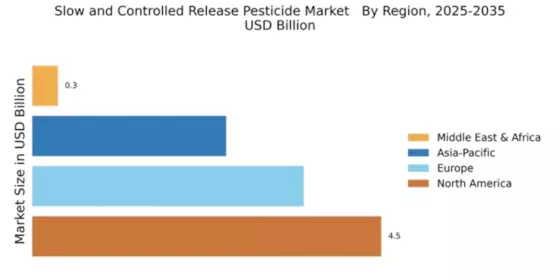
North America is poised to maintain its leadership in the Slow and Controlled Release Pesticide Market, holding a market size of $4.5 billion in 2025. The region's growth is driven by increasing agricultural productivity demands, stringent regulations promoting sustainable practices, and advancements in pesticide formulations. The rising adoption of precision agriculture techniques further fuels demand, ensuring effective pest management while minimizing environmental impact. The United States stands as the largest market, supported by key players like BASF SE, Bayer AG, and FMC Corporation. These companies are investing in R&D to innovate slow-release formulations that enhance efficacy and reduce application frequency. The competitive landscape is characterized by strategic partnerships and acquisitions, enabling firms to expand their product portfolios and market reach, solidifying North America's position as a global leader in this sector.
Europe's Slow and Controlled Release Pesticide Market is projected to reach $3.5 billion by 2025, driven by a strong emphasis on sustainable agricultural practices and regulatory frameworks aimed at reducing chemical usage. The European Union's Green Deal and Farm to Fork Strategy are pivotal in shaping market dynamics, encouraging the adoption of environmentally friendly pest control solutions. This regulatory support is crucial for fostering innovation in slow-release technologies. Leading countries such as Germany, France, and the Netherlands are at the forefront of this market, with significant contributions from companies like Syngenta AG and Bayer AG. The competitive landscape is marked by a focus on research and development, with firms striving to meet stringent EU regulations while addressing the growing consumer demand for organic and sustainable products. This trend is expected to enhance market growth and innovation in the region.
The Asia-Pacific region is witnessing significant growth in the Slow and Controlled Release Pesticide Market, projected to reach $2.5 billion by 2025. This growth is primarily driven by increasing agricultural production needs, rising population, and the adoption of modern farming techniques. Countries like India and China are focusing on enhancing crop yields and pest management efficiency, leading to a surge in demand for innovative pesticide solutions that align with sustainable practices. China and India are the leading markets in this region, with key players such as UPL Limited and Sumitomo Chemical Co., Ltd. actively participating in the market. The competitive landscape is evolving, with local manufacturers emerging alongside global giants, fostering innovation and price competition. As governments promote sustainable agriculture, the demand for slow-release pesticides is expected to rise, further propelling market growth in Asia-Pacific.
The Middle East and Africa (MEA) region represents an emerging market for Slow and Controlled Release Pesticides, with a market size of $0.33 billion projected for 2025. The growth in this region is driven by increasing agricultural activities, government initiatives to enhance food security, and the need for effective pest management solutions. The region's diverse climate and agricultural practices create a unique demand for tailored pesticide solutions that can address local challenges. Countries like South Africa and Kenya are leading the way in adopting slow-release technologies, supported by local and international players. The competitive landscape is characterized by a mix of established companies and new entrants, focusing on innovative products that cater to the specific needs of the region. As awareness of sustainable practices grows, the demand for slow-release pesticides is expected to increase, unlocking significant market potential in MEA.
The Slow and Controlled Release Pesticide Market is currently characterized by a competitive landscape that is both dynamic and multifaceted. Key growth drivers include the increasing demand for sustainable agricultural practices, the need for enhanced crop yields, and the rising awareness of environmental impacts associated with traditional pesticide use. Major players such as BASF SE (DE), Syngenta AG (CH), and Bayer AG (DE) are strategically positioned to leverage these trends. BASF SE (DE) focuses on innovation through research and development, particularly in biopesticides, while Syngenta AG (CH) emphasizes partnerships with local farmers to enhance product efficacy. Bayer AG (DE) is actively pursuing mergers and acquisitions to expand its portfolio, thereby shaping a competitive environment that is increasingly reliant on technological advancements and sustainable practices.In terms of business tactics, companies are localizing manufacturing to reduce costs and optimize supply chains, which appears to be a critical strategy in the current market. The competitive structure of the Slow and Controlled Release Pesticide Market is moderately fragmented, with several key players exerting influence over market dynamics. This fragmentation allows for a variety of product offerings, catering to diverse agricultural needs while fostering innovation among competitors.
In November FMC Corporation (US) announced a strategic partnership with a leading agricultural technology firm to develop precision agriculture solutions that integrate slow-release formulations. This collaboration is significant as it aligns FMC Corporation (US) with the growing trend of digital agriculture, potentially enhancing the effectiveness of their products and providing farmers with data-driven insights for better crop management.
In October Nufarm Limited (AU) launched a new line of slow-release herbicides designed to minimize environmental impact while maximizing crop protection. This product introduction is noteworthy as it reflects Nufarm Limited's (AU) commitment to sustainability and innovation, positioning the company favorably in a market increasingly driven by eco-conscious consumers and regulatory pressures.
In September UPL Limited (IN) expanded its operations in Latin America by acquiring a local pesticide manufacturer, thereby enhancing its distribution capabilities in the region. This acquisition is likely to strengthen UPL Limited's (IN) market presence and enable it to offer tailored solutions that meet the specific needs of local farmers, further intensifying competition in the area.
As of December current competitive trends in the Slow and Controlled Release Pesticide Market are heavily influenced by digitalization, sustainability, and the integration of artificial intelligence (AI) in product development. Strategic alliances are increasingly shaping the landscape, allowing companies to pool resources and expertise to drive innovation. Looking ahead, competitive differentiation is expected to evolve from traditional price-based competition to a focus on technological advancements, sustainable practices, and supply chain reliability, indicating a shift towards a more sophisticated and responsible approach to agricultural pest management.



In 2023, the Slow and Controlled Release Pesticide Market size was estimated at USD 9.93 billion. Increasing adoption of precision farming techniques to reduce environmental impact and improve crop yield is a primary growth driver. Furthermore, rising demand for high-value crops, such as fruits, vegetables, and flowers, is fueling the market's expansion. Asia-Pacific dominated the market in 2023 due to the extensive use of pesticides in agricultural practices and the presence of major agricultural economies like China and India.
The market is expected to witness significant growth in the Middle East and Africa, driven by government initiatives to enhance agricultural productivity and food security.Key recent developments include BASF's launch of Inzen™, a new slow-release fertilizer that optimizes nutrient availability for crops. Additionally, Syngenta has introduced Adepidyn™, a controlled-release insecticide that provides long-lasting protection against key pests. These innovations are poised to shape the future of pest management practices and contribute to the sustainable growth of the Slow and Controlled Release Pesticide Market.
The Slow and Controlled Release Pesticide Market is projected to grow at a 7.4% CAGR from 2025 to 2035, driven by increasing agricultural efficiency and environmental sustainability demands.
New opportunities lie in:
By 2035, the market is expected to achieve robust growth, positioning itself as a leader in sustainable agricultural solutions.
| MARKET SIZE 2024 | 10.83(USD Billion) |
| MARKET SIZE 2025 | 11.75(USD Billion) |
| MARKET SIZE 2035 | 23.84(USD Billion) |
| COMPOUND ANNUAL GROWTH RATE (CAGR) | 7.4% (2025 - 2035) |
| REPORT COVERAGE | Revenue Forecast, Competitive Landscape, Growth Factors, and Trends |
| BASE YEAR | 2024 |
| Market Forecast Period | 2025 - 2035 |
| Historical Data | 2019 - 2024 |
| Market Forecast Units | USD Billion |
| Key Companies Profiled | BASF SE (DE), Syngenta AG (CH), Bayer AG (DE), FMC Corporation (US), Nufarm Limited (AU), ADAMA Agricultural Solutions Ltd. (IL), UPL Limited (IN), Sumitomo Chemical Co., Ltd. (JP), Nippon Soda Co., Ltd. (JP) |
| Segments Covered | Application, Formulation Type, Mode of Action, Target Pest Type, End Use |
| Key Market Opportunities | Advancements in biodegradable formulations enhance sustainability in the Slow and Controlled Release Pesticide Market. |
| Key Market Dynamics | Rising demand for sustainable agriculture drives innovation in slow and controlled release pesticide formulations. |
| Countries Covered | North America, Europe, APAC, South America, MEA |
The projected market valuation for the Slow and Controlled Release Pesticide Market in 2035 is 23.84 USD Billion.
The market valuation for the Slow and Controlled Release Pesticide Market in 2024 was 10.83 USD Billion.
The expected CAGR for the Slow and Controlled Release Pesticide Market during the forecast period 2025 - 2035 is 7.4%.
Key players in the Slow and Controlled Release Pesticide Market include BASF SE, Syngenta AG, Bayer AG, and FMC Corporation.
The main application segments include Agricultural, Horticultural, Forestry, and Public Health.
The valuation of the Agricultural segment in 2024 was 3.25 USD Billion.
In 2024, the Horticultural segment was valued at 2.5 USD Billion, whereas the Public Health segment was valued at 3.58 USD Billion.
Formulation types include Granules, Coated Pellets, Microencapsulated, and Liquid.
The projected valuation for the Microencapsulated formulation type by 2035 is 6.5 USD Billion.



Kindly complete the form below to receive a free sample of this Report

“This is really good guys. Excellent work on a tight deadline. I will continue to use you going forward and recommend you to others. Nice job”


“Thanks. It’s been a pleasure working with you, please use me as reference with any other Intel employees.”


“Thanks for sending the report it gives us a good global view of the Betaïne market.”


“Thank you, this will be very helpful for OQS.”


“We found the report very insightful! we found your research firm very helpful. I'm sending this email to secure our future business.”


“I am very pleased with how market segments have been defined in a relevant way for my purposes (such as "Portable Freezers & refrigerators" and "last-mile"). In general the report is well structured. Thanks very much for your efforts.”


“I have been reading the first document or the study, ,the Global HVAC and FP market report 2021 till 2026. Must say, good info! I have not gone in depth at all parts, but got a good indication of the data inside!”


“We got the report in time, we really thank you for your support in this process. I also thank to all of your team as they did a great job.”


“The Automotive 48V ECU Components Procurement Intelligence Study” was a complex project, but the Market Research Future (MRFR) team handled it with quality, agility, and customer-centricity. They delivered all requested data on time and within the agreed scope. The team, including Shubhendra Anand and Rahul Gotadki, was always readily available to clarify questions and swiftly implement necessary adjustments, driving the project to a successful conclusion within a very demanding timeframe.
I would also like to specifically commend Akshay Agarwal for his responsiveness and support at every stage—from our initial inquiry on May 6th through to final delivery on June 18th. His dedication made the entire process seamless.”



