×
Request Free Sample ×

Kindly complete the form below to receive a free sample of this Report

* Please use a valid business email

Leading companies partner with us for data-driven Insights

clients tt-cursor
Hero Background

Smart Labels Market

ID: MRFR/PCM/0786-HCR
111 Pages
Snehal Singh
October 2025

Smart Labels Market Research Report By Technology (RFID, NFC, QR Codes, Printed Electronics), By Type (Electronic Shelf Labels, In-Mold Labels, Wearable Smart Labels), By End Use (Retail, Logistics, Healthcare, Manufacturing), By Material (Paper, Plastic, Metal, Wood) and By Regional (North America, Europe, South America, Asia Pacific, Middle East and Africa) - Forecast to 2035.

Share:
Download PDF ×

We do not share your information with anyone. However, we may send you emails based on your report interest from time to time. You may contact us at any time to opt-out.

Smart Labels Market Infographic
Purchase Options

Smart Labels Market Summary

As per MRFR analysis, the Smart Labels Market Size was estimated at 9.49 USD Billion in 2024. The Smart Labels industry is projected to grow from 13.84 USD Billion in 2025 to 600.82 USD Billion by 2035, exhibiting a compound annual growth rate (CAGR) of 45.8 during the forecast period 2025 - 2035.

Key Market Trends & Highlights

The Smart Labels Market is poised for substantial growth driven by technological advancements and increasing demand for sustainability.

  • The integration of IoT technology is transforming smart labels, enhancing their functionality and connectivity.
  • North America remains the largest market for smart labels, while Asia-Pacific is emerging as the fastest-growing region.
  • In the retail segment, smart labels are widely adopted, whereas the healthcare segment is experiencing rapid growth due to increased demand for tracking and compliance.
  • Key market drivers include rising demand for supply chain transparency and sustainability initiatives that are fostering innovation in labeling solutions.

Market Size & Forecast

2024 Market Size 9.49 (USD Billion)
2035 Market Size 600.82 (USD Billion)
CAGR (2025 - 2035) 45.8%

Major Players

Avery Dennison (US), Zebra Technologies (US), SATO Holdings (JP), Thin Film Electronics (NO), Smartrac (DE), Checkpoint Systems (US), Cimpress (IE), Invengo Technology (CN), NXP Semiconductors (NL), PragmatIC (GB)

Smart Labels Market Trends

The Smart Labels Market is currently experiencing a transformative phase, driven by advancements in technology and increasing demand for efficient tracking solutions. These labels, which integrate RFID, NFC, and other technologies, are becoming essential in various sectors, including retail, logistics, and healthcare. The growing emphasis on supply chain transparency and inventory management is propelling the adoption of smart labels, as businesses seek to enhance operational efficiency and reduce costs. Furthermore, the rise of e-commerce has intensified the need for accurate tracking and real-time data, making smart labels a vital component in modern logistics and inventory systems. In addition to operational benefits, the Smart Labels Market is also influenced by consumer preferences for sustainability and eco-friendly solutions. As companies strive to meet environmental standards, smart labels that utilize recyclable materials and energy-efficient technologies are gaining traction. This shift not only aligns with corporate social responsibility goals but also appeals to environmentally conscious consumers. Overall, the Smart Labels Market appears poised for continued growth, with innovations and sustainability driving its evolution in the coming years.

Integration of IoT Technology

The integration of Internet of Things (IoT) technology into smart labels is a notable trend. This development allows for enhanced connectivity and data exchange, enabling real-time monitoring and management of assets. As IoT devices proliferate, the synergy between smart labels and IoT is likely to create more efficient supply chains and improve overall operational visibility.

Focus on Sustainability

A growing emphasis on sustainability is shaping the Smart Labels Market. Companies are increasingly seeking eco-friendly labeling solutions that minimize environmental impact. This trend is reflected in the development of biodegradable materials and energy-efficient production processes, which not only meet regulatory requirements but also resonate with consumers' preferences for sustainable products.

Expansion in Healthcare Applications

The healthcare sector is witnessing a significant expansion in the use of smart labels. These labels facilitate better patient management, medication tracking, and asset management within healthcare facilities. As the demand for improved patient safety and operational efficiency rises, smart labels are becoming integral to healthcare logistics and inventory management.

Smart Labels Market Drivers

Rising E-commerce Sector

The expansion of the e-commerce sector serves as a vital driver for the Global Smart Labels Market Industry. With online shopping gaining immense popularity, retailers are adopting smart labels to streamline logistics and enhance customer experience. Smart labels enable efficient tracking of shipments, reducing delivery times and improving customer satisfaction. Furthermore, they assist in managing returns and inventory more effectively. The growth of e-commerce is expected to contribute significantly to the market's valuation, as businesses seek innovative solutions to meet the demands of a rapidly evolving retail landscape.

Market Growth Projections

The Global Smart Labels Market Industry is projected to experience substantial growth, with a market value of 3.9 USD Billion in 2024, anticipated to reach 9.5 USD Billion by 2035. This growth trajectory suggests a robust CAGR of 8.43% from 2025 to 2035, indicating a strong demand for smart labeling solutions across various sectors. The increasing integration of smart labels in logistics, retail, and healthcare highlights their versatility and importance in modern supply chains. As industries continue to innovate and adopt these technologies, the market is likely to witness significant advancements and opportunities.

Technological Advancements

The Global Smart Labels Market Industry experiences robust growth driven by rapid technological advancements. Innovations in RFID, NFC, and QR code technologies enhance the functionality and efficiency of smart labels. For instance, RFID tags are increasingly utilized in supply chain management, enabling real-time tracking of goods. This technology not only reduces operational costs but also improves inventory accuracy. As of 2024, the market is valued at 3.9 USD Billion, with projections indicating a rise to 9.5 USD Billion by 2035. The anticipated CAGR of 8.43% from 2025 to 2035 underscores the potential for continued innovation in this sector.

Environmental Sustainability Initiatives

Environmental sustainability initiatives increasingly influence the Global Smart Labels Market Industry. Companies are adopting eco-friendly practices, including the use of sustainable materials for smart labels. This shift is driven by consumer demand for environmentally responsible products and the need to reduce carbon footprints. Smart labels can also contribute to waste reduction by improving inventory management and minimizing product spoilage. As businesses align their operations with sustainability goals, the market for smart labels is expected to expand, reflecting a growing commitment to environmental stewardship across various sectors.

Regulatory Compliance and Safety Standards

Regulatory compliance and safety standards play a crucial role in shaping the Global Smart Labels Market Industry. Various industries, particularly pharmaceuticals and food, are subject to stringent regulations that necessitate accurate labeling and traceability. Smart labels provide a reliable solution for meeting these compliance requirements, ensuring that products are correctly labeled and monitored throughout the supply chain. This adherence to safety standards not only protects consumers but also enhances brand reputation. As regulations continue to evolve, the demand for smart labels is likely to increase, driving market growth and innovation.

Growing Demand for Supply Chain Transparency

The demand for enhanced supply chain transparency significantly propels the Global Smart Labels Market Industry. Businesses are increasingly adopting smart labels to provide real-time data on product origin, handling, and delivery status. This trend is particularly evident in the food and pharmaceutical sectors, where traceability is crucial for compliance and consumer safety. Smart labels facilitate better inventory management and reduce losses due to spoilage or theft. As companies strive to meet regulatory requirements and consumer expectations, the market is poised for substantial growth, reflecting the increasing importance of transparency in global supply chains.
Market Segment Insights

By Application: Retail (Largest) vs. Healthcare (Fastest-Growing)

The Smart Labels Market displays a dynamic application distribution, with the retail sector emerging as the largest segment due to increasing consumer demand for enhanced shopping experiences and inventory management. Following closely is the logistics application, capitalizing on the need for traceability and efficient supply chain operations. The healthcare sector is also gaining traction, primarily influenced by the growing need for patient monitoring and tracking of medical assets during recovery periods.

Retail: Dominant vs. Healthcare: Emerging

The retail segment stands as the dominant application in the Smart Labels Market, driven by advancements in RFID technology which enable real-time tracking of inventory and improved customer experiences. Retailers leverage smart labels to minimize losses, optimize stock levels, and elevate overall operational efficiency. Conversely, the healthcare sector is characterized as an emerging segment, rapidly adopting smart label technology for tracking medication, monitoring patients, and enhancing safety in medical environments. The healthcare industry's focus on improving patient outcomes and adhering to regulatory standards plays a pivotal role in propelling the demand for innovative labeling solutions.

By Technology: RFID (Largest) vs. NFC (Fastest-Growing)

In the Smart Labels Market, technologies such as RFID, NFC, QR Code, Barcode, and Printed Electronics are pivotal. RFID technology currently holds the largest market share, serving as a cornerstone for inventory management, asset tracking, and logistics. Its advanced capabilities in real-time tracking and data collection make it a leader in this space. Conversely, NFC technology is emerging rapidly and is expected to witness the highest growth rate. As consumer demand for contactless solutions surges, especially in payment systems and smart devices, NFC is poised to capture an increasing share of the smart label market.

RFID (Dominant) vs. NFC (Emerging)

RFID technology stands out in the Smart Labels Market as the dominant force, known for its efficiency and automation in supply chain processes. It enables real-time tracking of products, reducing manual errors and enhancing operational visibility. Its applications span diverse industries, including retail, healthcare, and logistics. On the other hand, NFC technology is emerging as a significant competitor, particularly in mobile payment solutions and consumer engagement. Its short-range communication capability fosters seamless interactions between devices, driving its adoption in smart packaging and interactive marketing. As NFC technology evolves, it is set to complement RFID by offering unique functionalities that enhance customer experiences.

By End Use: Consumer Goods (Largest) vs. Automotive (Fastest-Growing)

In the Smart Labels Market, the distribution of market share among end-use segments reveals that Consumer Goods holds the largest slice. This segment benefits from the increasing demand for smart packaging solutions that enhance product information, authenticity, and traceability. Following closely, Automotive is emerging as a rapidly growing segment, driven by advancements in vehicle technology and demands for improved logistics and supply chain management.

Consumer Goods: Dominant vs. Automotive: Emerging

The Consumer Goods segment is characterized by its dominant presence in the Smart Labels Market, primarily owing to the widespread adoption of smart labeling technologies by manufacturers seeking to improve consumer engagement and brand loyalty. These labels equip products with dynamic features such as QR codes and NFC technology, facilitating easy access to product information. In contrast, the Automotive segment, while still emerging, is gaining significant momentum as manufacturers integrate smart labels into vehicle components for real-time inventory tracking and enhanced safety features. This segment's growth is further fueled by increasing demands for automated systems and connected vehicle technologies.

Get more detailed insights about Smart Labels Market

Regional Insights

North America : Market Leader in Smart Labels

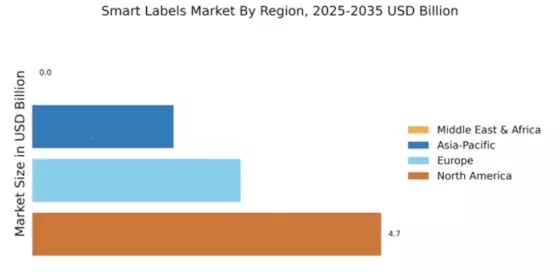
North America is poised to maintain its leadership in the Smart Labels Market, holding a significant market share of 4.74 in 2024. The region's growth is driven by increasing demand for automation in retail and logistics, alongside stringent regulations promoting traceability and safety. The adoption of IoT technologies further fuels this demand, as businesses seek to enhance operational efficiency and customer engagement. The competitive landscape in North America is robust, featuring key players such as Avery Dennison, Zebra Technologies, and Checkpoint Systems. These companies are leveraging advanced technologies to innovate and expand their product offerings. The U.S. stands out as the leading country, supported by a strong infrastructure and investment in R&D, ensuring that North America remains at the forefront of the Smart Labels Market.

Europe : Emerging Market with Growth Potential

Europe is witnessing a growing interest in the Smart Labels Market, with a market size of 2.83 in 2024. The region's growth is driven by increasing consumer demand for transparency and sustainability in supply chains, alongside regulatory frameworks that encourage the adoption of smart technologies. Initiatives aimed at enhancing product traceability and safety are also significant catalysts for market expansion. Leading countries in Europe include Germany, France, and the UK, where companies like Smartrac and Thin Film Electronics are making substantial contributions. The competitive landscape is characterized by innovation and collaboration among key players, ensuring that Europe remains a vital player in The Smart Labels. The European Commission emphasizes the importance of digital transformation in enhancing supply chain efficiency, which further supports market growth.

Asia-Pacific : Rapid Growth in Emerging Markets

The Asia-Pacific region is emerging as a significant player in the Smart Labels Market, with a market size of 1.92 in 2024. The growth is primarily driven by rapid urbanization, increasing disposable incomes, and a rising demand for smart packaging solutions in retail and logistics. Regulatory support for technological advancements in supply chain management is also a key factor propelling market growth. Countries like China, Japan, and India are leading the charge, with companies such as SATO Holdings and Invengo Technology playing pivotal roles. The competitive landscape is evolving, with a focus on innovation and strategic partnerships to enhance product offerings. As the region continues to embrace smart technologies, the Smart Labels Market is expected to expand significantly in the coming years.

Middle East and Africa : Untapped Potential in Smart Labels

The Middle East and Africa region currently shows minimal activity in the Smart Labels Market, with a market size of 0.0 in 2024. The slow growth can be attributed to limited infrastructure and lower adoption rates of advanced technologies. However, there is a growing awareness of the benefits of smart labeling in enhancing supply chain efficiency and product traceability, which could drive future demand. Countries like South Africa and the UAE are beginning to explore smart labeling solutions, but the competitive landscape remains underdeveloped. Key players are yet to establish a strong presence in this region, presenting opportunities for growth as businesses recognize the potential of smart technologies. As investments in infrastructure and technology increase, the Smart Labels Market in the Middle East and Africa may see gradual improvement.

Key Players and Competitive Insights

The Smart Labels Market is currently characterized by a dynamic competitive landscape, driven by technological advancements and increasing demand for efficient tracking solutions across various industries. Key players such as Avery Dennison (US), Zebra Technologies (US), and SATO Holdings (JP) are at the forefront, each adopting distinct strategies to enhance their market positioning. Avery Dennison (US) focuses on innovation in materials and digital solutions, while Zebra Technologies (US) emphasizes the integration of IoT capabilities into their labeling systems. SATO Holdings (JP) is leveraging its expertise in RFID technology to expand its product offerings, thereby contributing to a more competitive environment.

The market structure appears moderately fragmented, with numerous players vying for market share. Key business tactics include localizing manufacturing to reduce costs and optimize supply chains, which is particularly relevant in the context of global trade dynamics. The collective influence of these major companies shapes the market, as they engage in strategic partnerships and collaborations to enhance their technological capabilities and expand their geographic reach.

In November 2025, Avery Dennison (US) announced a partnership with a leading logistics firm to develop smart label solutions that enhance supply chain visibility. This collaboration is strategically significant as it aligns with the growing trend of digital transformation in logistics, potentially positioning Avery Dennison as a leader in providing innovative tracking solutions that meet the evolving needs of the industry.

In October 2025, Zebra Technologies (US) launched a new line of smart labels that incorporate advanced sensor technology, enabling real-time data collection and analysis. This move is indicative of Zebra's commitment to integrating AI and IoT into its product offerings, which may enhance operational efficiency for end-users and solidify its competitive edge in the market.

In September 2025, SATO Holdings (JP) expanded its RFID label production capacity by investing in a new manufacturing facility in Asia. This strategic investment is likely to bolster SATO's ability to meet the increasing demand for RFID solutions, thereby enhancing its market presence and operational efficiency in a rapidly evolving landscape.

As of December 2025, current trends in the Smart Labels Market are heavily influenced by digitalization, sustainability, and the integration of AI technologies. Strategic alliances among key players are shaping the competitive landscape, fostering innovation and enhancing product offerings. The shift from price-based competition to a focus on technological advancement and supply chain reliability is evident, suggesting that future competitive differentiation will increasingly hinge on the ability to innovate and adapt to changing market demands.

Key Companies in the Smart Labels Market market include

Industry Developments

  • Q2 2024: Avery Dennison launches atma.io connected product cloud for smart labels Avery Dennison announced the launch of its atma.io connected product cloud, a platform designed to enable end-to-end supply chain transparency and product authentication using smart labels and RFID technology.
  • Q2 2024: Zebra Technologies Introduces New RFID Smart Label Solutions for Retail and Healthcare Zebra Technologies unveiled a new line of RFID-enabled smart labels aimed at improving inventory management and patient safety in retail and healthcare sectors.
  • Q2 2024: CCL Industries Expands Smart Label Production with New Facility in Germany CCL Industries announced the opening of a new manufacturing facility in Germany dedicated to the production of smart labels, supporting increased demand in the European market.
  • Q3 2024: SATO and Fujitsu Partner to Develop Next-Generation RFID Smart Labels Market SATO Holdings Corporation entered into a partnership with Fujitsu to co-develop advanced RFID smart labels for logistics and supply chain applications.
  • Q3 2024: Thin Film Electronics ASA Announces Strategic Investment to Scale Smart Label Production Thin Film Electronics ASA secured a strategic investment to expand its smart label manufacturing capabilities, focusing on energy-efficient printed electronics.
  • Q3 2024: Avery Dennison Acquires Smart Label Startup PragmatIC Semiconductor Avery Dennison completed the acquisition of PragmatIC Semiconductor, a UK-based startup specializing in flexible electronics for smart labels, to enhance its product portfolio.
  • Q4 2024: Zebra Technologies Wins Major Smart Label Contract with Global Retailer Zebra Technologies secured a significant contract to supply RFID smart labels to a leading global retailer, supporting large-scale inventory tracking initiatives.
  • Q4 2024: Smartrac Launches Eco-Friendly Smart Labels Market for Food Packaging Smartrac introduced a new line of eco-friendly smart labels designed for food packaging, featuring recyclable materials and enhanced tracking capabilities.
  • Q1 2025: CCL Industries Appoints New President for Smart Labels Market Division CCL Industries announced the appointment of a new president to lead its Smart Labels Market Division, aiming to accelerate innovation and global expansion.
  • Q1 2025: Avery Dennison Unveils NFC-Enabled Smart Labels Market for Pharmaceutical Authentication Avery Dennison launched a new range of NFC-enabled smart labels designed to improve pharmaceutical product authentication and patient safety.
  • Q2 2025: SATO Opens New Smart Label R&D Center in Singapore SATO Holdings Corporation inaugurated a new research and development center in Singapore focused on advancing smart label technologies for logistics and healthcare.
  • Q2 2025: Zebra Technologies Partners with Microsoft to Integrate Smart Labels Market with Azure IoT Zebra Technologies announced a partnership with Microsoft to integrate its smart label solutions with Azure IoT, enabling enhanced data analytics and supply chain visibility.

Future Outlook

Smart Labels Market Future Outlook

The Smart Labels Market is projected to grow at a 45.8% CAGR from 2024 to 2035, driven by advancements in IoT, supply chain efficiency, and consumer demand for real-time tracking.

New opportunities lie in:

  • Integration of smart labels with blockchain for enhanced supply chain transparency.
  • Development of eco-friendly smart labels to meet sustainability demands.
  • Expansion into healthcare for patient tracking and medication management.

By 2035, the Smart Labels Market is expected to be a pivotal component of global supply chain solutions.

Market Segmentation

Smart Labels Market End Use Outlook

  • Consumer Goods
  • Automotive
  • Aerospace
  • Electronics
  • Industrial

Smart Labels Market Technology Outlook

  • RFID
  • NFC
  • QR Code
  • Barcode
  • Printed Electronics

Smart Labels Market Application Outlook

  • Retail
  • Logistics
  • Healthcare
  • Food and Beverage
  • Pharmaceutical

Report Scope

MARKET SIZE 20249.49(USD Billion)
MARKET SIZE 202513.84(USD Billion)
MARKET SIZE 2035600.82(USD Billion)
COMPOUND ANNUAL GROWTH RATE (CAGR)45.8% (2024 - 2035)
REPORT COVERAGERevenue Forecast, Competitive Landscape, Growth Factors, and Trends
BASE YEAR2024
Market Forecast Period2025 - 2035
Historical Data2019 - 2024
Market Forecast UnitsUSD Billion
Key Companies ProfiledAvery Dennison (US), Zebra Technologies (US), SATO Holdings (JP), Thin Film Electronics (NO), Smartrac (DE), Checkpoint Systems (US), Cimpress (IE), Invengo Technology (CN), NXP Semiconductors (NL), PragmatIC (GB)
Segments CoveredApplication, Technology, End Use
Key Market OpportunitiesIntegration of Internet of Things technology enhances tracking and inventory management in the Smart Labels Market.
Key Market DynamicsRising demand for enhanced tracking solutions drives innovation and competition in the Smart Labels Market.
Countries CoveredNorth America, Europe, APAC, South America, MEA

Market Highlights

Author
Snehal Singh
Assistant Manager - Research

High acumen in analyzing complex macro & micro markets with more than 6 years of work experience in the field of market research. By implementing her analytical skills in forecasting and estimation into market research reports, she has expertise in Packaging, Construction, and Equipment domains. She handles a team size of 20-25 resources and ensures smooth running of the projects, associated marketing activities, and client servicing.

Leave a Comment

FAQs

What was the market size for the Smart Labels Market in 2024?

The Smart Labels Market was valued at 3.9 USD Billion in 2024.

How much is the Smart Labels Market projected to be valued in 2035?

By 2035, the Smart Labels Market is projected to reach a value of 9.5 USD Billion.

What is the expected CAGR for the Smart Labels Market from 2025 to 2035?

Smart Labels Market is expected to grow with a CAGR of 45.8% in the period 2025-2035

Which region is predicted to have the largest market share in the Smart Labels Market by 2035?

North America is predicted to hold the largest market share, with an estimated value of 2.536 USD Billion in 2035.

What are the expected market values for RFID technology in the Smart Labels Market in 2024 and 2035?

RFID technology was valued at 1.7 USD Billion in 2024 and is expected to reach 4.2 USD Billion in 2035.

What are the market sizes for NFC technology within the Smart Labels Market by 2024 and 2035?

NFC technology was valued at 0.9 USD Billion in 2024 and 2.2 USD Billion in 2035.

Who are the major players in the Smart Labels Market?

Key players in the Smart Labels Market include Thinfilm, NXP Semiconductors, Avery Dennison, and Zebra Technologies among others.

What is the anticipated market growth for Europe in the Smart Labels Market by 2035?

Europe is expected to achieve a market value of 2.14 USD Billion in the Smart Labels Market by 2035.

What market size is expected for QR Code technology in the Smart Labels Market by 2024 and 2035?

QR Code technology was valued at 0.8 USD Billion in 2024 and is likely to reach 2.4 USD Billion in 2035.

What is the expected market value for Printed Electronics technology within the Smart Labels Market in 2024 and 2035?

Printed Electronics technology was valued at 0.5 USD Billion in 2024 and is expected to reach 0.7 USD Billion in 2035.

Download Free Sample

Kindly complete the form below to receive a free sample of this Report

Compare Licence

×
Features License Type
Single User Multiuser License Enterprise User
Price $4,950 $5,950 $7,250
Maximum User Access Limit 1 User Upto 10 Users Unrestricted Access Throughout the Organization
Free Customization
Direct Access to Analyst
Deliverable Format
Platform Access
Discount on Next Purchase 10% 15% 15%
Printable Versions