×
Hero Background
English
Chinese
French
Japanese
Korean
German
Spanish

Smart Machines Market Analysis

ID: MRFR/SEM/0649-HCR
110 Pages
Ankit Gupta
October 2025

Smart Machines Market Research Report Information By Type (Embedded systems, Expert system, Autonomous robot), by Application (Automotive, Aerospace, Logistics, Consumer Electronics, Defence, Healthcare), And By Region (North America, Europe, Asia-Pacific, And Rest Of The World) – Market Forecast Till 2035

Share:
Download PDF ×

We do not share your information with anyone. However, we may send you emails based on your report interest from time to time. You may contact us at any time to opt-out.

Smart Machines Market Infographic
Purchase Options

Market Analysis

In-depth Analysis of Smart Machines Market Industry Landscape

The smart machines market is undergoing dynamic transformations fueled by rapid advancements in artificial intelligence (AI), machine learning, and the Internet of Things (IoT). One of the key drivers shaping the market dynamics is the integration of smart machines across various industries to enhance automation and efficiency. Smart machines, equipped with cognitive abilities and self-learning capabilities, are becoming integral components in manufacturing, healthcare, transportation, and other sectors. The demand for increased productivity, reduced operational costs, and improved decision-making processes is driving the adoption of smart machines as organizations seek innovative solutions to stay competitive in the evolving business landscape.

That is particularly driven by the implementation of smart machines in manufacturing—a crucial market dynamic. These machines involve robotics or robotic systems, automated production lines as well as other devices which use AI and machine learning algorithms for optimizing the processes, predicting maintenance needs, and adapt operations based on changing requirements of production. The ability to sync smart machines in any manufacturing environment improves the precision and speed of production cycles, also ensuring a level of flexibility needed for operational effectiveness.

Transportation, logistics and support services are yet another segment supporting the development towards a more dynamic smart machines market. These new technologies such as autonomous vehicles, drones and smart traffic management systems using AI and IoT focused on safety integration; efficiency – increasing the capacity of use ; sustainability- to include environmentally friendly features in future planning. The goal of merging amorphous machines to this specific sector is geared towards remedying problems related to over congestions, too much consumption of fuel and need for continuous process in complex traffic.

The smart machines market is highly hypercompetitive; the competition within this particular market can be attributed to aggressive game-changing innovation and development of savvy technologies. Firms are spending vast amounts of money on improving research to build machines that learn from data feedback for assuring performance development over time. When their three technological components come together, cutting-edge artificial intelligence systems, which use machine learning and the Internet of Things technologies to analyse big amounts of data, create informed decisions and dynamically adapt.

Interconnection and interoperability play the determining role in a competitive market environment. However, as the ubiquity of smart machines increases, smooth plug-and-playability and platform compatibility are growing to be increasingly relevant concerns. By ensuring interactions among smart machines are easy, interoperability facilitates information sharing and establishing the cooperating as a well coordinated ecosystems such that contributions between smart machine share like. The smart machines can be listed as one of the most important aspects in terms of integrating a new phase, which is Industry 4.0 that requires using intelligent machines to have improved factories and supply networks. Ethical considerations and regulatory frameworks also play a significant role in shaping market dynamics. The ethical use of AI in smart machines, data privacy, and ensuring that these technologies align with societal values are important considerations for both developers and end-users. Regulatory standards are evolving to address the challenges associated with the deployment of smart machines, ensuring that they adhere to safety, security, and ethical guidelines.

Author
Ankit Gupta
Senior Research Analyst

Ankit Gupta is an analyst in market research industry in ICT and SEMI industry. With post-graduation in "Telecom and Marketing Management" and graduation in "Electronics and Telecommunication" vertical he is well versed with recent development in ICT industry as a whole. Having worked on more than 150+ reports including consultation for fortune 500 companies such as Microsoft and Rio Tinto in identifying solutions with respect to business problems his opinions are inclined towards mixture of technical and managerial aspects.

Leave a Comment

FAQs

How much is the Smart Machines market?

The Smart Machines Market size was valued at USD 269.84 billion in 2024.

What is the growth rate of the Smart Machines market?

The global market is projected to grow at a CAGR of 23.00% during the forecast period, 2025 to 2035

Which region held the largest market share in the Smart Machines market?

Asia Pacific had the largest share in the Smart Machines Market.

Who are the key players in the Smart Machines market?

The key players in the market are IBM Corporation, Apple Inc, BAE Systems, Google Inc., L.G. Electronics, Microsoft Corporation, ABB Limited, Digital Reasoning Systems, Inc. and General Electric Co.

Which type led the Smart Machines market?

The autonomous robot category dominated the market in 2022.

Which application had the largest market share in the market?

Consumer electronics had the largest share in the global market for Smart Machines.

Market Summary

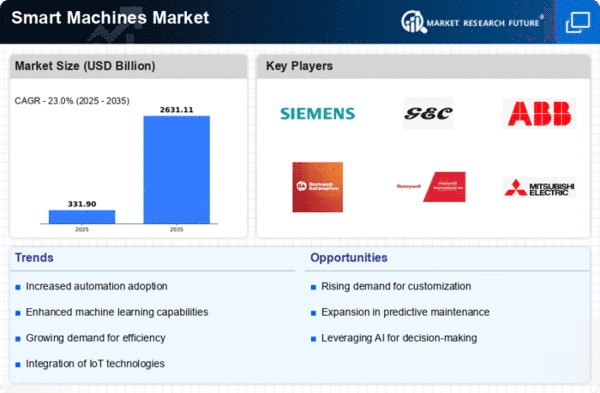
As per MRFR analysis, the Smart Machines Market Size was estimated at 269.84 USD Billion in 2024. The Smart Machines industry is projected to grow from 331.91 USD Billion in 2025 to 2631.11 USD Billion by 2035, exhibiting a compound annual growth rate (CAGR) of 23.0 during the forecast period 2025 - 2035.

Key Market Trends & Highlights

The Smart Machines Market is poised for substantial growth driven by technological advancements and increasing automation across various sectors.

  • North America remains the largest market for smart machines, driven by robust industrial automation and technological infrastructure.
  • The Asia-Pacific region is emerging as the fastest-growing market, fueled by rapid advancements in IoT and smart manufacturing practices.
  • Industrial automation continues to dominate the market, while the healthcare segment is experiencing the fastest growth due to rising demand for smart medical devices.
  • Key market drivers include the growing demand for efficiency and advancements in robotics technology, which are reshaping operational paradigms.

Market Size & Forecast

2024 Market Size 269.84 (USD Billion)
2035 Market Size 2631.11 (USD Billion)
CAGR (2025 - 2035) 23.0%
Largest Regional Market Share in 2024 North America

Major Players

<p>Siemens (DE), General Electric (US), Honeywell (US), Rockwell Automation (US), ABB (CH), Mitsubishi Electric (JP), Bosch (DE), Fanuc (JP), Cognex (US)</p>

Market Trends

The Smart Machines Market is currently experiencing a transformative phase characterized by rapid advancements in artificial intelligence, machine learning, and automation technologies. These innovations are reshaping various industries, enhancing operational efficiency, and enabling smarter decision-making processes. As organizations increasingly adopt smart machines, they are likely to witness improved productivity and reduced operational costs. The integration of these technologies into everyday business practices appears to be a driving force behind the market's growth, fostering a competitive landscape where agility and innovation are paramount. Moreover, the Smart Machines Market is witnessing a surge in demand for intelligent systems that can operate autonomously and adapt to changing environments. This trend is particularly evident in sectors such as manufacturing, healthcare, and logistics, where smart machines are deployed to streamline processes and enhance service delivery. The ongoing evolution of the Internet of Things (IoT) is also contributing to this dynamic, as interconnected devices facilitate real-time data exchange and analysis. Consequently, the Smart Machines Market is poised for continued expansion, with potential applications extending into various domains, thereby indicating a promising future for stakeholders involved in this sector.

Increased Automation in Industries

The Smart Machines Market is seeing a notable shift towards automation across diverse sectors. Organizations are increasingly implementing smart machines to automate repetitive tasks, which not only enhances efficiency but also allows human workers to focus on more complex responsibilities. This trend suggests a growing reliance on technology to optimize workflows and improve overall productivity.

Integration of AI and Machine Learning

The integration of artificial intelligence and machine learning into smart machines is becoming more prevalent. These technologies enable machines to learn from data, adapt to new situations, and make informed decisions. This trend indicates a move towards more sophisticated systems capable of performing tasks that were previously thought to require human intelligence.

Rise of IoT-Enabled Smart Machines

The proliferation of Internet of Things (IoT) technology is significantly impacting the Smart Machines Market. IoT-enabled devices facilitate seamless communication and data sharing between machines, leading to enhanced operational capabilities. This trend highlights the potential for smarter, interconnected systems that can respond dynamically to their environments.

Smart Machines Market Market Drivers

Technological Advancements

The Global Smart Machines Market Industry is experiencing rapid growth driven by continuous technological advancements. Innovations in artificial intelligence, machine learning, and robotics are enhancing the capabilities of smart machines, making them more efficient and versatile. For instance, the integration of AI in manufacturing processes allows for predictive maintenance, reducing downtime and operational costs. As a result, the market is projected to reach 269.8 USD Billion in 2024, reflecting the increasing adoption of these technologies across various sectors. This trend indicates a strong demand for smart machines that can adapt to complex tasks and improve productivity.

Market Segment Insights

By Application: Industrial Automation (Largest) vs. Healthcare (Fastest-Growing)

<p>In the Smart Machines Market, the application segment is dominated by Industrial Automation, which holds the largest share due to its extensive use in manufacturing and production processes. This segment benefits from the rise in smart factory initiatives and the increasing need for efficiency, pushing Industrial Automation ahead of other applications. On the other hand, Healthcare is emerging rapidly, driven by the need for innovative solutions in patient care, diagnostics, and robotic surgeries. This sector's growth can be attributed to technological advancements and the pressing requirement for remote monitoring and smart medical devices.</p>

<p>Agriculture: Precision Farming (Dominant) vs. Consumer Electronics (Emerging)</p>

<p>In the Smart Machines Market, the Agriculture segment, particularly precision farming, is recognized as a dominant force, leveraging smart technologies to enhance crop yields and resource efficiency. This dominant status is bolstered by advancements in IoT, AI, and data analytics that enable farmers to make informed decisions. Meanwhile, the Consumer Electronics segment is emerging, characterized by the integration of smart devices in daily life, from smart home systems to wearables. This sector is driven by consumer demand for convenience and connectivity, positioning itself as a significant player in the market as technology continues to evolve and shape user experiences.</p>

By End Use: Manufacturing (Largest) vs. Healthcare (Fastest-Growing)

<p>In the Smart Machines Market, the manufacturing sector maintains its position as the largest end-use segment, driven by the rising adoption of automation technologies. This sector significantly contributes to market share, emphasizing the integration of smart machines to enhance productivity and efficiency. Following closely is the healthcare segment, which is experiencing a noteworthy surge due to advancements in AI and robotics, leading to improved patient care and operational efficiency. Growth trends within this segment reveal that manufacturing remains dominant due to ongoing technological innovations and the need for operational excellence. Conversely, healthcare is recognized as the fastest-growing sector, fueled by increasing demand for smart devices that assist in diagnostics, treatment, and patient management, reflecting broader health industry trends. Investments in smart machines will likely continue to rise as organizations prioritize efficiency and patient-centric solutions.</p>

<p>Manufacturing (Dominant) vs. Healthcare (Emerging)</p>

<p>The manufacturing sector represents the dominant force within the Smart Machines Market, characterized by the implementation of sophisticated machinery that streamlines production processes and enhances quality control. As manufacturers seek to remain competitive amid global challenges, the integration of smart machines is proving essential in reducing operational costs and optimizing supply chains. Innovations such as robotics automation, predictive maintenance, and data analytics are setting new benchmarks in productivity. In contrast, the healthcare segment is emerging as a vital area for smart machines, with technologies such as surgical robots, telemedicine tools, and AI-driven diagnostics gaining traction. The focus on improving patient outcomes and operational efficiencies drives this growth. As healthcare providers increasingly rely on smart solutions to address challenges, the segment shows substantial potential for expansion, further reflecting the market's shift toward technology-driven healthcare solutions.</p>

By Technology: Artificial Intelligence (Largest) vs. IoT (Fastest-Growing)

<p>In the Smart Machines Market, Artificial Intelligence (AI) emerges as the largest technology segment, significantly contributing to automation and intelligent solutions. The distribution of market share among the key technologies showcases AI leading the charge, followed closely by Machine Learning and Big Data, which are instrumental in leveraging vast data resources for decision-making. Robotics and Internet of Things (IoT) also claim substantial shares, reflecting the industry's diverse technological landscape. Growth trends depict IoT as the fastest-growing segment, fueled by increasing connectivity and demand for smart devices. This rise is supported by advancements in cloud computing and data analytics, enhancing operational efficiency across sectors. Robotics continues to grow steadily, driven by automation needs in manufacturing and logistics. Overall, the synergy of these technologies drives innovation and market expansion, shaping the future of smart machines.</p>

<p>Artificial Intelligence: Dominant vs. Internet of Things: Emerging</p>

<p>Artificial Intelligence dominates the Smart Machines Market due to its ability to enable machines to simulate human-like cognition, leading to improved efficiency and decision-making. Its applications range from predictive maintenance to intelligent automation, making it essential across various industries. In contrast, the Internet of Things represents an emerging technology with vast potential, connecting devices and allowing for real-time data exchange. Its rapid adoption is driven by the proliferation of smart devices, creating networks that enhance operational efficiencies and user experiences. While AI offers sophisticated insights, IoT is key to data collection and connectivity. Together, they play pivotal roles in transforming the smart machines landscape.</p>

By Product Type: Smart Robots (Largest) vs. Wearable Technology (Fastest-Growing)

<p>The Smart Machines Market showcases a diverse product range, with Smart Robots commanding the largest share due to their extensive application across industries such as manufacturing, healthcare, and logistics. Autonomous Vehicles and Smart Appliances follow closely, capturing significant market interest. In contrast, Drones and Wearable Technology, while smaller in market share, are rapidly gaining ground, driven by increasing consumer interest and technological advancements. The growth trends in this segment indicate a robust expansion trajectory, with Smart Robots maintaining a dominant position thanks to innovations in AI and machine learning. Wearable Technology is emerging as the fastest-growing segment, propelled by escalating health awareness and the increasing integration of IoT features. The demand for efficient automation solutions and personalized smart devices continues to be a crucial driver in shaping the future landscape of the Smart Machines Market.</p>

<p>Smart Robots (Dominant) vs. Wearable Technology (Emerging)</p>

<p>Smart Robots are redefining operational capabilities across multiple sectors by enhancing efficiency, safety, and productivity. Their high adaptability allows them to perform complex tasks, from surgical procedures to warehouse logistics. As industries increasingly adopt automation to reduce costs and boost reliability, Smart Robots secure a prominent market position. Conversely, Wearable Technology, characterized by devices such as fitness trackers and smartwatches, is emerging rapidly due to its alignment with modern consumer lifestyles. The convergence of health monitoring and tech-savvy devices attracts new users and markets. This segment is characterized by continuous innovation, user engagement, and the integration of smart features that appeal to a broad audience.</p>

By Functionality: Data Analysis (Largest) vs. Process Automation (Fastest-Growing)

<p>In the Smart Machines Market, the market share is predominantly led by Data Analysis, reflecting the increasing importance of data-driven decision-making across industries. This segment utilizes advanced analytics tools to harness big data, enabling companies to gain valuable insights and enhance operational efficiency. Process Automation, on the other hand, is rapidly gaining traction as businesses seek to streamline operations and reduce costs, positioning itself as a key player in the market.</p>

<p>Process Automation: Dominant vs. Predictive Maintenance: Emerging</p>

<p>Process Automation has established itself as a dominant force within the Smart Machines Market, acting as a catalyst for operational efficiency. Companies are increasingly adopting automation technologies to minimize human intervention in repetitive tasks, leading to enhanced productivity and accuracy. Meanwhile, Predictive Maintenance is emerging as a crucial segment, leveraging AI and IoT to forecast equipment failures before they occur. This proactive approach not only prevents downtime but also extends the lifecycle of machinery, highlighting its growing significance in ensuring seamless operations.</p>

Get more detailed insights about Smart Machines Market Research Report- Forecast to 2035

Regional Insights

North America : Innovation and Leadership Hub

North America leads the Smart Machines Market with a share of 134.92M in 2024, driven by technological advancements and a robust manufacturing sector. The region benefits from significant investments in automation and AI, supported by favorable regulations that encourage innovation. The demand for smart machines is further fueled by the need for efficiency and productivity in various industries, including automotive and aerospace. The competitive landscape is characterized by major players such as Siemens, General Electric, and Honeywell, who are at the forefront of innovation. The U.S. is the leading country, with a strong focus on R&D and a skilled workforce. The presence of these key players ensures a dynamic market environment, fostering continuous growth and development in smart machine technologies.

Europe : Emerging Technology Adoption

Europe's Smart Machines Market is valued at 70.0M, reflecting a growing trend towards automation and smart technologies. The region is driven by stringent regulations aimed at enhancing energy efficiency and sustainability, which catalyze the adoption of smart machines across various sectors. Countries like Germany and France are leading the charge, supported by government initiatives that promote innovation and technological advancement. The competitive landscape features key players such as ABB and Bosch, who are investing heavily in R&D to stay ahead. Germany stands out as a manufacturing powerhouse, while the EU's regulatory framework encourages collaboration among member states. This synergy fosters a conducive environment for the growth of smart machines, positioning Europe as a significant player in the global market.

Asia-Pacific : Rapid Growth and Adoption

The Asia-Pacific region, with a market size of 55.0M, is rapidly emerging as a key player in the Smart Machines Market. The growth is driven by increasing industrialization, urbanization, and a rising demand for automation in manufacturing processes. Countries like Japan and China are at the forefront, supported by government policies that encourage technological innovation and investment in smart technologies. The competitive landscape is vibrant, with companies like Mitsubishi Electric and Fanuc leading the charge. Japan's advanced manufacturing capabilities and China's focus on smart manufacturing create a dynamic environment for growth. The region's emphasis on integrating AI and IoT into manufacturing processes positions it as a significant contributor to The Smart Machines.

Middle East and Africa : Emerging Market Potential

The Middle East and Africa region, with a market size of 9.92M, presents significant growth opportunities in the Smart Machines Market. The demand is driven by increasing investments in infrastructure and a push towards modernization in various sectors, including oil and gas and manufacturing. Governments are recognizing the importance of automation and are implementing policies to support technological advancements. Countries like South Africa and the UAE are leading the way, with initiatives aimed at enhancing industrial capabilities. The presence of key players is gradually increasing, fostering a competitive landscape. As the region continues to invest in smart technologies, it is poised for substantial growth in the coming years, making it an attractive market for investors.

Key Players and Competitive Insights

The Smart Machines Market is currently characterized by a dynamic competitive landscape, driven by rapid technological advancements and increasing demand for automation across various sectors. Key players such as Siemens (DE), General Electric (US), and Honeywell (US) are at the forefront, each adopting distinct strategies to enhance their market positioning. Siemens (DE) focuses on digital transformation and innovation, leveraging its expertise in automation and digitalization to offer integrated solutions. General Electric (US) emphasizes strategic partnerships and mergers to expand its technological capabilities, while Honeywell (US) is investing heavily in AI and IoT to enhance operational efficiency and product offerings. Collectively, these strategies contribute to a competitive environment that is increasingly centered around technological innovation and customer-centric solutions.

In terms of business tactics, companies are localizing manufacturing and optimizing supply chains to enhance responsiveness and reduce costs. The Smart Machines Market appears moderately fragmented, with a mix of established players and emerging startups. The collective influence of these key players shapes market dynamics, as they compete not only on price but also on technological advancements and service quality.

In November 2025, Siemens (DE) announced the launch of its new AI-driven automation platform, which aims to streamline manufacturing processes and improve operational efficiency. This strategic move is significant as it positions Siemens as a leader in the integration of AI within smart machines, potentially setting new industry standards and enhancing its competitive edge. Furthermore, the platform is expected to attract a broader customer base seeking advanced automation solutions.

In October 2025, General Electric (US) completed a strategic acquisition of a leading robotics firm, enhancing its capabilities in smart manufacturing. This acquisition is pivotal as it not only expands GE's technological portfolio but also strengthens its position in the rapidly evolving landscape of smart machines. The integration of advanced robotics into GE's offerings is likely to drive innovation and improve customer solutions, thereby reinforcing its market presence.

In September 2025, Honeywell (US) launched a new suite of IoT-enabled smart machines designed for industrial applications. This initiative reflects Honeywell's commitment to sustainability and efficiency, as the new machines are engineered to reduce energy consumption and operational costs. The introduction of these products is expected to resonate well with environmentally conscious consumers and industries, further solidifying Honeywell's reputation as a leader in sustainable technology.

As of December 2025, the Smart Machines Market is witnessing trends such as digitalization, sustainability, and AI integration, which are reshaping competitive dynamics. Strategic alliances among key players are becoming increasingly common, facilitating knowledge sharing and resource optimization. Looking ahead, competitive differentiation is likely to evolve, with a pronounced shift from price-based competition to a focus on innovation, technology, and supply chain reliability. Companies that can effectively leverage these trends will likely secure a competitive advantage in the marketplace.

Key Companies in the Smart Machines Market market include

Industry Developments

January 2020: IBM announced the launch of Advertising Accelerator with Watson to predict the optimal combination of creative elements to help drive high engagement and conversion for a given audience.

Future Outlook

Smart Machines Market Future Outlook

<p>The Smart Machines Market is projected to grow at a 23.0% CAGR from 2024 to 2035, driven by advancements in AI, automation, and IoT integration.</p>

New opportunities lie in:

  • <p>Development of AI-driven predictive maintenance solutions</p>
  • <p>Expansion of autonomous delivery systems in urban areas</p>
  • <p>Integration of smart machines in manufacturing supply chains</p>

<p>By 2035, the Smart Machines Market is expected to be a pivotal sector, showcasing robust growth and innovation.</p>

Market Segmentation

Smart Machines Market End Use Outlook

  • Manufacturing
  • Retail
  • Transportation
  • Construction
  • Healthcare

Smart Machines Market Technology Outlook

  • Artificial Intelligence
  • Machine Learning
  • Robotics
  • Internet of Things
  • Big Data

Smart Machines Market Application Outlook

  • Industrial Automation
  • Healthcare
  • Agriculture
  • Logistics
  • Consumer Electronics

Smart Machines Market Product Type Outlook

  • Autonomous Vehicles
  • Smart Robots
  • Smart Appliances
  • Drones
  • Wearable Technology

Smart Machines Market Functionality Outlook

  • Data Analysis
  • Process Automation
  • Predictive Maintenance
  • Remote Monitoring
  • Decision Support

Report Scope

MARKET SIZE 2024269.84(USD Billion)
MARKET SIZE 2025331.91(USD Billion)
MARKET SIZE 20352631.11(USD Billion)
COMPOUND ANNUAL GROWTH RATE (CAGR)23.0% (2024 - 2035)
REPORT COVERAGERevenue Forecast, Competitive Landscape, Growth Factors, and Trends
BASE YEAR2024
Market Forecast Period2025 - 2035
Historical Data2019 - 2024
Market Forecast UnitsUSD Billion
Key Companies ProfiledSiemens (DE), General Electric (US), Honeywell (US), Rockwell Automation (US), ABB (CH), Mitsubishi Electric (JP), Bosch (DE), Fanuc (JP), Cognex (US)
Segments CoveredApplication, End Use, Technology, Product Type, Functionality
Key Market OpportunitiesIntegration of artificial intelligence in Smart Machines enhances automation and operational efficiency across industries.
Key Market DynamicsRising demand for automation drives innovation and competition in the Smart Machines Market, reshaping industry dynamics.
Countries CoveredNorth America, Europe, APAC, South America, MEA

FAQs

How much is the Smart Machines market?

The Smart Machines Market size was valued at USD 269.84 billion in 2024.

What is the growth rate of the Smart Machines market?

The global market is projected to grow at a CAGR of 23.00% during the forecast period, 2025 to 2035

Which region held the largest market share in the Smart Machines market?

Asia Pacific had the largest share in the Smart Machines Market.

Who are the key players in the Smart Machines market?

The key players in the market are IBM Corporation, Apple Inc, BAE Systems, Google Inc., L.G. Electronics, Microsoft Corporation, ABB Limited, Digital Reasoning Systems, Inc. and General Electric Co.

Which type led the Smart Machines market?

The autonomous robot category dominated the market in 2022.

Which application had the largest market share in the market?

Consumer electronics had the largest share in the global market for Smart Machines.

No Data Available

Smart Machines Market Segmentation

Smart Machines Type Outlook (USD Million, 2020-2034)

  • Embedded systems
  • Expert system
  • Autonomous robot
  • Healthcare

Smart Machines Application Outlook (USD Million, 2020-2034)

  • Automotive & Aerospace
  • Logistics & Consumer Electronics
  • Defense
  • Healthcare

Smart Machines Regional Outlook (USD Million, 2020-2034)

  • North America Outlook (USD Million, 2020-2034)
    • North America Smart Machines by Type
      • Embedded systems
      • Expert system
      • Autonomous robot
    • North America Smart Machines by Application
      • Automotive & Aerospace
      • Logistics & Consumer Electronics
      • Defense
      • Healthcare
    • US Outlook (USD Million, 2020-2034)
    • US Smart Machines by Type
      • Embedded systems
      • Expert system
      • Autonomous robot
    • US Smart Machines by Application
      • Automotive & Aerospace
      • Logistics & Consumer Electronics
      • Defense
      • Healthcare
    • CANADA Outlook (USD Million, 2020-2034)
    • CANADA Smart Machines by Type
      • Embedded systems
      • Expert system
      • Autonomous robot
    • CANADA Smart Machines by Application
      • Automotive & Aerospace
      • Logistics & Consumer Electronics
      • Defense
      • Healthcare
  • Europe Outlook (USD Million, 2020-2034)
    • Europe Smart Machines by Type
      • Embedded systems
      • Expert system
      • Autonomous robot
    • Europe Smart Machines by Application
      • Automotive & Aerospace
      • Logistics & Consumer Electronics
      • Defense
      • Healthcare
    • Germany Outlook (USD Million, 2020-2034)
    • Germany Smart Machines by Type
      • Embedded systems
      • Expert system
      • Autonomous robot
    • Germany Smart Machines by Application
      • Automotive & Aerospace
      • Logistics & Consumer Electronics
      • Defense
      • Healthcare
    • France Outlook (USD Million, 2020-2034)
    • France Smart Machines by Type
      • Embedded systems
      • Expert system
      • Autonomous robot
    • France Smart Machines by Application
      • Automotive & Aerospace
      • Logistics & Consumer Electronics
      • Defense
      • Healthcare
    • UK Outlook (USD Million, 2020-2034)
    • UK Smart Machines by Type
      • Embedded systems
      • Expert system
      • Autonomous robot
    • UK Smart Machines by Application
      • Automotive & Aerospace
      • Logistics & Consumer Electronics
      • Defense
      • Healthcare
    • ITALY Outlook (USD Million, 2020-2034)
    • ITALY Smart Machines by Type
      • Embedded systems
      • Expert system
      • Autonomous robot
    • ITALY Smart Machines by Application
      • Automotive & Aerospace
      • Logistics & Consumer Electronics
      • Defense
      • Healthcare

    • SPAIN Outlook (USD Million, 2020-2034)
    • Spain Smart Machines by Type
      • Embedded systems
      • Expert system
      • Autonomous robot
    • Spain Smart Machines by Application
      • Automotive & Aerospace
      • Logistics & Consumer Electronics
      • Defense
      • Healthcare
    • Rest Of Europe Outlook (USD Million, 2020-2034)
    • Rest Of Europe Smart Machines by Type
      • Embedded systems
      • Expert system
      • Autonomous robot
    • REST OF EUROPE Smart Machines by Application
      • Automotive & Aerospace
      • Logistics & Consumer Electronics
      • Defense
      • Healthcare
  • Asia-Pacific Outlook (USD Million, 2020-2034)
    • Asia-Pacific Smart Machines by Type
      • Embedded systems
      • Expert system
      • Autonomous robot
    • Asia-Pacific Smart Machines by Application
      • Automotive & Aerospace
      • Logistics & Consumer Electronics
      • Defense
      • Healthcare
    • China Outlook (USD Million, 2020-2034)
    • China Smart Machines by Type
      • Embedded systems
      • Expert system
      • Autonomous robot
    • China Smart Machines by Application
      • Automotive & Aerospace
      • Logistics & Consumer Electronics
      • Defense
      • Healthcare
    • Japan Outlook (USD Million, 2020-2034)
    • Japan Smart Machines by Type
      • Embedded systems
      • Expert system
      • Autonomous robot
    • Japan Smart Machines by Application
      • Automotive & Aerospace
      • Logistics & Consumer Electronics
      • Defense
      • Healthcare
    • India Outlook (USD Million, 2020-2034)
    • India Smart Machines by Type
      • Embedded systems
      • Expert system
      • Autonomous robot
    • India Smart Machines by Application
      • Automotive & Aerospace
      • Logistics & Consumer Electronics
      • Defense
      • Healthcare
    • Australia Outlook (USD Million, 2020-2034)
    • Australia Smart Machines by Type
      • Embedded systems
      • Expert system
      • Autonomous robot
    • Australia Smart Machines by Application
      • Automotive & Aerospace
      • Logistics & Consumer Electronics
      • Defense
      • Healthcare
    • Rest of Asia-Pacific Outlook (USD Million, 2020-2034)
    • Rest of Asia-Pacific Smart Machines by Type
      • Embedded systems
      • Expert system
      • Autonomous robot
    • Rest of Asia-Pacific Smart Machines by Application
      • Automotive & Aerospace
      • Logistics & Consumer Electronics
      • Defense
      • Healthcare
  • Rest of the World Outlook (USD Million, 2020-2034)
    • Rest of the World Smart Machines by Type
      • Embedded systems
      • Expert system
      • Autonomous robot
    • Rest of the World Smart Machines by Application
      • Automotive & Aerospace
      • Logistics & Consumer Electronics
      • Defense
      • Healthcare

    • Middle East Outlook (USD Million, 2020-2034)
    • Middle East Smart Machines by Type
      • Embedded systems
      • Expert system
      • Autonomous robot
    • Middle East Smart Machines by Application
      • Automotive & Aerospace
      • Logistics & Consumer Electronics
      • Defense
      • Healthcare
    • Africa Outlook (USD Million, 2020-2034)
    • Africa Smart Machines by Type
      • Embedded systems
      • Expert system
      • Autonomous robot
    • Africa Smart Machines by Application
      • Automotive & Aerospace
      • Logistics & Consumer Electronics
      • Defense
      • Healthcare
    • Latin America Outlook (USD Million, 2020-2034)
    • Latin America Smart Machines by Type
      • Embedded systems
      • Expert system
      • Autonomous robot
    • Latin America Smart Machines by Application
      • Automotive & Aerospace
      • Logistics & Consumer Electronics
      • Defense
      • Healthcare


Infographic

Free Sample Request

Kindly complete the form below to receive a free sample of this Report

Get Free Sample

Customer Strories

Compare Licence

×
Features License Type
Single User Multiuser License Enterprise User
Price $4,950 $5,950 $7,250
Maximum User Access Limit 1 User Upto 10 Users Unrestricted Access Throughout the Organization
Free Customization
Direct Access to Analyst
Deliverable Format
Platform Access
Discount on Next Purchase 10% 15% 15%
Printable Versions